What happened in the 1956 Suez Crisis? After Gamal Abdel Nasser nationalized the Suez Canal Company on 26 July 1956, Israel attacked Egypt in late October; Britain and France then intervened militarily. The United Nations called for a ceasefire and established its first armed emergency peacekeeping force to supervise withdrawal. The crisis reshaped regional and international politics.
November 2026 marks seventy years since the fighting and diplomatic emergency surrounding the 1956 Suez Crisis. The anniversary is a chance to return to the original records rather than repeat familiar slogans. Britain, France, Israel, Egypt, the United States, the Soviet Union and the United Nations all feature in the story, but their roles and interests were not interchangeable. This source-led history follows the dates recorded by the U.S. Office of the Historian and the United Nations, examines Port Said as an actual battlefield, and explains why the UN force was institutionally innovative. Photographs used here come from genuine period military archives and are labeled with their perspective rather than presented as neutral pictures of every civilian experience.
For separate historical context, see the construction and early history of the Suez Canal and the 1952 Revolution and the rise of the new Egyptian republic.
Why the canal mattered long before 1956
The Suez Canal linked the Mediterranean and Red Sea and was a strategically important route for shipping, trade and imperial communications. Its nineteenth-century construction reshaped Egyptian economic and political life, and the company that operated it became a symbol of foreign financial influence. By the mid-twentieth century, the question of who controlled the company had consequences far beyond ordinary commercial management. The U.S. Office of the Historian places the canal dispute within the changing relationships among Egypt, Britain, France and other states after the Second World War.
The canal’s physical construction in 1859–1869 is a different story from the 1956 nationalization, and this article does not duplicate the site’s source-based construction history. It examines a later crisis involving state sovereignty and Cold War politics. The company, the shipping route and the surrounding cities need to be distinguished: nationalizing a corporation did not mean physically moving the canal, and an attack on Port Said was an intervention in a populated city rather than a symbolic battle in empty water.
Egypt after 1952 and Nasser’s political ambitions
The Free Officers’ movement of July 1952 helped end the Egyptian monarchy and opened a new political era. Gamal Abdel Nasser emerged as the leading figure of the republic and emphasized national sovereignty, regional influence and development. Britain’s earlier military presence and international influence remained central questions. The Suez Canal Company, still associated with British and French interests, became a visible test of authority over an essential Egyptian resource.
Understanding those ambitions does not require presenting every choice as inevitable or every actor as having one simple motive. Egypt also faced economic development challenges, disputes over arms and regional security, and the political effects of decolonization. Nasser’s government saw control of major resources as part of development and independence, while British and French governments feared the strategic and political consequences of losing their position. A balanced history can describe those distinct interests without treating foreign military intervention as a routine business negotiation.
The Aswan High Dam funding dispute
The U.S. Office of the Historian and the United Nations’ official mission history connect the crisis to the withdrawal of American support for the Aswan High Dam project in July 1956. The development project promised changes to Nile water storage and Egyptian agriculture, and finance was a significant political issue. Nasser presented canal income as a potential means of supporting the dam, although the larger nationalization decision belonged to a wider debate over political autonomy.
Reducing the entire conflict to a single canceled loan conceals the strategic competition already taking place. Britain and France had their own long-standing concerns, Israel faced tense relations with Egypt, and the Cold War encouraged each side to interpret developments through wider alliances. The funding decision helped precipitate the July announcement, but it did not by itself dictate the exact military action that followed three months later.
26 July 1956: the Suez Canal Company is nationalized
On 26 July 1956, President Nasser announced the nationalization of the Suez Canal Company. The American diplomatic history and British archival education material identify this as the defining legal and political trigger. The Egyptian decision proposed control over the company and compensation for shareholders. Britain and France rejected the direction of the move and challenged its implications for international shipping and their influence.
The distinction between a company and a waterway matters. Egypt argued that a company operating on its territory could be brought under national control, while other governments contested the move through diplomatic and strategic arguments. A historical summary should avoid saying that the act was a declaration of war or that the canal had always been the private property of Britain alone. Those claims oversimplify legal, commercial and political arrangements inherited from the nineteenth century.
Diplomacy and the failure of a negotiated settlement
During the months after nationalization, international diplomacy sought a formula for operating the canal and protecting navigation. The United Nations’ historical record describes Security Council consideration and discussions of principles for the canal in October. Those negotiations did not produce an agreed settlement that prevented war. Diplomatic documents show that a crisis can escalate even while governments publicly maintain talks about technical management or international guarantees.
The failure was not only a misunderstanding over pilotage fees or a dispute between Egypt and one European country. National sovereignty, imperial status, Cold War alliances, international commerce and regional security were all implicated. The details of what the governments said publicly and what military leaders prepared privately belong to different bodies of evidence. Archival analysis should distinguish official declarations from the operational decisions made as the fighting approached.
29 October: Israeli forces attack Egypt
The United Nations records that Israeli forces attacked Egyptian territory on 29 October 1956 and entered Sinai. This invasion transformed a dispute about canal company control into a military conflict. The events affected Egyptian territory and regional security, and the United Nations subsequently treated withdrawal of the invading forces as a central objective. The precise military timetable should be anchored to institutional records rather than retrospectively flattened into one vague ‘October battle’.
Israel’s security calculations existed within a wider regional context of armistice disputes and violence before 1956, which the UN’s full historical account documents. Explaining that background does not mean treating the invasion as automatically justified or omitting its consequences. A serious history should preserve the sequence: canal nationalization in July, negotiations and rising tension, Israeli military attack in late October, then Anglo-French intervention and global diplomacy.
Britain and France intervene and Port Said comes under attack
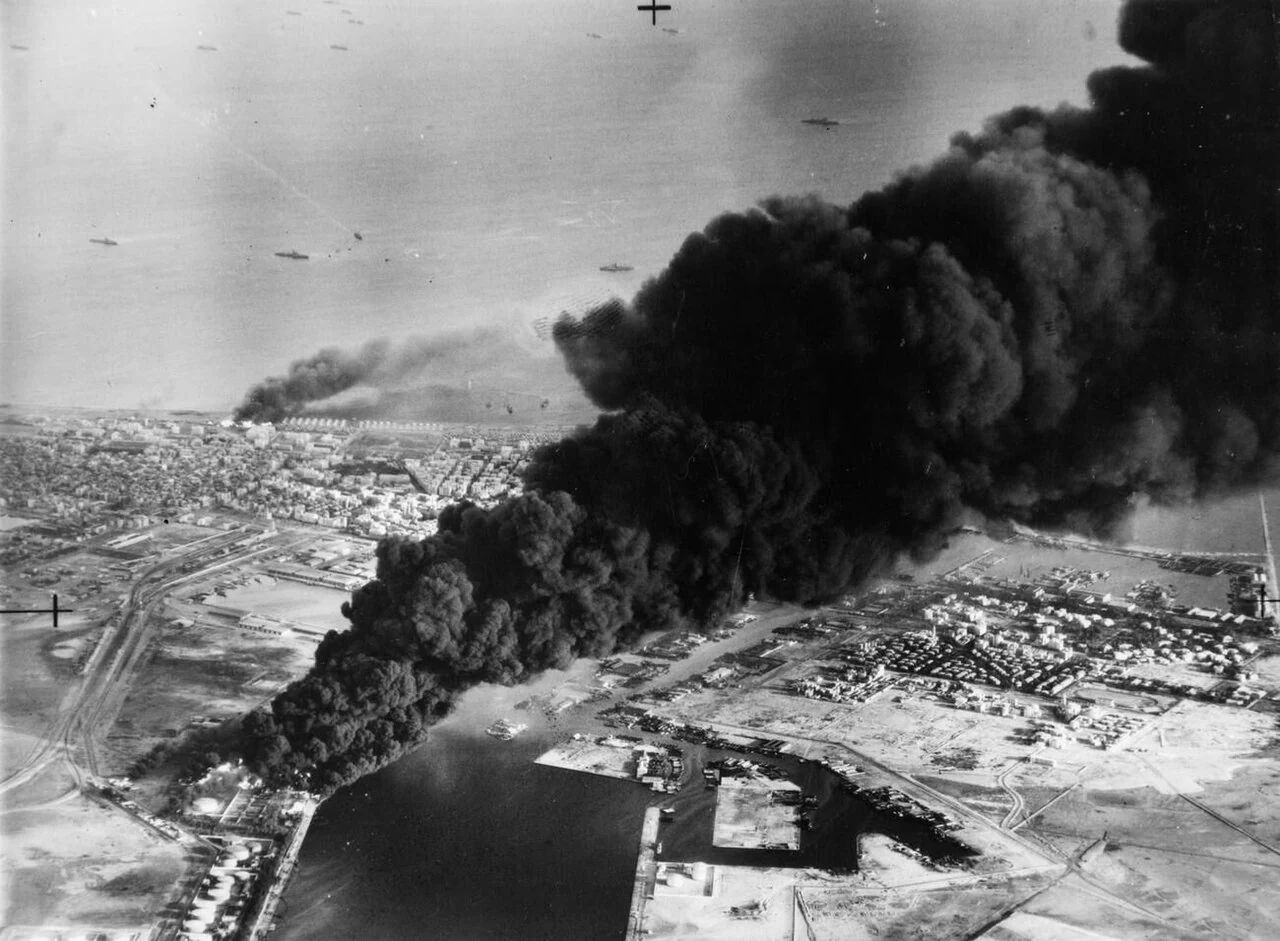
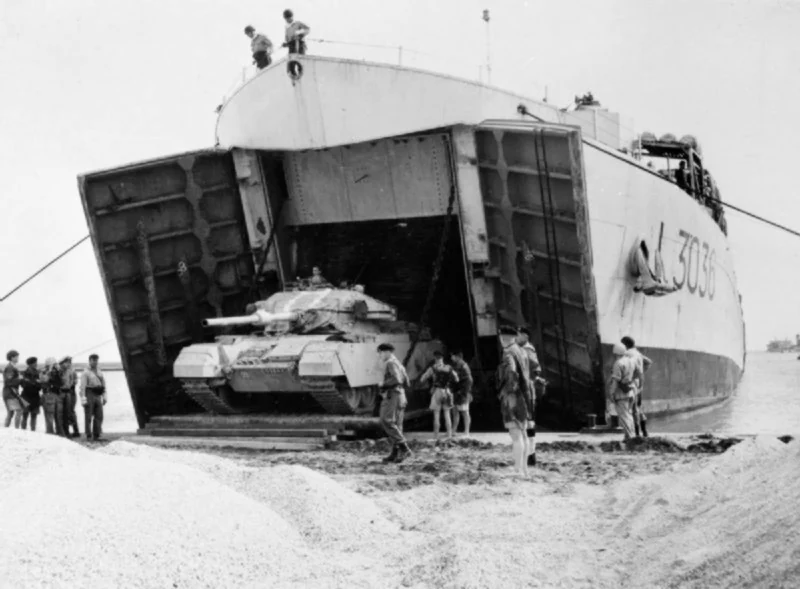
British and French forces began military operations against Egypt at the end of October, including air attacks, followed by landings in the canal zone. Port Said at the Mediterranean entrance became a central location in the fighting. The U.S. Office of the Historian and UN accounts identify the British-French operation as part of the broader three-country intervention. Port Said was a lived city with residents and infrastructure, not merely a tactical marker on a military staff map.
Photographs taken by official British service photographers can show aircraft, tanks, roads and forces in the area. They must not be used to claim they represent the entire Egyptian experience. Images created from one military side do not automatically document civilian casualties, Egyptian resistance or the political meaning of the fighting. Historians need multiple types of records, including accounts from affected communities, to understand the impact beyond what the camera was assigned to photograph.
The Security Council deadlock and the General Assembly response
The United Nations describes how Britain and France used their Security Council veto power during emergency discussions, preventing agreement on a draft response to the intervention. That deadlock shifted the focus toward the General Assembly and procedures associated with the Uniting for Peace resolution. The emergency special session opened on 1 November 1956 and called for a ceasefire and withdrawal of foreign forces.
The institutional difference is important. The Security Council and General Assembly have different powers and procedures, and a failure in one body did not mean the United Nations simply disappeared from the crisis. Diplomats and the Secretary-General worked to create a mechanism capable of monitoring withdrawal. This was a consequential moment for international organizations, though the operation was not a conventional enforcement army dispatched to conquer the disputing states.
4 November 1956 and the creation of an emergency peacekeeping mechanism
On 4 November, the UN General Assembly adopted Resolution 998 (ES-I), requesting a plan for an emergency international force. The subsequent establishment of the first United Nations Emergency Force is an important milestone in peacekeeping history. The UN distinguishes this early armed peacekeeping mission from earlier observer operations: it was designed to supervise a ceasefire and withdrawal rather than replace the parties’ governments.
The force’s role depended on consent and defined limitations. The United Nations’ historical summary explains that its units were armed but intended to use weapons only in self-defense, and the mission was to serve as a buffer after foreign troops withdrew. Calling UNEF the ‘first UN force ever’ without qualification would be misleading because the UN had deployed unarmed observation missions earlier. Its innovation was the first armed emergency peacekeeping force of this kind.
December 1956 and March 1957: the withdrawal timeline
UN historical records state that British and French troops left the canal zone by 22 December 1956. Israeli withdrawal from the occupied territory was completed by 8 March 1957, after further negotiation and UN deployment. These separate dates make it inaccurate to say that the crisis ended with all foreign forces departing on one day in November. Ceasefire declarations, military withdrawals and the restoration of navigation occurred through overlapping but distinct stages.
The initial deployment of UNEF helped supervise these processes. The mission later remained for years, demonstrating that a peacekeeping arrangement can continue after the immediate withdrawal it was created to oversee. The conflict’s consequences therefore continued into regional diplomacy well beyond the newspaper headlines of autumn 1956. Accurate chronology clarifies what diplomats accomplished, what remained contested and why UNEF became a model for later missions.
The United States and Soviet Union in a Cold War crisis
The United States opposed aspects of the Anglo-French military intervention and sought a negotiated outcome, according to the Office of the Historian. Soviet pressure and threats also contributed to the international context. Neither superpower was simply a bystander, yet their objectives and methods differed. The crisis revealed tensions among countries nominally connected through Western alliances, while Egypt navigated the growing geopolitical competition.
It would be inaccurate to describe one outside government as having acted solely from humanitarian concern or to reduce every diplomatic choice to Cold War rivalry. Strategic interests, fears of escalation and questions of international legitimacy all mattered. The historical record allows the reader to see a more complex balance of pressures without treating an international crisis as a simple contest between two personalities.
Was the crisis a victory or a defeat?
The aftermath is often evaluated differently depending on whether one emphasizes tactical military events, political survival, canal ownership, international prestige or civilian suffering. Egyptian accounts frequently emphasize resistance to foreign intervention and the endurance of national control, while diplomatic histories examine the damage to British and French influence. It is possible to recognize the military realities of the invasion without equating them with a durable political settlement on the intervening powers’ terms.
The language of victory also must not erase the experiences of residents in affected areas. Port Said’s destruction and disruption cannot be captured fully by a photograph of a tank or a diplomatic communiqué. A historically careful conclusion distinguishes national political outcomes from human costs and avoids using one type of evidence to cancel the other. Source provenance is especially important in this contested subject because photographs and claims circulate without their original dates.
Seventy years later: why this is more than an anniversary headline
The seventieth anniversary in 2026 provides a reason to reexamine the primary timeline rather than simply publish a celebratory list. The Suez Crisis helped reshape the politics of decolonization, relations among Western allies and the emergence of UN peacekeeping. It also connects two different histories in Egypt: the nineteenth-century building of a crucial international route and the twentieth-century conflict over national ownership and strategic control.
Readers should start with the United Nations’ institutional history, the U.S. Office of the Historian and archival British material, then compare these with Egyptian records and local accounts. Every source has a viewpoint and a purpose. A dated military photograph can show what was present, while a diplomatic source can explain decisions and legal procedure; neither is a complete substitute for the lived experience of people caught in the conflict.
Chronology and evidence: key dates without conflation
| Date | Documented event | Important caveat |
|---|---|---|
| 26 July 1956 | Egypt announced nationalization of the canal company | Not a declaration of war |
| 29 October 1956 | Israeli invasion of Egyptian territory | Not a continuation of the 1869 building project |
| Early November 1956 | Anglo-French military operation and Port Said fighting | Military images represent partial viewpoints |
| 4 November 1956 | UN plan requested for an emergency international force | UN had earlier observer missions |
| 22 December 1956 | British and French withdrawal completed | Not the date of the last Israeli withdrawal |
| 8 March 1957 | Israeli withdrawal completed | UN mission continued afterward |
Historical archives, original photo rights and further reading
Institutions and original archival material form the evidentiary basis of the chronology. Photography is from actual period military collections and captions preserve its institutional and national vantage point. Editorial review: 4 November 2026.