The Suez Canal was not built by one man, one machine or a single ceremonial gesture. Between the first excavation in April 1859 and the grand opening in November 1869, a changing population of Egyptian agricultural workers, migrant laborers, engineers, dredging crews, contractors and local residents transformed a stretch of Egypt’s northeastern landscape into a shipping passage between the Mediterranean and Red Seas. The waterway altered world commerce, but its history begins with the people whose names rarely appear on commemorative monuments.
This illustrated study reconstructs the construction of the Suez Canal, 1859–1869, through official canal records, nineteenth-century maps and illustrations, and modern scholarship on workers and Port Said. It examines the system of forced rural labor, the transition toward mechanized excavation, freshwater supply, the creation of new towns, the concession agreements and the opening ceremony. It also confronts a difficult question: how can we acknowledge the suffering and death of workers without repeating a precise casualty figure that the surviving evidence does not adequately establish?
The Suez Canal in 1859–1869: essential dates and evidence
| Event | Date or documented detail |
|---|---|
| First canal concession | 30 November 1854, granted under Sa’id Pasha to Ferdinand de Lesseps |
| Second concession | 5 January 1856, with expanded conditions for the company and route |
| Company foundation | 1858, Universal Company of the Maritime Canal of Suez |
| Groundbreaking | 25 April 1859, near the future Port Said |
| Water reaches Lake Timsah | 18 November 1862, according to Suez Canal Authority chronology |
| Change in forced-labor arrangements | 1864, as political dispute and mechanized excavation intensified |
| Waters meet | 18 August 1869 |
| Inauguration | 17 November 1869 |
| Original canal length | Approximately 164 km at opening, later extended and modified |
Dates and original dimensions: Suez Canal Authority historical chronology. Figures describe the canal at a stated historical moment, not present-day operating dimensions. Accounts of labor and mortality require separate scholarly scrutiny.
Before the excavation: what the canal changed geographically
For maritime trade between Europe and parts of Asia, the most familiar pre-1869 ocean route ran around southern Africa. Suez offered a shorter connection from the Mediterranean to the Red Sea for many voyages, although the actual savings depended on origin, destination, steamship technology and the need for coal. Egypt’s northeast was already connected by caravan routes, Nile waterways and regional commerce; the canal did not create transportation out of an empty void.
The new project used a route across the Isthmus of Suez, drawing upon the geography of coastal sands, lakes and the northern end of the Gulf of Suez. At its broadest scale it was a sea-level maritime waterway rather than a staircase of locks. That engineering choice became feasible because of the local terrain and corrected surveys. Earlier fears about dramatically different sea levels had been part of debates over whether the crossing could work.
Ancient and medieval Egyptians had used various Nile-to-Red-Sea water routes in some periods. Those histories are relevant but should not be conflated with the direct Mediterranean-to-Red-Sea canal opened in 1869. Earlier canals typically involved branches of the Nile and different alignments. The modern project was a new industrial and political undertaking with a different scale, financial organization and maritime function.
In 1866 Thomas Kerr Lynch published Visit to the Suez Canal, illustrated with a sketch map of the route. A period map records what its maker knew and expected at that date: it is invaluable evidence for contemporary geographical thinking, but not a modern chart for ship navigation. Our reproduction preserves that distinction and identifies the original published source.

The 1854 and 1856 concessions: who controlled the project?
The canal did not begin with a bulldozer. It began with agreements giving a company broad responsibilities and rights. On 30 November 1854, Sa’id Pasha, the ruler of Egypt, granted a concession to Ferdinand de Lesseps to create a company charged with constructing and operating the canal. A second concession in January 1856 elaborated the arrangements. The Suez Canal Authority’s documentary timeline summarizes their provisions, including the planned 99-year operating term from inauguration, profit arrangements and the principle that navigation should not exclude particular nations’ merchant vessels.
Egypt was then an autonomous but still formally Ottoman-ruled territory, with European powers exerting growing economic and diplomatic influence. British and Ottoman objections formed part of the early controversy. The project was therefore political before excavation began. Agreements shaped who paid, who exercised authority over construction and whose interests would be protected if costs or labor conditions changed.
The Universal Company of the Maritime Canal of Suez was incorporated in 1858. Its initial capital was divided into shares, and Egypt’s eventual shareholding became substantial partly because securities reserved for other investors were not taken up. The Suez Canal Authority records the Egyptian government’s purchase of further shares using expensive borrowing. A share certificate or contractual clause mattered as much as a surveyor’s plan: a major work of infrastructure could create financial obligations lasting decades.
It would be misleading to characterize the canal as a personal gift from Lesseps to Egypt or solely as a foreign theft conceived without Egyptian participation. Egyptian rulers, administrators, laborers and investors were deeply entangled in the project, but they did not always hold equal negotiating power. The agreements and later controversies reveal an uneven partnership through which Egyptian society bore significant costs.
25 April 1859: the beginning of a new town and worksite
The ceremonial first excavation took place on 25 April 1859 near what became Port Said. The official Suez Canal history places the opening stage there, but historians distinguish the symbolic first spadeful from the massive labor systems that developed later. Lucia Carminati’s Seeking Bread and Fortune in Port Said reconstructs a relatively small early group of workers, sailors and other staff that included Egyptians and men from several Mediterranean backgrounds. A project that would involve enormous labor mobilization started with a modest and precarious settlement.
The construction was not a single continuous trench dug at an even speed. Different stretches presented different problems, and people established working camps, supply points and towns as excavation progressed. Bringing drinking water, food, medical assistance, fuel and equipment to the isthmus was a problem in itself. Where the landscape offered scarce freshwater, movement and logistics could determine the viability of human life at the worksites.
Port Said developed at the Mediterranean end as a new harbor and settlement. In the early years, its identity was inseparable from construction contracts, foreign employees, Egyptian workers and the movement of materials. Its streets and buildings did not spring fully formed from a master plan on opening day; the town developed unevenly as commercial opportunity, legal privileges and conflicts over governance intensified.
The experience of 1859 is therefore a better introduction to the social history of modern Egypt than a solitary portrait of a celebrated diplomat. Infrastructure creates communities as it is built. Some workers came under coercion, while others travelled to find paid opportunities. Their motives and legal situations were different, and it would be inaccurate to portray every person in the canal region either as a voluntary adventurer or as a forced laborer.
Egyptian corvée labor: the people who paid the human cost
One of the central facts of the construction story is the use of corvée labor: obligatory work extracted from rural Egyptian men through state systems. The practice had precedents in public works and irrigation maintenance, but its use on the canal exposed workers to severe demands far from their homes. They worked in a difficult environment involving desert heat, exhausting physical excavation and chronic problems of water and provisions. Their experience cannot be reduced to a small footnote beneath the careers of engineers.
Historians distinguish periods and labor categories. Egyptian forced contingents were especially important before 1864, while paid workers and migrants remained involved throughout. Lucia Carminati’s 2024 chapter, Of Machines and Men: Mechanization and Migrant Labor on the Suez Canal, 1859–64, shows that human labor and machines coexisted rather than succeeding one another neatly. The Egyptian government, Ottoman authorities, the company and European diplomats held conflicting positions over conscription, costs and the social consequences of bringing foreign workers to the canal.
Criticism of forced labor was also a political instrument in imperial competition. Britain’s public opposition to particular aspects of the arrangement did not make the broader colonial environment disinterested or equal. At the same time, pressures on the company and Egyptian authorities eventually contributed to the withdrawal of compulsory Egyptian labor on the canal in 1864. The historical question is not whether the system was harsh, which is well documented, but how recruitment, resistance and diplomatic bargaining interacted over time.
A comprehensive history must make room for individual workers whose lives have largely disappeared from celebratory records. Families could lose agricultural labor during recruitment, while men on site faced exhausting work and uncertainty over payment or their return home. Such general conditions are supported by research; invented first-person diaries or invented named victims are not. Where historians recover actual voices from petitions, administrative correspondence or other documents, those should be clearly attributed.
How many canal workers died? Evidence versus popular numbers
Historical memory frequently repeats that 120,000 workers died during the construction of the Suez Canal. This number appears in Egyptian public commemorations and on a Cairo Governorate page about the 1869 opening. It communicates how strongly the suffering of Egyptian workers has been remembered, but the figure is not a secure, independently verified total from surviving death registers.
The French national research center CNRS explicitly notes that Gamal Abdel Nasser repeated an estimate of 120,000 deaths, while accurate contemporary archives to verify such a total are lacking. Researchers agree that conditions caused suffering and loss of life. However, the precise number of deaths, their distribution through time, and the medical or occupational causes cannot be reconstructed confidently from the available evidence. Estimates associated with different periods or categories of labor should not be casually added together.
Several tempting shortcuts make poor history. It is not enough to divide a claimed number by ten and announce an average yearly death rate. Nor can a mortality total be inferred directly from the number of workers mobilized, since people entered and left the project at different times. The very size of the labor force is described differently depending on whether a source counts individuals, compulsory service rotations or total participation across the decade.
The historically responsible formulation is straightforward: Egyptian canal workers labored under exceptionally harsh conditions; people died; and the exact aggregate number remains uncertain. That statement neither minimizes the human costs nor turns a contested public-memory figure into an audited statistic. A website claiming to teach history should preserve both the suffering and the evidence limits. CNRS’s historian interview explains this distinction.
1864: from hand digging to dredges and engineered excavation
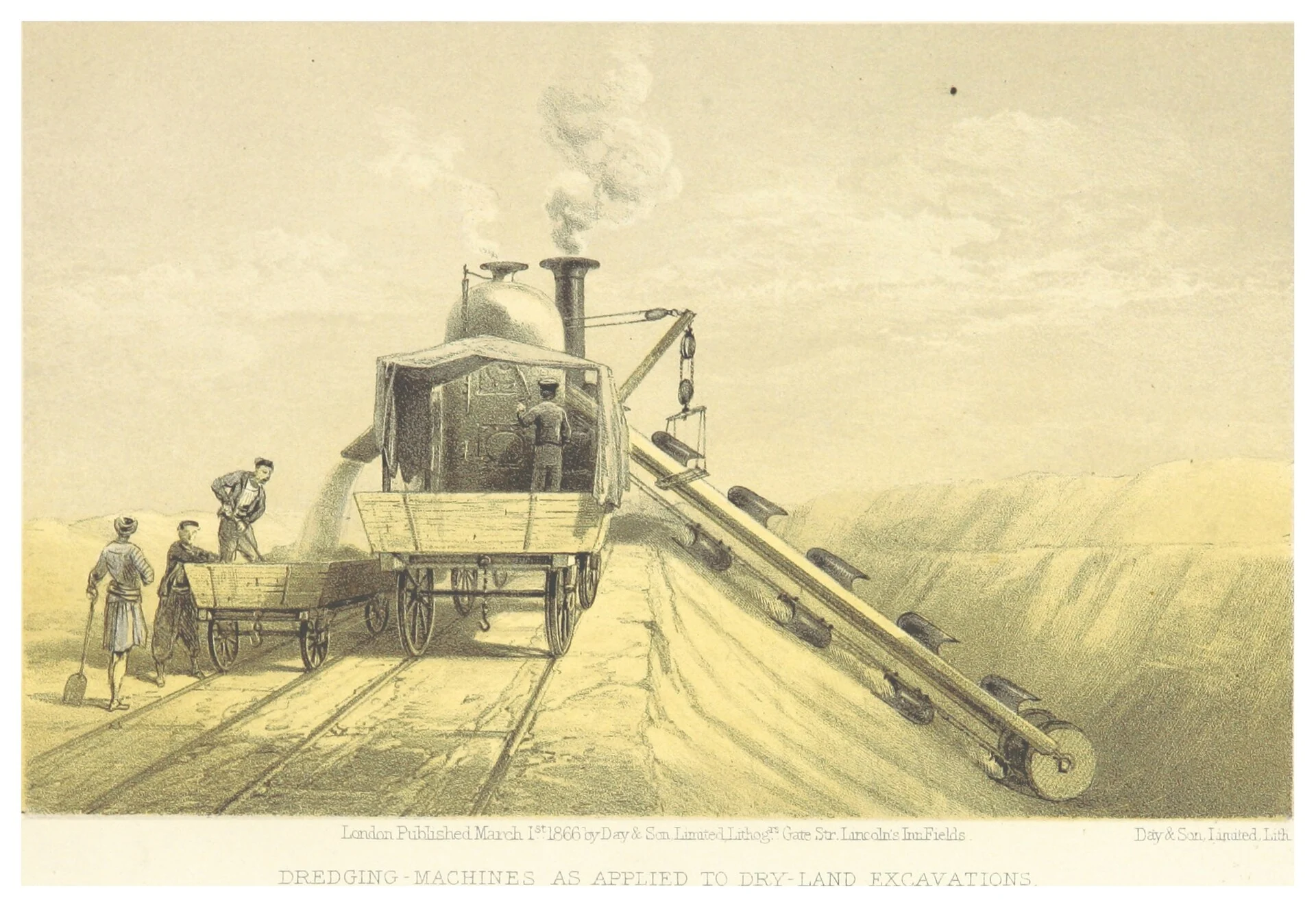
Popular accounts sometimes picture the Suez Canal as a straight trench dug entirely by hand and completed only when machines replaced people. The actual technology and labor history was more complex. Manual work remained important, and excavation machinery had different strengths depending on soil, depth and access. Engineers developed and deployed bucket dredgers, cranes, conveyors and supporting transport systems while maintaining a workforce capable of installing, feeding, repairing and operating the machinery.
After the end of the large-scale system of forced Egyptian contingents in 1864, the company faced pressure to expand mechanized methods and recruit other kinds of labor. Lucia Carminati identifies political negotiations, budgetary problems and technical necessities working together in this transition. There was no clean boundary between humans and machines: dredges needed workers, and new machinery changed rather than eliminated demands for human effort.
What did a nineteenth-century observer actually see? Thomas Kerr Lynch’s 1866 book included an engraving titled Dredging Machines as Applied to Dry-Land Excavations. The visual is a published period illustration, useful for understanding how contemporaries represented industrial methods. It should not be treated as a high-resolution photograph of every mechanical process or as proof that the depicted machine was installed at every worksite.
The relevant historical achievement was organizational as well as mechanical. Canal building required site surveys, components delivered from afar, fuel, replacement parts, boats, workshops and operators with specialist skills. The equipment was inseparable from the financial and labor structures that supported its use. Describing the undertaking as either “the work of modern machines” or “only the sweat of peasants” erases that interdependence.
The freshwater canal: keeping people and settlements supplied
One of the most consequential problems in building a canal through a dry and thinly populated region was providing fresh water. Workers needed drinking water, while camps and towns required supply systems that did not depend solely on distant shipments. The freshwater canal linked areas of the Nile-fed landscape toward the isthmus and supported settlements including Ismailia. It served a different purpose from the completed saltwater maritime canal and should not be confused with it.
The Suez Canal Authority notes the entry of Mediterranean water into Lake Timsah on 18 November 1862, a landmark in the maritime works. The supply of potable water involved its own channels, engineering and maintenance. Water availability was therefore both a technical necessity and a question of human welfare. Worksite hardships should not be blamed entirely on climate when the organization and timing of provision were crucial factors.
In the 1860s, Ismailia grew as a base for company administration, workshops and settlement. A contemporary published illustration by Lynch shows the town near the freshwater canal. It is not a modern aerial view, and the architecture it depicts cannot simply be treated as a precise survey of every building. But it documents the way the canal enterprise produced linked waterways and settlements, rather than a narrow navigation trench in isolation.
Roads, rails and waterways complemented one another. Coal, grain, machinery and construction materials needed transport across difficult terrain. Workers moved between camps and homes under conditions that varied by legal status and available means. The creation of infrastructure changed who could travel, where economic opportunities emerged and which communities bore disruption.

Port Said: a city built alongside the canal, not after it
Port Said is easily reduced to the canal’s northern entrance, but the town had a more complicated social history. The project founded it in 1859, and building the waterway attracted workers, boatmen, traders, contractors, brokers, domestic servants and entrepreneurs. Some came from other Egyptian towns and villages; others arrived from the Mediterranean and beyond. Their reasons ranged from official assignments and forced recruitment to pursuit of wages or commerce.
Lucia Carminati’s research follows this mobile population through administrative and social records. The town’s population grew in unequal ways, and its cosmopolitan identity was neither a guarantee of harmony nor a description of identical rights for all inhabitants. Foreign residents might benefit from consular protections different from those available to Egyptians. Work opportunities also varied by skill, origin, class and circumstance.
As construction approached completion, some livelihoods became uncertain. The event that created the permanent canal could also end temporary excavation jobs. Workers who were not incorporated into continuing port or maintenance work faced a new need to find employment. In this sense the 1869 opening was both an economic beginning and an ending, depending on whom one asked.
Lynch’s 1866 illustration of Port Said gives a contemporary visual perspective on the rapidly forming settlement. Like many Victorian travel images, it may have been modified for publication, and its composition represents an artist’s choices. It should be read alongside photographs and documentary records rather than imagined as an exact street-level snapshot.

Ismail Pasha, spending and the financial burden of the project
Khedive Ismail, who ruled Egypt from 1863 to 1879, became closely associated with the canal’s completion and the spectacular inauguration. His reign was also marked by public works, borrowing and increasingly difficult negotiations with creditors. The canal was not the only source of state indebtedness, and a rigorous economic history should not attribute every Egyptian fiscal crisis to the celebration of one waterway.
The Suez Canal Authority reports that construction required approximately 433 million French francs, about double the original estimate, and involved the excavation of roughly 74 million cubic meters of material. Those are figures presented in an official historical account, with historical currencies and measurement conventions. They are not directly comparable to a present-day construction budget without careful conversion and adjustment.
The share structure and fiscal terms became politically important after the opening. In 1875 Egypt sold a large block of canal company shares to the British government under Benjamin Disraeli, against a backdrop of financial pressure. This did not mean that Egypt immediately ceased to exist as a state, nor that the canal was physically transferred to Britain as its sovereign territory. Distinctions between company shares, navigation rights, administration and sovereignty are essential.
Broader foreign financial supervision developed in the later 1870s. Kemet Vault examines those linked events in the separate Ismail debt crisis and financial control, 1876–1879. Here, the key issue is how a major infrastructure project became embedded in the political economy of nineteenth-century Egyptian state-building.
17 November 1869: the ceremony and the people absent from its portraits
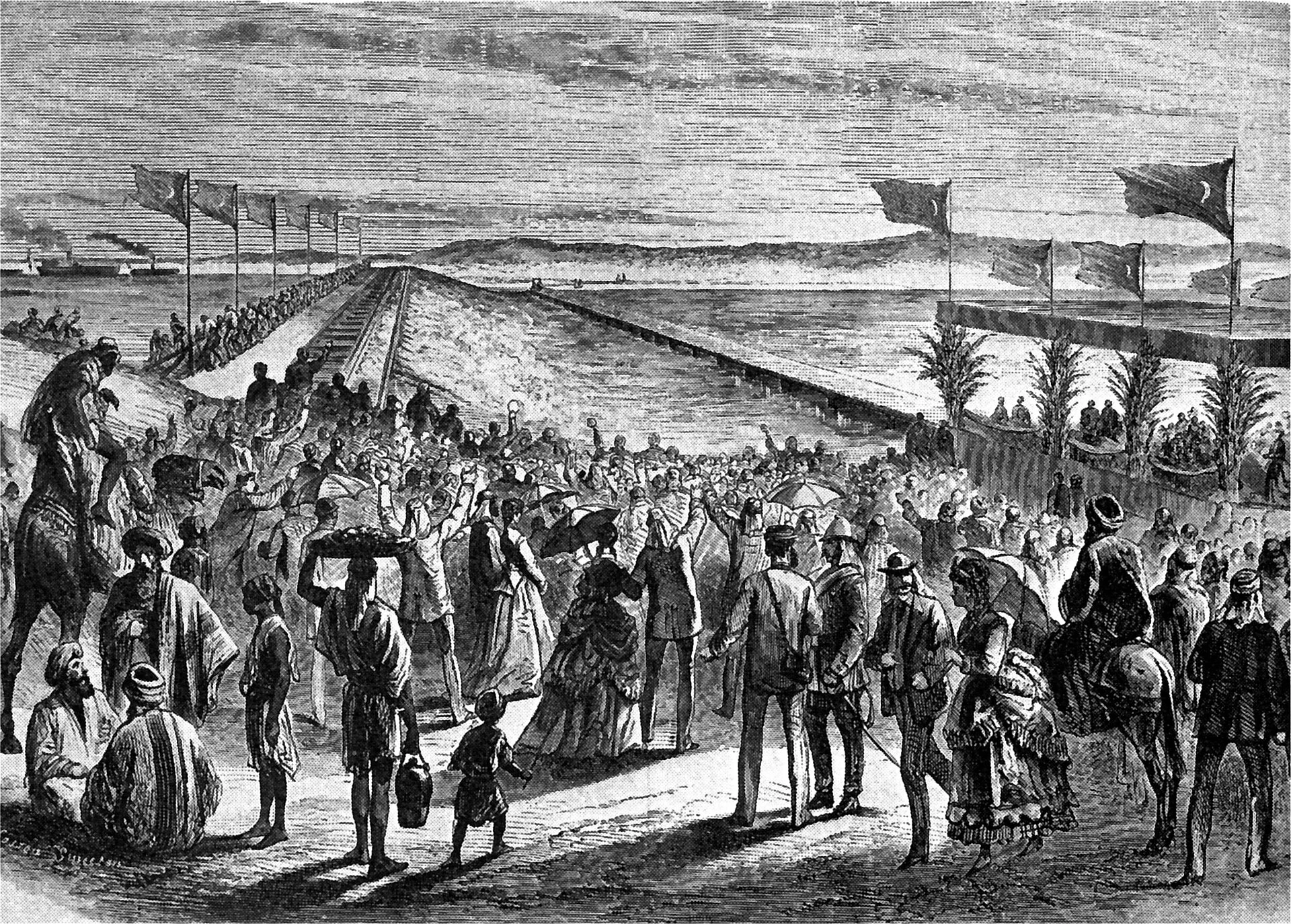
The canal opened officially on 17 November 1869, after the Mediterranean and Red Sea waters had met in August. The opening ceremony drew imperial and royal guests, political representatives and international attention. The Suez Canal Authority lists participants including the French Empress Eugénie, members of European royal families, Egyptian political figures and other distinguished visitors. A procession entered the canal at Port Said and continued along the new maritime route.
For Khedive Ismail, the spectacle placed Egypt at the center of a highly visible international event. For the company and its investors, the opening marked the transformation of a risky capital project into a functioning waterway. For the laborers, it may have meant wages, new work, dismissal or the memory of hardship. The event carried different meanings depending on social position.
Period illustrations of the opening often emphasize flags, pavilions, fleets and formally dressed dignitaries. These pictures matter as documents of political spectacle, but they do not necessarily show the underlying work crews or the communities affected by excavation. An accurate history can admire the visual scale of the ceremony while also examining the limits of whom that imagery chose to celebrate.
The historical illustration below is dated by its Commons source as a contemporary representation of the opening, though the reproduction was later published in a twentieth-century compilation. It must therefore be distinguished from an original camera photograph of November 1869. The documented anniversary and the image’s status as an illustration are both made explicit.
The actual canal at opening: engineering limits and later changes
The original maritime canal was not the enormous channel visible in modern footage. The Suez Canal Authority gives its opening length as around 164 km, with a surface width around 52 meters and depth around 7.5 meters. Navigation was initially restricted by draft and available facilities, and ships did not have the full flexibility associated with much later operations. These figures help correct the misleading impression that the modern canal was finished in its present form in 1869.
Engineering was an ongoing process. The authority records the later introduction of night navigation in 1887, and repeated widening, deepening and operational changes followed across generations. Such improvements are not evidence that the 1869 inauguration was fraudulent. They show how a newly opened infrastructure project was adapted as ships, trade volumes, technology and institutional demands changed.
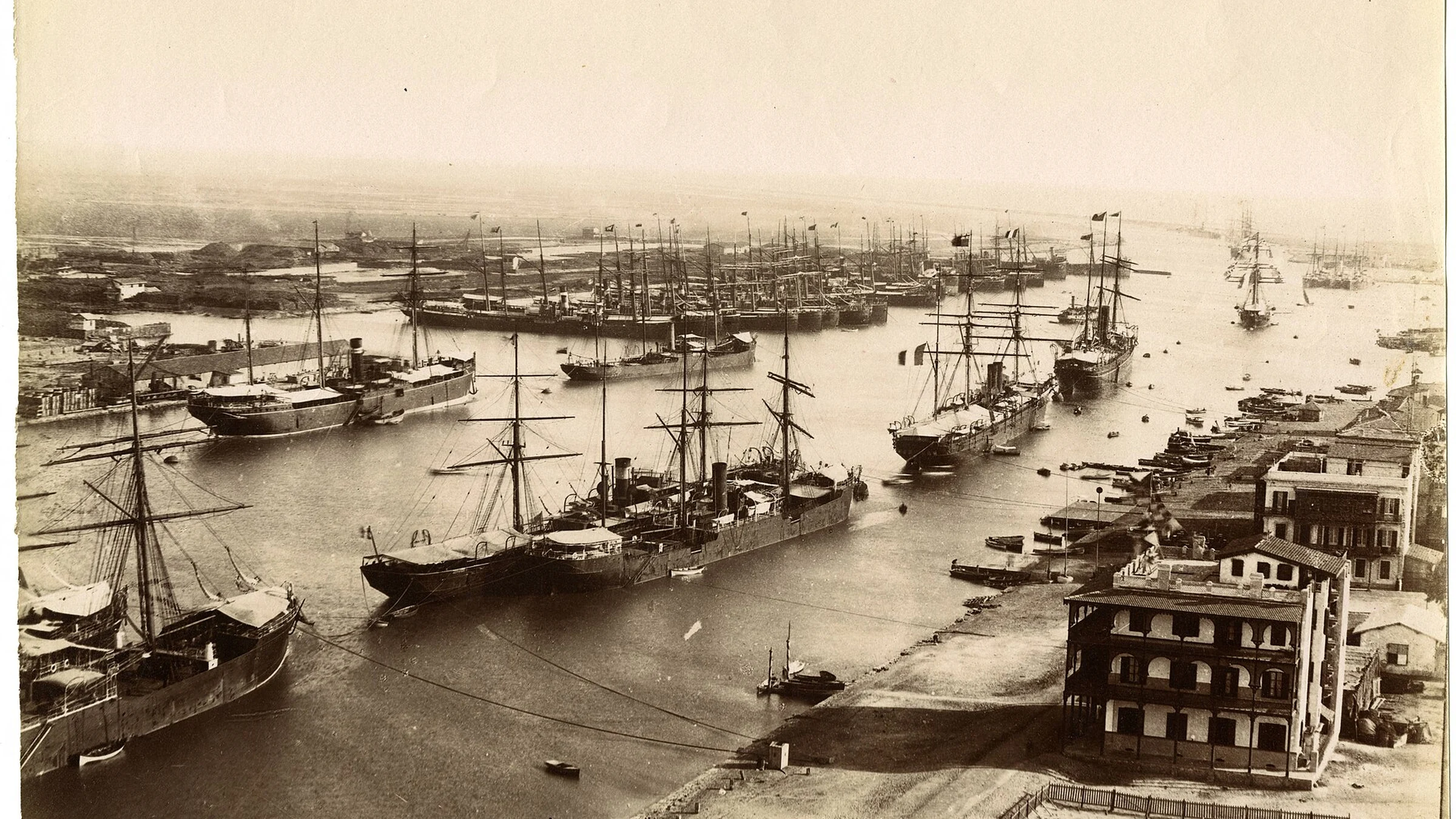
The harbor photograph reproduced below comes from a nineteenth-century view attributed to Hippolyte Arnoux, preserved in the Knox College collection and supplied through the Digital Public Library of America. It shows the entrance at Port Said and provides genuine photographic evidence of the canal environment. The archive’s 2013 date refers to a digital record, not the day the photograph was exposed, and an annotation mentioning the 1869 opening does not prove the camera captured the ceremony itself.
The difference between photographs and engravings matters for a serious historical encyclopedia. Even camera photographs can be staged or framed selectively, and a date on the back may be retrospective. A hand-drawn machine engraving can still be an authentic historical source if described correctly. Reliable historical interpretation rests on identification, provenance and the limits of what each source shows.
How the Suez Canal reshaped trade without ending imperial rivalry
Once open, the canal altered shipping routes and strengthened the importance of steam-powered maritime commerce between Europe and Asia. Its advantages were substantial for many services that otherwise went around the Cape of Good Hope. Yet the benefits varied by port, commodity, ship size, fuel requirements and shipping infrastructure. Not every sea journey became shorter, and the canal did not eliminate alternative trade routes.
Politically, Suez became a strategic concern for European powers and for Egypt. Foreign influence over the canal company, later financial interventions and British occupation formed different but connected chapters. They should not be collapsed into a claim that one opening ceremony directly caused all subsequent political developments. The 1875 share sale, the 1882 British military occupation and the 1956 nationalization are distinct events requiring separate analysis.
The canal also altered the urban and demographic geography of Egypt’s isthmus. Port Said, Ismailia and Suez developed networks of work, supply and commerce. Their populations were not merely appendages of a shipping company. Families established lives in and around ports, and migrants carried skills, languages and attachments across borders. Labor history reveals a much more populated story than a map of cargo routes.
The geographic transformation brought continuing maintenance needs and dependence on an engineered waterway. The canal was a powerful symbol of modern infrastructure, but it remained vulnerable to political conflict, interruption and changing technology. That is part of the history of modern Egypt, not an exception to it. To examine how nineteenth-century infrastructure and urban redevelopment affected the capital in a different way, see Kemet Vault’s documentary study of modern Cairo, its Nile landscape and public spaces. That article has a distinct focus from the Suez workers and construction history.
What the surviving sources prove and what they do not
| Claim | Established evidence | Important qualification |
|---|---|---|
| Construction began in 1859 | Suez Canal Authority dates the start to 25 April | Symbolic groundbreaking differs from later labor scale |
| Egyptian forced labor helped build the canal | Modern archival research documents corvée until 1864 | Workforces changed; not everyone was conscripted |
| 120,000 people died | Prominent commemorative claim | No reliable comprehensive death registers confirm the exact total |
| Machines excavated the canal | Contemporary images and research show dredges and related systems | Machinery required workers; human toil continued |
| The waters connected in 1869 | Official chronology records 18 August | Opening celebrations followed on 17 November |
| The canal transformed global trade | Longer-term shipping and political history | Effects varied by route and period, with later modifications essential |
The canal history is powerful precisely because the evidence can be examined at several scales: one 1854 legal agreement, the bodily experiences of workers, the installation of machines, the emergence of towns, the 1869 ceremonial fleet, and the financial choices made years later. We do not need a single heroic or villainous explanation to make the story compelling.
Frequently asked questions
When did construction of the Suez Canal begin and end?
Excavation officially began on 25 April 1859. The Suez Canal Authority records the joining of Mediterranean and Red Sea waters on 18 August 1869 and the formal inauguration on 17 November 1869. Work and modification continued after the official opening.
Who built the Suez Canal?
The canal was built through the combined work of Egyptian laborers, many subjected to corvée recruitment in earlier phases, and other workers, migrants, engineers and contractors. Ferdinand de Lesseps led the company responsible for the project, but crediting him alone erases the vast human organization required.
How many Egyptians died building the canal?
The frequently cited figure of 120,000 deaths is not supported by comprehensive surviving death registers. Researchers document severe working conditions and mortality, but the precise aggregate cannot be verified confidently. It is important to acknowledge the deaths without presenting an uncertain number as an audited historical fact.
What changed in 1864?
The large-scale compulsory labor arrangement was stopped amid political negotiations and disputes. Excavation increasingly used mechanized dredging and other labor recruitment. The change did not instantly remove human hardship: machines still needed workers, maintenance and material support.
Why is Port Said important to the history of the canal?
Port Said was founded in 1859 as the canal’s northern harbor and worksite settlement. It developed through Egyptian and Mediterranean migration, construction employment and commerce. Its social history shows how a waterway created new urban communities long before the opening ceremony.
Did the Suez Canal have locks when it opened?
No. The maritime Suez Canal was designed as a sea-level crossing without the sequence of locks familiar from some other canals. Its initial dimensions and shipping conditions differed substantially from modern measurements, and later improvements expanded its capabilities.
Primary records, academic references and visual provenance
Official canal documents: Suez Canal Authority, Canal History; Cairo Governorate, 17 November commemoration. These should be distinguished from scholarship, particularly where casualty figures appear in public memory.
Research: Lucia Carminati, “Of Machines and Men: Mechanization and Migrant Labor on the Suez Canal, 1859–64”, in The Oxford Handbook of Modern Egyptian History (2024); Carminati, Seeking Bread and Fortune in Port Said, University of California Press; CNRS, “The Turbulent History of the Suez Canal”; Carminati, “Suez: A Hollow Canal in Need of Peopling” (2021).
Archival visuals: The six figures are a genuine historic Port Said camera photograph from the Hippolyte Arnoux/Knox College–DPLA collection and five public-domain historical maps or printed illustrations, including images from Thomas Kerr Lynch’s Visit to the Suez Canal (1866). Captions identify each medium, source collection and reuse status. All images are self-hosted after editorial WebP optimization; no invented reconstruction is presented as a nineteenth-century photograph.
Research and source review: 25 October 2026. This feature covers the 1859–1869 construction and social transformation, not a modern maritime operations guide or a standalone political analysis of the 1956 Suez Crisis. Dates, labor estimates and visual evidence are presented with their documentary limits.