What happened to the Khedivial Opera House? The original Cairo opera house was built for Khedive Ismail’s 1869 cultural celebrations, opened with Rigoletto rather than Aida, and was destroyed by fire on 28 October 1971. Today’s Cairo Opera House is a different building opened on Gezira Island in 1988.
This article traces the vanished theatre through its original photographs, performances, construction, urban setting and the cultural institutions that survived its loss. It separates the Azbakeya building from the modern Gezira complex and cites original Egyptian institutional records rather than recycled myths.
Why Khedive Ismail commissioned an opera house
The Khedivial Opera House emerged from the nineteenth-century reorganisation of Cairo under Khedive Ismail. The ruler linked construction with the celebrations surrounding the Suez Canal’s opening in 1869, but the theatre was located in the Azbakeya district rather than beside the canal. Its purpose combined performance, ceremonial display and the projection of a cosmopolitan capital. A theatre was a tangible cultural institution, requiring rehearsal, music, scenery and an audience, not merely a façade built for the attention of foreign dignitaries. Its public presence on Opera Square connected the new venue with broader changes in urban planning, commerce and cultural activity. The official Cairo Opera account identifies this institutional ambition, although its retrospective narrative should be read alongside historical photographs and contemporary sources rather than as the complete social history of the city.
The project is often treated as an incidental decoration to the Suez Canal story. That obscures the different forms of work involved in each undertaking. A canal required excavation, navigation planning and water management; the opera house required architectural design, timber construction, musicians and stage craftspeople. The two belonged to the same political period, but one was not part of the other’s physical infrastructure. See the separate research on Suez Canal construction for its engineering and labour history. The distinction provides a richer picture of the ambitions and contradictions of Ismail’s era.
The Italian architectural design
Egypt’s national opera institution names Pietro Avoscani and Rossi as the Italian architects behind the original building. The project was reportedly completed on an exceptionally short schedule, commonly described as six months. That timeline is useful for understanding its ceremonial urgency but does not establish the exact working conditions or materials used in every room. The building’s external composition followed a European theatre vocabulary, with an imposing façade that stood apart in Cairo’s evolving cityscape. Surviving documentary photographs capture the visible exterior but cannot reveal everything about auditorium acoustics, stage machinery or backstage circulation. A sound historical account keeps those evidentiary boundaries clear.
Architectural patronage was never just the activity of a ruler and two named designers. Carpenters, decorators, painters and construction workers had to turn drawings into a usable theatre. Musicians and theatrical personnel then gave the structure its public purpose. Their work should not disappear under a simplified narrative of a European architect delivering culture to Egypt. The theatre belonged to a changing Egyptian capital where multiple forms of music and public entertainment already existed. An opera building was one part of that environment, while later Egyptian professional ensembles continued to reshape its artistic significance.
1869: the opening and the Suez celebrations
The Khedivial Opera House dates to 1869, the year in which the Suez Canal was inaugurated. Cairo Governorate’s cultural references place the opening among the grand events of that period, while different municipal pages mention more than one precise opening or performance date. That discrepancy is a reminder that a ceremonial opening, a first attended event and a specific opera performance may not be identical milestones. The secure historical narrative identifies the year and the operatic programme without disguising the limitations of short institutional summaries.
The event attracted attention because Egypt was presenting itself to visiting rulers and international observers through both infrastructure and ceremonial culture. It would be simplistic to describe the theatre as a normal commercial building with no political significance. Equally, the fact that international visitors were present does not establish what ordinary Egyptian residents could afford or whether every social group participated. The history of a prestigious performance venue is inseparable from questions of access, patronage and the public image of the state.
Why Rigoletto opened the theatre, not Aida
The official Cairo Opera history explains that Ismail hoped to open the theatre with Giuseppe Verdi’s Aida, whose story drew on ancient Egyptian themes. The production was not ready. Delays related to war and the movement of scenery and costumes prevented the intended first presentation. Verdi’s Rigoletto was performed instead, and Aida did not premiere in Cairo until 1871. These details correct a familiar but false claim that Aida opened the opera house on its first night.
The distinction between commissioned prestige and actual performance illustrates why memorable facts should be checked against institutional sources. A story may be repeated in brochures because it combines a famous opera, a pharaoh-themed narrative and the canal celebration. Repetition is not documentation. The verified sequence gives the tale more substance: cultural ambitions were shaped by practical production difficulties, and the theatre’s importance continued beyond its first ceremonial season. The first production was not the whole story of the institution.
Two genuine photographs of the vanished theatre
The first photograph included with this article is an archival 1869 image of the Khedivial Opera House, preserved in the Bibliotheca Alexandrina’s Memory of Modern Egypt archive and available through Wikimedia Commons. It shows the building and Opera Square before Ibrahim Pasha’s statue was installed. This is an actual historical photograph of the lost venue, not a digital reconstruction created to fill an image slot. The photographer is unknown; the Commons record describes the original as public domain under the applicable Egyptian and United States copyright terms.
A second distinct archival photograph documents the same theatre in 1869 from another view. Both files are tied to individual archival records, and their captions distinguish what each image documents. A monochrome exterior does not certify the precise colour of the curtains, the size of an audience or the acoustics of an interior. Digital cleaning and resizing for the web do not transform a historical picture into fresh evidence about invisible rooms. The significance of these images is their authenticated building identity and period context.

Opera Square and the geography of modern Cairo
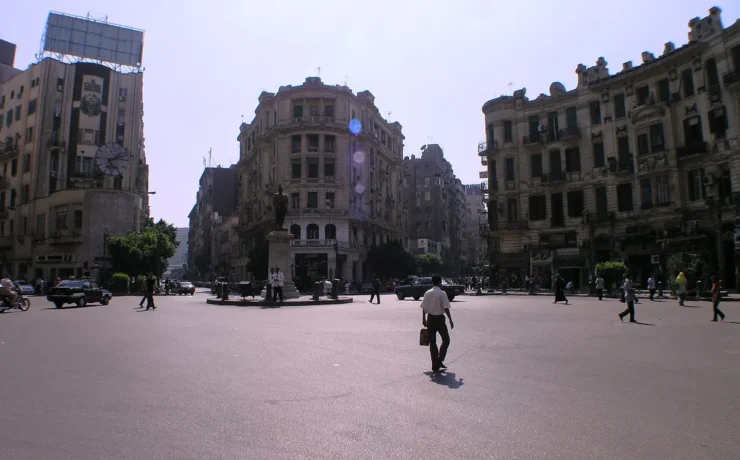
The old theatre stood in Azbakeya and lent its name to a central urban space. Its placement made the building part of the movement of people through the modernising city, with a relationship to gardens, streets, commerce and other cultural attractions. That public frontage helps explain why period photographs and postcards of the square became important archival sources. The theatre’s identity was connected not only with the events performed inside but also with the landscape seen from surrounding streets.
Today’s visitor must distinguish Opera Square from the current Cairo Opera House. The replacement institution opened on Gezira Island, in a different site and architectural form. Search results and image galleries sometimes blur the distinction because both are called Cairo Opera House. That can lead to misleading captions, contradictory maps and a false claim that a nineteenth-century building is still standing. The difference between place and institution should be explicit in any local heritage description.
Opera and Egyptian artistic life
Performances at the Khedivial building belong to the wider cultural history of Egypt. Imported European repertoire formed an important part of the original programme, but over time Egyptian performers, teachers and musicians developed their own participation in opera and concert life. The Cairo Opera Company archive describes the institutional development of Egyptian opera performers particularly in the twentieth century. Its history should not be projected backwards to suggest that the same ensemble had existed with identical membership since 1869.
A theatre is sustained by performers and audiences as well as architecture. Rehearsal schedules, education, technical work and artistic collaborations can shape an institution across political transitions. Focusing exclusively on visiting monarchs at the first opening would obscure much of the subsequent century. Egypt also had active traditions of Arabic music, popular theatre and later cinema. They deserve their own historical treatment rather than being presented as an afterthought to European opera.
The 1971 fire and the end of the original structure
The official Cairo Opera authority dates the devastating fire to the morning of 28 October 1971. The nineteenth-century opera house was destroyed, ending more than a century at its Azbakeya site. The building had included substantial timber construction, a fact that helps explain its vulnerability, although a general history should not claim to reproduce the findings of a technical fire investigation that it has not consulted. The loss made the historical photographs especially valuable because the original façade and auditorium could no longer be visited.
The disappearance of a major landmark changes the city’s memory. Archival images and written accounts can preserve visual and institutional history even without the surviving physical fabric. The cultural consequences extended beyond architecture: companies and artists needed alternative venues, and audiences lost a familiar home for performances. An honest site guide should not invite readers to enter a building that burned down decades earlier or confuse later commemorations with a physical reconstruction.

What happened to performances after 1971?
The destruction did not mean that all operatic activity disappeared from Cairo. The Cairo Opera Company history records performances continuing in alternative venues, including the Gomhouria Theatre, while the nation lacked a dedicated equivalent to the destroyed structure. This distinction corrects the exaggerated statement that Cairo had no opera at all between the old fire and the new complex. Organisations can survive the loss of their headquarters even while facing financial and practical disruption.
Temporary arrangements placed real demands on stage crews, dancers, singers, instrumentalists and administrators. A specialist theatre requires space, equipment and repeated rehearsal. The interlude therefore belongs to the history of cultural labour, not merely to the dates of two architectural openings. It also helps explain why a new national performance centre became an institutional priority rather than only a project for improving the skyline.
The modern Cairo Opera House opened in 1988
The present Egyptian Opera House officially opened on 10 October 1988 at Gezira. The national opera website credits cooperation between Egypt and Japan, including the Japan International Cooperation Agency. The new building was designed for a different site and era, incorporating a broader national cultural complex. It is a successor to the old Khedivial institution rather than a surviving wing, restoration or exact reproduction of the 1869 theatre.
The complex now hosts contemporary performances whose programmes and visitor conditions vary over time. A permanent history article cannot promise particular shows, seat availability, current ticket costs or unrestricted tours. Travellers wanting to see a performance should consult the official Cairo Opera website and its current calendar, keeping the performance decision separate from a heritage visit to historic Azbakeya. The two locations and experiences are related through cultural tradition, not physical continuity.
The opera house in the wider history of Ismail’s Egypt
Ismail’s reign saw ambitious infrastructure, urban improvements and international cultural investments. These initiatives were associated with considerable cost, administrative change and later political debate. A theatre’s construction alone cannot establish whether the programme benefited every Egyptian equally. A richer modern-history explanation would connect the opera house with railways, the Suez Canal and the changes in state finance that affected Egypt in the decades following the opening.
For distinct angles, Kemet Vault examines the Alexandria–Cairo railway and Ismail’s later debt crisis. These topics should be linked, but not rewritten into identical introductions. The railway concerns transport engineering, the debt crisis financial and political control, and the opera house cultural architecture and institutional history. Together they show how different forms of modernisation interacted without collapsing them into a promotional slogan.
What the evidence can and cannot settle
The strongest established facts are the original 1869 venue, the connection with Ismail’s Suez Canal celebrations, Rigoletto preceding Aida, the destruction on 28 October 1971 and the opening of a different opera complex on 10 October 1988. Official sources are consistent on this broad sequence. They are less uniform about the exact timing of some early opening events, so a responsible account does not invent certainty where different civic entries use dates differently.
Historic photographs provide credible exterior evidence but should be described by their individual source records. The full working life of the theatre, including the contributions of performers and staff, requires more than a two-image gallery. Today’s visitors can study archives and the changing Opera Square landscape, and attend contemporary performances at Gezira, without pretending that the destroyed nineteenth-century theatre remains open. That distinction is the basis of a trustworthy modern Egyptian cultural history.
Primary sources and historical photographs
Core dates come from the Egyptian Opera’s official institutional history, Cairo Governorate’s culture archive and the Cairo Opera Company. Both historical photographs are distinct records held by the Bibliotheca Alexandrina Memory of Modern Egypt archive and made available under public-domain tags on Wikimedia Commons.