When did Egypt’s first railway open? Egypt’s first railway project was contracted under Abbas I with engineer Robert Stephenson in 1851. An initial section operated in 1854, while the complete Alexandria–Cairo single-track line opened in 1856, according to the Science Museum Group and Cairo Governorate’s official railway history. These dates describe different stages and should not be confused.
The railway transformed travel and transport in nineteenth-century Egypt, connecting the Mediterranean port of Alexandria with the capital and eventually a route toward Suez. This evidence-led article explores the contract, construction, early services, Delta economy and institutional history. The accompanying original photographs show modern railway stations, explicitly identified as such rather than passed off as images from the 1850s.
Why Egypt built a railway between Alexandria and Cairo
The Alexandria–Cairo railway belongs to the mid-nineteenth-century transformation of Egypt’s transport and economy. Steam-powered rail service offered a new way to connect a Mediterranean port with the country’s capital and Nile Delta settlements. Before the line was completed, moving large numbers of people and goods required combinations of roads, waterways and slower transport methods. The project was therefore a major infrastructural intervention, not merely a curiosity about the first train.
Egypt’s strategic geography made the line relevant to wider movements between Europe and Asia. The Egyptian Gazette’s historical account and research on early railway planning describe the importance of overland connections before the Suez Canal opened in 1869. Those international interests shaped discussions about investment and routes, but Egyptian state decisions, workers and communities were central to what was actually built.
The overland mail route to India before the Suez Canal provides related context without being the same subject. That article concerns an older system of transit across Egypt; this study is about the physical railway, its engineering, opening sequence and consequences for nineteenth-century society.
Abbas I, Robert Stephenson and the 1851 agreement
The Science Museum Group’s British railway heritage collection records that Abbas I contracted Robert Stephenson in 1851 to build Egypt’s first standard-gauge railway. Stephenson was a prominent British engineer whose name became attached to early projects abroad. His involvement is a documented engineering connection, but it is misleading to describe Egypt’s railway as a British domestic line simply transplanted into an empty landscape.
Planning railway infrastructure meant securing political approval, arranging equipment, surveying routes and mobilising labour. The Egyptian state was taking on a major project whose operation would affect cities, agriculture and international transit. The contract date matters because it is not the same as the first public train service. Histories sometimes choose 1851, 1852, 1854 or 1856 as the start of Egyptian railways, and they may be referring to different stages of the same endeavour.
The Cairo Governorate’s official cultural history says work began in 1852, whereas the Science Museum Group describes the 1851 agreement and construction activity around that time. Rather than invent a single unquestionably exact groundbreaking date, this guide identifies the agreement and the construction phase separately and notes the source conventions.
Construction across the Nile Delta
The route linked Alexandria on the Mediterranean coast with Cairo through the cultivated Delta. Its engineering challenges differed from those of building on a featureless desert plain. Land ownership, irrigation channels, existing settlements and transport crossings influenced what could be constructed. A railway is a corridor with stations, track, workshops and operating arrangements, not just a locomotive arriving for a ceremonial photograph.
British engineering expertise and imported equipment played a role, but railway construction and maintenance depended on extensive local work. Individual labour conditions are not established simply by naming Stephenson, and claims about exact workforce totals require wage records, company accounts or contemporary reports. The fact that infrastructure served elite international transit does not mean ordinary Egyptians were absent from its construction or later use.
The railway also changed how the Delta could be imagined as a connected economic region. Agricultural goods, administrative movement and passenger traffic could be reorganised around stations and schedules. The degree of change varied by time and place; a nineteenth-century line should not be credited with solving every problem of transport or development across Egypt.
What actually opened in 1854?
The Science Museum Group records that a section of the line opened in 1854 between Alexandria and the village of Kafr El-Eiss. Other public summaries describe early rail services through different Delta locations and may use slightly different route shorthand. The important distinction is that a working section was not yet the entire Alexandria–Cairo line.
A date in a tourist article may claim that Egypt’s first railway opened in 1854 without further explanation. That is defensible only when the writer identifies it as an early operating segment. It is inaccurate to imply that the entire route had been completed and operated end to end by that year. Equally, the contract signed in 1851 was not itself a passenger train service.
A reliable chronology can therefore distinguish four milestones: planning and contracting, construction, partial operation and completion of the through connection. This approach is more informative than arguing over a single ‘first year’ while using inconsistent definitions of what opened.
The full Alexandria–Cairo line in 1856
The Science Museum Group states that the complete single-track line was opened in 1856 with twelve stations, including the main termini at Cairo and Alexandria. Cairo Governorate’s history also dates the opening of the full first line to 1856. The agreement between these independent summaries makes 1856 the appropriate date for discussing the completed Alexandria–Cairo railway rather than the first short operating segment.
Stations introduced a new kind of public infrastructure. They organised waiting, baggage, goods, tickets and the predictable movement of trains. The names and buildings seen by modern visitors are not necessarily identical to those of the first service. Architecture has been rebuilt, expanded or altered many times, and a surviving historic photograph has its own date rather than proving that the entire original terminal still stands unchanged.
The line’s opening was part of a continuing national transport story. What started as a single-track connection could be expanded and incorporated into changing networks over decades. A modern rail photograph illustrates the survival of railway culture but should never be captioned as if it were taken in 1856.
From railway to the Cairo–Suez connection
The original Alexandria–Cairo project soon became connected to a larger strategic transport system. Cairo Governorate’s historic account describes work on the Cairo–Suez line beginning in 1856 and the completion of that second line in 1858. The sequence is important because through Egypt’s territory, passengers and mail could eventually move between Mediterranean and Red Sea transport systems before the Suez Canal offered ships a continuous sea route.
This railway development should not be confused with the later digging of the canal itself. A train line and a navigable waterway require different engineering, financing, labour and operating systems. The history of Suez Canal construction and Egyptian labour addresses the distinct waterway project in the following decade.
Some summaries emphasise international trade as if Egypt’s domestic requirements mattered little. The railway also connected Egyptian cities and the agricultural Delta, and over time its uses widened beyond mail and transit. A sound account of the route recognizes both foreign interests in travel and the internal effects of new infrastructure.
Stations and the documentary photographs in this article
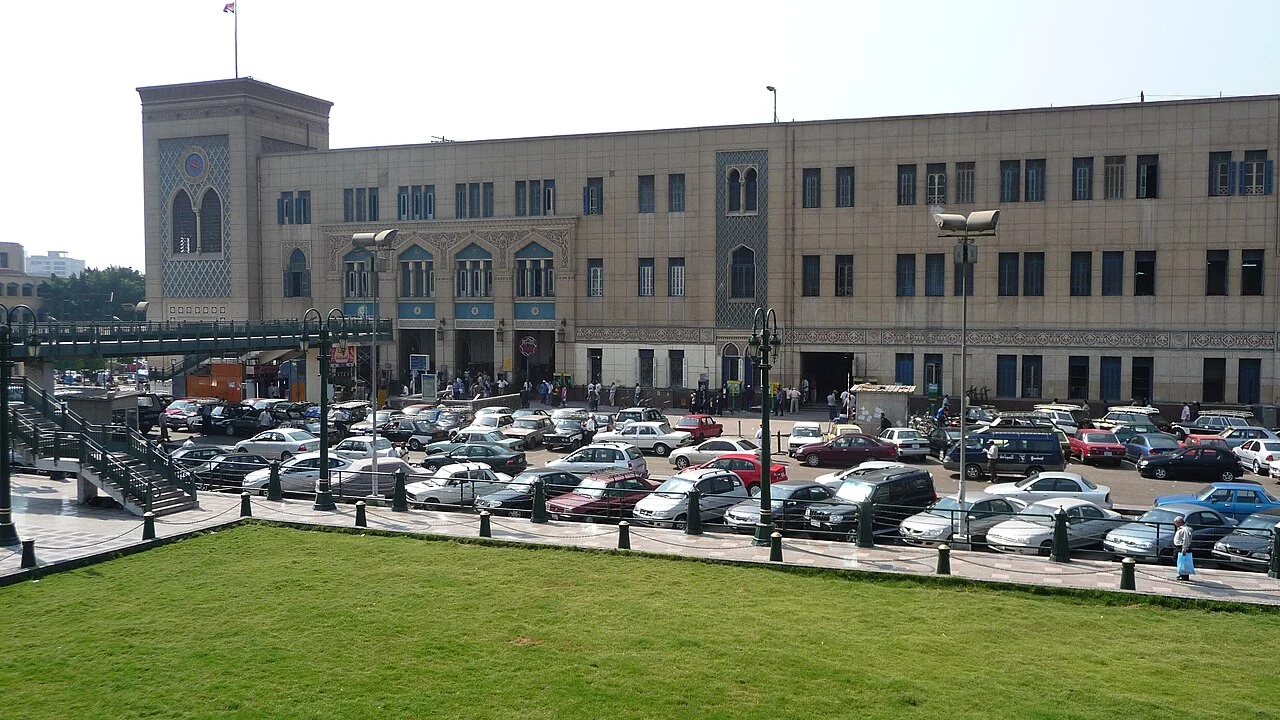
The first accompanying photograph shows Cairo’s Ramses railway station in July 2008, originally photographed by a Commons contributor known as bastique. It is not a nineteenth-century image and cannot prove that the building is the exact terminal completed in 1855. The photograph serves as a visual record of the continuing place of the railways in Egypt’s capital and as a reminder of the difference between historic origin and modern fabric.
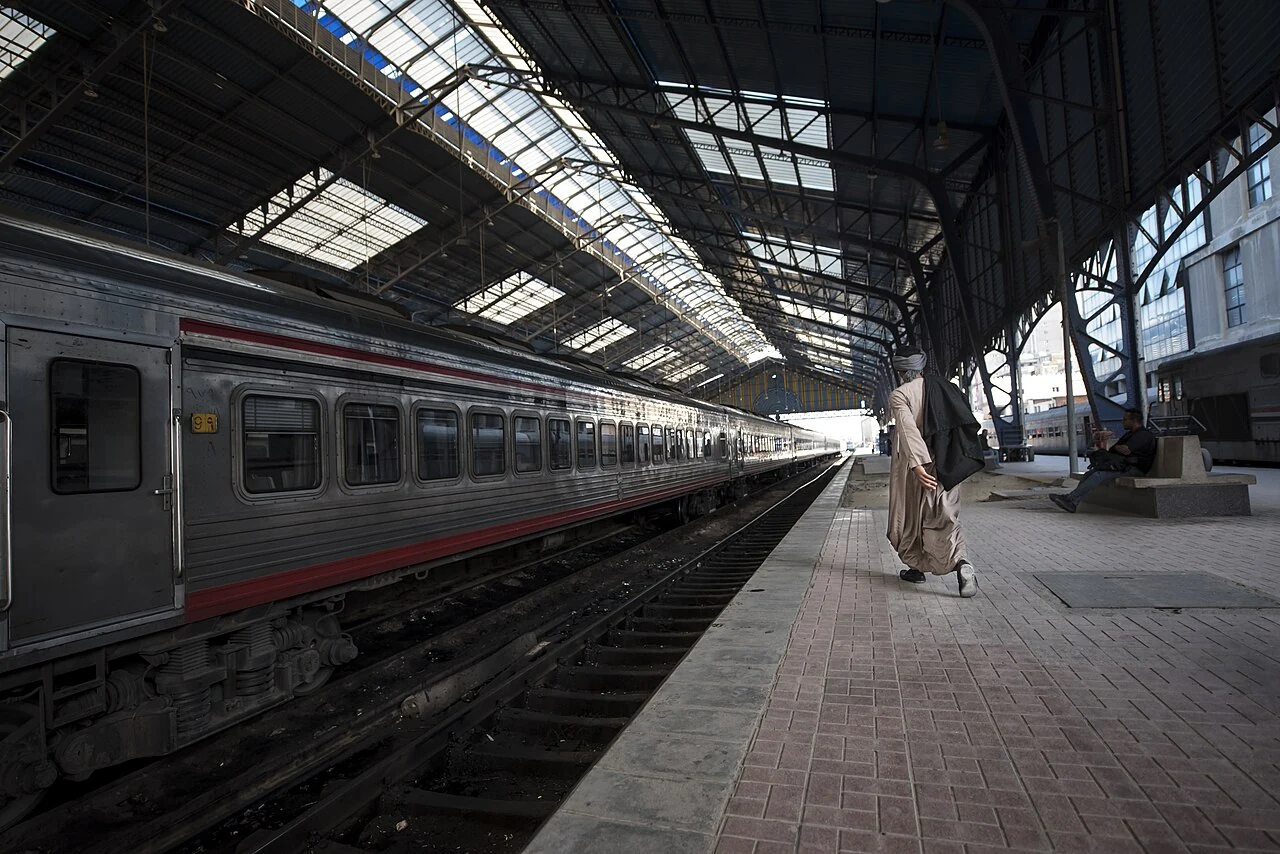
The second original photograph shows the railway station in Alexandria in December 2019, photographed by Mona Hassan Abo-Abda. Again, it documents a present-day successor in the city where Egypt’s earliest railway connection began, not the 1850s station described in nineteenth-century records. Its architecture and surroundings invite questions about the long urban history of rail transport.
Both documentary images are freely licensed and traceable to their authors. The present article uses them as visual evidence of modern rail heritage rather than attaching them to fabricated captions about the first locomotive or an opening ceremony.
Passengers, goods and the railway economy
Railways can change the relationship between agricultural production, market towns and ports. A more regular connection from the Delta toward Alexandria or Cairo could offer new possibilities for moving crops, merchandise and people, although different communities faced different access and costs. A general history should not invent freight tonnage or passenger numbers for the 1850s in the absence of contemporary records.
New stations created commercial activity around timetables, waiting, loading and repair. They could also reshape movement through towns and urban approaches. The railway therefore affected not only the speed of a journey but the social organisation of work and the physical form of places along the line. Historical evidence for these effects comes from later accounts, maps and archival sources, not merely the fact that a locomotive existed.
Different layers of railway history should be read together. A station photograph might show later building campaigns, while an early contract names the engineer. Neither source alone provides the complete experience of a porter, farmer or passenger in the first decade of service.
The British–French context without a simple conspiracy story
International strategy did influence Egyptian transport projects in the nineteenth century. British interests viewed land transit between the Mediterranean and Red Sea as valuable, while French interests pursued canal-related schemes. But the history cannot be explained entirely by one external country’s wishes. Egyptian rulers negotiated projects, and the resulting infrastructure required Egyptian administration, investment decisions and labour.
Contemporary political and economic struggles should be described with reference to dated agreements and policies. The existence of foreign engineers is not proof that every commercial benefit went abroad. Conversely, a railway framed as a national achievement should not erase international influence or the uneven distribution of its economic effects. The archival literature supports a more complex story.
Later Egyptian debates about debt, financial oversight and control of revenue help explain why infrastructure became politically sensitive. Kemet Vault’s research on Ismail Pasha’s debt crisis examines a different period, when financial pressures and control over revenues acquired new significance.
How railway institutions and names changed
The Science Museum Group notes that Egypt’s railways later came under the Ministry of Communications in 1919. After the establishment of the republic in 1953, the name of the state railways changed, reflecting the country’s altered political organisation. These are examples of the institution’s continuing history after the line’s Victorian-era beginnings.
Institutional renaming should not be mistaken for the physical construction of an entirely new railway at every political transition. Tracks, stations, rolling stock, management systems and the people using the service can change at different speeds. A chronology of railways therefore needs separate strands for infrastructure, administration, ownership and public service.
Modern rail investment belongs to another research question and should be treated through current official information. This article does not claim that an 1850s construction project describes today’s train classes, timetables or safety performance. Its purpose is to explain the foundation of Egyptian railway transport within the history of modern Egypt.
What is known, what remains uncertain, and where to read more
The basic chronology has strong independent support: Abbas I’s railway agreement with Robert Stephenson is dated to 1851, construction proceeded in the early 1850s, a section opened in 1854, and the through Alexandria–Cairo line opened in 1856. The Cairo–Suez connection followed in the later 1850s. These events can be described without inventing precise figures for every engineering process or all station openings.
The most misleading popular accounts collapse the events into a single first-train ceremony, claim that a modern station is identical to the 1850s terminal, or use the later Suez Canal’s opening date as a railway milestone. Separating chronology and infrastructure type makes the narrative both easier to follow and more historically accurate.
For readers interested in the wider period, the related Kemet Vault studies of the overland route, the canal and nineteenth-century debt show how transport, political authority and international commerce became linked in modern Egyptian history. The original records cited below remain the foundation for the specific dates in this page.
Historical sources and photo provenance
Key dates follow the Science Museum Group’s Egyptian State Railways collection and Cairo Governorate’s official historical account. A contemporary discussion of the historical evidence is available in the Egyptian Gazette’s railway retrospective. The public photographs are separately dated 2008 and 2019 and credited to their original creators through their Commons records; neither purports to show the 1850s railway works.