Why is Seti I’s temple at Abydos important? The Nineteenth Dynasty monument is distinguished by seven ritual chapels, finely carved and colored reliefs and the selective Abydos King List, which shows Seti I and his son Ramesses honoring royal predecessors. It was begun under Seti I and embellished under successors. The building is not the same place as the king’s tomb KV17 at Thebes.
This archaeology-led study uses Egyptian official records, the American Research Center in Egypt and museum catalogues to separate the surviving monument from legend.
A major temple at Abydos with a distinctive ritual plan
The Temple of Seti I at Abydos is one of the most significant surviving monuments of Egypt’s Nineteenth Dynasty. It was begun by Seti I, continued by his son Ramesses II and decorated further in later phases. The Egyptian Ministry of Tourism and Antiquities identifies seven chapels as a defining feature, dedicated to several major deities and to the deified king himself. The monument is celebrated for the preservation of colored reliefs as well as a royal list that names selected predecessors. These features make the site more than a collection of attractive wall carvings. The temple expresses a particular view of kingship, ritual continuity and the relationship between the reigning dynasty and the sacred landscape of Abydos. It is distinct from Seti’s tomb KV17 in the Valley of the Kings, which lies across the Nile near Thebes. The difference between memorial temple, burial place and subsequent religious memory is essential for understanding why the king commissioned more than one large sacred project.
Where Abydos sits in the landscape of ancient Egypt
Abydos is a historic religious and archaeological region in Upper Egypt, associated especially with the cult of Osiris. Across many centuries it developed cemeteries, royal monuments, pilgrimage traditions and ritual landscapes. Seti I built within a place already charged with religious significance; he did not create the holy city from nothing. Earlier remains in the region include royal tombs from the first dynasties and later Middle Kingdom memorials. Our Abydos pilgrimage and cenotaph study explores why people from different periods wished to be linked with this landscape. The temple’s context explains why its gods, texts and royal ancestry mattered. A visitor should not treat the building as a disconnected museum gallery, nor assume every visible ancient structure belongs to Seti’s reign. Abydos is a site of many historical phases. Its sacred geography and earlier associations contributed to the choices made by the Nineteenth Dynasty court.
Seti I and the transition into Dynasty Nineteen
Seti I was the second king of the Nineteenth Dynasty, following his father Ramesses I and preceding Ramesses II. The Metropolitan Museum of Art associates his reign with military campaigns, major building projects and efforts to reaffirm the authority of the Egyptian state. This is the wider political context for the temple. Its carefully carved scenes do not constitute an objective modern biography of the king. They are representations of ideal religious service and legitimate royal succession. Seti’s extensive construction program is known from monuments in several parts of Egypt. Abydos is particularly important because it was a prestigious site for divine worship and royal commemoration. A new dynasty had incentives to associate itself with established traditions. The king’s relation to ancestors and gods therefore appears on the walls as a deliberate public statement. Readers should distinguish the historic fact of Seti’s reign from the religious and political claims made in commissioned inscriptions.
The seven chapels and the divine recipients
The Ministry of Tourism and Antiquities describes seven principal chapels as a major characteristic of the temple. They were dedicated to Osiris, Isis, Horus, Amun-Re, Re-Horakhty, Ptah and Seti I himself. This arrangement reflects the overlap of royal worship with several major divine traditions rather than the existence of seven unrelated local temples. Different chapels present offerings and rituals suited to their recipients, while the overall complex still operates as a coherent royal foundation. A visitor may be tempted to count every doorway and assume the surviving sequence tells the complete story of all rites once performed. In reality, the wall decoration captures an ideal ritual program, while daily activity depended on priests, objects, offerings and resources not all preserved in place. The seventh chapel is particularly revealing: the king appears in a divine setting, expressing royal commemoration alongside the worship of deities. This helps explain the temple’s status as a memorial institution rather than a secular palace.
Seti’s L-shaped architecture and connected spaces
The building is often described as having an unusual L-shaped plan. The arrangement reflects the relationship between successive halls, chapels and additional rooms, although the surviving monument has been altered over time. Visitors should examine how the layout controls movement: some spaces are more open, while others lead deeper toward darker ritual areas. The architectural sequence matters because scenes were not intended as a flat illustrated encyclopedia for modern tourists. Their placement on walls helped organize a sacred environment in which formal movements, offerings and spoken or sung formulae had particular meanings. When interpretation treats each carving as a stand-alone photograph, these relationships are lost. An archaeological floor plan can reveal how corridors connect to chapels, but reconstruction should not assert that every priest walked the same route at the same hour. The surviving architecture establishes possibilities, not an exact minute-by-minute documentary of ceremonies that ceased long ago.
What the surviving colored reliefs actually depict
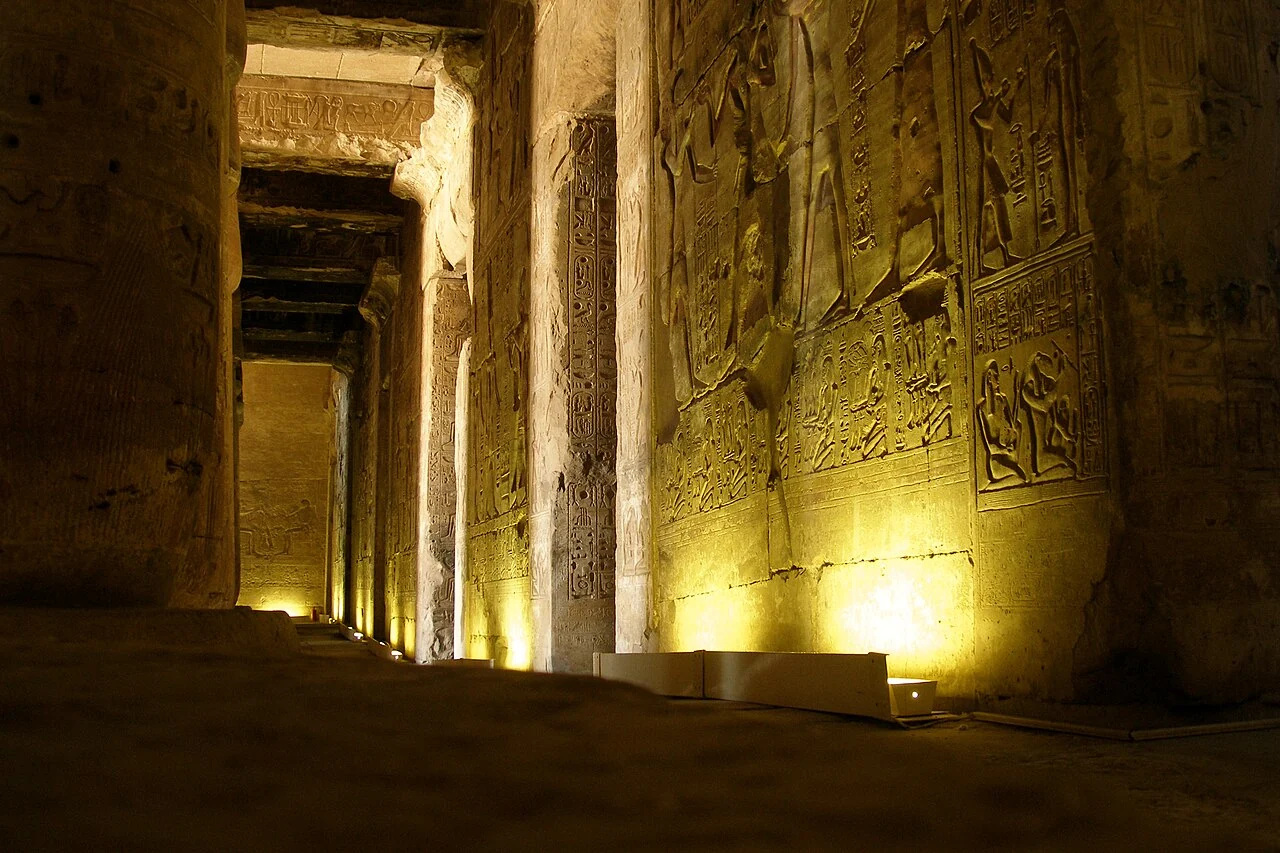
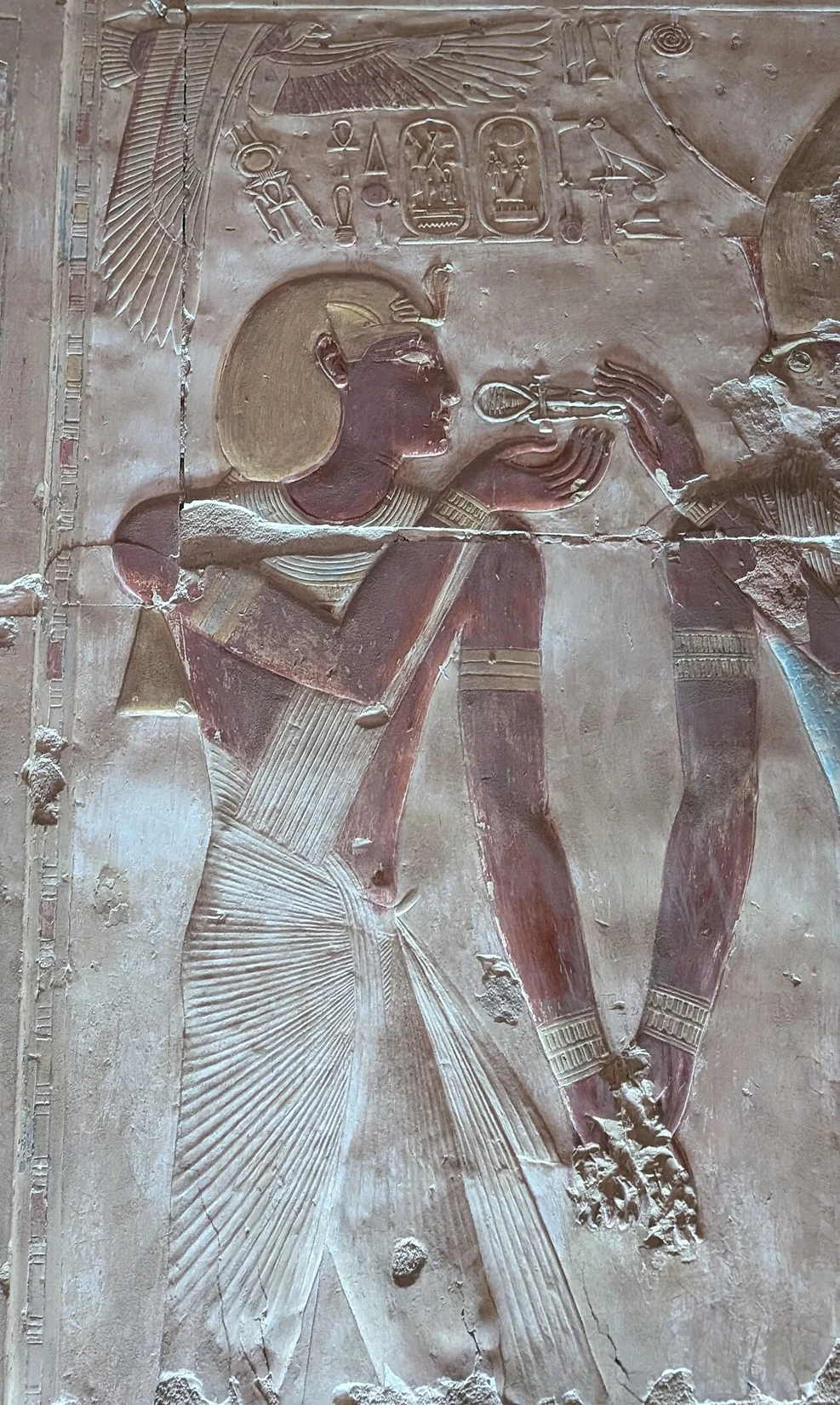
The Temple of Seti I is admired for its delicately carved and often beautifully preserved ritual scenes. Many show the king presenting offerings, purifying divine images or appearing before gods. Relief colors help communicate details of costume, crowns and ritual objects, but photographs can exaggerate saturation or omit the physical scale. Artistic perfection should not be confused with literal records of one dated ceremony. Egyptian temple scenes are highly structured religious images, produced by skilled workshops according to conventions and the patron’s program. Their historical value includes the vocabulary of ritual, divine identities and artistic technique. The first documentary photograph in this article shows the real interior of the temple, not a digitally created ancient rite. It is possible to appreciate the visual beauty without inventing a precise scene or claiming that all visible pigment remains completely untouched since Seti I. Conservation, weathering and changes to the temple environment affect what is visible today.
The Abydos King List and what it was designed to do
One of the temple’s most researched inscriptions is the Abydos King List. The American Research Center in Egypt explains that it was carved on a wall of the passage leading from the second hypostyle hall to the so-called Butcher’s Hall. The scene includes Seti I and his son, the future Ramesses II, performing rites before selected names of royal predecessors. The king list is therefore part of a religious act of commemoration, not simply an objective state spreadsheet. It establishes a line of approved rulers whose memory was considered appropriate for worship and dynastic legitimacy. The number of names and their exact sequence can be checked from the surviving cartouches and scholarly transcriptions. Yet the list was not intended to be complete. A useful historical account explains both the evidence it preserves and the political and ritual choices behind its omissions. Reading the cartouches in context is far more valuable than treating them as proof that every omitted ruler never existed.
Why Hatshepsut and the Amarna kings are absent
The Abydos list is selective. The American Research Center in Egypt explicitly identifies the absence of rulers including Hatshepsut and the Amarna kings, along with groups of rulers from periods not incorporated into the temple’s approved historical sequence. Such omissions can reflect later political or religious judgments, not gaps in the entire Egyptian historical record. Archaeological monuments and written sources elsewhere independently document many of these rulers. The omission does not establish that they were imaginary or that the temple secretly hid a universal chronological key. It shows how Seti’s regime wished to invoke kingship through an approved ancestral chain. Our Hatshepsut historical dossier and Amarna correspondence study supply evidence from other sources. Combining them with the king list illustrates why multiple archaeological records are necessary. A single monumental list should never be allowed to erase the broader documentary history of Egypt.
Seti I, Ramesses II and royal succession on the temple walls
The image of Seti I with his son Ramesses is a particularly revealing part of the royal list’s setting. According to the American Research Center’s interpretive description, Ramesses appears as prince and participates in the offering scene. This is evidence for how dynastic continuity was publicly staged in sacred architecture. It is not proof that the father and son personally stood before the finished wall for every ritual represented. Temple artists created ideal images with a timeless ceremonial purpose. Ramesses II later became one of Egypt’s most famous rulers and continued elements of his father’s projects. The link between their reigns is important at Abydos, but some decorations belong to different phases. A careful study asks which features were completed under Seti and which were finished or altered afterward. An inscription containing a later royal name can be useful for identifying a phase, while still requiring consideration of subsequent restorations and reuse.
Osiris and the mythology represented in the monument
Abydos was closely associated with Osiris, the deity linked to death, renewal and legitimate succession. The temple’s reliefs engage that religious world through images of divine figures, offerings and episodes associated with the Osiris story. The Egyptian Ministry notes particularly notable scenes connected to the death and revival of Osiris. These should be treated as representations of ancient belief, not evidence that a mythical event can be assigned a verifiable historical date. The presence of Isis and Horus in the chapels places the temple within a network of related deities and narratives. For readers wishing to explore beliefs in their own terms, our Isis and Osiris myth study describes the textual traditions. The archaeological monument and the mythology dossier answer different questions: one concerns real walls, images and construction; the other concerns ancient religious stories known through texts and visual programs.
An Osirian complex adjacent to the main temple
Visitors and scholars sometimes discuss the so-called Osireion in connection with Seti I’s temple. This subterranean stone structure forms part of the broader sacred area but should not be casually described as the king’s royal tomb in the Valley of the Kings. Its functions, development and relationship to Osiris worship have been subjects of investigation. The monument’s massive masonry and distinctive water-related appearance have encouraged popular speculation about an impossibly ancient lost technology. Architectural differences do not constitute evidence of extraterrestrial builders or an unverified civilization. The correct method is to compare building materials, inscriptions, excavation records and scholarly interpretations. A guide should also clarify whether public access is currently allowed before promising a visit. The existence of a visually striking neighbouring structure is not proof that every dramatic theory about it is correct. The broader Abydos landscape supports serious questions about religious architecture without requiring sensational claims.
The temple and Seti I’s actual tomb KV17
Seti I’s tomb in the Valley of the Kings is catalogued KV17, well away from Abydos near Luxor. The Ministry of Tourism and Antiquities describes its extensive painted burial chambers and the funerary compositions that decorate it. It is a different archaeological place from the memorial temple built at Abydos. Confusion occurs because both monuments are associated with the same king and contain outstanding religious art. The temple at Abydos emphasizes divine service and royal commemoration in a major sacred city; the royal tomb involves the king’s burial and his intended passage through the afterlife. Comparing them clarifies why Egyptian rulers commissioned structures with distinct functions in different locations. The ancient funerary books overview provides context for texts such as the Amduat and Book of Gates, which feature prominently in tomb decoration. Neither monument should be used as an all-purpose illustration of the other.
Evidence from surviving material outside Egypt
The Metropolitan Museum of Art holds a granodiorite statue of Seti I identified with Abydos, as well as reliefs from a chapel of Ramesses I that Seti helped complete. These objects show that a temple’s archaeology cannot be studied solely through what remains on its present walls. Pieces were transported, collected and recontextualized in other institutions, where their inventory numbers and provenances require close examination. A museum label describing the statue’s connection to Abydos is not the same thing as a photograph proving its original exact placement within the building. Material analysis, excavation history and the form of the object all play a role. The second documentary image selected for this article is a real temple relief photographed at the site, with its own attribution record. The images complement the Met’s catalogue evidence but should not be substituted for it. Studying objects at several institutions is valuable when the question is historically focused and provenance-aware.
A visitor-first approach without invented prices
The Ministry’s published temple information places the monument in the Abydos area of Sohag Governorate, near al-Balyana, and supplies official visitor details. Tickets, admission times, photography policies and access to individual rooms can change, especially during conservation work or holidays. Check official Egyptian monument channels before travelling rather than using an undated travel blog’s prices. Visitors interested in reliefs should allow time to see more than one chapel and to understand the layout of the halls, while respecting closed areas and staff guidance. It is possible to study an ancient temple without inventing a fixed total walking duration or promising perfect lighting in every chamber. This article is principally a historical and archaeological dossier; practical logistics are limited to what can be verified. The distinct focus also prevents it from competing unnecessarily with general temple visitor guides whose purpose is broader trip planning.
What the independent sources establish
The Egyptian Ministry’s official Seti I temple record documents the royal patronage, chapels, colors, Osiris program and king list. The American Research Center in Egypt’s specialized list study explains the list’s ritual use, location and omissions. The Met’s statue of Seti I and chapel reliefs of Ramesses I supply museum-object evidence for the king’s wider building program. The separate official KV17 tomb page protects the distinction between a memorial temple and a royal burial. Two authentic Commons photographs are individually attributed to their photographers with reusable licences. This article avoids conjectural restoration claims and keeps the king list’s religious selectivity separate from modern chronological reconstruction.