The National Museum of Egyptian Civilization (NMEC) in Cairo brings together royal mummies, archaeology, textiles and objects spanning Egypt’s prehistoric past to its modern cultural life. Located in Fustat at Ain el-Sira, the museum is best understood as a journey through the people and practices of Egyptian civilization, not another version of the Grand Egyptian Museum. This visitor and collection guide explains what to see in the Main Gallery, Textile Gallery and Royal Mummies Gallery, how the 2021 transfer changed the museum landscape, and what the surviving objects actually tell us.
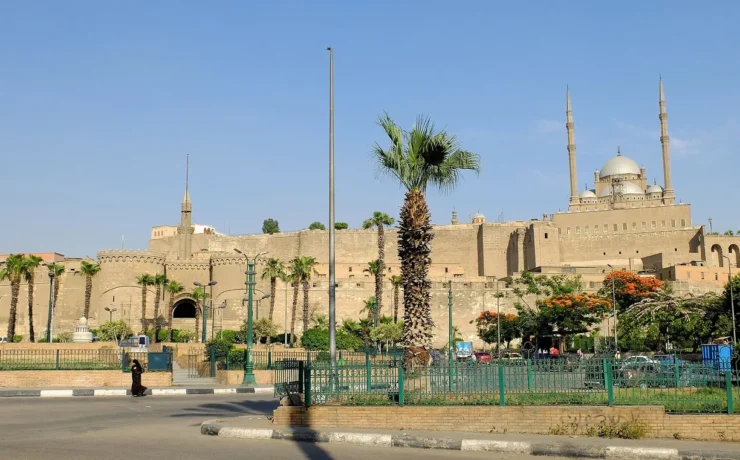
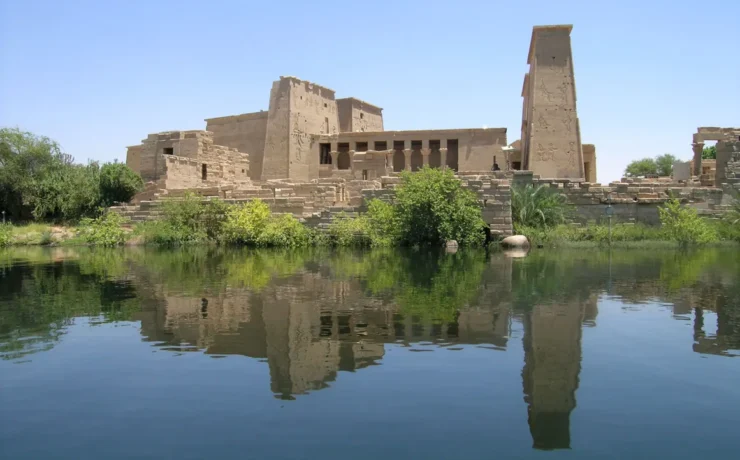
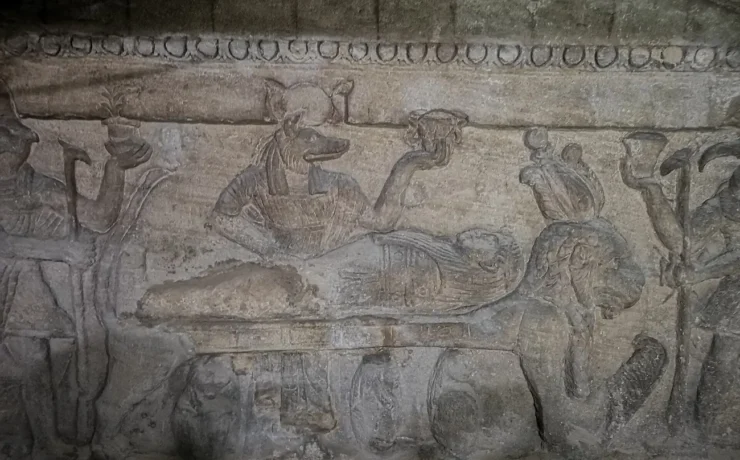
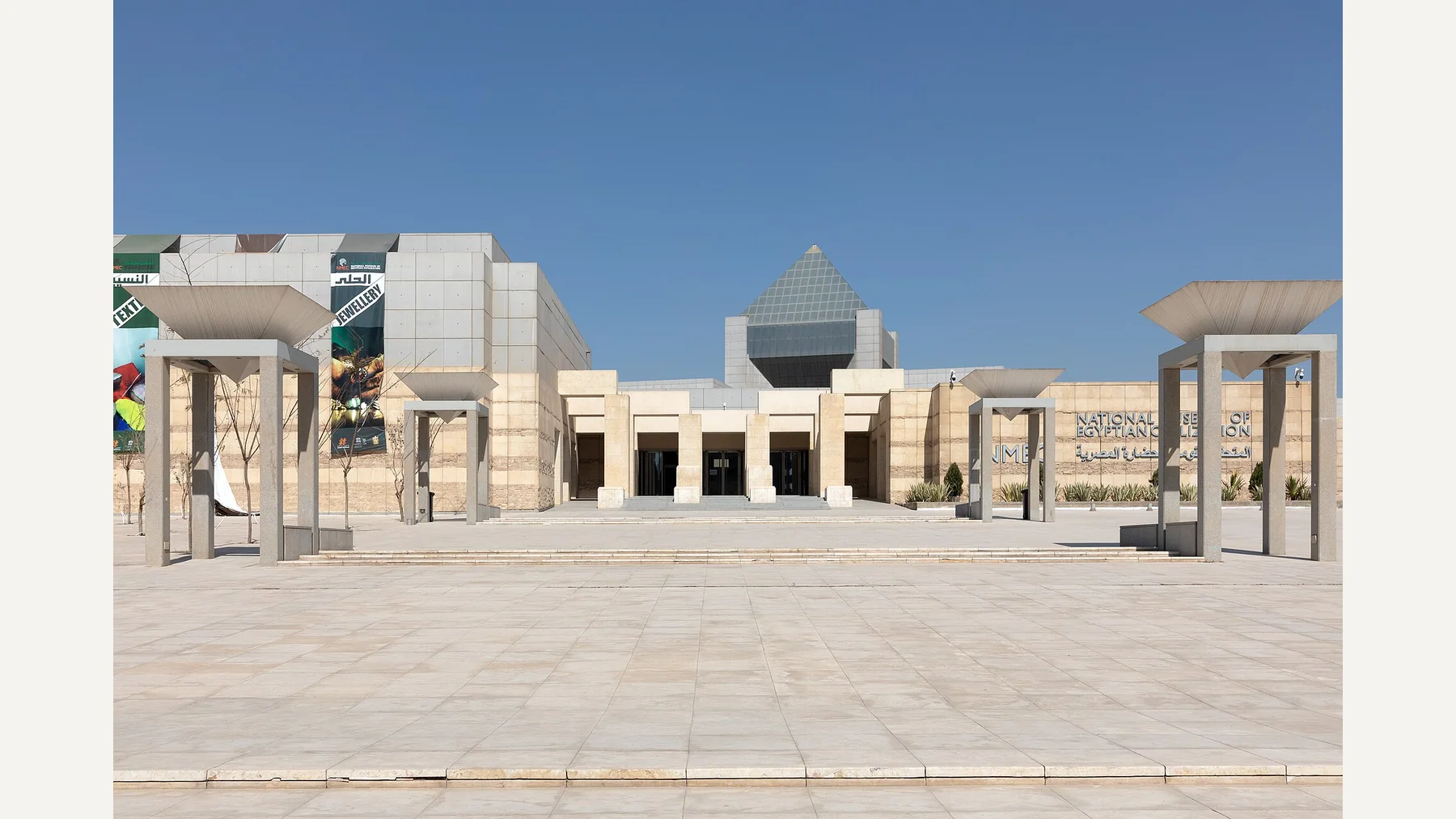
Information about opening hours, tickets and gallery access has been checked against official sources on 26 October 2026. Four credited Wikimedia photographs document the real entrance, the earlier main hall and original museum displays; none is an AI-generated mummy, invented temple interior or unverified ‘treasure’. The guide distinguishes the 22 mummies transported in 2021 from conflicting official descriptions of how many are currently displayed.
Why visit the National Museum of Egyptian Civilization?
The National Museum of Egyptian Civilization, usually shortened to NMEC, gives visitors something different from a sequence of pharaohs and pyramids. Its central idea is continuity: how communities living in the Nile Valley and Delta made, used, protected and reinterpreted objects over many millennia. Its permanent galleries reach from prehistoric evidence through ancient Egyptian, Greek and Roman, Coptic, Islamic and modern Egypt. Royal mummies are a major reason people travel to Fustat, but the museum is not merely a room of mummies. Ceramics, textiles, funerary objects, tools, public art and craft traditions offer alternative ways of understanding what civilization meant in practice. A visitor might come for Ramesses II and leave remembering a prosthetic toe, a wooden coffin or a historic textile. This guide combines the museum’s official collection descriptions with practical ticket information as checked on 26 October 2026. Some displays and regulations can change, so exact arrangements should always be reconfirmed through the institution rather than treated as permanent facts. The larger lesson is to read a museum as an interpretation supported by objects, not simply a showcase of beautiful things.
Where is NMEC? Fustat, Ain el-Sira and the meaning of the location
NMEC is in the Fustat and Ain el-Sira area of Cairo, south of the modern city centre. Its location is significant because Fustat occupies a foundational position in the urban history of Islamic Egypt. A visitor is therefore seeing an institution devoted to the long span of Egyptian civilization situated near a landscape with its own important layers of archaeological and urban memory. Yet the museum building is modern; it should not be described as an ancient monument. Equally, the broader Fustat area is not just one excavation site or a single historical century. Egypt’s capital and city districts expanded, moved, contracted and were rebuilt in different periods. The official address is El-Fustat Road, Ain el-Sira, Cairo, and the institution itself identifies Mar Girgis as a nearby metro station. A short taxi or other locally suitable transfer may still be necessary, especially for families or visitors with mobility needs. Verify any navigation route against current traffic and accessibility conditions. The museum’s setting also creates opportunities to explore Cairo’s cultural geography without pretending every nearby monument belongs to the same period as the artifacts inside.
How the museum developed: before 2017, 2021 and 2022
The museum’s development was staged rather than a single overnight opening. Egypt’s Ministry of Tourism and Antiquities describes an early public milestone in 2017, when a temporary exhibition on crafts presented pottery, woodwork, textiles and jewelry from different periods. The central exhibition hall was opened in 2021, when the institution also received the royal mummies brought from the Egyptian Museum in Tahrir. A dedicated textile exhibition followed in 2022. Those dates matter because online descriptions sometimes treat every gallery as if it opened at once. They also explain why historical photographs of the building taken before the major openings may differ from what a visitor encounters now. The museum’s stated ambition extends to conservation, research and public education, not only ticketed sightseeing. Public displays are supported by the less visible work of curators, conservators and collections specialists. When an object is moved from a former museum or storage facility into a new narrative, its identity and archaeological provenance remain important. The new building does not rewrite where that object was excavated, nor does a modern display automatically fill every gap in its history.
Understanding the museum’s three main experiences
Planning is easier when NMEC is understood as a group of complementary experiences. The main gallery moves through Egyptian civilization across periods and cultural practices. The textile gallery focuses on garments, woven materials, production and later historical dress, and the Royal Mummies Gallery gives a quieter setting for preserved kings and queens and their funerary context. This arrangement is not a set of three interchangeable rooms. The main gallery rewards a broad historical approach, the textile material allows attention to technology and daily use, and the mummies gallery asks visitors to consider mortality, conservation and the ethics of showing human remains. The museum’s website also introduces a historic dye house, conservation laboratories, scientific work and other cultural facilities. Not every named facility is necessarily freely accessible as part of an ordinary admission ticket, and research spaces are not automatic visitor galleries. Begin by examining the current visitor route and temporarily closed areas on arrival. For a first visit, choose three or four questions that matter, rather than trying to memorize every label. This produces a more memorable encounter than a hurried attempt to photograph every object.
Main Gallery: 35,000 years and more than one civilization
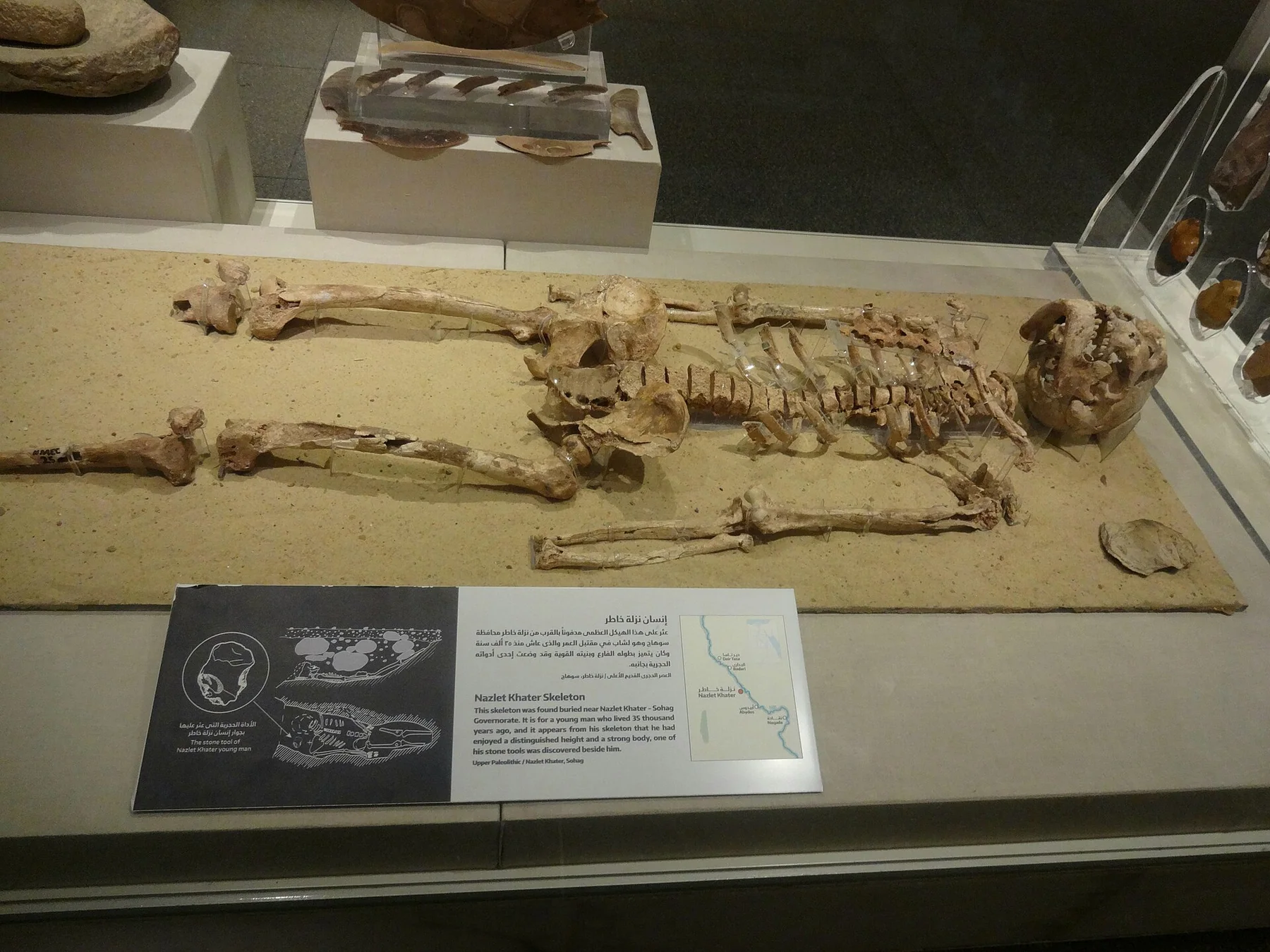
The Main Gallery is designed to carry visitors across a long chronological panorama. Its official highlights include the Nazlet Khater human remains, royal sculpture, New Kingdom funerary art, Graeco-Roman representations, objects from Coptic contexts, Islamic furnishings and Egyptian modern sculpture. These objects should not be read as stages in which each community simply replaced the one before it. Cultural change often involved overlapping practices, local continuities and adaptations to new political and religious worlds. The museum identifies the Nazlet Khater skeleton as approximately 35,000 years old, an extraordinary date that belongs to prehistoric scientific study rather than dynastic chronology. It is better to describe this as the museum’s presentation of a particular human find than to invent a precise biography for the individual. Likewise, a stone statue and a finely worked textile can represent very different systems of labor and belief while occupying the same national story. This is an excellent gallery for asking how historians know what they claim: what was excavated, what material survives, what date is assigned, and which interpretations depend on inscriptions rather than appearance alone.

A real early human witness: the Nazlet Khater skeleton
One of the most striking features in the museum’s public Main Gallery list is the Nazlet Khater skeleton. The official collection description gives an age of roughly 35,000 years. That claim belongs to a scientific context, not to the history of later Egyptian kings: prehistoric human remains must be evaluated through excavation context, physical anthropology and dating studies. The visitor should resist the familiar temptation to call such a person a ‘pharaoh before the pharaohs.’ Dynastic kingship and its iconography arose tens of thousands of years later. Museum interpretation also has ethical responsibilities when displaying human remains. Respectful presentation requires acknowledging that an ancient body was once a person, not simply a visual attraction. Looking closely at the label, burial circumstances and the explanation of how the age was determined is more informative than photographing the bones without context. Prehistoric objects are particularly valuable for a national museum because they begin the narrative long before recognizable hieroglyphs or pyramids. The presence of such an exhibit illustrates why a civilization museum differs from a collection devoted mainly to a royal dynasty or a single archaeological location.
The Akhenaten statue and what royal sculpture can say
NMEC’s Main Gallery highlights a monumental statue of Akhenaten associated with his temple at Karnak. The object belongs to the intense artistic and religious experimentation of the Eighteenth Dynasty, when the king promoted the Aten in an unprecedented way. Royal sculpture does not simply give us a photograph-like record of its subject’s face. Its proportions, pose and inscriptions may express deliberate theological and political choices. Visitors should therefore be cautious when treating unusual features of Amarna-period royal art as straightforward diagnoses of illness. The location of the object’s original setting matters as much as its present museum address: a work from Karnak participated in a temple environment, then underwent a very different history before entering modern collections. The museum’s selection makes it possible to connect artistic form with changes in kingship and ritual practice. Readers who want a wider account of Egyptian divine imagery can continue to our study of the Egyptian solar tradition, without conflating the god Re in older traditions with the particular royal theological project of Akhenaten.
Sennedjem’s coffin and the lives behind royal tombs
The museum identifies an inner coffin of Sennedjem among its significant New Kingdom objects. Sennedjem came from the skilled community at Deir el-Medina, whose workmen and their households were involved in building and decorating royal tombs in the Theban necropolis. A decorated coffin has more than one story. Its images and writing served religious and commemorative purposes; the wood and pigments also record labor, technology and access to materials. An artisan’s tomb could be ambitious and beautiful even when its owner was not a ruler. This makes Sennedjem an especially useful counterpart to the royal mummies. The burial apparatus evokes protections associated with goddesses and a desired life after death, but the iconography is evidence of belief, not a literal photograph of an afterlife landscape. The museum’s description of the coffin invites visitors to think about the hands that fashioned royal monuments while also preparing their own families’ funerary equipment. For more on linen, natron and the difference between religious and physical preservation, see the archaeology of Egyptian mummification.
The prosthetic toe and the history of ordinary bodies
The Main Gallery also lists a prosthetic toe linked with Tabaket en Mut and ancient Thebes. This small, functional object can be more revealing than a colossal stone statue. It suggests that ancient Egyptian craft specialists sometimes responded to practical bodily needs with carefully shaped materials. Yet a preserved prosthesis should not be used to claim that everyone in ancient Egypt received comparable medical care. Access, manufacture, individual circumstances and whether an object was used during life all require scientific and archaeological interpretation. Modern researchers have studied the performance of ancient Egyptian artificial toes, but a museum visitor should distinguish what an individual artifact demonstrates from general statements about medical systems. The toe gives visitors a direct question to consider: what can wear, attachment methods, or bodily fit reveal that an inscription might not? This is one of the strengths of NMEC’s cross-period storytelling. Objects associated with daily comfort, crafts and bodily practice receive attention alongside royal objects. Such juxtapositions are intellectually useful, provided the viewer does not force all periods into one unchanging account of ‘the ancient Egyptian way of life.’
Roman, Coptic and Islamic Egypt in the same story
An expansive national gallery can make visible periods that ancient-Egypt-focused tours often neglect. NMEC’s published highlights include a Roman representation of the Nile, a late Roman treasure associated with Dush in Kharga Oasis, architectural material from Coptic Egypt and Islamic furnishings such as a minbar from a Cairo mosque. Each of these items has an independent historical setting. A Roman personification of the river does not mean that Egyptian communities abandoned older river beliefs overnight. A church architectural fragment is not simply a decorative afterthought to pharaonic art. A mosque pulpit belongs to a building, community and history of religious practice that differs from a tomb object’s context. The museum’s advantage is to place these periods in conversation while still recognizing their differences. Visitors should spend time with labels that explain original place, material, patronage and approximate date. Without those details, objects become a row of attractive souvenirs rather than witnesses to changing Egyptian societies. The approach also helps correct the misconception that Egypt’s cultural history stopped at the end of pharaonic kingship.
Modern Egyptian art and the idea of living heritage
The museum’s published Main Gallery highlights reach as far as the twentieth century with works such as Mahmoud Mokhtar’s Al-Fallaha, a modern image of an Egyptian rural woman. This extends the story beyond the familiar end dates of ancient-history textbooks. National history is not simply a museum chronology in which the country becomes silent for centuries after its classical monuments. Modern sculpture represents choices about identity, labor, gender, rural life and artistic expression within a new political and cultural environment. A work made in recent centuries has its own artist, materials and historical pressures; it must not be treated merely as a decorative echo of ancient statuary. This is also where the idea of intangible heritage becomes useful. Songs, craft knowledge, celebrations, social practices and ways of making things can be significant even when museums cannot collect them as neatly as a stone figurine. Exhibitions can connect surviving objects with such practices, but labels should specify what is documented and what is reconstructed. A visitor who moves between prehistoric evidence and modern sculpture is seeing a curated argument about continuity and change, not an uninterrupted style that remained identical for 35,000 years.
The Textile Gallery: fabrics as historical documents
Textiles are unusually powerful evidence because they bring us close to the ordinary materials that people touched, wore and repaired. NMEC’s official Textile Gallery describes a collection of about 600 artifacts covering techniques and periods, including historical dress and royal-era clothing. Such a collection should be approached through weave, fiber, dye, embroidery, labor and the social purpose of a garment, not only whether a fabric appears luxurious. Linen has deep roots in Egyptian life, but historical Egyptian textile traditions also include wool, silk, cotton and mixed practices in different places and eras. Objects may survive because they were preserved in tombs, stored by institutions or kept as heirlooms, which biases the record toward some groups and uses over others. A costume with elaborate metallic thread raises different questions from a fragment of everyday cloth. A visitor might ask who spun the fibers, who paid for the material, whether the wearer could move comfortably, and why the piece was preserved. The Textile Gallery makes economic and social history visible in a way that monumental architecture often cannot.
From court uniforms to a silk prayer rug
The Textile Gallery’s own descriptions offer examples extending into the Muhammad Ali dynasty. One prayer rug, described as a wedding gift from Muhammad Ali to his daughter Zeinab, is associated with rich red silk and metal-thread embroidery. Other displays include service uniforms belonging to specialized roles in royal processions and household organization. The value of these objects is not only the expense of the materials. Uniforms communicated ranks and tasks; ceremonial gifts spoke to dynastic family relationships and patronage. If visitors look only for pharaonic objects, they miss the museum’s unusual opportunity to connect clothing with the workings of more recent Egyptian institutions. The institution also identifies a historical textile linked with the Kaaba covering, which should be described according to the label and its specific documented origin, rather than generalized as an entire original covering from an unspecified century. As with any historic fabric, lighting and visitor handling are conservation issues, and no museum should be expected to make its most fragile textiles available for touching. Photographs can record appearance; curatorial documentation is needed to explain provenance and function.
The Royal Mummies Gallery and respect for the dead
The Royal Mummies Gallery is among NMEC’s most discussed spaces. The museum’s design is inspired by the atmosphere of the Valley of the Kings and aims to encourage a more reflective encounter with preserved rulers and their funerary objects. This is a display of actual ancient human remains, not a theme-park simulation. For ethical and conservation reasons, visitors should follow every onsite direction about photography, silence and distance from the cases. The importance of the hall goes beyond a celebrity list of kings. Some royal bodies were discovered in caches where they had been moved and reburied in antiquity, often in response to threats to tomb security. Their modern discovery, study and transfer form another layer of history. The display can introduce the viewer to changes in embalming, identification and conservation, but it cannot answer every biological or historical question simply by exposing the body. The most responsible approach is to study what researchers have actually documented, recognize the limits of individual identifications and preserve a sense of dignity around the deceased. Because visitor rules may be stricter here, plan to absorb the interpretation rather than rely on smartphone photography.
Twenty-two transferred, but how many mummies are on display?
On 3 April 2021, the Pharaohs’ Golden Parade transferred 22 royal mummies from the Egyptian Museum in Tahrir to the National Museum of Egyptian Civilization. The event’s official accounts identify 18 kings and four queens in that transfer. This is a statement about the procession, not a guarantee that all 22 bodies must always be presented in one visitor gallery. Current NMEC web pages are not fully consistent: its Mummies Hall page describes 20 displayed remains with an 18-king and two-queen breakdown, while its Royal Mummies Gallery page describes 20 with a 17-king and three-queen breakdown. We therefore distinguish the firmly documented total transferred from the number the institution currently describes for its display. Conservation procedures, reinstallation or website updates may affect what visitors actually see on a given day. The museum’s official list includes figures such as Seqenenre Taa II, Hatshepsut, Thutmose III, Seti I and Ramesses II. Visitors should use the current hall labels to establish which individual bodies are being exhibited, rather than treating a parade photograph as a live case inventory.
Ramesses II, Hatshepsut and individuals behind famous names
Royal mummies are often advertised with the names of Ramesses II, Hatshepsut and Thutmose III. Each figure is historically important for different reasons. Ramesses II is associated with an extensive royal building program and a reign central to New Kingdom Egyptian political history. Hatshepsut is notable for adopting full royal titles and images as a woman ruler within the Eighteenth Dynasty, and for major architectural patronage. Thutmose III played a leading role in campaigns and the expansion of Egyptian influence in western Asia. A mummy is not, however, a complete biography. Identifications draw on combinations of coffin inscriptions, cache records, ancient labels, anatomical observations and later scientific work. The modern history of transporting and displaying the body is also distinct from the king’s life. Students should not conclude that seeing a body proves a popular anecdote about its owner’s personality or final thoughts. Respectful interpretation connects each named individual to dated inscriptions, monuments and archaeological context. The hall can be a starting point for that research, but the museum label and carefully sourced historical scholarship are better guides than dramatic internet reconstructions.
From hidden caches to modern conservation
Many famous royal mummies reached modern museums through the rediscovery of caches rather than from untouched royal tombs. The Deir el-Bahari cache and the tomb of Amenhotep II, KV35, are crucial to this history. In 1898, Victor Loret examined the latter tomb, where multiple royal bodies had been protected in secondary arrangements. Movement in antiquity complicates the story: an individual’s original burial, later reburial, archaeological discovery and final museum presentation are separate events. A body can survive in a cache without the associated tomb chamber being intact. Today, conservation work must balance the research value of preserved human remains with their physical stability and cultural sensitivity. Imaging technologies can sometimes examine internal conditions without destructive intervention, but scanning produces interpretations that require specialist expertise. It does not magically transform a mummy into a speaking historical witness. When NMEC introduces technology in the Royal Mummies Gallery, viewers should understand it as a way of exploring documented material, rather than a promise that every question about ancient embalming has been solved.
The 2021 Pharaohs’ Golden Parade in historical context
The Golden Parade was both a modern cultural event and a major museum transfer. The procession on 3 April 2021 carried the royal mummies through Cairo from the older Egyptian Museum in Tahrir to NMEC at Fustat. The transfer drew public attention to collections management, conservation, and the different purposes of Egypt’s museum institutions. However spectacular the event appeared on television, the mummy caches and dynastic relationships predated the parade by millennia. The procession should not be confused with an ancient royal funeral, nor should television imagery be used as proof of where an individual was originally buried. The museum later commemorated the event with objects associated with its performances and presentation, according to its own announcements. These are artifacts of twenty-first-century cultural history, not ancient Egyptian objects. Their presence raises worthwhile questions about how societies remember and reinterpret archaeological heritage. For visitors, the 2021 date is also a practical clue when comparing old travel articles: recommendations published before that transfer may send readers to the wrong museum to see royal mummies.
NMEC, the Grand Egyptian Museum and the Egyptian Museum in Tahrir
Three institutions are easily confused but should not be described as one interchangeable attraction. NMEC in Fustat uses civilization across long time periods as its unifying theme and is the home of the transferred royal mummies. The Grand Egyptian Museum at Giza presents extensive ancient Egyptian collections, including Tutankhamun material, in the context of the pyramid landscape. The Egyptian Museum in Tahrir, a landmark that opened in 1902, retains a major collection with its own historical galleries and museum history. No visitor should be told that all objects from Tahrir have moved, or that the royal mummies went to the Grand Egyptian Museum. For planning the Giza institution, use our verified Grand Egyptian Museum visitor guide. Visitors seeking a smaller coastal collection may instead read the separate Hurghada Museum guide. These links are intended to help a reader choose the institution that matches a specific interest, not to create multiple articles competing for the same generic phrase ‘Egypt museum’.
| Ticket category | General admission (EGP) | Official note |
|---|---|---|
| Egyptian adult | 90 | Bring a valid identity document where requested |
| Egyptian student | 45 | Valid student proof may be required |
| Foreign adult | 550 | Base admission, not an optional guided-tour package |
| Foreign student | 300 | Student status must meet eligibility requirements |
| Child under six | Free under stated rules | Verify latest museum concession conditions |
General admission checked 26 October 2026 against Egypt’s official monuments ticket portal. Prices can change.
Tickets and entry prices checked in October 2026
The Ministry of Tourism and Antiquities’ visitor listing and the official e-ticket portal currently show adult admission at EGP 90 for Egyptians and EGP 550 for non-Egyptians. The associated student prices are EGP 45 and EGP 300 respectively. These figures were reviewed on 26 October 2026; museums can revise their rates, concession requirements or booking rules later. The online portal also lists special services that should not be mistaken for the base museum ticket, including packages with a guide. Children under six may qualify for free admission. Additional eligibility categories, including some senior visitors and students, are governed by detailed institutional conditions and may be restricted on Fridays, Saturdays or official holidays. Bring relevant documents where a concession is requested. A guide to prices is most useful when it differentiates residency and eligibility rules instead of promising a universal discount. Visitors are best served by confirming the basket total in the actual booking portal before payment, especially for combined services or groups. The table below gives the general admission figures rather than any temporary promotional package.
| Day or session | Published opening | Last ticket |
|---|---|---|
| Saturday–Thursday | 09:00–17:00 | 16:00 |
| Friday day | 09:00–17:00 | 16:00 |
| Friday evening | 18:00–21:00 | 20:00 |
Opening hours, Friday evening and the final admission cutoff
The museum’s published standard schedule is 9:00 am to 5:00 pm daily, with the daytime ticket window normally closing at 4:00 pm. The official visitor information also lists a separate Friday evening session, from 6:00 pm to 9:00 pm, with a final ticket purchase around 8:00 pm. This second session is useful for a visitor who wants to avoid using an entire sightseeing day, but its availability should be rechecked for holidays, Ramadan and special events. The word ‘closes at five’ does not mean that arriving at 4:45 pm will permit a new visit. Aim to allow enough time for the main collection and the more contemplative Royal Mummies Gallery. Two to three hours is a reasonable planning allowance for many first-time visitors, although individual interests and pace will change the experience. A family with children might prioritize fewer galleries, while a student researching textiles may spend the entire visit in one area. If time is limited, concentrate on the main gallery, one or two objects that merit close study, and the royal collection.
Photography, accessibility and the right way to behave inside
NMEC publishes policies covering photography and behavior. Visitors should not use flash, obstruct cases or photograph people without consent. The museum distinguishes personal photography from commercial filming and professional projects requiring separate advance authorization and payment. Its visitor-policy page also refers to photography tickets, while the Ministry’s ticket information states that mobile-phone photography can be free. Because these descriptions differ in specificity and rules can vary by gallery, visitors should follow the most current instructions at the entrance and inside restricted areas rather than assume a site-wide right to photograph every object. In particular, human remains deserve a more restrained approach. Accessibility needs should be considered before arrival: confirm accessible entrances, lifts, seating and any available assistance with the museum directly if those details are essential to the trip. A museum visit need not be a race through narrow corridors. Quiet observation, readable labels and breaks can make the history more accessible for children and adults alike. The museum’s own policies ask parents and carers to supervise children so exhibits and visitors remain safe.
Planning a visit around genuine questions, not a checklist
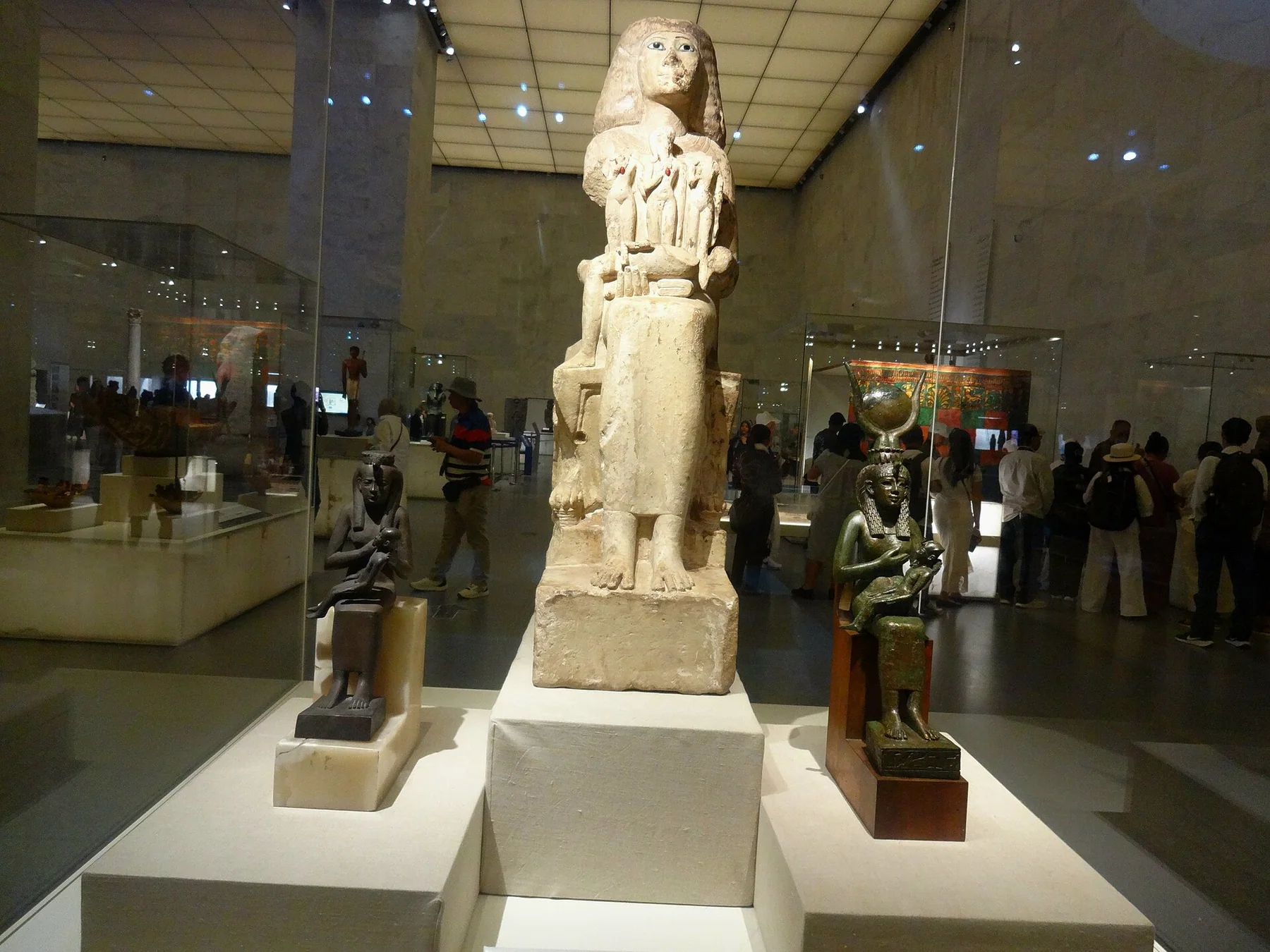
A strong museum itinerary starts with a theme. Someone interested in bodily practices might examine the prosthetic toe, a decorated coffin, textile production and the history of mummification. A visitor focused on political culture might compare Akhenaten’s sculpture, royal mummies and later objects that express rulers’ power. Those studying cultural change could move from a Roman Nile image to Coptic material, an Islamic minbar and modern sculpture. This approach draws evidence from several rooms without forcing a complete survey of every artifact. Take notes of the exact object label and whether it contains an accession number; do not invent provenance where the museum identifies only a general category. Consider how materials carry information about technique and access to resources. Photography can be helpful, but reading a catalogue and recording a question are often more valuable. Visitors interested in the funerary collections can read the site’s Book of the Dead research guide after the visit, taking care not to confuse religious texts with the biological preservation of actual bodies.
Museum photographs, object descriptions and provenance
Illustrations in a heritage guide must be labelled with the same discipline as the objects being discussed. A photograph of NMEC’s entrance establishes what the photographed building looked like at the time the image was made; it does not prove that every exhibition shown in a modern guide existed when the shutter was released. An interior photograph from 2017 is therefore labelled as an architectural record, not as proof of today’s display. More recent images of collection cases show genuine objects in the museum, but the photographs’ broad Wikimedia captions do not identify every artifact or its accession number. Assigning a royal identity to an unnamed figure merely because it is inside an Egyptian museum would be irresponsible. This guide uses photographs with credited authors, source-page links and reuse licenses, and preserves that distinction. Its historical object descriptions, by contrast, derive from NMEC’s named exhibit records and not from speculative image recognition. These are complementary kinds of evidence. The source records are supplied below so readers can follow museum interpretations, examine photographs’ dates and check whether newer research changes a claim.
Primary sources, official booking and editorial review
The National Museum of Egyptian Civilization’s Main Gallery, Textile Gallery, Royal Mummies Gallery and Mummies Hall pages provide the named exhibits and institutional interpretation used here. The Ministry of Tourism and Antiquities’ NMEC visitor listing and the official e-ticket portal are the reference points for general pricing and hours as of 26 October 2026. Official descriptions of the 2021 royal transfer provide the parade count. The Cairo Governorate cultural guide confirms the institution’s location and cross-period purpose. These sources do not all describe the current number of displayed royal bodies in the same way; that discrepancy is openly acknowledged above rather than silently resolved by guesswork. Prices and access rules remain time-sensitive details, not permanent archaeological facts.
Frequently asked questions about NMEC
Where is the National Museum of Egyptian Civilization? It is on El-Fustat Road in Ain el-Sira, Cairo, near historic Fustat. The museum identifies Mar Girgis metro station as a nearby public-transport reference.
Are the royal mummies at NMEC or at the Grand Egyptian Museum? The royal mummies transferred in the 2021 parade went to NMEC at Fustat, not the Grand Egyptian Museum in Giza.
How many mummies were moved in the parade? Twenty-two in April 2021. Current official museum pages describe a smaller number displayed and differ on the kings/queens breakdown.
Is the textile gallery only about pharaonic linen? No. It covers a wider history of fabrics, clothes and ceremonial objects, including modern-dynasty examples.
Can visitors take photographs? Rules differ by activity and gallery, and commercial work requires permission. Follow the museum’s onsite instructions.