There is a detail about Philae that changes the way you see it: the island on which the temples stand today is not the island where their builders placed them. The columns, carved walls and sanctuaries are ancient. Much of the landscape immediately around them is the result of a twentieth-century rescue operation.
That’s worth knowing before you board the boat from Aswan. Philae is both a sanctuary of Isis and a remarkable conservation project. The visit makes more sense when you follow those two stories together.
Start with the boat, and know what you’re paying for
The temples are on Agilkia Island south of Aswan. They are normally reached by a boat arranged at a mainland boarding point rather than by road. Egypt’s Ministry of Tourism and Antiquities describes the site as accessible by boat and publishes the official monument admission information. Boat transport can be a separate service from the entrance ticket, so ask whether your booking covers both journeys across the water and who is operating the boat.
Don’t assume an old blog’s quoted fare is still correct, or that every driver and boat operator has identical terms. If you’re travelling with a child, have difficulty with steps or need other accessibility arrangements, ask in advance about boarding and the movement between the quay and the temple paths.
The official Philae listing is the right starting point for the site’s current published opening hours and admission. Those details can change. It’s sensible to check them shortly before travelling rather than treat a price in a long-lived article as an unchanging fact.
Why the temples are on another island
For centuries the sanctuary stood on Philae, an island associated with Isis near the First Cataract. Changes to river control threatened the monuments, and the development of the Aswan High Dam made the need for a large rescue effort urgent. UNESCO’s international Nubian monuments campaign, launched in 1960, brought together archaeologists, engineers and conservators to save sites in the region.
Philae’s monuments were dismantled, carefully recorded, moved and reconstructed on higher Agilkia Island between 1972 and 1979. UNESCO’s history of the Nubian rescue places that operation alongside work at Abu Simbel and elsewhere along the Nile. This was not a relocation of an intact island. The buildings were taken apart and reassembled, with their setting adapted to the new site.
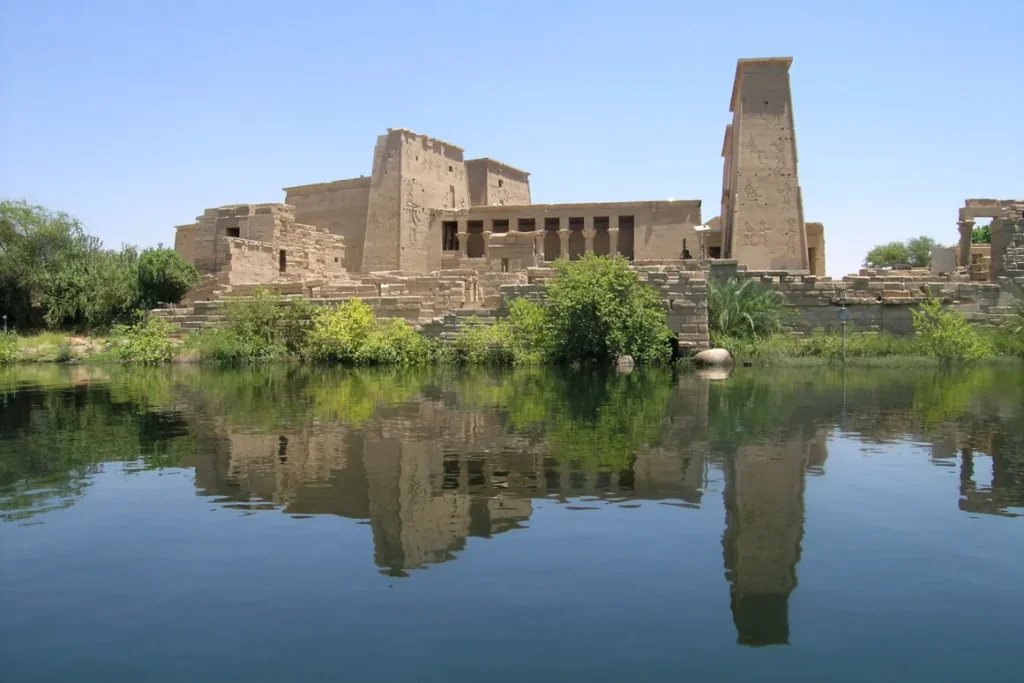
Seen from the boat, the temple complex looks naturally at home among the water and rocks. That effect required planning. Understanding the rescue makes the visit more impressive, not less authentic: you’re looking at original ancient architecture preserved through one of the great international conservation projects of the twentieth century.
A walk through the sanctuary of Isis
Philae includes monuments from several periods, though much of the main sanctuary dates to the Ptolemaic era. The Ministry identifies the principal Temple of Isis as begun under Ptolemy II Philadelphus in the third century BCE. The main processional spaces lead toward the temple’s inner rooms, while carved walls show rulers making offerings to deities.
Isis was the central figure of the cult. Her connection with Osiris and Horus appears throughout Egyptian religious tradition, and at Philae the sacred story takes architectural form. In the mammisi, a birth house attached to the temple complex, images celebrate the divine birth of Horus. One scene described by the Ministry shows Isis nursing the young god among marsh plants.
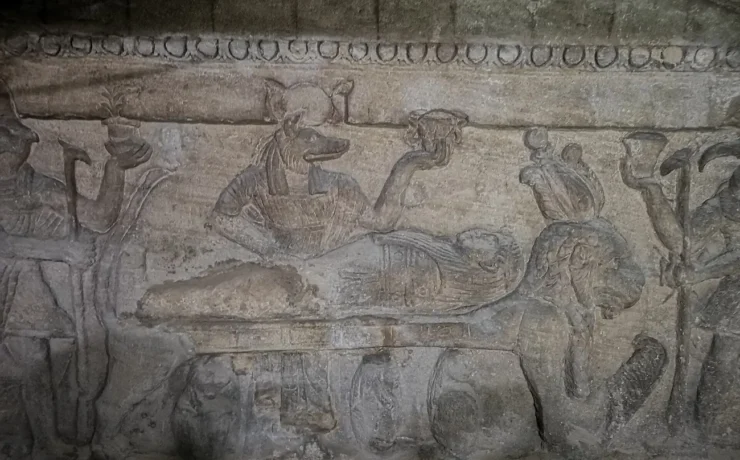
It’s easy to move quickly past the reliefs in search of the next impressive facade. Instead, look at the change in scale from open courtyards to more enclosed temple areas. Notice how the royal figures and gods repeat, not as illustrations of a single historical event but as a ritual program made for a living sanctuary.
Readers interested in the stories behind the images can compare this with our account of the Isis and Osiris tradition. Mythology explains the divine relationships; the surviving walls establish which versions and emphases the temple artists chose to represent.
The kiosk that appears in almost every Philae photograph
One of the best-known monuments at the site is the Kiosk of Trajan. Its tall columns, partly completed walls and absent roof produce a remarkably open structure. The Egyptian Ministry dates the kiosk to the Roman emperor Trajan’s reign and notes that the richly arranged columns made it popular with early travelers and artists.
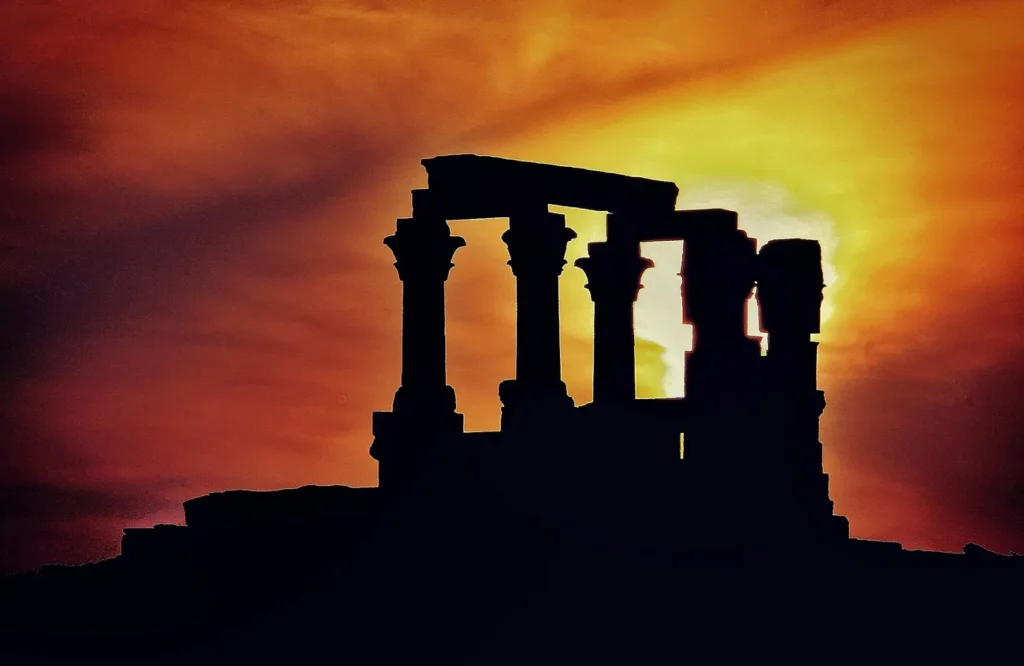
The kiosk is not the main Temple of Isis, and its Roman date matters. Philae remained important well after the age of the pharaohs commonly represented in popular culture. Roman rulers continued to appear in Egyptian religious imagery, and the sanctuary’s story lasted into late antiquity.
Look also for smaller monuments and gateways rather than treating every stone structure as an annex to the same building phase. The Ministry’s site record mentions a temple of Hathor connected with Ptolemy VI and Augustus. A guide that distinguishes the different patrons will help visitors understand the complexity without needing to memorize every cartouche.
The last hieroglyphs and the end of temple worship
Philae holds an unusually important place in the history of writing. A dated inscription carved by a priest named Esmet-Akhom in 394 CE is generally regarded as the last known dated hieroglyphic inscription. By then, the Roman Empire had changed enormously, and Egyptian temple traditions were operating in a very different political and religious world.
Later, under the Byzantine emperor Justinian, the traditional sanctuary was closed; the temple was subsequently used as a Christian church, and some older reliefs were damaged or altered. These changes are part of the same site history. It would be a mistake to imagine a perfectly unchanged temple frozen in the Ptolemaic period.
There is a human story behind those late inscriptions: people continued to use an ancient script and religious language for centuries after the last Ptolemaic king. Their practices did not disappear overnight when Egypt became a Roman province.
How to plan a visit without racing through it
Allow time for the boat crossing, the entrance arrangements and a walk through more than just the first courtyard. The most rewarding route includes the Isis sanctuary and the surrounding structures, with pauses to look back toward the water and the relocated island setting. On a hot day, shade and drinking water matter more than trying to visit every decorative detail in one uninterrupted circuit.
The mainland transfer and the return boat may shape the timetable more than the distance between the buildings. Confirm when the last practical return is available and whether any part of the complex is temporarily closed. Photography regulations and access to enclosed spaces can also change.
| Before going | What to check |
|---|---|
| Monument ticket | Current published prices and hours on the official Philae page |
| Boat transfer | Departure quay, return trip, fare and operator |
| Mobility | Boarding steps, uneven surfaces and access to internal rooms |
| What to see | Temple of Isis, birth house, Kiosk of Trajan and smaller monuments |
| Conservation | Closed areas, photography rules and respectful handling of carved stone |
Philae can be paired with other Aswan experiences, but don’t assume every Nile cruise includes a visit. Our cruise versus felucca comparison explains why a sailing trip and a temple excursion are different bookings. UNESCO’s Nubian Monuments dossier is worth opening before the trip for a wider view of the rescued heritage landscape.
The lasting memory of Philae may be the temple’s silhouette across the water. The deeper story is of people building a sanctuary for Isis, generations continuing to worship there, and modern teams refusing to let those ancient stones disappear beneath the river.