There’s something unexpected about the Catacombs of Kom el-Shoqafa. You descend into a Roman burial complex in Alexandria, then find Egyptian gods appearing in a setting shaped by Greek and Roman architecture. The result is neither a conventional pharaonic tomb nor a Roman cemetery transplanted unchanged from Italy. It belongs to Alexandria, where different cultural traditions met and took on new forms.
For visitors, the surprise begins with the staircase. For historians, it begins with the decorated tomb at the bottom: a place where the arrangement of rooms, the funerary meals and the images of gods all have something to say about life and death in Roman Egypt.
What lies beneath the city?
Kom el-Shoqafa is an underground burial complex dating broadly to the Roman period. The Egyptian Ministry of Tourism and Antiquities places it among Alexandria’s important necropoleis and highlights its mix of Egyptian and Greek funerary imagery. UNESCO’s description of the site dates its origins to around the late first or early second century CE, with use continuing into later antiquity.
The site may have begun as a family tomb before being expanded with additional burial spaces. That development helps explain why the interior feels less like a single chamber and more like a complicated underground building. There are galleries for burials, a central tomb, and spaces where the living gathered to remember the dead.
The name is often translated as the ‘Mound of Shards’, referring to broken pottery once associated with the area. It is a memorable name, but the more important thing to notice is the architecture: the catacombs were designed around practices of burial and commemoration, not as a secret passage to the ancient Library of Alexandria.
Down the spiral staircase
The principal entrance follows a deep spiral stair toward a circular central area, often called the rotunda. The layout establishes the catacombs’ vertical character. Instead of an open cemetery laid out across the ground, a visitor moves between levels and along corridors carved below it.
Near the upper level is a triclinium, a dining room used in connection with memorial meals for the dead. The term comes from the three-couch arrangement familiar in the Roman world. It’s a useful reminder that burial wasn’t only about a sealed chamber. Families and other groups returned to honor the deceased, and those gatherings needed their own spaces.
Some areas of the complex have been affected by water, and not every underground level is necessarily available to visitors. The passage into the site can also be challenging for anyone who has difficulty with stairs or confined spaces. It is worth checking conditions before arriving rather than assuming an underground archaeological complex works like a modern museum with step-free circulation.
The burial chamber tells the richer story
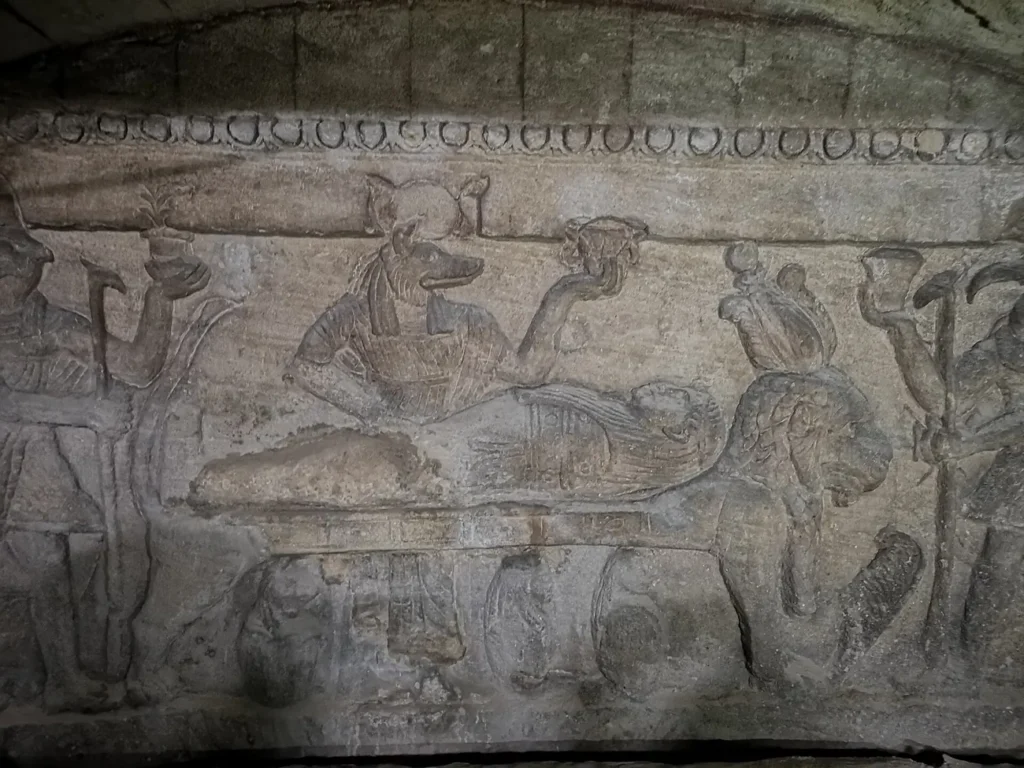
The main tomb offers a remarkable mixture of forms. Its architectural plan is often compared to a Greek temple: an anteroom leads toward a main burial space, with columns and carved details. But the iconography is emphatically Egyptian as well. A visitor can encounter funerary imagery associated with Osiris, Horus and Anubis in a monument belonging to Roman-period Alexandria.
One particularly striking figure is Anubis, the jackal-headed god, shown with attributes of Roman military dress. This is not the same Anubis image that appears on an Old Kingdom burial object. The differences matter. The god retained a role in funerary protection, but the artist’s visual language had changed in a city shaped by several traditions.
Scholar Marjorie Susan Venit examines this kind of visual combination in her study of Graeco-Roman Egyptian tombs. The tomb’s classical architectural plan and its Egyptian religious figures are not random decoration thrown together. They work within a funerary program that helped the dead and the living make sense of identity, memory and the afterlife.

Three things to look for during a visit
| Look for | Why it matters |
|---|---|
| The spiral stair and rotunda | They show how visitors and funerary participants moved through a tomb built on multiple levels. |
| The triclinium | It connects burial with commemorative meals, not merely the placement of bodies. |
| Egyptian gods in Roman-era art | They reveal how religious imagery was adapted in cosmopolitan Alexandria. |
Pay attention to where the images appear, not only what they depict. The entrance to a burial chamber, the shape of a sarcophagus and the scenes carved nearby belong to the same environment. A photograph of an isolated figure can be dramatic; understanding its position in the tomb explains much more.
How to fit the catacombs into an Alexandria day
The catacombs are worth giving their own block of time. In our one-day Alexandria route, Kom el-Dikka, Bibliotheca Alexandrina and Qaitbay Citadel make a fairly coherent introduction to the city. If underground funerary art interests you more than the Roman theatre, substitute Kom el-Shoqafa for that stop rather than treating it as another attraction to squeeze in.
Check the Ministry’s monument information for current tickets and access. Shoes suitable for steps, a willingness to move through enclosed spaces and time to read interpretation signs are more valuable here than a strict 30-minute schedule. Photography restrictions can change too. Respect roped-off areas and carved surfaces, which carry details that cannot be replaced once damaged.
The wider city includes other important cemeteries and archaeological sites, but their periods and functions aren’t interchangeable. Our Kom el-Dikka study, for instance, concerns public and domestic spaces in Roman and Byzantine Alexandria, not an underground burial complex.
Why this is an Alexandrian monument, not a historical curiosity
At first, the catacombs’ combination of imagery may seem contradictory: Greek architectural language, Roman funerary customs and Egyptian gods sharing the same rooms. But in a Mediterranean city where people moved between languages and traditions, such combinations were part of the lived culture.
Kom el-Shoqafa gives that history a physical form. Its staircases and burial spaces survive; the people who used them are far harder to reconstruct. We cannot read every individual’s beliefs from a wall carving, but we can recognize that Alexandrian families developed funerary practices that drew from more than one tradition. That is what makes the site worth visiting carefully.
Source notes: the Egyptian monument authority’s Alexandria overview identifies the Roman-era catacombs and their hybrid decoration; UNESCO’s Alexandria heritage description provides chronology, architecture and background; and Venit’s scholarly chapter examines the funerary program. The two photographs are existing licensed documentary photographs by Carole Raddato, not AI reconstructions.