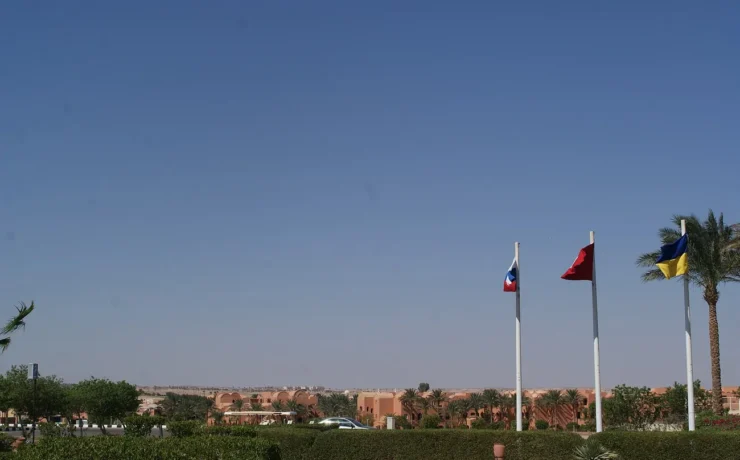
The Grand Egyptian Museum (GEM) in Giza is far more than the place where Tutankhamun’s golden mask is displayed. Purpose-built near the Giza pyramids, it brings together the story of Egypt across thousands of years with monumental sculptures, the grand staircase, twelve themed main galleries, the collections of Tutankhamun, and Khufu’s ancient wooden ship. Following its official November 2025 opening, its principal collections now welcome visitors. A considered visit is a cultural experience in its own right, not just a quick stop on the way to the pyramids.
This independent English visitor guide explains the museum’s major sections, ticket prices for Egyptians and foreigners, the published ticket-price change scheduled for 1 November 2026, advance booking, opening times, transportation, photography and how long to allow. All featured photographs are authentic 2025–2026 photographs of the actual museum, individually credited and legally reusable. As this is the visitor-facing introductory guide, each gallery can later receive its own in-depth Kemet Vault study without repeating the same ticket and travel advice.
| Visitor essentials | Grand Egyptian Museum |
|---|---|
| Location | El Remayah Square, Cairo–Alexandria Desert Road, Giza |
| Official website | gem.eg |
| Direct ticket booking | tickets.gem.eg |
| What is included | Tutankhamun Galleries, Main Galleries, Grand Hall, Grand Stairs, Khufu’s Boats Museum, gardens and visitor areas |
| Gallery hours | 9 AM–6 PM most days, 9 AM–9 PM Wednesday and Saturday |
| Suggested visit | 4–5 hours for highlights; 6–8 for deeper exploration |
What makes the Grand Egyptian Museum different?
GEM is designed around one civilisation, but it does not tell only one story. It follows Egypt from its prehistoric beginnings through later historical periods, while its collections and architecture make the relationships between kingship, ordinary society and religious thought visible. The museum’s setting near Giza is deliberate: objects associated with rulers, pyramids and funerary culture can be understood alongside the monuments that still stand on the plateau.
The museum experience is arranged through connected but distinct spaces. The entrance and Grand Hall introduce the scale of Egyptian royal sculpture. The Grand Stairs become an exhibition in their own right. The Main Galleries explore long-term Egyptian history across 12 halls. The Tutankhamun Galleries concentrate on an extraordinary collection from one royal tomb, while the Khufu boat draws attention to the technology and ritual contexts of the pyramid-building era.
GEM must not be confused with the historic Egyptian Museum in Tahrir Square. That is a separate museum with different collections, a different location and a separate admission policy. The newer building does not make the Tahrir institution redundant; travelers interested in the full range of Cairo’s archaeology may wish to see both, ideally on different days.

How the main museum sections fit together
For a first-time visit, think of GEM as a set of experiences rather than an intimidating list of rooms. The Grand Hall provides a monumental introduction. The Grand Stairs integrate ancient statues with modern architecture. The Main Galleries form the historical core, presenting twelve halls around the themes of Kingship, Society and Beliefs. The Tutankhamun Galleries tell the story of the young king through thousands of objects. Khufu’s Boats Museum addresses royal boatbuilding, conservation and the world of pyramid funerary practice.
The museum also lists the Hanging Obelisk, gardens, places to eat, retail areas and spaces for educational activities. A Children’s Museum, education programmes and changing experiences can follow their own timetable and may require separate booking. The official collection index provides the institution’s latest map of major visitor zones.
Visitors with limited time should prioritise two or three areas without forgetting the grand architectural route. Travelers with a full day can see the wider sequence, pause to read object labels, and take breaks rather than turning the visit into an exhausting photograph hunt.
Grand Hall: the colossal Ramesses II statue
The Grand Hall’s most striking landmark is the imposing statue of Ramesses II. This genuine ancient royal sculpture introduces the public to the authority, material skill and monumentality of Egyptian kingship. Its setting encourages visitors to appreciate the colossal figure in the round rather than from a single compressed viewpoint. The scale of the building and statue together makes a powerful introduction to GEM.
Look beyond the immediate impression of size. Royal crowns, proportions, bodily posture and the careful shaping of hard stone were deliberate visual languages of rulership. In ancient Egypt, statuary was not simply decorative; it could proclaim legitimacy, preserve a name, and connect a ruler to ritual and sacred places. The museum setting offers a rare opportunity to examine the monument at close range within a clear modern spatial context.
The statue is only the start. Visitors who spend their entire visit in the hall miss the museum’s larger purpose, which is to connect celebrated kings with the societies, craftsmanship and beliefs that shaped their world.

The Grand Stairs: ancient monuments in a modern architectural journey
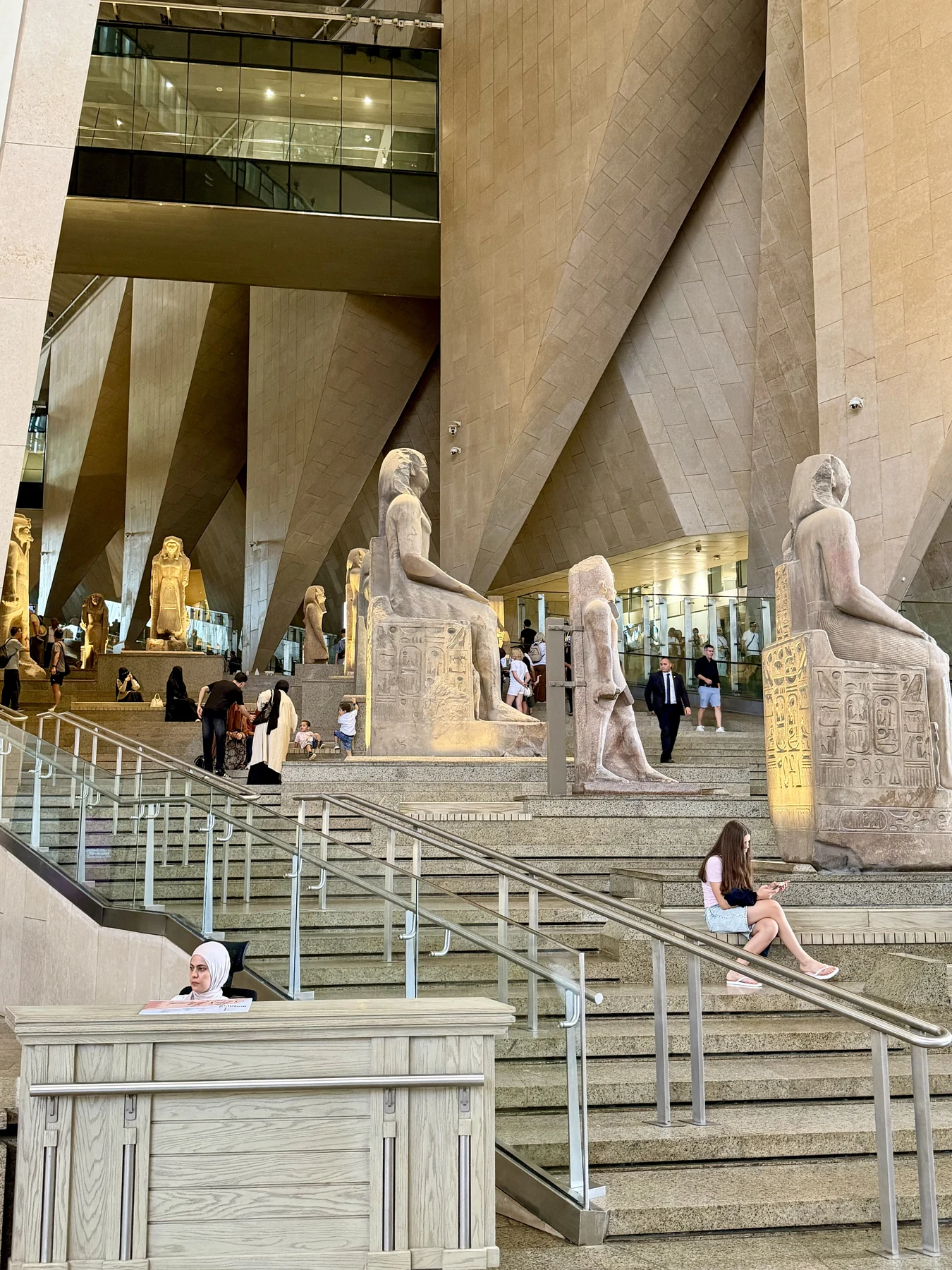
The Grand Stairs combine a passage through the building with an exhibition of monumental Egyptian works. Visitors encounter royal representations and significant stone pieces as they ascend, moving between ancient ideas of authority and a contemporary view of the Giza landscape. The experience is more rewarding when approached as a gallery rather than a staircase to rush up.
Look at the differences between sculptural forms: whether a figure is seated or standing, the ways royal names are displayed, how stone surfaces have survived, and what museum labels say about original locations. Ancient artists were not making one timeless kind of pharaoh. The forms and messages of royal sculpture changed significantly through Egyptian history.
Architecture is part of the experience. The expansive stairs, light, geometric lines, and framed outward views establish a conversation between historic objects and a modern building. Crowds may gather at scenic points; moving slowly and being considerate to other visitors will make photography and reading easier.
The 12 Main Galleries: Kingship, Society and Beliefs
The Main Galleries are central to understanding the Grand Egyptian Museum. According to Egypt’s Ministry of Tourism and Antiquities, the twelve halls trace Egyptian history from prehistoric times into the Roman era, using three recurring themes: Kingship, Society and Beliefs. Their value lies in connecting objects across time rather than presenting the entire past as an unchanging succession of gold, pyramids and pharaohs.
Kingship reveals how rulers communicated authority through monuments, political institutions, temple associations and inscriptions. The subject goes beyond individual royal biographies: visitors can investigate how the image of the king changed and why objects connected to power were created. Society turns attention to everyday material culture, production, social organisation and the communities whose labour sustained Egyptian civilisation. Beliefs explores divine imagery, ritual practice, protection, burial and the variety of Egyptian ideas about life and death.
Try exploring these three themes in combination. A tomb object may reveal religious practice but also the social resources needed to make it. A royal statue can communicate political power and sacred obligation at once. The museum’s approach allows visitors to see history as the interaction of people, institutions, materials and ideas across different periods.
The precise exhibits and arrangements can change. A first-time tourist should consult the museum’s current gallery signage instead of trusting an unofficial online list claiming that every specific artefact is in a fixed room. Separate, object-focused guides to the twelve halls will form a useful future Kemet Vault series; this page is an overview for planning the visit.
Tutankhamun Galleries: the world’s most famous royal burial collection
For many visitors, the Tutankhamun Galleries are the defining attraction. They bring together more than 5,000 objects associated with the young pharaoh’s tomb, creating an experience that places celebrated treasures alongside the everyday and ceremonial equipment prepared for royal burial. The golden funerary mask is globally famous, but the surrounding furniture, chariots, ritual figures, containers and personal objects make the collection meaningful as a historical whole.
Tutankhamun ruled during Egypt’s Eighteenth Dynasty, and the discovery of his tomb by Howard Carter’s team in 1922 shaped the modern world’s understanding of Egyptian archaeology. Yet the objects belong to an ancient context more than three thousand years older than their rediscovery. They reflect workmanship, religious protection and the resources mobilised for a royal afterlife. Instead of racing to the mask, choose a few small objects and ask how they were made, why they were deposited, and what they reveal about life at court.
The galleries can attract substantial crowds. Some displays have special photography restrictions, so visitors should follow room notices even though non-commercial photography is otherwise allowed in many museum spaces. Dramatic stories of Tutankhamun’s curse are modern popular mythology, not evidence of supernatural events surrounding the excavation.

Khufu’s Boats Museum: the incredible wooden vessel of pyramid-age Egypt
The Khufu’s Boats Museum offers a very different highlight: a monumental ancient wooden vessel associated with King Khufu’s funerary complex at Giza. It provides direct evidence of sophisticated boatbuilding skills in Fourth Dynasty Egypt and helps visitors appreciate the relationship between the pyramids, transport, ceremony and royal burial culture.
The vessel is frequently called a solar boat, referencing ancient religious associations between boats and the sun’s journey. That name is useful, but the precise original purpose of the boat should not be described as settled beyond archaeological debate. The material structure, joints, hull form and history of reconstruction tell a technical story even while scholars continue discussing symbolic and practical uses.
Take time to observe the boat’s proportions from more than one angle and look for explanatory displays on conservation. The museum connects this wooden structure with the far larger landscape of ancient Giza, helping visitors imagine the expertise and organisation behind monuments that often appear in photographs as solitary pyramids.
A standard GEM admission ticket is described by the official ticketing website as including Khufu’s Boats Museum. Optional guided services or special experiences may involve separate fees. For additional background, consult our research on King Khufu and the Giza Pyramid Complex.
Children’s Museum, education centres and additional experiences
GEM also provides learning activities beyond the principal exhibition halls. The Children’s Museum and museum educational programmes can make Egyptian history more engaging for younger visitors, but their schedule and entry arrangements should be verified independently. Workshops, immersive experiences and temporary exhibitions may not follow the same rules as ordinary gallery admission.
The official calendar and ticketing platform list current programmes and optional add-ons. Families should check age restrictions and the days on which a selected experience runs before choosing their main admission slot. For visitors with disabilities or specific access needs, the official accessibility guidance is a useful starting point, and the museum can be contacted before travel.
The gardens, cafés, restaurant and retail areas can be welcome places to pause, but they are not a substitute for allowing enough time in the collections. A full day at GEM is more enjoyable when it includes breaks, especially for people with young children.
Grand Egyptian Museum ticket prices for Egyptians and foreigners: October and November 2026
Critical update for travel planning: the museum’s standard admission prices are scheduled to increase on 1 November 2026. Figures announced on 17–18 October differ from some mid-October online screenshots, especially for adult foreign admission. The table below distinguishes the published pre-increase tariffs from the announced new tariffs. All amounts are in Egyptian pounds (EGP) and exclude optional guided tours and paid experiences.
| Ticket category | Through 31 Oct 2026 | From 1 Nov 2026 |
|---|---|---|
| Egyptian adult | EGP 200 | EGP 220 |
| Egyptian child, student or eligible senior | EGP 100 | EGP 110 |
| Arab / foreign adult | About EGP 1,570* | EGP 1,830 |
| Arab / foreign child or student | EGP 790 | EGP 920 |
| Foreign resident adult in Egypt | EGP 790 | EGP 920 |
| Foreign resident child or student | EGP 400 | EGP 460 |
*The reported October 2026 foreign adult rate is not fully consistent across public accounts: one contemporary report gives EGP 1,570 and a live-booking observation gives EGP 1,590. These are dated reference prices, not a guaranteed checkout quote. For the amount that actually applies to a selected date and nationality, check the official ticket portal. Sources: Ahram Online, 17 October 2026 and Egypt Independent, 18 October 2026. Prices checked 20 October 2026.
The extra detail is important because a price for an Egyptian student is not the same as a foreign student ticket, and a foreign resident in Egypt may qualify for a different category than a short-term visitor. A guided tour or special event can also cost more than basic admission. Choose the appropriate nationality, age and residence category at booking, and bring valid documentation.
Free entrance, age categories and discounts
The official GEM ticketing policy lists children under six, visitors with disabilities and ICOM members among visitors exempt from the general admission fee. Some Egyptian university students and staff, guides, veterans and approved educational or institutional groups can qualify under specific conditions, which may exclude certain weekends or public holidays. Valid ID, proof of age or advance written approval may be required.
Foreign spouses of Egyptian citizens and their children may qualify for Egyptian ticket rates when appropriate relationship documents are shown. Where standard admission is free, a guided tour may still require payment for the guided service. The precise eligibility terms are maintained by the official GEM FAQs and booking website, not by older blogs.
How to book official GEM tickets without using imitation websites
The direct ticket platform is tickets.gem.eg, linked from the museum’s own Plan Your Visit page. Egypt’s State Information Service documented the April 2026 transition to the upgraded booking service and warned about unofficial websites imitating the museum. Avoid third-party pages that describe themselves as the official museum when their web address is unrelated to the real institution.
On the booking screen, select the date, entry window and appropriate ticket category. Choose a standard Admission Ticket if you intend to explore independently. The site also offers guided-tour bookings and optional experiences, which should be distinguished from basic entrance. Review the nationality and age categories carefully, fill in the visitor details and retain the confirmation on your phone. The museum’s FAQ asks visitors to book online in advance rather than relying on arrival without a reservation.
The chosen time window controls when you are admitted; it does not necessarily impose a fixed length of stay inside the galleries. Tickets are usually for one named visitor, one entry and one date, and are generally non-refundable. Identification may be requested for discount eligibility. Arriving ahead of the booked time and allowing for security checks is wise on busy days.
Grand Egyptian Museum opening hours and the best time to visit
| Days | Complex | Exhibition galleries | Last entry |
|---|---|---|---|
| Sunday, Monday, Tuesday, Thursday, Friday | 8:30 AM–7:00 PM | 9:00 AM–6:00 PM | 5:00 PM |
| Wednesday and Saturday | 8:30 AM–10:00 PM | 9:00 AM–9:00 PM | 8:00 PM |
The separate closing times are important. A visitor may still be able to use some of the complex when galleries have closed, but that does not mean late admission to Tutankhamun or the main displays is possible. For a museum-focused day, aim to start in the morning. Wednesday or Saturday evening hours are attractive for a shorter visit or visitors who prefer later hours, but a full collection tour can easily consume most of the day.
Hours may change for public holidays, special events and museum operations. Check the official opening-hours page before booking transport or tours.
Where is the Grand Egyptian Museum and how do visitors reach it?
GEM stands near the Giza pyramids at El Remayah Square on the Cairo–Alexandria Desert Road. The location is outside central Cairo and separate from the museum in Tahrir Square. It can be reached by taxi, hired vehicle, group tour or other available road transport. Depending on the visitor’s starting point and traffic conditions, traveling from the city centre can take considerable time.
The museum provides official driving instructions and identifies road access via the desert road and its parking entrance. Its public-transport guidance still indicates that additional metro information will be supplied, so do not depend on claims of a dedicated operating metro stop without checking a current transport authority source. The exact driving route is less useful to international visitors than the confirmed museum entrance and an appropriate arrival time.
It is possible to combine GEM with the pyramids, but the sites have separate admissions and entrances. If both are priorities, avoid an overcrowded itinerary. For pyramid tickets and logistics, use Kemet Vault’s practical Giza visitor guide; for history, use the separate Giza Pyramid Complex research guide.
Two recommended visit plans: highlights or an immersive day
Four to five hours: start with the Grand Hall and Ramesses II, enjoy the monumental Grand Stairs, explore selected parts of the Main Galleries, then prioritise Tutankhamun and Khufu’s Boats Museum. This highlights route gives an excellent introduction, but you will not have time to examine every room in depth. Include short breaks and do not assume that queue times will be negligible.
Six to eight hours: choose an early arrival and explore the main gallery themes with time to read labels and compare artefacts. Give the Tutankhamun collection an extended session, and visit the Khufu boat without rushing. Use the museum facilities for a meal or a rest. The longer itinerary is especially suitable for students, history enthusiasts and travelers making GEM a main purpose of their Giza stay.
With children: focus on visually distinctive spaces and shorter attention spans. Check the Children’s Museum and family-program schedule before travel, then alternate exhibitions with rest periods. Most visitors will enjoy learning more by studying a manageable selection of objects closely than by attempting to inspect every display at once.
Photography, prohibited items, accessibility and visitor comfort
Personal, non-commercial photographs are generally permitted in the museum, but important restrictions apply. The museum forbids flash, tripods, monopods, selfie sticks, drones, additional lighting and live streaming. Some areas of the Tutankhamun Galleries have stricter photography rules; gallery signs and instructions from staff take priority over broad general guidance. Commercial photography and filming require prior museum authorization.
Large luggage and parcels exceeding 40 by 40 centimetres must be stored in designated areas. Outside food is not permitted on museum premises. Small water bottles may be allowed in galleries under current rules; check posted restrictions. Do not touch ancient objects, lean on cases or enter areas separated by barriers. A large museum benefits from comfortable shoes and periodic breaks.
Visitors who need mobility or other support can review the museum’s official accessibility information before arriving. The site is a large, carefully organized public venue, but an individual visitor’s requirements should be clarified directly rather than inferred from attractive promotional photographs.
Grand Egyptian Museum and the pyramids: planning an Egyptian cultural itinerary
GEM makes an excellent companion to a visit to the Giza pyramids and Great Sphinx. The two experiences illuminate one another: the pyramids show the scale of the royal burial landscape, while objects in the museum help explain the technology, belief systems and institutions behind it. However, it is a mistake to assume that one ticket covers both attractions or that the entrance to each site is immediately adjacent.
Travelers with additional days in Cairo can explore Saqqara, Dahshur and the historic Egyptian Museum in Tahrir. Each has a different significance. GEM’s purpose is not to replace all Egyptian heritage attractions but to present a major curated museum experience close to Giza. Later Kemet Vault guides can take readers deeper into individual GEM halls and object histories while keeping this page useful for visitors making practical decisions.
Frequently asked questions
Is the Grand Egyptian Museum open in 2026? Yes. The museum’s ticketing service lists admission to the Grand Hall, Grand Stairs, Main Galleries, Tutankhamun Galleries and Khufu’s Boats Museum. Programmes and special experiences may have different schedules.
How much is a ticket for an Egyptian adult? The reported standard admission price is EGP 200 through October 2026 and EGP 220 from 1 November. Eligible Egyptian students, children and seniors move from EGP 100 to EGP 110.
What about foreign visitors? Reports place adult admission around EGP 1,570–1,590 in October, increasing to EGP 1,830 from 1 November 2026. Reduced rates apply to qualifying children, students and foreign residents in Egypt.
Does a ticket include Tutankhamun and the Khufu ship? The official ticket website lists both the Tutankhamun Galleries and Khufu’s Boats Museum among the museum’s main admission-accessible spaces; add-on experiences and guided services are separate.
Must tickets be booked in advance? Yes. The official FAQ directs visitors to advance online booking for a selected date and admission time. Use tickets.gem.eg to confirm availability and the final rate.
How long does a good visit take? Around four to five hours covers major highlights. Enthusiasts interested in all three Main Gallery themes, Tutankhamun and the boat should plan most of a day.
Is the Grand Egyptian Museum the same as the Cairo Egyptian Museum? No. GEM is near Giza, while the older Egyptian Museum is in central Cairo’s Tahrir Square. Each has separate access and collections.
Research sources and authentic photo credits
Museum authorities: Grand Egyptian Museum official website, collection guide, visitor information, official FAQ, and direct booking platform. The Egyptian government’s April 2026 statement confirms the upgraded ticketing channel.
Ticket-price confirmation as at 20 October 2026: Ahram Online, 17 October 2026 and Egypt Independent, 18 October 2026, confirming the scheduled 1 November increase. The booking portal controls actual eligibility and checkout charges.
Photographs: all illustrations in this article are actual photographs of GEM, not synthetic depictions. Entrance by Amr F. Nagy (2025); Grand Stairs and Ramesses II by Slyronit (2026); Tutankhamun golden mask by Egyptiankeng (2025); Khufu Boats Museum by Mohamed abdelzaher (2026). Individual Commons originals, photographer attribution and CC BY-SA 4.0 licence links appear directly with each image. All photos have been resized or cropped as identified in their captions. This guide is a visitor overview and is intentionally separate from planned in-depth gallery guides.