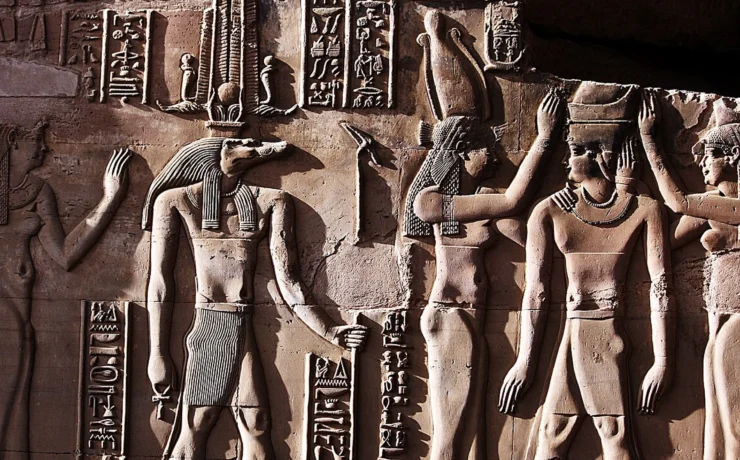
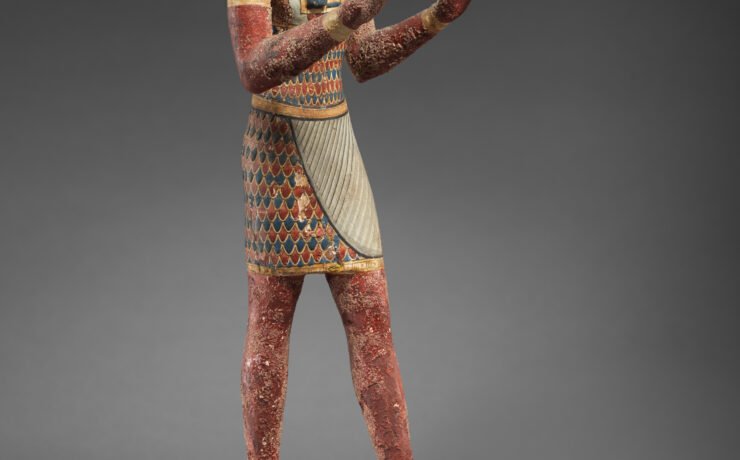
Ra, often written Re in Egyptological publications, was one of the great solar powers of ancient Egyptian religion. Understanding him requires more than the statement that he was “the sun god.” Solar theology described creation, the regular passage of time, the defense of cosmic order, kingship, and the vulnerability and renewal expressed by the passage from night to morning. Ra appears in prayers, ritual objects, royal names, funerary books, monumental art and small protective amulets, but he does not always appear in exactly the same divine form.
This Kemet Vault dossier explores the religion using authentic museum objects and Egyptian religious texts. It separates Ra himself from related forms such as Khepri, Atum, Re-Harakhty and Amun-Re, avoiding the misleading idea that all Egyptian deities had one unchanging identity. It is a historical study of real religious practices and evidence, not a claim that mythic events were documented human history.
Ra at a glance
1. Who was Ra in Egyptian religious thought?
Ra was a powerful divine expression of the sun’s presence, movement and capacity for renewal. At Heliopolis, creation traditions placed solar emergence at the center of accounts of how an ordered world came into existence. Over time, the solar god also became closely associated with royal identity, sacred protection and rituals for the deceased.
Modern books sometimes describe Ra as the supreme god of Egypt, which may be useful shorthand in a particular historical or theological context but is not an accurate universal summary for all places and periods. The relative importance of individual gods changed, and local temple traditions combined divine identities in complex ways. An ancient Egyptian worshipper might invoke Ra, Amun-Re or Re-Harakhty in different circumstances without viewing every form as an unrelated deity.
Studies of Egyptian religion therefore rely on dated texts and objects. We should distinguish an Old Kingdom royal name referring to Ra from a Late Period amulet depicting Re-Harakhty; both reflect solar belief but were made in different social and historical settings.
2. The solar cycle as an explanation of renewal
Sunrise, daylight, sunset and night could become a sacred cycle in Egyptian cosmology. The rising sun suggested renewed creation, the full sun represented divine power, and the threatened night voyage allowed Egyptians to think about danger, protection and return. These associations are powerful precisely because they connected cosmic repetition with human fears about death and the hope of transformation.
The morning solar form Khepri was associated with the scarab beetle, which could evoke the pushing or emergence of the sun. Atum was especially prominent in traditions of creation and the setting sun. These identifications should be described as theological relationships rather than as three scientifically distinct astronomical objects. Local texts may emphasize different combinations.
The regular sun did not mean cosmic order was taken for granted. Ritual texts describe powers that threatened its continuity, and divine assistance ensured the solar journey could be renewed. The literary and visual accounts make meaningful claims about worldview, not a mechanical astronomy manual.
3. Heliopolis, kingship and sacred geography
Ancient Heliopolis, known to Egyptians as Iunu, was one of the major centers of solar religious thought. Its theological traditions concerned divine generation, emergence and kingship. As royal culture changed, solar associations became an important component of royal names and ideology, including titles that connect rulers to the son of Ra.
The link between the sun and kingship was not simply an ornament. A ruler’s position was framed through religious language that placed Egyptian society within an enduring cosmic order. This theological claim is evidence for a political and ritual ideology; it does not allow modern historians to infer every practical decision of a king from one divine epithet.
Royal funerary monuments of the Fourth Dynasty and sun temples especially prominent in the Fifth Dynasty show how monumental architecture participated in the development of royal solar ideas. An exact equation between every pyramid and a fully formed later solar doctrine would be anachronistic. Read the separate Fourth Dynasty historical overview for the royal architectural context.
4. Re-Harakhty: the sun and Horus of the Horizons
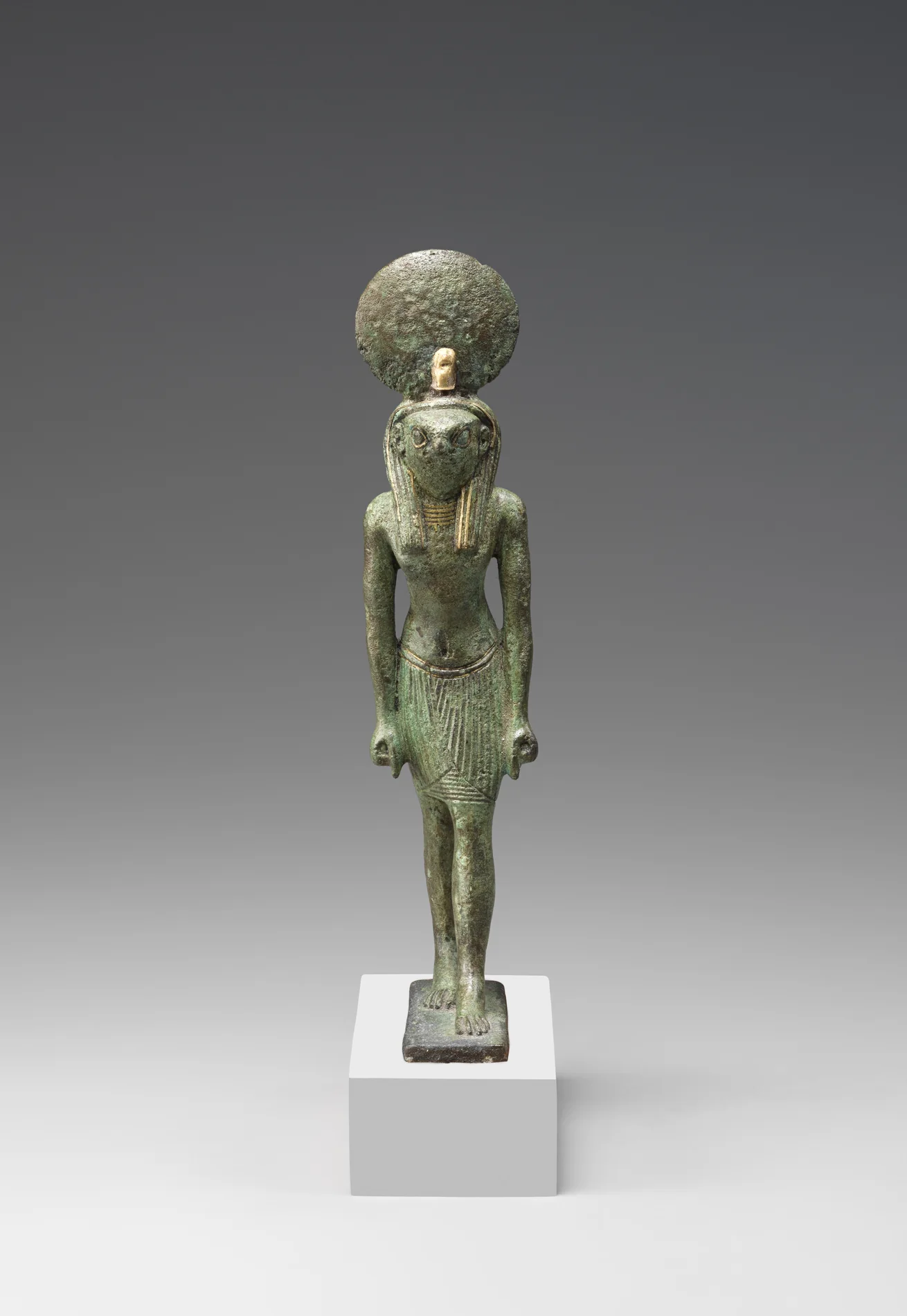
Re-Harakhty is a composite solar form connecting the sun deity Re with Horus in his aspect as ruler of the horizons. He can be depicted with a falcon head and solar disk. This is not proof that every falcon image in Egypt portrays one identical named god; headdresses, inscriptions and ritual context are essential when identifying an object.
A standing bronze figure cataloged as Re-Harakhty by The Met offers a carefully identified material example. The object is from the Late Period, far later than the first kings of the Fourth Dynasty. Its photograph is useful evidence for later iconography and devotional practice rather than a reconstruction of the earliest worship at Heliopolis.
Composite divine names are part of Egyptian theology. They can join characteristics of different divine traditions without necessarily erasing the independent cults of the components. Researchers should not assume a merger happened once on an exact date and remained unchanged forever.
5. A painted wooden stela: Re-Harakhty and Atum
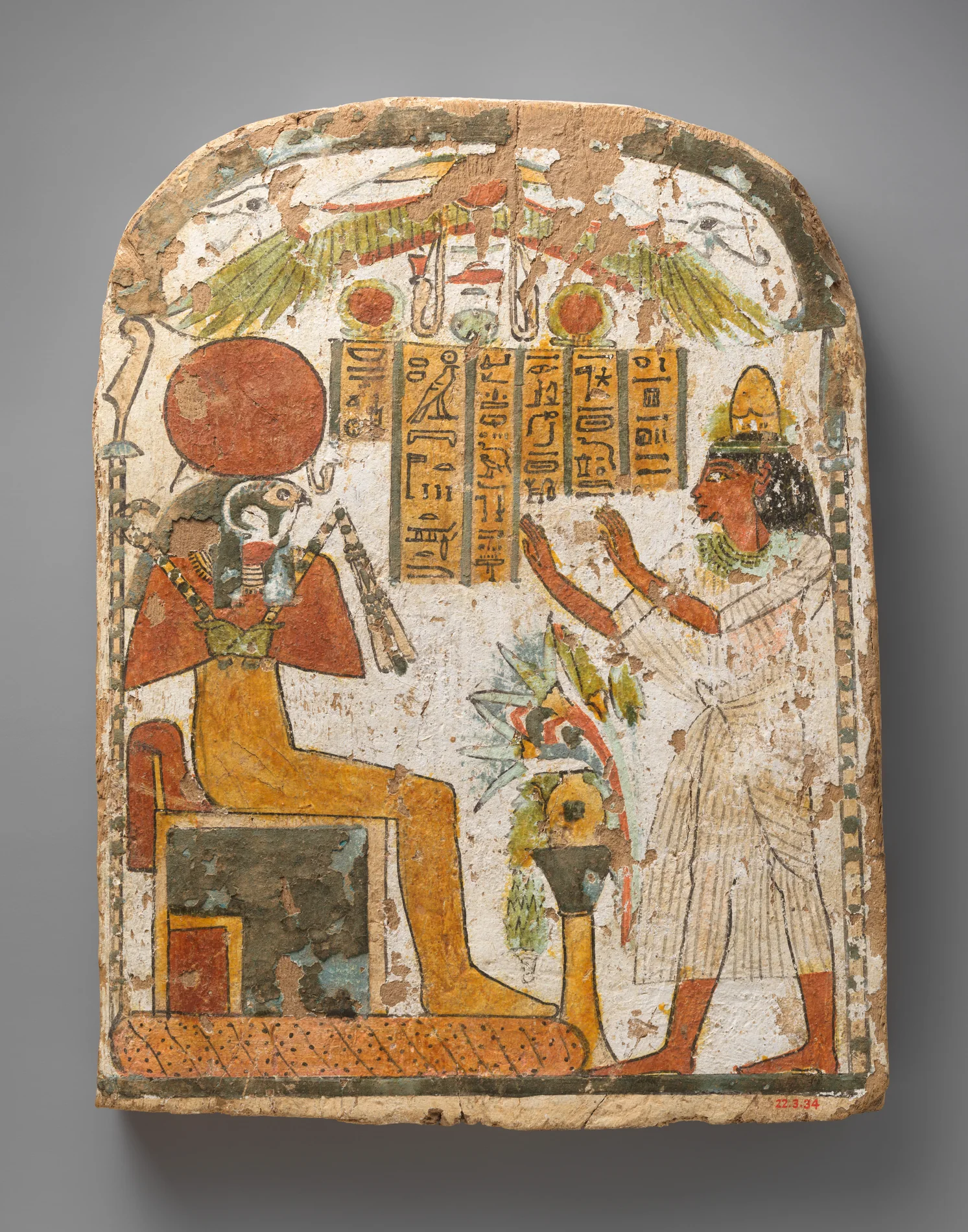
On a stela, the image of a person worshipping a solar deity communicates a relationship between human devotion and divine power. The Met identifies a painted wooden example, accession 22.3.34, as showing Djedbastet adoring Re-Harakhty-Atum. Its combined divine name demonstrates how solar identities could be joined in one devotional context.
The object comes from the Third Intermediate Period. It cannot be presented as a photograph of a temple scene from the Old Kingdom. The find context at Thebes also matters: a work recovered from a burial environment can illuminate funerary and devotional practice in addition to broader solar theology.
For a student, the first question should be what the catalog actually identifies: the dedicator, deity, material, date and archaeological location. Only then should an interpretation of the religious meaning be proposed.
6. The sacred solar bark and the night journey
Egyptian funerary compositions describe the sun’s passage through the hours of night, the transformation of divine beings and the overcoming of dangerous forces. A solar bark can appear as the means by which the sun god and divine companions traverse a cosmic environment. Different books and ritual traditions organize the journey in different ways; a modern summary that merges them into one fixed storyline risks losing that diversity.
The Book of the Dead and New Kingdom underworld compositions preserve aspects of this world of thought. They were made for ritual and funerary purposes rather than to serve as modern illustrated myth textbooks. Reading a passage in isolation can obscure its intended audience, whether royal, priestly or associated with a particular deceased person.
The idea of the sun’s renewed emergence also provides a connection between solar mythology and funerary hopes for transformed existence. This theological relation should not be reduced to the claim that Egyptians believed every human being physically traveled across the ordinary sky in a boat.
7. A genuine papyrus showing a solar boat
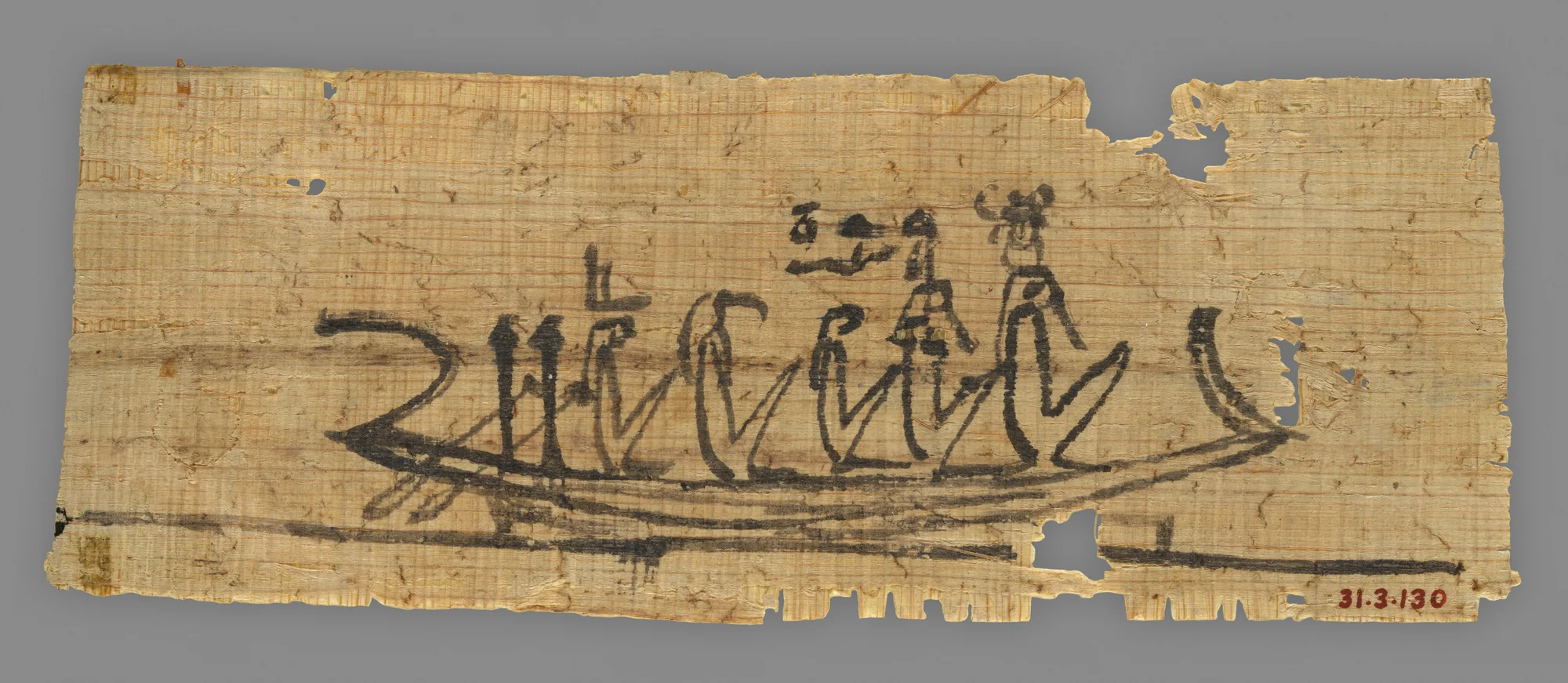
One of the most useful original objects for this subject is The Met’s papyrus fragment 31.3.130. The catalog describes a solar boat with the gods Khepri, Shu, Tefnut, Thoth and Isis. It was recovered in an embalming cache, providing a funerary context for understanding the image. The museum connects it to spells enabling a transformed spirit to join Re’s boat.
Notice the distinction between the boat of Re and the figures actually visible. A careless internet caption might claim the painted scene shows a single falcon-headed Ra steering a ship. That would misrepresent the official catalog: the listed figures form a divine group with different identities, while Re’s bark provides the broader solar setting.
Small papyri and paintings may carry exceptionally rich religious information. Their size should not make them seem secondary to statues or temples when they offer clear iconography and original archaeological association.
8. A named official adoring the solar deity

The Met holds a limestone stela fragment depicting a royal official named Pay raising his hands in adoration before Re-Harakhty. The museum dates the object to the late Eighteenth Dynasty during the reign of Tutankhamun and identifies further parts of the stela with solar and other hymns. This provides a different kind of evidence from a monumental temple relief: a named human figure interacting with a deity through praise and ritual language.
Hymns are not dispassionate theological handbooks. They are ritual and devotional speech, structured to praise, petition or affirm divine functions. Yet they can reveal the vocabulary through which Egyptians described the sun’s power and their relation to it. Translating such speech requires attention to poetic and ritual conventions.
Personal expressions of religious devotion varied with time, resources and setting. A wealthy dedicator’s surviving stone stela cannot automatically establish that every household worshipped Ra in precisely the same way. Combining different classes of evidence gives a more responsible picture.
9. Scarabs, amulets and everyday solar protection

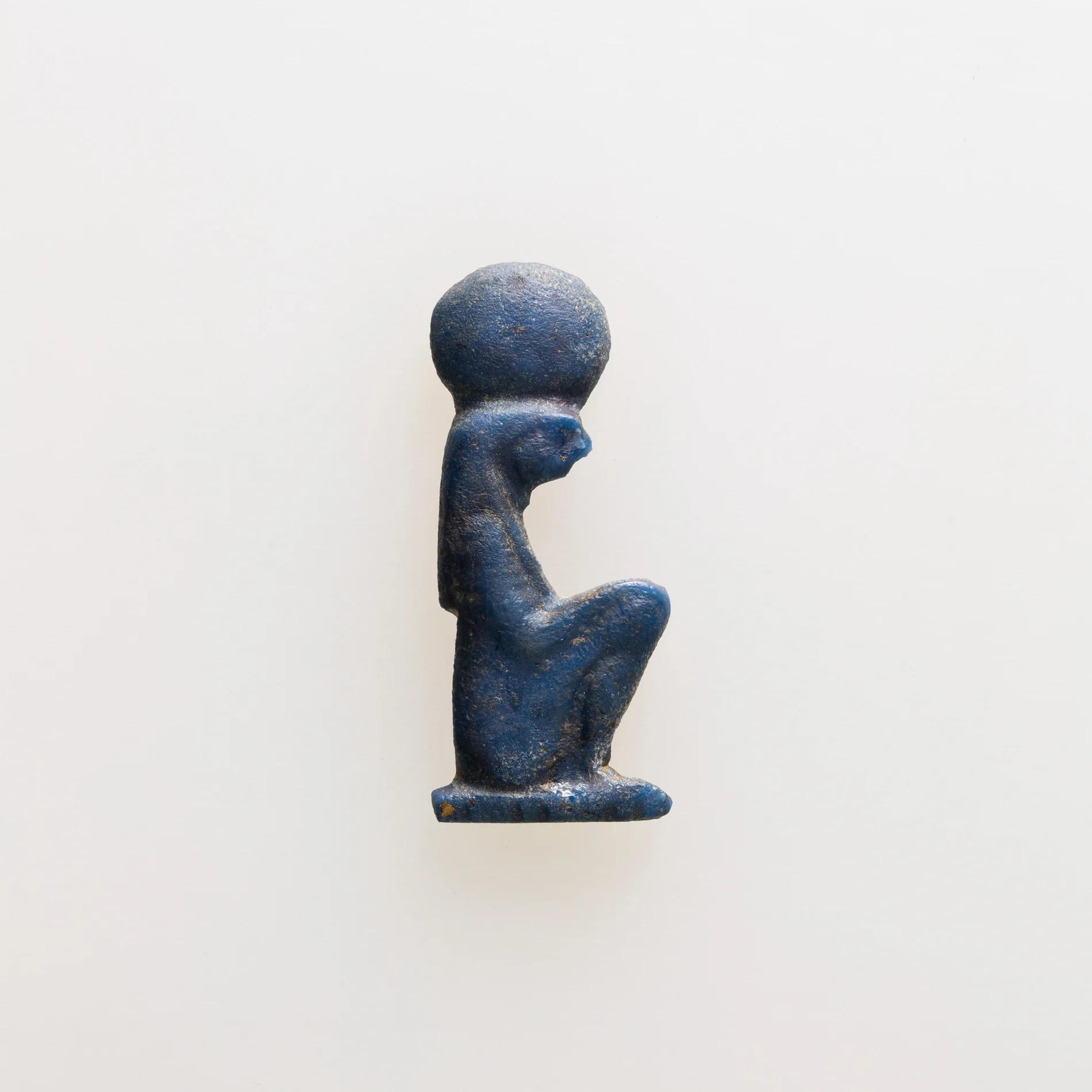
Solar imagery was not limited to large sanctuaries. Scarabs, gold-sheet amulets and glass figures carried symbols in small, portable forms. Some objects invoke the deity through inscriptions, others through recognizable iconography. They can be linked to devotion, blessing or protection, but their exact function depends on archaeological context and the museum’s reading.
The Met describes molded glass amulets from later Egyptian periods as objects often placed among mummy wrappings. A surviving amulet can therefore speak to concerns about death and protection without having served as an everyday necklace. The material, size and original findspot must be checked before giving a practical explanation.
The scarab’s solar association is important but not universal in every carved beetle object. Seal and amulet designs can have specific inscriptions or other functions. Khepri’s rising-sun symbolism provides one major interpretive framework, but scholars still need to read the individual object.
10. Re, Amun-Re and other divine combinations
In New Kingdom and later religion, Amun-Re became a major divine form combining the identity and roles of Amun and Re. The relationship demonstrates the flexibility of Egyptian theology. Deities could be joined for a particular ritual or political context without automatically ceasing to exist under their independent names.
Re-Harakhty similarly unites solar and horizon-associated Horus imagery. Atum-Re and other names can emphasize different aspects of creation, sunset or cosmic renewal. A list of divine combinations is therefore not a family tree of biologically separate figures. Modern writing should explain their functions before presenting a diagram that might mislead readers.
This complexity also protects against another oversimplification: Egyptian religion changed over millennia. A deity’s name in an Old Kingdom pyramid complex and a gold amulet from the first millennium BCE may share a religious heritage while belonging to very different material and ritual worlds.
11. The solar god and the struggle for cosmic order
Egyptian sacred stories often depict the renewal of the sun as threatened by disorder and defended by divine action. Apophis, usually referred to as Apep in Egyptian contexts, is commonly the serpent-like adversary of the solar journey. This conflict expresses the fragility of an ordered universe that must be continually sustained through ritual and divine power.
A narrative about a hostile serpent is not evidence that ancient Egyptians observed a literal animal attacking the astronomical sun. It belongs to the symbolic and theological language of the texts. Such narratives provided ways to discuss time, danger, fear and the security of life against disorder.
Texts can differ about which gods protect the sun, and Seth himself may have an important protective role in some solar traditions even though he opposes Horus in the Osirian succession narratives. Treating every god as uniformly good or bad across the entirety of Egyptian religion is often misleading.
12. Does Ra have one fixed appearance?
Representations of solar powers include the solar disk, falcon-headed figures with a disk, scarab beetles, hybrid images and symbolic hieroglyphs. Which form appears depends on the deity being invoked, the period, the artistic setting and the source’s theological purpose. A figure wearing a solar disk could also belong to a composite form such as Re-Harakhty or Amun-Re.
Accurate image captions are therefore essential. This guide identifies Re-Harakhty figures by the catalog titles of the holding museum rather than replacing their names with the simplistic caption “Ra statue.” Likewise, the papyrus showing Khepri and other deities in the bark is not mislabeled as a literal image of Ra alone.
Studying iconography becomes a method of reading religious history when students compare the specific attributes of each object with its accession record and date.
13. Timeline: changes in solar religion
Old Kingdom royal tradition
Solar theology and divine language shaped royal ideology. Heliopolitan traditions and increasing use of solar associations set a foundation for later royal cults, while surviving evidence varies between reigns.
Fifth Dynasty developments
Royal solar temples and changing funerary programs offer material evidence of intensified or reconfigured solar themes; they cannot be read as a sudden complete replacement of earlier gods.
New Kingdom devotional and funerary compositions
Solar hymns and underworld texts illuminate the nightly journey, divine protection and renewed emergence in varied ritual contexts.
Third Intermediate and Late Period objects
Small stelae, amulets and portable objects show diverse forms of Re-Harakhty, Atum and solar protection in the lives and deaths of individuals.
14. A student’s method for understanding solar theology
Identify the ancient object’s exact title
Check whether the holding museum calls the image Ra, Re-Harakhty, Khepri or a combined god. These distinctions can alter the interpretation.
Record period and provenance
A New Kingdom prayer and a Late Period amulet are not interchangeable documents even if both invoke a solar deity.
Interpret the material medium
Large relief, wooden stela, funerary papyrus and tiny gold amulet were made for different functions and audiences.
Compare narrative and ritual sources
A myth of the night voyage and a personal hymn can share solar symbolism while serving different religious purposes. Do not force one into the role of a universal definitive story.
15. Frequently asked questions about Ra
Are Ra and Re different gods?
No. Ra and Re are different conventional renderings of the Egyptian divine name in English scholarship. They generally refer to the same solar deity.
Is Ra the same as Horus?
Not universally. Re-Harakhty is a composite form linking Re and Horus of the Horizons. Egyptian theology often joins divine identities without making every independent manifestation identical.
What is the difference between Ra and Khepri?
Khepri is especially associated with the rising sun and scarab imagery, while Re is a broad solar identity. In some theological frameworks they can represent aspects within one solar cycle.
Why is Ra associated with a boat?
Solar bark imagery expresses the sun’s daily and nightly passage in religious literature. Individual papyri and temple scenes give the most precise evidence for how this was pictured.
Was Ra worshipped only by kings?
No. Personal objects such as stelae and protective amulets show solar devotion beyond royal monumental architecture, though surviving evidence reflects social and chronological differences.
Is a falcon-headed statue always Ra?
No. Several Egyptian divine identities use falcon imagery. Museum identification, crown, inscription and context are necessary to distinguish Horus, Re-Harakhty and other forms.
16. Continue exploring gods, kings and original objects
The Isis and Osiris narrative explains another family of divine traditions and the links between kingship, death and renewed order. Compare royal uses of solar language in the Fourth Dynasty study, study authentic objects in the Digital Museum, and explore broad chronological changes with the Interactive Timeline. A live historic temple or visitor itinerary should only be linked when published as a separate page.
Research sources and authentic photo records
- The Met — Standing Figure of Re-Harakhty, 26.7.848.
- The Met — Djedbastet Adoring Re-Harakhty-Atum, 22.3.34.
- The Met — Papyrus Solar Boat, 31.3.130.
- The Met — Pay Adoring Re-Harakhty, 04.2.527.
- The Met — Re-Harakhty Gold Amulet, 23.10.54.
- The Met — Re-Harakhty Glass Amulet, 17.194.2522.
- Egyptian Ministry — Old Kingdom and royal ideology context.
Editorial method: independent scholarly synthesis based on museum object catalogs and institutional Egyptology references. Representations are source-identified devotional and funerary works, not staged photographs of historical divine encounters. All artworks are Open Access CC0 photographs, self-hosted on Kemet Vault with original archive and licensing records.