Sobek, the crocodile god of ancient Egypt, embodies one of the most compelling paradoxes in Egyptian religion. The Nile crocodile could kill a person at the water’s edge, yet the same animal offered a powerful image of divine life, fertility, defense and royal authority. Egyptians did not need to pretend that crocodiles were harmless in order to worship Sobek. They sought protection and blessing from a force they knew could be dangerous.
His story reaches from the Pyramid Texts and the waterways of the Fayum to the twin sanctuary of Kom Ombo, beautifully rendered bronzes, painted limestone sketches and the mummified bodies of sacred reptiles. It is also a story that changed. Sobek could be a dangerous, overwhelming presence in one context and a nourishing, solar creator in another. This illustrated encyclopedia examines those differences through ancient texts, excavated objects, dated museum catalogues and surviving temples, without reducing multiple centuries of beliefs to a single modern fantasy.
Who was Sobek in ancient Egyptian religion?
Sobek (also written Sobk, Sebek or Suchos in different transcription traditions) was an Egyptian god who appeared in the form of a crocodile or as a human figure with a crocodile’s head. Water, fertility, the vegetation sustained by inundation and a formidable kind of protective strength were central to his religious identity. He was especially prominent where crocodiles and wetlands were familiar parts of the environment, notably the Fayum and Kom Ombo in Upper Egypt. Nevertheless, museum objects show that knowledge of him was not restricted to those two locations.
In some local theological settings, Sobek protected rulers or embodied sovereign power; in others, he was linked with Re, the sun god, as Sobek-Re. The Metropolitan Museum of Art’s Ptolemaic bronze crocodile on a shrine, accession 58.76.1, makes the larger development clear. The museum describes his associations with inundation and fertility, increased royal significance during the Middle Kingdom, and broader divine identities in later times. Those are historical developments, not competing modern definitions of one fixed character.
The ancient Egyptian landscape helps explain the appeal. Crocodiles lay nearly invisible in the water, emerged suddenly with immense force and moved between river and land. They could threaten livestock, boats and people, but they also belonged to the great wetland systems on which Egyptian agricultural communities depended. Religion gave this intimidating presence a name, imagery, stories and rituals. Calling Sobek simply an “evil crocodile god” misses this essential complexity.
How to recognize Sobek in ancient Egyptian art
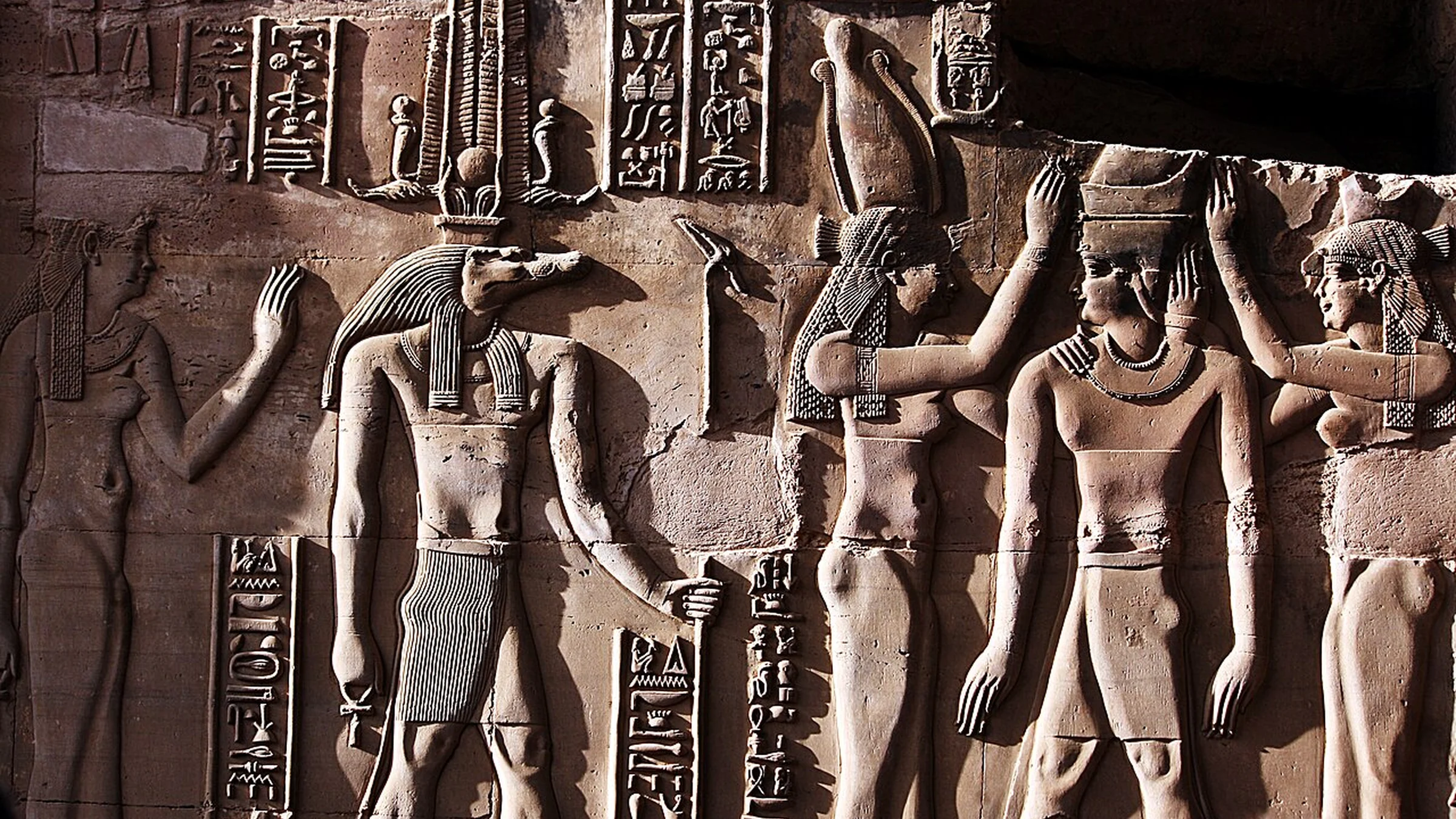
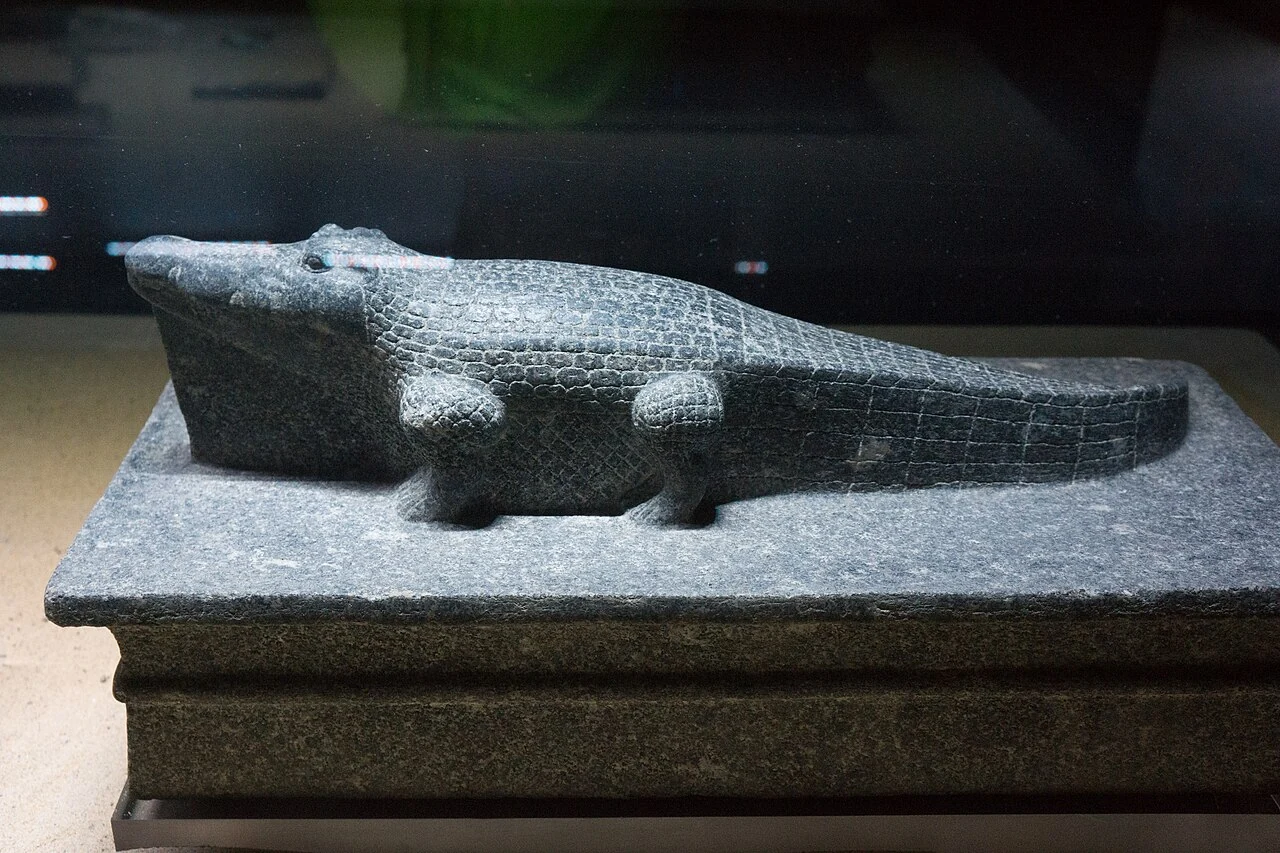
Sobek’s most immediately recognizable feature is his elongated crocodile head. In wall scenes his body may be unmistakably human: he stands upright, wears a kilt and carries ritual insignia. Other depictions show a full crocodile, sometimes resting on a shrine or standard. Neither form is simply a disguise. Egyptian divine art frequently combined human and animal features to communicate attributes and relationships, rather than to describe what a deity supposedly looked like in ordinary life.
The crocodile head, crown and solar disk
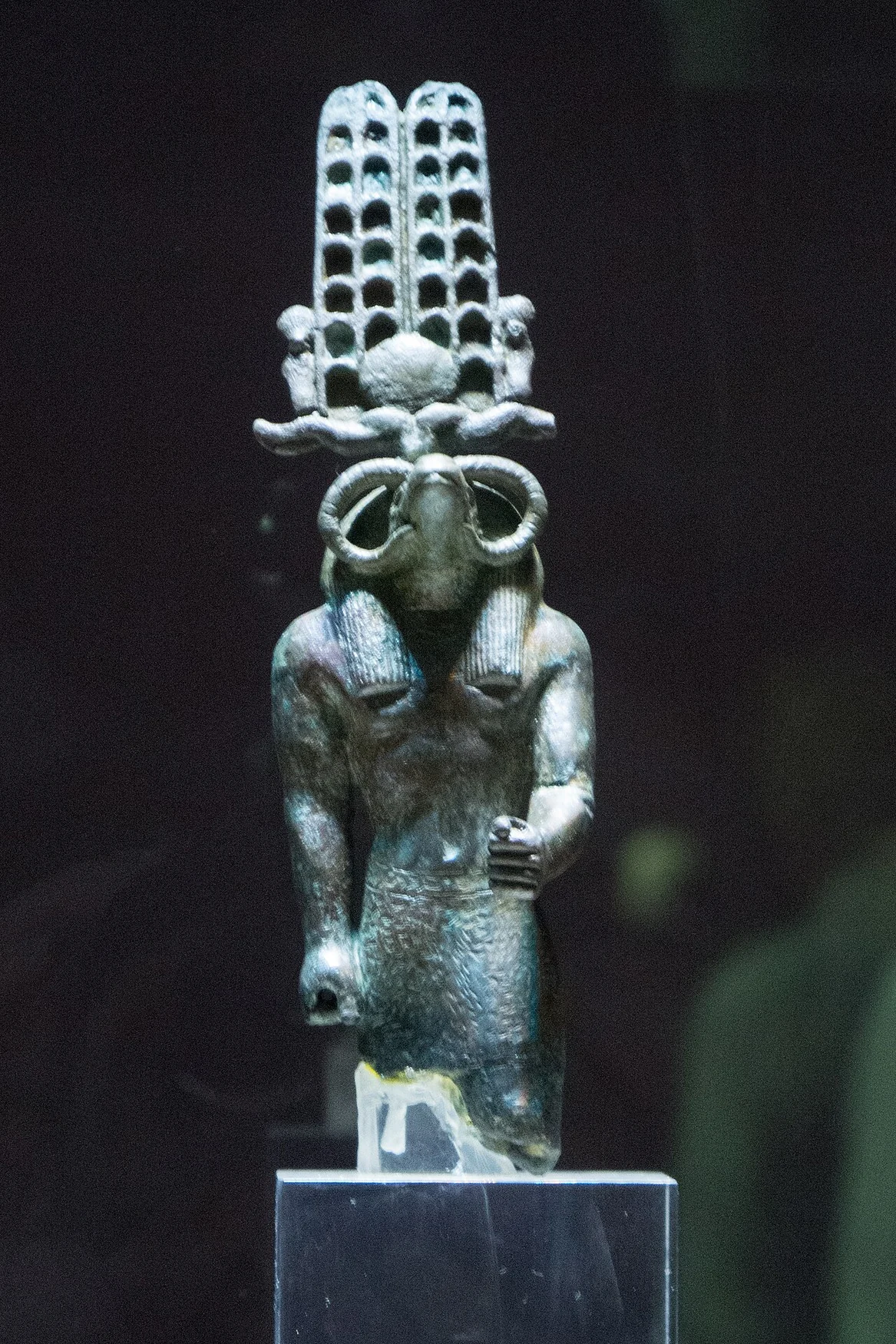
His crown often includes high plumes, a sun disk and curved horns, especially when his connection with solar powers is emphasized. A sacred cobra may appear as another royal or protective marker. Yet these features are not a universal checklist. A small crocodile figurine with no crown may also represent Sobek, while a crocodile-like form in a different context can require more careful identification.
The ankh, was-scepter and life-giving symbolism
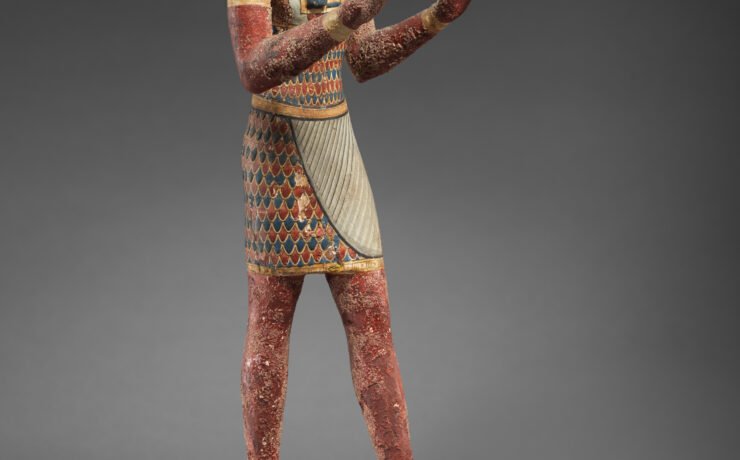
Images of Sobek may include an ankh, the sign of life, and a was scepter, associated with dominion and power. These are shared elements of Egyptian divine iconography, not weapons unique to Sobek. On an ostracon now at the Met, accession 29.2.23, he stands with a decorative staff and water plants, surrounded by symbols of fertility. The combination gives the reptile’s dangerous force a more complex meaning: strength joined to life and abundance.
The inscription beside a figure, its findspot and its archaeological date matter as much as its shape. A crown alone does not establish which manifestation of the god is intended. Some objects with combined crocodile and falcon attributes illustrate specific regional forms, so an unfamiliar hybrid should not automatically be dismissed as an artistic mistake.
Sobek in the Pyramid Texts: an early god of overwhelming power
The Pyramid Texts, inscribed in royal pyramids during the Old Kingdom, offer some of the earliest surviving evidence for Sobek’s religious significance. In the sequence normally cited as Pyramid Text 317, the deceased king identifies with Sobek in striking language that emphasizes the reptile’s vitality and presence. The Egyptologist Edda Bresciani discusses the passage in the chapter “Sobek, Lord of the Land of the Lake,” published in Divine Creatures: Animal Mummies in Ancient Egypt (2005).
Within this early religious text, Sobek is linked to a mighty divine mother through a mythic description of origin and emergence. Bresciani notes his epithet associated with Shedet in the Fayum. The passage belongs to the world of royal transformation and divine identification. It should not be read as a modern zoological origin story, nor as proof that all Egyptians at every date believed in exactly the same family tree for Sobek.
This early attestation matters because a popular account may suggest that crocodile worship began when late Greek or Roman visitors encountered Egyptian temples. It did not. The surviving history of Sobek reaches much further back, although the scale, organization and local forms of his cult changed across dynasties. A later monumental sanctuary can be the most visible part of an older religious tradition.
The Oxford Academic chapter record is particularly useful here because it ties a specific text citation to the history of the god, rather than relying on an unattributed summary of “ancient Egyptian beliefs.” Readers interested in the wider purpose of royal funerary texts can also consult Kemet Vault’s guide to the Pyramid Texts, Coffin Texts and later afterlife books.
Why the crocodile symbolized both danger and protection
A Nile crocodile was an immediate, material threat in ancient Egypt. Crossing waterways, working near the river or moving animals toward the water all required caution. The Met’s scholarly bulletin An Egyptian Bestiary discusses the crocodile as a powerful adversary and an important presence in Egyptian magical thinking. That is the starting point for understanding the apparent contradiction at the center of Sobek’s cult.
For an ancient worshipper, danger and sacred power were not mutually exclusive. A deity might command the very force people feared. Ritual offerings could seek protection from that force or petition it to act beneficially. Sobek therefore makes sense within a religion concerned with maintaining relationships between people, nature and divine agencies. The animal’s capacity to destroy did not cancel its associations with survival, regeneration and fertile land.
A famous tale preserved in the Middle Kingdom literary tradition, the Westcar Papyrus, describes a crocodile made from wax becoming real by magical means. It reveals the cultural imaginative power of the animal. However, the tale’s crocodile should not automatically be called Sobek: not every crocodile in Egyptian art, magic or literature is a direct named appearance of this god. Distinguishing a dangerous reptile motif from an explicit cult image is precisely what careful historical interpretation requires.
The Met’s New Kingdom scarab 09.180.1008, which combines the crowned Sobek with symbols interpreted as the cobra goddess Wadjet, helps reveal another dimension: crocodile power could intersect with divine protection and royal legitimacy. A small object of glazed faience thus illuminates concepts also visible on monumental temple walls.
The Fayum: Sobek’s sacred landscape of lakes, fields and kings
For centuries, one of Sobek’s greatest centers was the Fayum, a region west of the Nile Valley whose lake, marshes and cultivated land created an environment closely connected with water management. The town of Shedet became famous in Greek sources as Crocodilopolis, reflecting the importance of its crocodile cult. The association is not merely a modern nickname: ancient Egyptian inscriptions preserve the god’s identification with Shedet.
During the Middle Kingdom, the Fayum became a focus of royal development and investment. Kings of Dynasty 12, including Amenemhat III, are closely associated with this landscape and its monuments. Sobek’s religious importance fitted a region where fertility, lakes and state power converged. The link between the god and kingship is attested in collections such as the Met’s crocodile-on-shrine object, but royal and local religion should not be treated as identical institutions.
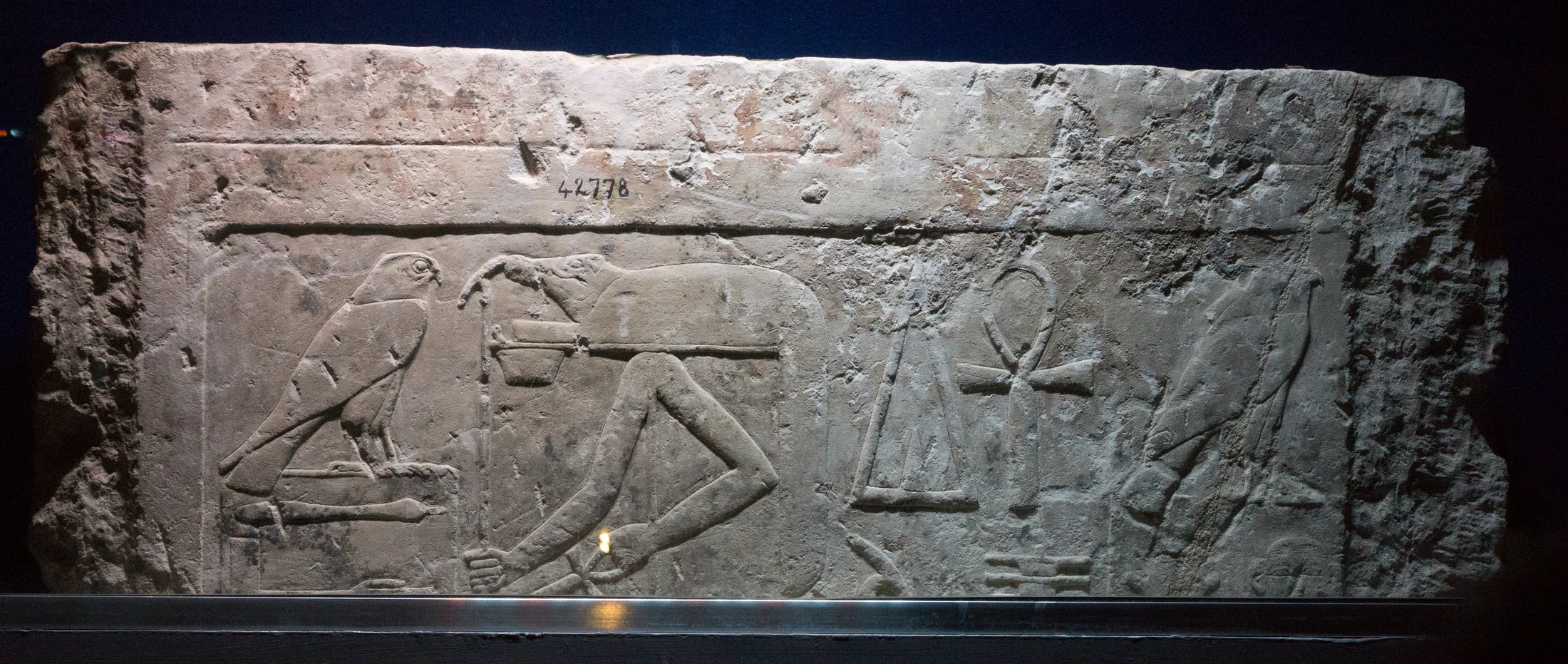
A particularly revealing source is a Middle Kingdom limestone statuette of a priestly overseer named Ameny, accession 66.99.6 at the Metropolitan Museum. Its offering inscription invokes Sobek of Shedet, providing an individual human and a local title rather than an abstract story of crocodile worship. Another relevant object is the decorated panel associated with Kiman Fares in the Fayum, photographed on display at Kom Ombo’s Crocodile Museum. It shows how the god’s image could be incorporated into offerings and sacred representations.
The Fayum should not be imagined as one unchanging crocodile temple surrounded by empty marshes. Across Egyptian, Ptolemaic and Roman history it was a complex inhabited landscape with settlement, agriculture, documentary writing and different cult places. The changing levels and use of its waters contributed to a long interaction between geography and worship. The name of the same god could connect different villages and religious communities without erasing local differences.
Sobek-Re and Soknopaios: one god, different local forms
Egyptian deities could share attributes or combine in explicitly named theological forms. Sobek-Re joins crocodile symbolism to the solar power of Re. This did not require Egyptians to erase the older associations with the Nile. A sun disk crowning a crocodile-headed deity could make a theological statement about life, kingship and the rhythms of cosmic renewal.
The Fayum also offers a more distinctive example: Soknopaios, a Greco-Egyptian form connected with Sobek of Dimeh. The Met’s catalogue for a small falcon-headed crocodile, accession 30.8.307, cautiously identifies the figure as possibly Soknopaios. Its combination of crocodile and falcon features is particularly instructive because the museum explicitly distinguishes a plausible interpretation from certainty. This is the right level of care for fragmentary or unusual divine art.
The temple of Soknopaios Nesos at Dimeh, in the Fayum, flourished under the Ptolemies and Romans. Local religious practice could incorporate familiar Egyptian ideas alongside forms and languages used in the Mediterranean world. An evocative name or an unusual image is not proof of a single standardized Egyptian theology. The Book of the Fayum, known from later manuscript traditions, presents a sophisticated sacred interpretation of the region’s geography and deities; it is one important witness to theological development, not a straightforward tourist map or a text composed by one known author for every Egyptian community.
Scholars compare the cults of the Fayum and Kom Ombo precisely because the same principal god could take on different ritual and mythic emphases. Research into Sobek’s forms and the Book of the Fayum underscores why an encyclopedic account must preserve local names and dates rather than collapsing all crocodile deities into a single unchanging narrative.
Kom Ombo: the extraordinary double temple of Sobek and Horus
On the eastern bank of the Nile north of Aswan stands one of the most visually compelling monuments of Greco-Roman Egypt: the Temple of Kom Ombo. The sanctuary was dedicated jointly to Sobek and Horus the Elder, also called Harwer or Haroeris. This Horus must be understood within the temple’s local theological setting rather than assuming that every Horus figure refers to exactly the same episode of the Isis–Osiris cycle.
According to Egypt’s Ministry of Tourism and Antiquities, an earlier sanctuary already existed at Kom Ombo during the New Kingdom, but most of the surviving structure belongs to the Ptolemaic and Roman periods. Ptolemy VI is the earliest king named in its existing fabric, and much of the decoration was completed under Ptolemy XII. The temple’s architecture is organized around two parallel ceremonial axes and two sanctuaries. The southern axis is assigned to Sobek, while the northern is associated with Horus the Elder.
Its doubled plan is not merely architectural symmetry for tourists to admire. It expresses the ritual importance of two divine powers in one monumental religious complex. Its images, calendars and ceremonial spaces help archaeologists understand a functioning temple institution. Reliefs connect rulers with gods through formal offerings; texts record religious events and their sequence. The site is a source of theological and institutional evidence, not just an attractive stone backdrop.
Hathor and Khonsu in Sobek’s Kom Ombo theology
At Kom Ombo, Egypt’s official monument guide names Hathor as Sobek’s consort and Khonsu as their son. That is a local cultic grouping. It should not be presented as a universally fixed family accepted in every Egyptian temple. Other texts connect Sobek with the goddess Neith as his mother. The seemingly contradictory relationships illustrate how different theological communities organized their divine worlds. In Egyptian religion, the setting and period are often part of the meaning.
Reading the walls rather than inventing a hidden mystery
Kom Ombo’s reliefs contain kings, divine figures, festival calendars and a much-discussed scene depicting objects generally interpreted as medical or surgical instruments. Egypt’s Ministry dates that particular scene to the Roman period. Such evidence is impressive without claims of impossible technologies, secret scientific prophecies or unrecorded rituals. Good archaeological interpretation begins with what the carvings actually show and where they sit in the temple.

Sacred crocodiles, temple care and crocodile mummies
The belief that a particular crocodile could embody Sobek was central to some forms of his worship. In sanctuaries associated with the cult, selected animals could be maintained as sacred representatives and honored with ritual care. When such an animal died, mummification could form part of the religious response. The Egyptologist Edda Bresciani describes the succession of an individual sacred reptile by another within this pattern of animal cult practice.
But not every crocodile mummy was a singular temple god. In the Late, Ptolemaic and Roman periods, votive animal mummies became an important expression of individual devotion. The Met’s wooden and gilded crocodile mummy mask, accession 12.182.33, is connected with offerings to Sobek, while the Brooklyn Museum’s small crocodile mummy, accession 37.1365E, shows another scale of practice. A range of reptile sizes, preparations and contexts should be expected.
Mummification was itself materially complex. Researchers examine linen, bindings, associated coverings and, where available, imaging or archaeological records to learn about how animals were prepared. The British Museum has discussed a large mummified crocodile with numerous hatchlings attached to its back. Such examples reveal a ritual world much richer than the single idea of preserving a dangerous animal after death.
The Crocodile Museum at Kom Ombo, opened in 2012, displays actual mummified Nile crocodiles and artefacts associated with their cult. The Ministry notes specimens approximately 2 to 4.3 metres long, as well as representations of crocodile fetuses, elements of ornamentation and models explaining burial practices. These are museum descriptions of genuine collections; they are not evidence that every Egyptian worshipper kept a crocodile as a pet.
Modern discussions must also resist romanticizing the cult. A sacred animal could be revered in a ritual setting while ordinary crocodiles remained a serious threat elsewhere. A museum display of mummies documents beliefs, manufacture and animal remains, not a uniform attitude toward every living reptile across Egypt.

Sobek and pharaonic kingship: the force that guards sovereignty
Royal ideology in ancient Egypt often drew on animals to express what human rulers could not demonstrate physically every moment: the strength of a lion, the reach of a falcon or the unyielding power of a crocodile. Sobek’s position in the Fayum during the Middle Kingdom and his connections with other royal and solar deities made him particularly useful to political-religious imagery. The Met explicitly links Sobek’s prominence in the Fayum with the growth of his royal associations.
One remarkable object in the Met collection, accession 26.7.552, shows a pair of opposed crocodiles on a scarab. Its curatorial description notes that the hieroglyphic word for sovereign could be written with two crocodiles. This is a specific example of how crocodiles could participate in the language of rulership. It would be an exaggeration to turn that observation into the claim that every pair of crocodiles everywhere “means pharaoh.” Date, composition and text remain essential.
Royal association also helps explain why an apparently dangerous god could be viewed as a protective force. The king ideally controlled disorder and defended the land; Sobek embodied a formidable kind of power that could be invoked on behalf of that task. This association belongs to religious symbolism, not to verified reports of crocodiles marching alongside Egyptian armies.
Readers exploring the theological relationship between god and ruler may compare Horus and divine kingship. Horus and Sobek have different histories and iconographies, yet both illuminate how Egyptian religious thought described legitimate power and protection.
Sobek as a creator and life-giving water deity
The crocodile god was not only a patron of raw strength. Some later traditions developed a cosmic role for Sobek, linking him with the primordial waters and the renewal of life. The Met’s catalogue of a Ptolemaic faience crocodile amulet, accession 1989.281.96, preserves a mythic explanation in which the Nile is imagined as issuing from Sobek’s sweat. That image is symbolic theology: it should not be offered as a literal hydraulic theory shared by every ancient Egyptian farmer.
His connections with vegetation and inundation are nevertheless intelligible within Nile agriculture. Fertile land depended on water, and Egyptian religious language often represented the natural conditions of growth through divinities and personified forces. In some settings, a crocodile’s movement between watery and dry spaces could make it an especially apt image for a creative power emerging from primordial waters.
The connection to Re strengthened these ideas. A solar crown or a combined name could merge watery vitality with the recurring return of sunlight. Egyptian theology was capable of complex layering: a local god of the lake could also be connected with a much wider cosmic order. See Kemet Vault’s separate study of Re, the solar journey and creation traditions for the solar side of these associations.
That does not mean Sobek replaced Re or that the two gods were indistinguishable. Divine combinations are interpretive developments with their own histories. Treating Sobek-Re as one attested form makes better historical sense than claiming an unchanged pantheon in which every figure had only one job.
What Sobek’s surviving objects actually tell us
A convincing history of Sobek requires an archaeological record, not merely modern retellings. The following objects can be checked directly in public institutional catalogues. Together they show his image across centuries and different materials; none is enough by itself to reconstruct every ritual carried out in his name.
| Evidence | Approximate period | What it reveals | Collection |
|---|---|---|---|
| Crocodile on shrine, 58.76.1 | Ptolemaic | Full-crocodile depiction and religious prominence | The Met |
| Sobek ostracon, 29.2.23 | New Kingdom, Ramesside | Divine dress, water plants and ritual symbols | The Met |
| Ameny statuette, 66.99.6 | Middle Kingdom | Inscribed link to Sobek of Shedet | The Met |
| Crocodile mummy mask, 12.182.33 | Late–Ptolemaic | Animal cult and ritual mummification | The Met |
| Falcon-headed crocodile, 30.8.307 | Ptolemaic–Roman | Possibly Soknopaios, composite local form | The Met |
| Votive crocodile mummy, 37.1365E | Ptolemaic or later | Personal prayer and animal offering | Brooklyn Museum |
Material and context matter. A limestone ostracon used for a drawing and a bronze figure set on a shrine may both show Sobek, but they were not necessarily made for the same audience. The former records the making or circulation of imagery; the latter can document offerings, display and ritual attention. The Met’s object descriptions often specify whether a findspot is secure, approximate or unknown. That caution is as valuable as the striking objects themselves.
Even a small amulet has a historical life: it was manufactured, acquired, used or dedicated, and eventually found or transferred into a collection. When a catalogue gives no confirmed excavation context, an attractive interpretation of its intended wearer remains a possibility rather than proven biography. Museums are strongest when they distinguish the object, the ancient meaning and the modern hypothesis.
What did Greek and Roman observers say about the crocodile cult?
Greek and Roman writers encountered Egyptian practices that could appear unfamiliar to them. Herodotus, writing in the fifth century BCE, discussed differences in crocodile treatment and worship between Egyptian communities. His descriptions are important historical evidence, but they also reflect the perspective, questions and limitations of a particular author. His words should not automatically be treated as a comprehensive account of what every Egyptian believed.
The Greek form Suchos and names such as Crocodilopolis reflect this contact between Egyptian tradition and Greek terminology. Later Ptolemaic and Roman Egypt maintained elaborate religious institutions, while local deities were interpreted and represented in new contexts. A Roman-period object depicting Sobek may therefore express both continuity and change. One cannot infer a uniform national religious identity from a surviving statuette or a Greek place name.
Archaeological evidence balances the literary record. Temple architecture, inscriptions, votive objects, mummies and documentary papyri show the range of practices associated with crocodiles and their divine forms. These sources do not always answer the same question. A text may preserve a hymn; a mummy may reveal burial technique; a temple wall may show ritual performance as an idealized image. Combining them carefully produces a richer account than repeating a single traveler’s anecdote.
Neith, Hathor, Horus and other gods in Sobek’s religious world
Ancient Egyptian divine relationships should be understood as local and historically changeable. One tradition connects Sobek to the goddess Neith, who could be characterized as a primordial creator and mother. The Met’s faience amulet 21.6.46 shows Neith nursing two crocodiles and explains that these could refer to Sobek and another crocodile son, Shemanefer, or represent a solar and lunar interpretation. The museum presents possibilities rather than assigning one reading dogmatically.
At Kom Ombo, however, Sobek belongs to a different principal family grouping with Hathor and Khonsu. These are not errors that a modern writer must force into one family tree. They are evidence of religious creativity in different places. Similarly, composite forms involving Re or potentially falcon imagery do not mean that Sobek and Horus were always the same being.
For an overview of the goddess’s broader roles, explore Kemet Vault’s study of Isis and divine motherhood. Isis is not identified here as a universal spouse of Sobek; her relevance is to the wider Egyptian pattern in which divine kinship and mythology had different emphases in different cult places.
Five misconceptions about the crocodile god
- “Sobek was the Egyptian devil.” Ancient Egyptian religion did not make him a simple universal embodiment of evil. He could be feared, protective, fertile and creative, depending on context.
- “Every crocodile mummy was worshipped alive as the same named god.” Museum research distinguishes selected sacred animals from votive mummies and varying ritual practice.
- “Kom Ombo was a temple only for Sobek.” Its surviving plan is explicitly double, shared with Horus the Elder.
- “All versions of Sobek had the same family.” Neith appears in some traditions, while Hathor and Khonsu form a local grouping at Kom Ombo.
- “Any crocodile figure must be Sobek.” Identifications rely on inscriptions, attributes and context. A narrative crocodile, an amulet and an image of a local composite deity are not interchangeable.
The common thread is the need to read surviving objects and texts in their own historical settings. Explanations that make one Egyptian god the ruler of exactly one element can be entertaining, but they often remove the features that made ancient religious life meaningful.
Where can Sobek’s surviving heritage be seen today?
At Kom Ombo, visitors can see surviving reliefs and the unusual shared temple layout. The neighboring Crocodile Museum displays mummified reptiles and images of the deity. For those planning a cultural visit, Egypt’s official Kom Ombo Temple and Crocodile Museum pages are the right places to check changing opening arrangements and admission details. This article focuses on historical interpretation rather than current itinerary costs.
Beyond Egypt, the Metropolitan Museum of Art and Brooklyn Museum hold documented objects that allow readers to explore Sobek in unusually close detail online. Their catalogues offer object numbers, dates and descriptions that support rigorous comparison. The museums show why the god matters beyond any single temple: an ancient culture’s ideas about power, nature and protection survive in durable material forms.
Researchers tracing the Fayum’s archaeology should also distinguish objects from the Fayum from objects displayed in another place. The photographed Kiman Fares panel in the Kom Ombo museum is useful precisely because its present museum location and its archaeological association can be named separately. The same distinction applies to internationally collected amulets and stelae.
Frequently asked questions about Sobek
Was Sobek good or evil?
Neither description is sufficient. Sobek embodied the formidable strength of crocodiles but was also associated with fertility, life-giving water, kingship and protection. Different texts and local cults stressed different aspects. His religious identity is best understood through specific ancient sources rather than a modern hero-versus-villain label.
Why did Egyptians worship crocodiles?
Crocodiles were dangerous but powerful inhabitants of the Nile environment. In some religious settings, sacred crocodiles could manifest Sobek, while other animals were mummified as offerings. Worship did not mean all Egyptians thought every crocodile was harmless or holy in exactly the same way.
Who was Sobek’s mother?
In important traditions, Sobek was associated with the goddess Neith. The Met records a representation of Neith nursing two crocodiles, potentially depicting Sobek and another crocodile deity. Divine genealogies varied across Egypt, so one relationship should not be imposed on every region or period.
Was Sobek the same god as Re?
No. Sobek-Re was a combined divine form joining crocodile attributes with solar theology. This is a historically attested aspect of Egyptian religious development, not evidence that the separate identities of Sobek and Re disappeared throughout Egypt.
Which temple was dedicated to Sobek?
Kom Ombo is the most visually famous surviving temple associated with Sobek, but it was jointly dedicated to Sobek and Horus the Elder. The Fayum also housed major Sobek cult centres, including Shedet, later called Crocodilopolis, and traditions connected with Dimeh.
Are there real Sobek artefacts in museums?
Yes. The Metropolitan Museum holds an ostracon depicting Sobek, crocodile amulets, a crocodile on a shrine and a crocodile mummy mask. The Kom Ombo Crocodile Museum exhibits mummified crocodiles and Sobek-related objects. Each provides a different kind of historical evidence.
Research sources and photographic documentation
Primary institutional records: The Met, crocodile on a shrine; The Met, Sobek ostracon; The Met, possible Soknopaios; The Met, Neith with crocodiles; The Met, crocodile mummy mask; Brooklyn Museum, crocodile mummy; and Egyptian Ministry of Tourism and Antiquities, Kom Ombo.
Textual and scholarly references: Edda Bresciani, “Sobek, Lord of the Land of the Lake”, in Divine Creatures: Animal Mummies in Ancient Egypt (2005), pp. 199–206; British Museum Ramesseum papyrus records and scholarly bibliography; and The Met, An Egyptian Bestiary.
Photographic evidence: all six pictures are photographs of genuine temple reliefs, ancient objects, the Kom Ombo complex or mummified crocodiles. Each figure identifies its own photographer, original Wikimedia Commons file and applicable reuse license. Photographs were resized or cropped in WebP format for page layout. No fantasy CGI or AI reconstruction is labelled as archaeological evidence.
Scope: This feature reconstructs Sobek’s historical cult from preserved archaeological evidence. It does not claim that every myth or family relation was universally accepted, or that a museum object’s findspot is known unless its documented record permits that conclusion. Source review: 25 October 2026.