The Philae sanctuary of Isis is an unusually powerful place to explore how Egyptian religious traditions continued and changed under Ptolemaic and Roman rule. Its architecture, inscriptions and dramatic modern rescue are part of the same evidence story. It is not a single frozen 'pharaonic' temple from the Old Kingdom, and the site visitors see today is not in its original island location.
A sacred landscape near the First Cataract
The complex developed near Aswan, where Nile channels, islands and connections toward Nubia shaped cultural geography. Egyptian rulers had long engaged with the region, but much of the monumental Philae complex visible today belongs to Ptolemaic and Roman periods. Its importance lies partly in this long continuity: the temple could use ancient religious language and iconography while patrons lived within a much later political world. Visiting the site is not the same as reading it. Walls provide a record of ritual performance and royal representation, but they do not reveal exactly how every priest, pilgrim or traveller understood Isis. Regional practices, language traditions and later transformations all deserve attention.
Architecture, reliefs and political legitimacy
The sanctuary includes monumental gateways, courts, columned spaces and the Temple of Isis, along with other structures from successive phases. Royal and imperial names in Egyptian temple scenes demonstrate that Ptolemaic kings and Roman emperors took part in a visual tradition of presenting themselves before Egyptian deities. The depiction of a ruler making an offering is not evidence that the emperor personally visited on that date. Architecture can record changes in patronage across reigns, while inscriptions define sacred activities and mythological relationships. Comparing buildings is especially useful here because 'Greek', 'Roman' and 'Egyptian' are not mutually exclusive visual categories; the political era, local religious setting and artistic tradition can coexist.
Why Philae is a Ptolemaic and Roman sanctuary, not an Old Kingdom time capsule
Philae is frequently labelled an 'ancient Egyptian temple' without a useful chronology. The sanctuary certainly drew on long religious traditions, but most surviving monumental architecture belongs to the Ptolemaic and Roman periods. The Egyptian Ministry of Tourism and Antiquities identifies the prominent temple begun under Ptolemy II Philadelphus and dedicated to Isis. Earlier structures and sacred associations existed, and the surviving kiosk of Nectanebo I is important for understanding the late pre-Ptolemaic phase. Archaeologists must distinguish the probable earlier sanctuary from the buildings the visitor can inspect now. A carved royal offering scene from a Ptolemaic ruler is evidence of that ruler's representation within Egyptian cult, not proof that the whole building was erected by a pharaoh of the Pyramid Age. This article treats the fabric, inscriptions and successive patrons as separate evidence strands. The practical route to Agilkia and current ticket arrangements belong in the site's companion visitor guide, not in a source-critical account of the cult.
Reading the first pylon as a monument of political theology
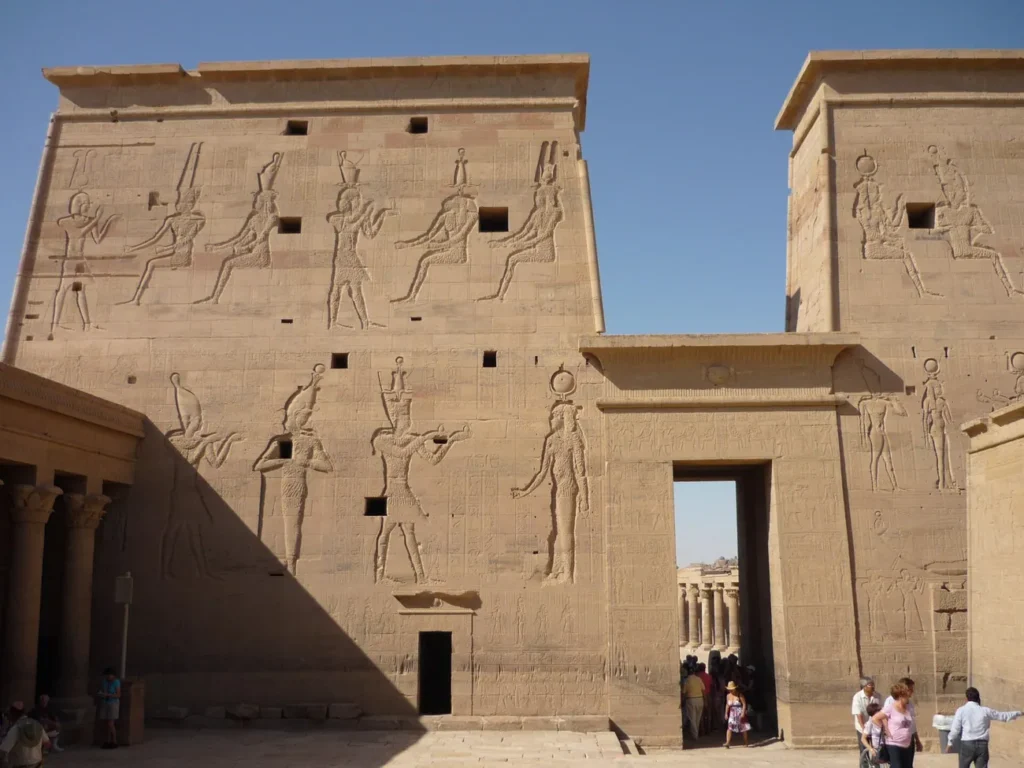
The original photograph of Philae's first pylon shows its massive gateway and relief-covered walls. A pylon is part of an architectural sequence that regulates movement toward inner sacred spaces; it is also a surface for presenting royal power. Scenes of offerings and ritual acts should be read as idealized temple imagery produced under particular patrons, not as everyday snapshots of imperial administrators performing those rites in person. The details matter: royal cartouches, named deities, the arrangement of figures and adjacent inscriptions provide clues to phase and function. The pylon's appearance is also a product of later damage and twentieth-century relocation. Dating every visible block simply by the most prominent king would overlook reused elements and successive construction. For an informed interpretation, visitors should compare the published monument catalogue and the Egyptian antiquities authority's site record. The accompanying photograph shows the reconstructed monument at Agilkia, not its original position on the now-flooded island.
Courts, colonnades and the gradation of sacred access
Moving conceptually from the forecourt toward the sanctuary helps explain Philae's architecture without turning this historical page into a walking tour. Exterior courts and colonnades mediated processions, visibility and circulation, while inner chambers had different ritual roles. Not every part of a temple was accessible to every person at all times, and a surviving doorway does not tell us the full social history of the visitors who passed through it. Decorated surfaces belong to an ordered religious environment, but the order itself evolved as buildings were expanded. Capitals, screen walls and gateways can combine distinctive Egyptian architectural practices with the political realities of Ptolemaic and Roman patronage. To interpret a photograph accurately, identify the exact building and direction of view; an attractive column photograph without that identification is weak documentary evidence. At Philae the island's rebuilt setting complicates spatial interpretation further, so an archaeological plan and conservation history should accompany photographs of significant structures.
The mammisi and the divine birth of Horus
The mammisi, or birth house, is essential to Philae's religious imagery because it presents the divine birth of Horus and his relationship to Isis. The Egyptian antiquities authority identifies a scene of Isis nursing the child in the marshes. A modern reader may be tempted to treat this as a literal natural-history account, but the relief belongs to mythic and ritual language. The narrative connects motherhood, royal succession and protective power in a space designed for ceremonial meaning. The same goddess can have overlapping identities across Egyptian regions and centuries, and a scene's function depends on its location and the surrounding inscriptions. Understanding the mammisi requires looking beyond one famous picture to the programme of texts and representations, as well as the building's historical patrons. Readers should also distinguish this particular Ptolemaic-period institution from Old Kingdom birth beliefs, which are documented in very different textual and monumental settings.
Isis, Osiris and Horus: mythic narrative versus archaeological fact
A history of Philae must explain the goddess to whom its principal temple was dedicated, but explanation does not require portraying mythology as observed fact. Isis appears within complex relationships involving Osiris, Horus and royal legitimacy. Her reputation for protection, magic and devoted kinship is documented across a wide body of texts and images rather than being invented by a modern travel narrative. At Philae, royal offering scenes, sacred birth imagery and Osirian themes form a local ritual discourse. Different passages and buildings may emphasize different relationships. A careful article states that an image 'depicts' Isis protecting Horus, not that archaeology has proven divine intervention. This distinction also prevents a popular retelling of one myth from being used to interpret every relief indiscriminately. The site's imagery is evidence for what people expressed, commissioned and maintained, while the private beliefs of every priest, worker or pilgrim remain beyond direct recovery.
Roman emperors in Egyptian dress and what those images demonstrate
Philae preserves evidence that the Roman imperial state could be represented through an Egyptian religious visual language. Augustus, Tiberius and later emperors appear in temple contexts as patrons or idealized ritual participants. Such scenes can express political legitimacy and the continuity of ceremonial frameworks across a change of regime. They do not prove that the named emperor visited the sanctuary, participated personally in each rite or shared every priest's private faith. The contrast between the political administration of Roman Egypt and the local language of temple decoration is central to the site's significance. The Temple of Hathor and neighboring monuments also reflect building programmes extending beyond the principal Isis sanctuary. The Ministry's site record identifies construction under Ptolemy VI and Augustus in the Hathor complex. A publication that groups these different monuments under the vague label 'Roman ruins' loses the specific evidence of individual patrons, architectural phases and cultic functions.
Isis, Osiris and the interpretation of religious stories
Isis was associated with protection, magic, kinship and royal legitimacy, and her stories developed across varied textual and visual traditions. Philae's iconography connects her with Osiris and Horus, but it would be misleading to treat any one wall as the definitive version of a single fixed mythology. Ancient sacred narratives should be presented as beliefs and ritual texts, not proof of supernatural occurrences. Reliefs also have spatial settings; a scene near an entrance and one within a restricted sacred area could serve different ceremonial functions. The object of research is to understand the evidence for religious practice, rather than to assign a modern universal meaning to every carved image.

The UNESCO rescue and the relocated landscape
The Aswan High Dam and rising waters threatened numerous Nubian monuments in the twentieth century. An international preservation campaign between 1960 and 1980 moved major architectural groups; the Philae complex was transferred to nearby Agilkia Island. This rescue preserved crucial architectural fabric but altered the landscape in which the sanctuary originally stood. The UNESCO World Heritage listing explicitly covers a network of monuments from Abu Simbel to Philae and emphasizes their varied histories. A visitor today must therefore distinguish original carved stone, modern reconstruction joints, museum interpretation and the changed shoreline. Conservation is part of the site's history, not an invisible technical footnote.
Studying Philae without confusing it with tourist advice
Historical documentation should identify which relief, building or inscription supports a claim and whether a photograph depicts its current relocated setting. Practical planning requires separate verification of transport, admission, access and opening times, which can change. Readers can use our cultural guide to Aswan for the living city and Nile islands, and this dossier for a documented understanding of Philae. The site also invites comparisons with Edfu, Dendera and Nubian monuments, provided each comparison respects different dates and purposes.
The Gate of Hadrian and an unusually revealing relief programme
The second real photograph depicts the Gate of Hadrian at Philae, a Roman-period gateway carrying meaningful religious images and inscriptions. It is not the same monument as the first pylon or Trajan's open-columned kiosk. UNESCO emphasizes the symbolism associated with Osiris at the gate, while photographs of its individual panels allow close attention to the imagery. A decorated gateway must be read as part of an ancient religious and architectural programme, not as proof that a Roman ruler authored every line preserved there. Exact wall location and inscriptions matter for scholarly discussion. They also matter when using photographs: a caption naming the Gate of Hadrian should not be attached to a different tourist-facing structure just because both stand on Agilkia Island. Carole Raddato's photograph documents the actual gateway as visible in February 2020. It records the modern state of surviving and reassembled material, not an untouched entrance photographed in antiquity.
The image of Hapi: iconography and the Nile's sacred geography
The third photograph zooms in on the north wall of the Gate of Hadrian, where the Nile deity Hapi is depicted in a cave-like setting with a surrounding serpent. This specific panel is a stronger historical teaching aid than a generic landscape view because the reader can compare a named iconographic subject with a verified location. The Nile had practical importance for water, transport and agriculture, but religious images express symbolic relationships that cannot be reduced to an engineering diagram. The relief presents a sacred vision of the river's source and abundance, rather than an empirical map of hydrology. Even well-known gods may be portrayed differently at separate temples and times. We should therefore describe this as one identifiable representation at Philae, not 'the definitive' Egyptian conception of Hapi. The image also demonstrates why object-level captions are useful: a close photograph can preserve evidence hidden in a panoramic shot, while still requiring inscriptional and architectural context.
The final dated hieroglyphic text and why its date matters
A particularly important late inscription at Philae was made by Esmet-Akhom in 394 CE, during the later Roman period. The Egyptian Ministry identifies it as the last known dated hieroglyphic text. This wording is important: it does not establish the last moment anyone anywhere could read a hieroglyph, nor does it prove that all forms of Egyptian writing ended that year. Its preservation documents a highly specialized writing tradition still in use within a religious context. Scholarship connects this late inscription with the Gate of Hadrian and an image associated with the Nubian deity Mandulis. The southern frontier setting matters because Philae's network of worshippers and inscriptions was not limited to a single ethnic or political community. Epigraphic history examines the surviving marks, ancient dating formulae and archaeological context together. The photograph here shows a separate Hapi relief, not the Esmet-Akhom graffito; no image should be falsely identified as that text merely for drama.

Demotic inscriptions and a later ending than the hieroglyphic date
The year 394 CE is an important milestone but an incomplete endpoint for Egyptian-language written evidence at Philae. Demotic inscriptions continued into the fifth century. Scholarship on the latest dated Demotic graffiti has refined the reading of Philae 365, placing a particular dated text in December 452 CE; the day has been reassessed in specialist literature. Other inscriptions may be late without carrying the same direct calendar anchor. The careful formulation is that these are among the latest known dated examples of Demotic, not that all Egyptian-speaking communities immediately disappeared. Philae's inscriptions also include Greek and other scripts, reflecting a complex linguistic environment. The history of a writing system is not identical to the history of a language or the beliefs of the people using it. Readers comparing a 394 hieroglyphic inscription with a 452 Demotic one should ask which script is under discussion and whether the text is securely dated or merely assigned by style.
Late antique religion, Nubian participation and Christian transformation
Philae's late history intersects with communities from south of the First Cataract, changing imperial policy and Christian religious institutions. Archaeological writing about the sanctuary includes Nubian worshippers and priests, and some late inscriptions were produced in spaces that suggest shifts in access and authority. It is misleading to narrate this as one abrupt event in which an entire culture vanished overnight. The Egyptian antiquities authority associates the final closure of the temple's traditional cult with the period of Justinian I in the sixth century and notes Christian adaptation of part of the complex. Physical alterations, damaged reliefs and reused spaces can provide evidence for that transition, but each needs dating and context. The differing trajectories of hieroglyphic, Demotic, Greek and Coptic should be investigated rather than blended into a single 'end of ancient Egypt'. A serious account recognizes coexistence, dispute and change across generations, while avoiding ungrounded claims about the private beliefs of every inhabitant.
Agilkia and the preservation paradox: authentic stone in a moved setting
The Philae sanctuary seen today is on Agilkia Island, not the original Philae island. As rising water threatened Nubian monuments, the UNESCO-led international campaign rescued major structures; the ancient buildings were dismantled and reassembled on higher nearby ground. The project's extraordinary achievement also changed the setting in which the complex is experienced. Conservation documentation helps distinguish original stones and carvings from modern intervention, alignment adjustments and landscape design. This matters for photographic interpretation: a high-resolution contemporary picture can show authentic ancient reliefs while recording an explicitly twentieth-century arrangement. UNESCO treats the relocated Philae component within the broader Nubian Monuments World Heritage property, alongside separate sites and histories. The rescue does not make the monument 'fake', but neither does it justify pretending the modern approach and shoreline reproduce antiquity perfectly. Educational content should explain both preservation success and the loss or transformation of contextual relationships; practical tickets and boats remain a separate visitor-service question.
Evidence comparison and key distinctions
| Topic | What the evidence establishes |
|---|---|
| Earliest surviving structure | Kiosk of Nectanebo I; earlier sacred history cannot be reconstructed solely from current architecture. |
| Isis sanctuary | Much surviving architecture constructed or decorated in Ptolemaic and Roman periods. |
| Ptolemy II | Principal Temple of Isis begun in his reign according to Egyptian antiquities authority. |
| Mammisi | Ritual birth-house imagery concerning Isis and Horus, not a literal biological record. |
| Gate of Hadrian | Roman-era gateway and significant religious iconography; distinguish from Trajan's Kiosk. |
| 394 CE | Last presently known dated Egyptian hieroglyphic inscription, Esmet-Akhom, not the end of all Egyptian language. |
| Fifth-century Demotic | Dated writing continued after 394 CE; specialist readings of inscriptions refine the precise 452 CE day. |
| Relocated modern setting | Ancient carved fabric reassembled at Agilkia through the UNESCO Nubia rescue campaign. |
Frequently asked questions
Was Philae built by the Pyramid Age pharaohs?
No. Earlier sacred activity may be present, but the prominent surviving Isis sanctuary is predominantly Ptolemaic and Roman, with older late-period elements.
Did Roman emperors personally make every offering shown on its walls?
The reliefs represent idealized royal cult and legitimacy. Their imagery is not proof of an emperor's personal visit.
Is the last dated hieroglyphic inscription from Philae?
Yes. Esmet-Akhom's inscription is dated 394 CE and is generally treated as the latest known dated hieroglyphic example; Demotic writing continued later.
Is the temple still on its original island?
No. The archaeological buildings were moved from Philae to Agilkia to protect them from flooding; the preserved stonework is ancient but the island context changed.
References, museum evidence and photography credits
All cited providers and institutions should be consulted at their original sources. Photographs below document the actual Abydos excavations, Egyptian archaeological landscapes and Philae monuments at recorded modern dates. They are not artistic reconstructions or images of ancient life.
- UNESCO — Nubian Monuments from Abu Simbel to Philae
- Egyptian Ministry of Tourism and Antiquities — Nubian Monuments
- Egyptian Ministry of Tourism and Antiquities — Philae (monuments and dated last hieroglyphs)
- UNESCO World Heritage — Nubian Monuments from Abu Simbel to Philae
- University of Groningen — Religious encounters on the southern Egyptian frontier
- Archaeology Magazine — When Isis Was Queen, Philae's late priests and Nubians
- Nile Scribes — Philae late inscriptions and Demotic dating nuance
- University of Memphis — Philae reliefs and inscription evidence
- Heidelberg University open scholarly research — Philae sanctuary before Ptolemy II
- First pylon Philae1.JPG — Rémih, CC BY-SA 3.0.
- The Gate of Hadrian, Philae, Egypt (49812829886).jpg — Carole Raddato / Following Hadrian, CC BY-SA 2.0.
- North wall of the Gate of Hadrian with a representation of the Nile god Hapi crouched in his cave and surrounded by a serpent, Philae, Egypt (49812288128).jpg — Carole Raddato / Following Hadrian, CC BY-SA 2.0.
Historical-source cross-check and further reading
Evidence and dating note (23 October 2026): Predominantly Ptolemaic and Roman sanctuary; the dated Esmet-Akhom hieroglyphic inscription is 394 CE; relocated to Agilkia during the international Nubian rescue, not ancient.
Original institution or academic research record: https://egymonuments.gov.eg/en/archaeological-sites/philae/
Scholarly reading / comparative reference: UNESCO Nubian monuments campaign, 1960–1980, https://whc.unesco.org/en/list/88/.
Scope: a source comparison of the named historical point, not independent scholarly approval of every claim or every image in this article.