Karanis, modern Kom Aushim in Egypt’s Fayum, offers an unusually detailed archaeological picture of a farming town during the Ptolemaic and Roman periods. Houses, streets, granaries, temples, glass vessels, children’s clothing and written documents survived in a dry environment. Rather than telling the history of Roman Egypt only through emperors, Karanis makes ordinary work and household choices visible. The strongest interpretations combine the excavated objects with the original field notebooks and papyri. This study also examines how the American excavations of 1924–1935 assembled their evidence and why surviving museum collections do not represent every resident equally.
An agricultural town in the Fayum depression
Karanis stood in the Fayum region, where cultivable lands depended on water diverted from the Nile and managed within an oasis landscape. Modern Kom Aushim preserves the ancient site; the physical setting should not be imagined as an isolated desert city with no relationship to irrigated fields. The Karanis Collaboratory at the University of Michigan dates occupation broadly from the third century BCE to the fifth century CE. This long history means that buildings visible in the ruins were not necessarily occupied at the same moment. Fields, transport routes and water availability linked the town to wider Egyptian economies under changing dynasties and emperors. A settled agricultural community required storage, access to labour and ways to transport produce. Those needs did not erase religious or social differences among inhabitants. The site’s importance is a combination of ordinary objects and contextual excavation records rather than a claim that it was the largest or richest Roman town in the Nile Valley. Researchers reconstruct a changing settlement from layers, not a frozen model of one ancient afternoon.
A foundation and a history longer than Roman rule
Karanis originated during the Ptolemaic age following the Macedonian conquest of Egypt, centuries before Roman annexation in 30 BCE. The University of Michigan’s childhood archaeology exhibit describes its foundation around 250 BCE and later expansion under Roman government. Such figures should be treated as approximate period markers, not a city charter excavated on a single foundation stone. The archaeological sequence includes houses and installations associated with different periods. Early and late phases can be confused if photographs show walls from separate levels side by side. The site also continued through changing religious and economic circumstances into late antiquity. A Roman name for a period is therefore not a claim that all inhabitants spoke Latin or understood themselves primarily as Roman citizens. Greek and Egyptian linguistic and social traditions existed under wider imperial structures. Compare the Roman conquest study for political chronology; the Karanis investigation narrows the question to how people adapted within one particular agricultural town.
What the Michigan excavations actually found
The University of Michigan excavated Karanis between 1924 and 1935 in a programme associated with Francis W. Kelsey, initially under J. L. Starkey and later under Enoch Peterson. The Kelsey Museum’s own history records large quantities of finds from ordinary structures, including thousands of artifacts preserved with unusually detailed excavation records. The Karanis Collaboratory gives 46,415 artifacts and more than five thousand archival photographs associated with the expedition. These numbers refer to a research archive, not to a count of all possessions used in the town’s history. Excavations did not recover every building and were affected by earlier digging for fertile soil. Field labels recorded rooms and strata, offering more context than an isolated market-purchased object usually possesses. Even so, earlier archaeological methods had different assumptions from those of contemporary archaeology. The continuing task is to link field diaries, individual objects, photographs, maps and papyrus editions without mistaking an old interpretation for an eternal fact. Modern scholarship can test past labels against new evidence rather than merely celebrating the original expedition.
Domestic houses, rooms and evidence for rebuilding
Karanis is especially important for the archaeology of houses. Multiple floors, storage spaces, wall surfaces and activity deposits help historians ask how households were organised. The Kelsey Museum describes excavated occupation strata spanning Ptolemaic, Roman and later centuries, with lower, middle and upper sequences that could sometimes be difficult to separate. A wall excavated beside a stair may belong to a different building phase from the one pictured in the same wide-angle photograph. The appearance of a multi-storey dwelling is partly an archaeological interpretation derived from construction and collapse patterns. Household activities could shift across rooms or generations. Grain storage, cooking, textile work and other tasks should be inferred from assemblages rather than from assumptions about the modern family. The famous dry environment preserved organic material that is often lost in wetter settlements. This makes the houses rich in evidence, but it does not mean the inhabitants were uniquely unusual. Karanis survives well enough to illuminate wider questions about housing, labour and adaptation in Roman Egypt.
Granaries and the material foundations of farming
Large storage installations and grinding equipment testify to the town’s place in agricultural production and distribution. The Karanis Collaboratory describes more than ten granaries in the excavated settlement. Such buildings can inform discussions of harvest storage, administration and economic planning, but they do not immediately reveal how many households owned every stored quantity. Papyri and records may describe obligations or exchanges, while archaeological containers preserve evidence of the materials that moved through the economy. Roman taxes played a role in Egyptian agriculture, yet no single granary is proof of a uniform taxation rule. The relationship between state officials, local farmers and property holders changed over centuries. Some food was consumed locally, some stored for future use and some transported. Looking at the material arrangements encourages a more exact history than repeating that Egypt was simply Rome’s granary. A town such as Karanis has a distinct social life, not just an output figure in an imperial wheat ledger.
Papyri, letters and the people behind administrative records
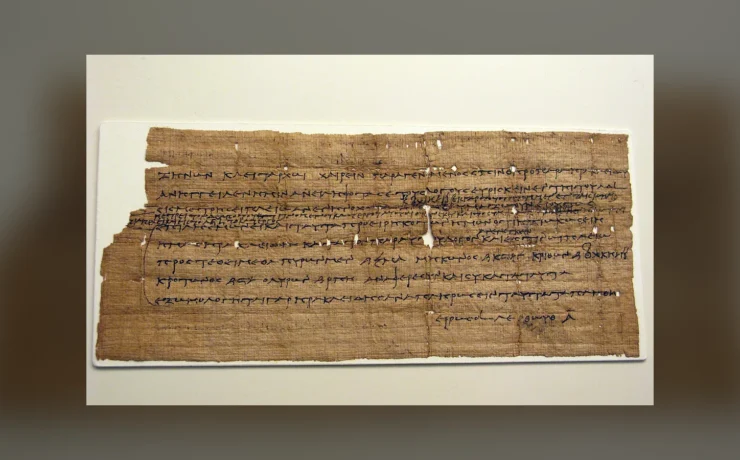
Karanis produced an unusually large collection of papyri and other written materials, including contracts, taxation evidence, personal correspondence and administrative documents. Michigan’s collections retain letters, accounts and records that allow scholars to connect places and, sometimes, named individuals across separate texts. A dated papyrus can sometimes anchor a building or occupation phase more precisely than pottery style alone. But a fragment’s date does not automatically fix the construction date of every wall around it; writing material can be reused or moved. A personal letter is equally not an objective description of all village households. It records a particular sender addressing a particular recipient. The Oxyrhynchus papyri article examines a different Egyptian documentation centre. Reading both sites together highlights shared documentary practices while keeping findspot and excavation history separate. A papyrus recovered at Karanis should not be labelled as an Oxyrhynchus document because both belong to Roman Egypt.
Crocodile temples and the town’s religious landscape
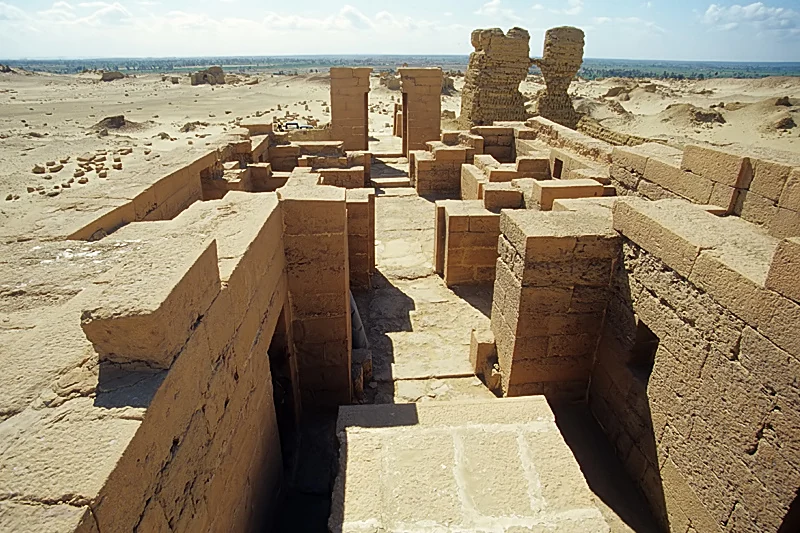
Karanis contained temples associated with local crocodile divinities, including buildings conventionally known as the north and south temples. Their architectural remains are visible in genuine site photographs. The Karanis Collaboratory describes two important stone temples at the heart of the town, but the religious world extended beyond those buildings. Finds associated with jackal gods, household amulets and later Christian practice demonstrate changing and overlapping forms of devotion. The Kelsey Museum even documents a loan agreement involving a priest of Anubis dated to 131 CE, showing how a religious role can intersect with everyday legal documents. One papyrus about a priest does not establish that every household worshipped the same deity. Likewise, a temple monument is not proof that civic life revolved around daily public rituals of one unchanging kind. The Sobek article provides a broader cultural context without confusing a specific town’s excavated temples with every shrine in the Fayum.
The north temple in a documented photograph
The first accompanying photograph shows the interior of the north temple at Kom Aushim, as photographed by Roland Unger in 2003. The image records surviving stone architecture in the modern archaeological setting. It is not a reconstruction of a Roman procession, and it does not prove the exact original colours of architectural surfaces. Weathering, restoration and modern site access affect how the ruins look. To use a documentary site photo responsibly, identify what part of the complex it actually depicts and distinguish the photographer’s date from the building’s ancient period of use. A temple at Karanis can be discussed as part of the town’s religious landscape without assigning every carved surface an undocumented function. The building’s importance comes from its relationship to neighbouring streets, houses and excavated objects. Written sources from the area add further detail, but no single image supplies a complete measured architectural plan. Visitors can contrast real ruins with museum displays, where stone elements may appear detached from the urban landscape that once surrounded them.
Children, clothing and preservation of fragile things
Among the Kelsey Museum’s powerful teaching materials are objects associated with children, including footwear preserved from the Roman era. Its childhood exhibition records a child’s cloth bootie from the Karanis excavations, accession KM 13795, and situates it within roughly the first to fourth centuries CE. Clothing is important because perishable objects rarely survive across many archaeological sites. A sandal or garment can show size, fabric, stitching and wear, but its presence does not reveal the child’s personal name or household circumstances. Objects of play also need contextual interpretation: miniature items are not always toys, and carefully made objects could have ceremonial roles. Studying children shifts attention away from a history organised only around emperors or monumental temples. It also makes the limits of the evidence clear. An exceptional survival from one house is not a statistical sample of all children’s clothing in the Roman Empire. Archaeology has to work with preserved moments while remembering the people and materials that have disappeared.
Glass vessels, doors and the texture of daily work
The excavations yielded glass flasks, wooden doors, locks, storage boxes, sandals and numerous pieces of domestic equipment. Michigan’s Karanis exhibitions identify specific objects by accession and field number: for example a glass vessel with stopper and several wooden household furnishings. Each object reveals a different practical decision. Glass could store or present a substance; a locked door speaks to movement between spaces and securing property; a storage box may have served more than one function over time. If a display includes modern mounts or reconstructed hardware, that information should be included in interpretation. A museum case can misleadingly make unrelated objects look as though they once shared a room. Researchers return to the catalogue and excavation records to establish context. In this sense Karanis is an excellent place to teach the difference between an artefact type and an actual historical household. The number of recovered objects is impressive, but the significance lies in their documented associations and changing use.
Roman military connections without reducing the village to a fort
Veteran settlement and military-related evidence form part of Karanis’s history. A town associated with agricultural land and former soldiers nevertheless cannot be understood merely as an army outpost. The Kelsey Museum’s research discusses Roman military equipment and a later exhibition featuring items such as armour, alongside civilian paperwork and ordinary households. This diversity matters: the town’s residents farmed, traded, maintained religious institutions and raised families. Some individuals may have had military careers, but an object interpreted as military equipment does not make every neighbouring house a barracks. Scholars investigate changes through the first centuries CE and the transition to late antiquity, including shifts in government, language and belief. The Roman state affected taxes, security and administrative demands, yet local social arrangements were not replaced overnight by a standard plan dictated from Rome. Karanis is most valuable when viewed as a complex community within an imperial province, not as a tourist caricature of legionaries marching past the Nile.
Photographs, site conservation and archaeological ethics
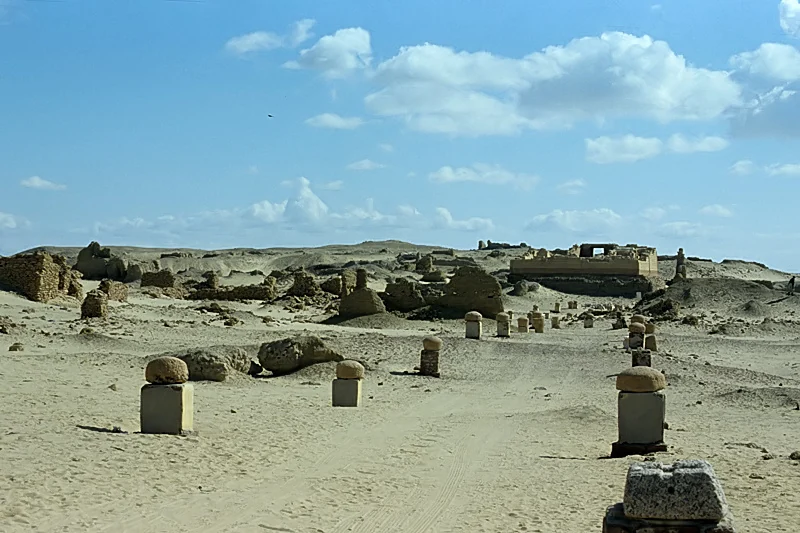
The Michigan excavations were extensively photographed, and modern scholarship can use their archive to reassess changing interpretations. But archaeology also has a colonial and collecting history. Many materials were divided between Egyptian institutions and the university at the conclusion of the expedition under the arrangements of that time. Modern researchers must record where each object is held, how it entered the collection and whether claims of original context are supported by expedition documents. The present archaeological site has faced damage, weathering and changing land use. Contemporary photographs, including the second view toward a temple, show ruins as they survive today; they should not be presented as pictures made by the ancient inhabitants. The most responsible historical story connects site photographs, accession records and papyrus editions while recognising the limitations of early excavation. Researchers and visitors can appreciate the survival of thousands of objects without treating the modern distribution of those collections as a timeless or ethically neutral fact. Clear provenance is part of what makes Karanis useful to students of social history.
Excavation records and independent research
The Kelsey Museum’s Karanis expedition history, the Karanis Collaboratory’s site overview and the Oxford Griffith Institute’s excavation record provide complementary evidence. Object counts refer to particular curated collections and not to the entire population or every artifact originally used at the site. Source review 31 October 2026.