What are the real mysteries of the Great Pyramid? Khufu’s pyramid contains scientifically measured hidden spaces, remarkably accurate alignment and impressive ancient engineering. But stories that its shape prevents meat from rotting, sharpens razors or admits a birthday sunbeam onto a king’s head are not established facts. The famous twice-yearly solar illumination happens at Abu Simbel, not in the Great Pyramid.
Four thousand five hundred years after its construction, the Great Pyramid has genuine unsolved questions. The point of this investigation is to separate documented discoveries, plausible hypotheses and viral legends, with direct links to official Egyptian records, peer-reviewed physics papers and the earliest published history behind the claims.
| Popular claim | Evidence verdict |
|---|---|
| Meat never decays inside the pyramid | Unsubstantiated: temperature and moisture matter |
| Razors stay sharp under pyramid shapes | No reproducible shape-specific effect established |
| Sunlight strikes Khufu on his birthday | Confused with Abu Simbel; no confirmed Khufu birthday illumination |
| A previously unknown large void exists | Confirmed by muon radiography in 2017 |
| A hidden nine-metre north-face corridor exists | Confirmed in 2023 and studied further in 2025 |
| Exceptional alignment to true north | Measured and supported by published surveying research |
Why the Great Pyramid attracts extraordinary claims
The Great Pyramid of Khufu has stood on the Giza Plateau for roughly 4,500 years. It was extraordinarily tall for its age, was faced with finely dressed limestone and contains a complex set of passages and internal spaces. These real features make it an irresistible subject for stories about hidden energies, impossible engineering and lost secrets. The most compelling way to investigate those stories is not to laugh at the questions, but to look at what has actually been measured or found.
This article has a very specific task. It tests popular claims that meat will not decay inside the Great Pyramid, razor blades stay sharp under pyramids, and sunlight hits a king on his birthday. It then follows discoveries confirmed through archaeology, geometry, ancient records and modern muon imaging. It does not replace our complete archaeological guide to Giza, which examines all three pyramids and the surrounding cemetery. A dramatic question deserves an accurate answer, not a second generic overview of the plateau.
Mystery 1: Does meat really refuse to rot inside the pyramid?
The story goes that a piece of raw meat kept inside the Great Pyramid stays fresh or becomes perfectly preserved because of the structure’s special energy. Versions of this claim appeared in twentieth-century pyramid-power literature, sometimes citing animals said to have dried out inside the King’s Chamber. Yet an animal drying out in a particular environment is not evidence for a force produced by a pyramid’s geometric shape. A dry setting can allow tissues to lose water; drying is not the same as keeping food safe, fresh or free of microbial contamination.
The United States Department of Agriculture explains that food spoilage is influenced by microbial growth, temperature and available moisture. A genuinely controlled experiment would require matched meat samples, identical temperatures, humidity and airflow, contamination controls and measurements taken over time. Nothing about the claim establishes that the stone pyramid suspends bacterial activity. Nor would a visually dried sample become safe to eat merely because it looked less decomposed. Verdict: no credible evidence of a pyramid-specific preservation effect.
Some academic-looking papers have proposed investigating pyramid-shaped packaging. Their existence should not be confused with independently replicated proof that such packaging safely preserves meat without normal food controls. The correct scientific test measures microbial growth and environmental conditions against comparison containers, rather than assuming the pyramid effect before the study begins.
Mystery 2: Can a pyramid keep razor blades permanently sharp?
An equally famous claim says that a used razor placed beneath a small pyramid will regain its edge or retain sharpness longer than an identical blade left outside. Czech inventor Karel Drbal became closely associated with this idea, and the claim circulated internationally through the pyramid-power boom of the 1970s. Its popularity is understandable: a tiny cardboard model promising a miracle makes an attractive household experiment. A patent or a personal account, however, cannot by itself demonstrate that a physical mechanism works.
Blade sharpness depends on the geometry and surface of a metal cutting edge, wear, corrosion and how it is used and stored. Keeping a razor dry can reduce corrosion, whether it sits beneath a pyramid or in an ordinary dry container. If a blade seems easier to shave with after storage, that feeling must be separated from objective magnified edge measurements and equal-use controls. Researchers have not established a repeatable shape-specific sharpening effect under such tests. Verdict: the claimed miraculous razor effect remains unsupported.
The history of the claim is itself a genuine curiosity. Modern sources trace the story through pyramid-power enthusiasts and a Czech patent, not through Fourth Dynasty tools excavated from Giza. No ancient Egyptian text has been identified instructing builders to construct pyramids so that future razor blades remain sharp.
Mystery 3: Does sunlight illuminate Khufu on his birthday?
The much-shared story about the sun entering a monument to illuminate the king at special dates has a real Egyptian counterpart, but it is in the wrong place. At the Great Temple of Ramesses II at Abu Simbel, sunlight reaches statues in the inner sanctuary around February 22 and October 22. Egypt’s Ministry of Tourism and Antiquities describes this twice-yearly event, in which three statues are illuminated while the statue of Ptah remains in shadow. It happens at a New Kingdom rock-cut temple far south of Giza, not inside the Great Pyramid of Khufu.
The popular connection of those dates with Ramesses II’s birthday and coronation is a traditional explanation, not a securely demonstrated ancient birth certificate and accession schedule. Different modern accounts even reverse which day is associated with which event. Some twentieth-century descriptions also note that the temple was relocated in the 1960s during the UNESCO Nubian monuments rescue. Neither the existence of this real solar spectacle nor its preservation during relocation proves an identical annual illumination occurs in Khufu’s burial chamber. Verdict: real solar phenomenon, wrong monument and uncertain birthday interpretation.
There is no identified annual event in the Great Pyramid in which sunlight shines through a doorway onto a surviving statue or mummy of Khufu’s head. In fact, no such intact seated statue is present in its King’s Chamber.
Mystery 4: What about the small shafts inside the King’s Chamber?
The Great Pyramid does contain narrow passages extending from the King’s Chamber, commonly called shafts. The northern and southern shafts reach the pyramid’s exterior; other shafts associated with the Queen’s Chamber differ in layout. Their intended ancient functions remain debated, with proposals involving ventilation, ritual symbolism, stellar targets or solar orientation. The important point is that a physical shaft, a measurable angle and a hypothesis about symbolism are three distinct kinds of evidence.
A 2021 published investigation proposed that sunlight could have entered the southern King’s Chamber shaft under particular astronomical conditions. That is a testable scholarly hypothesis, not confirmation of a birthday ritual or a sunbeam striking the head of Khufu every year. The photograph shown in this article depicts the real northern shaft opening from the King’s Chamber as documented in 2010. It is not an image of sunlight illuminating the chamber, and the northern opening should not be used as a picture of the southern-shaft hypothesis. Verdict: the shafts are real; their exact original purpose remains debated.
Statements about the alignment of individual shafts with particular ancient stars must take account of changes in the night sky over millennia. A plausible astronomical alignment is interesting, but should not be presented as a proven map of every spiritual journey imagined by the builders.

Mystery 5: How tall was the Great Pyramid really?
Egypt’s Ministry of Tourism and Antiquities gives an original height of approximately 146.5 metres for Khufu’s pyramid. Its original outer surface was covered in fine pale limestone from Tura, whereas much of the visible structure today is the exposed local limestone core. Loss of outer casing and the upper tip explains why the monument is shorter in its present state. Figures around 138.5 metres often describe its surviving height, but modern methods and reference points can introduce small differences.
When discussing the original height, it is important not to add a modern measurement and a reconstruction of missing stone as though both are equally direct observations. The original figure is derived from archaeological reconstruction and surveys of the form. The Ministry also regards the Great Pyramid as the surviving member of the Seven Wonders of the Ancient World and says the construction took an estimated ten to twenty years. Those are documented historical estimates, not magic numbers hidden in its proportions. Verdict: the giant original height is real and evidence-based.
Mystery 6: Was the pyramid aligned with astonishing precision?
This one is genuinely impressive. Surveyor Glen Dash’s published study of Fourth Dynasty alignment methods notes that Khufu’s casing was aligned to the cardinal directions with an error better than four minutes of arc. That is a small fraction of one degree. It is also a real surveyed feature, not an invented claim about an invisible force field. The builders had access to systematic surveying, observation of the sky and practical geometrical techniques whose use scholars continue to investigate.
Several methods have been proposed, including observations of stars and the Sun. Field tests assess what accuracy the methods could reasonably produce, but high precision alone cannot establish which procedure a particular building team selected. It is therefore fair to celebrate the alignment and unfair to state that it demonstrates lasers, extraterrestrial assistance or knowledge of a modern GPS receiver. Verdict: extraordinary alignment is documented; the precise historical surveying method remains debated.
Measurements can also vary depending on which surviving casing lines are used, preservation conditions and the definition of a monument’s geometric axis. Describing the source and tolerance is stronger evidence than simply claiming the pyramid points perfectly north without any error.
Mystery 7: Did its original white surface shine like a beacon?
The ancient pyramid did not look exactly like the rough stepped stone mass seen in most current photographs. Egypt’s Ministry states that high-quality limestone casing was brought from Tura, south of Maadi, by boat. The monument’s carefully faced exterior would have presented a far smoother and lighter surface than the exposed core seen today. In strong sun, the pale limestone could have been visually striking across the plateau. That conclusion follows from known construction materials.
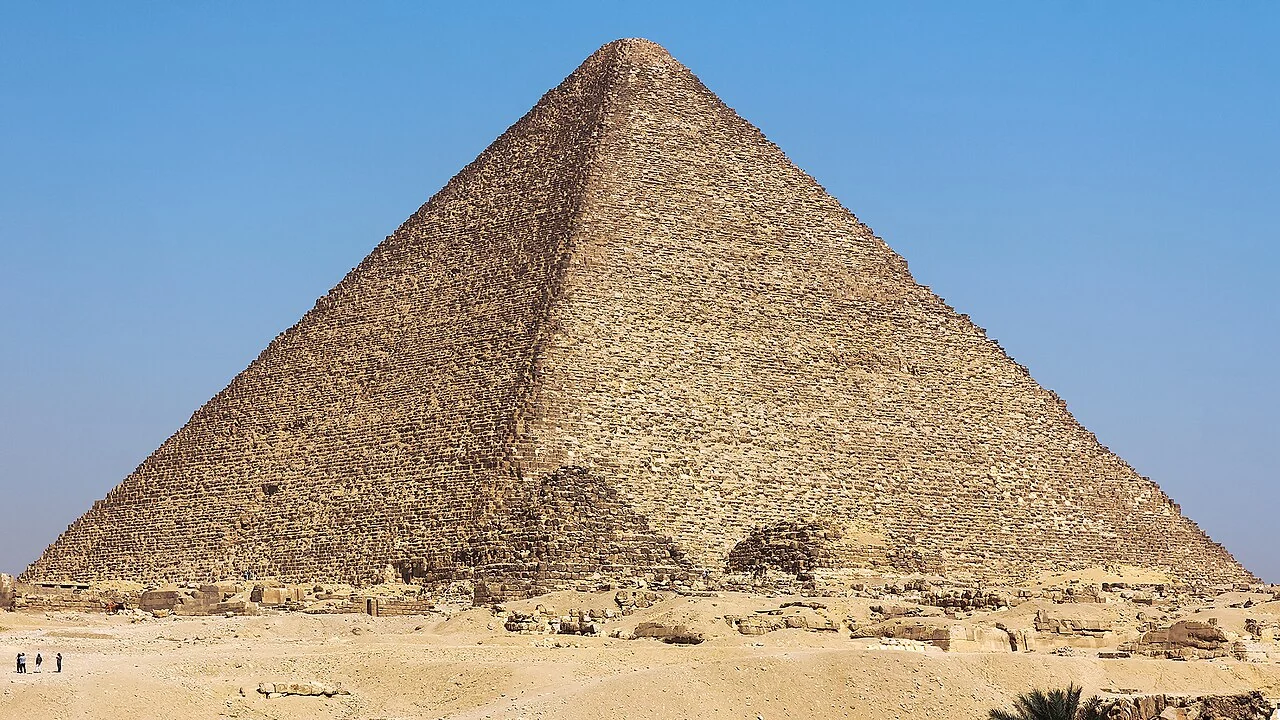
The extent to which the entire monument might have glittered at a particular hour, or could have been seen from a specific distance, is harder to reconstruct. Modern photographs depict weathered masonry, surrounding buildings and an altered environmental context. The opening photograph on this page is an original 2023 view of the real Great Pyramid, not a digitally manufactured recreation of its ancient casing. Verdict: original fine limestone casing is established; extravagant claims about supernatural glowing are not.
Mystery 8: Is there a huge void that no one knew about?
Yes. In November 2017, a peer-reviewed paper in Nature reported a low-density space inside the Great Pyramid at least 30 metres long, above the Grand Gallery. The discovery came from the ScanPyramids project, which used muons, particles produced by cosmic rays that pass through stone at different rates depending on the density of the material. Separate teams used different detector technologies to confirm the anomaly. This is a scientifically measured discovery, not a guess based on drawings.
The researchers named it the ScanPyramids Big Void. Their paper explicitly stated that its exact intended purpose was unknown. There is no evidence in that study for treasure, a hidden king, advanced electronics or an alien engine. Some archaeologists have suggested that internal voids may have served structural or construction-related purposes, but the large space has not been fully characterised by direct entry. Verdict: a substantial previously unknown void is established; its function remains an open question.
This is a more compelling mystery than the razor-blade story because researchers can measure the location of a real anomaly, test it using independent instruments and publish both the result and the uncertainty.
Mystery 9: What was the newly revealed north-face corridor?
In March 2023, scientists and Egyptian antiquities officials announced a previously unknown corridor-shaped space behind the chevron stones near the Great Pyramid’s original north-face entrance. Nature Communications detailed measurements from cosmic-ray muon detectors, while other researchers used ground-penetrating radar and ultrasound. Reports described a corridor about nine metres in length and roughly two metres in both width and height. An endoscope also produced images of the interior.
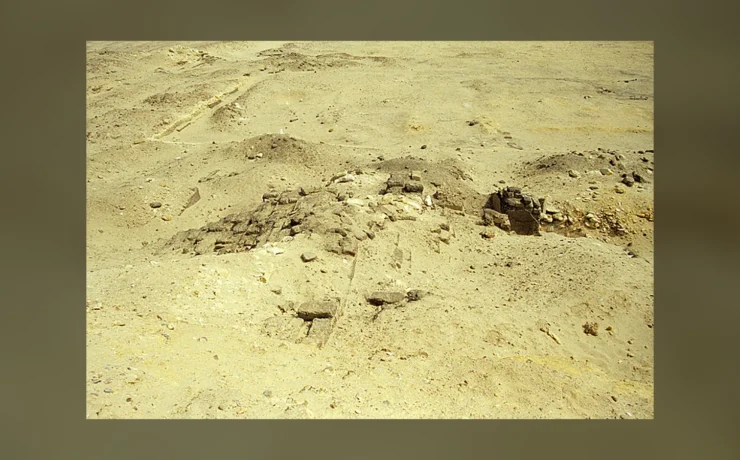
The north-face corridor must not be confused with the longer Big Void detected above the Grand Gallery in 2017. They are distinct locations and separate reported discoveries. One can point to the known chevron arrangement outside the pyramid, but that does not mean the public can freely walk into the sealed scientific investigation space. The second photograph on this page is a 2009 image of the historic northern entrance masonry, not a photograph taken from inside the 2023 corridor. Verdict: the hidden corridor was confirmed; its original use remains uncertain.

Mystery 10: Did later scientists confirm the corridor?
Yes. In March 2025, a paper in Scientific Reports described the ScanPyramids North Face Corridor using a combination of nondestructive techniques and image fusion. The research confirmed earlier observations rather than proposing a completely separate mysterious doorway. This matters when reading headlines about a new chamber every few years: the same space can be studied repeatedly as measurement methods improve.
UNESCO’s 2025 seminar materials also referred to the two major discoveries, the 2017 Big Void and the 2023 north-face corridor, as significant outcomes of ScanPyramids. Continued study has helped refine where previously unknown low-density regions lie, while access and full interpretation remain limited. A measured feature should be identified with its published date and position before anyone describes it as a new find. Verdict: multiple independent techniques support the corridor discovery, not every dramatic theory about what lies beyond it.
Mystery 11: Were the stones moved by unexplained technology?
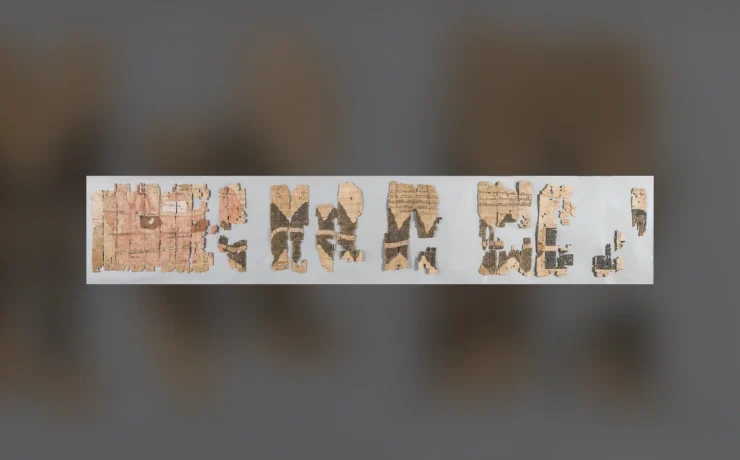
The scale of the pyramid is extraordinary, and the complete construction sequence is not documented in a surviving ancient engineering manual. But there is direct evidence of the people and logistics involved. The Diary of Merer, discovered at Wadi al-Jarf on the Red Sea coast, records a work crew transporting fine limestone from the Tura quarries toward Khufu’s pyramid complex. The Egyptian archaeological edition of the papyri contains the daily administrative record, and studies of the Giza plateau identify a transport infrastructure related to the Nile.
The diary does not describe how every stone was lifted into its final position. It does, however, directly contradict the idea that there is no documentary evidence of ordinary Egyptian teams working on the project. Nearby settlements, workshops and provisioning systems offer other kinds of evidence. For the detailed logistics, Kemet Vault already has a dedicated study of Merer’s work diary; this myth-check article uses it briefly rather than duplicating that full account. Verdict: major construction logistics are directly documented; some lifting techniques remain debated.
Mystery 12: Does its latitude encode the speed of light?
A viral comparison places the figure 29.9792458 degrees north beside the speed of light in a vacuum, 299,792,458 metres per second, and asks whether the matching digits are too perfect to be coincidence. There is a genuine numerical resemblance for one line of latitude passing through the structure. But the number is selected from many possible lines through a large monument, and a latitude alone does not specify a unique point on Earth.
The comparison also depends on contemporary decimal geographic coordinates, the modern metre and a modern definition of seconds, none of which demonstrates an intention by Fourth Dynasty surveyors. A fact-check by Full Fact examined the claim and explained that thousands of alternative lines would also intersect the pyramid. A meaningful historical claim would need evidence that Egyptian builders used the specific units and deliberately recorded the physical constant. Verdict: a selected numerical coincidence, not evidence of an ancient speed-of-light code.
Recognising the selection problem does not diminish ancient surveying achievements. In fact, the accurately measured alignment of the pyramid is more impressive as historical engineering than a numerical coincidence manufactured with measurement units invented much later.
Mystery 13: Was the King’s Chamber a mysterious power plant?
The King’s Chamber is real. It contains a granite sarcophagus, and the entrance route passes through the monumental ascending Grand Gallery. The Egyptian Ministry explicitly describes the sarcophagus as associated with Khufu’s royal burial. Claims that the chamber must instead have been a generator often start from a genuine material fact, such as its granite construction or unusual geometry, and then jump to an unsupported function without archaeological traces of an electrical system.
There is no demonstrated ancient wiring network, functioning electrical apparatus, fuel system or contemporaneous written instruction identifying the Great Pyramid as a machine for generating power. Removing a claim’s dramatic label does not solve all architectural questions. The Grand Gallery’s specific structural role, the internal shafts and concealed spaces remain active topics of research. But a structure can be technically impressive and religiously significant without being a modern factory in disguise. Verdict: the chamber and granite sarcophagus are physical evidence; the power-plant interpretation is unsubstantiated.
Mystery 14: Why is the chamber empty of a royal mummy?
The absence of Khufu’s mummy from the King’s Chamber has inspired many theories. The room contains a sarcophagus, but no intact royal body is present. That does not prove that the pyramid was never a tomb. Burial places across ancient Egypt were robbed, disturbed, reused or partly dismantled at different points in history. A missing body is a problem to investigate with archaeology, not automatic evidence of a completely different original purpose.
Khufu’s other monuments and the wider royal cemetery fit the Fourth Dynasty funerary setting. The Ministry’s site account identifies the Great Pyramid as his tomb, while the surviving internal plan supports a serious investigation of how the burial spaces functioned. The absence of a mummy does mean that some details of the original burial and its later disturbance cannot be reconstructed directly. Verdict: an empty sarcophagus today is real; a secret alternative identity for the monument does not follow from that fact.
Mystery 15: Did the pyramids possess an ancient curse?
Tales of curses follow many Egyptian tombs in modern films, books and social media. They can be entertaining, but a dramatic story is not a documented property of Khufu’s pyramid. The monument is a real royal funerary site, and ancient Egyptians certainly had religious beliefs about protection, sacred space and the afterlife. Those beliefs should be studied through original texts and excavated contexts rather than reshaped into a universal rule that an invisible curse punishes anyone who approaches a pyramid.
Claims of a curse usually rely on coincidences or selectively chosen later events. A responsible historical account would need a known ancient text, a securely identified location, a documented chain of events and evidence that could distinguish the alleged cause from ordinary risks. Our overview of Egyptian funerary literature provides a better foundation than horror-film dialogue. Verdict: fascinating modern folklore, not an established archaeological mechanism.
What an honest pyramid mystery actually looks like
The strongest mysteries are questions with tangible evidence and a method for learning more: what is the precise function of the 2017 Big Void? Why was the 2023 north-face corridor built? Which surveying procedure produced the pyramid’s extraordinary alignment? How were the heaviest elements lifted and installed within a broader documented construction economy? None has to be settled by inventing supernatural powers.
Those questions are interesting precisely because researchers can improve on earlier answers. Muon detectors, radar, ultrasound, archaeological excavation and ancient written documents have distinct strengths and limitations. Their agreement can support a claim more strongly than a viral story repeated thousands of times. The Great Pyramid’s survival, internal spaces and engineering achievement are astonishing enough without asserting that a razor blade sharpens itself or that raw meat becomes safe to eat merely because of geometry.
Use this article as a fact-checking gateway. Continue with the Giza archaeological landscape, Khufu’s historical dossier or the practical visitor guide according to what you want to know next.
Frequently asked questions about the Great Pyramid’s mysteries
Does meat really stay fresh forever inside the Great Pyramid?
No controlled evidence establishes that claim. Spoilage depends on microorganisms, temperature, water and other conditions. Drying is not the same as food safety.
Do razor blades sharpen themselves inside a pyramid?
The pyramid-power story is popular, but the proposed special effect has not been convincingly demonstrated with controlled, repeatable tests. Keeping a razor dry is a separate and ordinary physical matter.
Does sunlight shine on Khufu’s face on his birthday?
No such annual illumination has been demonstrated inside Khufu’s pyramid. The documented event involves statues at Ramesses II’s temple in Abu Simbel, and its traditional birthday interpretation is not securely established.
What was discovered inside the Great Pyramid in 2017?
Researchers detected a low-density void at least 30 metres long above the Grand Gallery using three independent forms of cosmic-ray muon measurement. Its function remains unknown.
What did researchers discover in 2023?
The ScanPyramids North Face Corridor, approximately nine metres long near the pyramid’s north entrance, was confirmed with non-invasive surveys and endoscopic photography. It is separate from the Big Void.
Is the Great Pyramid perfectly aligned with true north?
Its original casing was aligned exceptionally accurately, within a few minutes of arc, but not with mathematically perfect zero error. Scholars continue testing which ancient surveying procedures achieved that accuracy.
Research sources and evidence trail
This article uses original scientific papers, official Egyptian archaeology records and source-identified research on the twentieth-century stories. It does not treat speculative claims as archaeological discoveries.
- Egyptian Ministry of Tourism and Antiquities, The Great Pyramid: original height, casing, three chambers, sarcophagus and royal attribution.
- Nature (2017), Discovery of a big void in Khufu’s Pyramid by observation of cosmic-ray muons: the three-technique confirmation and dimensions.
- Nature Communications (2023), North-Face Corridor measured by muons: the smaller hidden passage.
- Scientific Reports (2025), multimodal confirmation of the north-face corridor: follow-up nondestructive imaging.
- Glen Dash (2015), Journal for the History of Astronomy: measured alignment and field-tested surveying proposals.
- Egyptian Ministry, the twice-yearly Abu Simbel solar event: the correct site of the sunlight phenomenon.
- Skeptical Inquirer: the history of pyramid-power claims and The Skeptic on Karel Drbal’s razor claim: origins and evidentiary weaknesses of the myths.
- USDA Food Safety and Inspection Service: How do bacteria spoil food?: measured variables controlling decay.
- Full Fact: why the latitude-speed-of-light claim is misleading: choice of coordinate and measurement units.
- French Institute of Oriental Archaeology, Wadi al-Jarf papyri translation: Merer’s original work records of Tura limestone deliveries.
Photographic standards: The actual 2023 external pyramid photograph, 2009 north-face masonry photo and 2010 King’s Chamber shaft photo each have a separate author, original record and CC licence. No photograph of an imaginary energy field or supposed Khufu birthday solar event has been passed off as a real historical discovery.