What is Abu Mena? Abu Mena, also called Abu Mina, is the early Christian pilgrimage city south of Alexandria associated with Saint Menas. Its ruins include churches, a baptistery, pilgrim accommodation, baths and workshops. UNESCO inscribed the site in 1979, placed it on the World Heritage in Danger list in 2001, and removed it from that list in 2025 after conservation progress.
The remains tell more than a story of a revered martyr. Abu Mena was a built community where people worshipped, gathered, worked, stayed and carried objects and traditions to other regions. This source-led study separates sacred tradition from archaeology and explains how rising groundwater threatened the ruins, why UNESCO changed their conservation classification in 2025 and what its 2026 decision actually requires.
Where is Abu Mena and why did a city grow there?
Abu Mena stands in the Mariut desert region south of Alexandria, in Egypt’s western Nile Delta landscape. The site is an archaeological settlement organized around a place of Christian veneration associated with Saint Menas. It is not simply one ruined church. UNESCO describes an early Christian pilgrimage center with religious buildings, accommodation, productive workshops, streets and a wider settlement that grew to serve people traveling to the shrine.
Its geography matters. The area lay within reach of Alexandria and Mediterranean connections while retaining a desert character distinct from the city’s dense urban landscape. Pilgrims could cross regional routes to reach the sacred place. Over time, the infrastructure needed to feed, host and organize visitors became part of the archaeological record. Understanding Abu Mena therefore requires both religious history and the ordinary economics of travel, water, craft production and building maintenance.
The UNESCO World Heritage description places the major phase of development broadly from the fifth through seventh centuries CE. Individual structures can have their own histories and phases. A date given for one church or an early shrine should not be used as an unqualified founding year for every surviving wall at the property.
Saint Menas: historical memory and religious tradition
Saint Menas, also rendered Mina or Mena, is a martyr venerated in Egyptian Christianity. The Egyptian Ministry of Tourism and Antiquities connects the pilgrimage center with traditions about his burial in the desert. It recounts the story of a camel carrying the body that would not continue, leading people to interpret the location as the intended grave. That is a tradition of religious memory, not a claim supported by an independently dated travel diary.
The distinction matters because sacred sites often preserve several kinds of evidence: stories that explain religious meaning, material remains of cult buildings and later written descriptions of their importance. The stories can be historically influential even where the precise events cannot be reconstructed by archaeological method. Abu Mena’s significance does not depend on presenting a devotional account as a scientifically demonstrated sequence.
The ministry reports that the shrine had become an important pilgrimage destination by the late fourth century. UNESCO emphasizes the subsequent monumental growth of the settlement. Together these sources suggest a developing sacred center rather than a perfectly planned city completed in a single generation. This gradual expansion offers a better explanation for the complex archaeological layers recorded at the site.
The Great Basilica and the scale of worship
The Great Basilica was one of the most prominent buildings in the pilgrimage complex. Historic photographs show column bases and ruined masonry that help identify parts of the ancient ecclesiastical landscape. Its scale suggests organized patronage, labour and access to building materials, not merely a temporary shelter for a local community. Visitors in antiquity encountered an architectural setting designed to express the site’s importance.
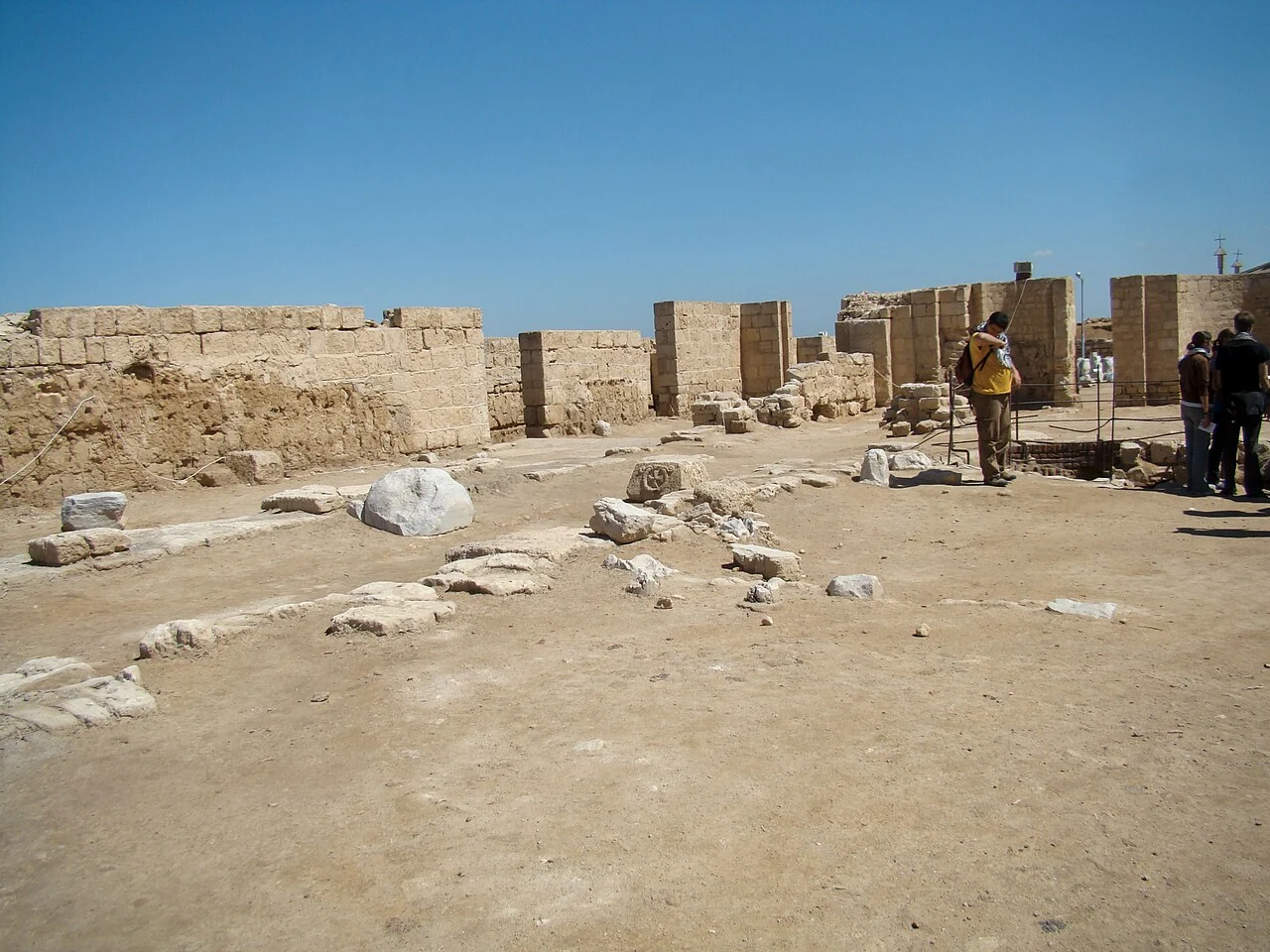
UNESCO describes the ecclesiastical complex as including multiple churches and a baptistery, alongside the tomb church and associated structures. These names should not be collapsed into a single modern church. Distinguishing one building from another is essential when assigning historical images and explaining the layout. The first photograph in this article documents remains of the Great Basilica itself, not a generic church elsewhere in Egypt.
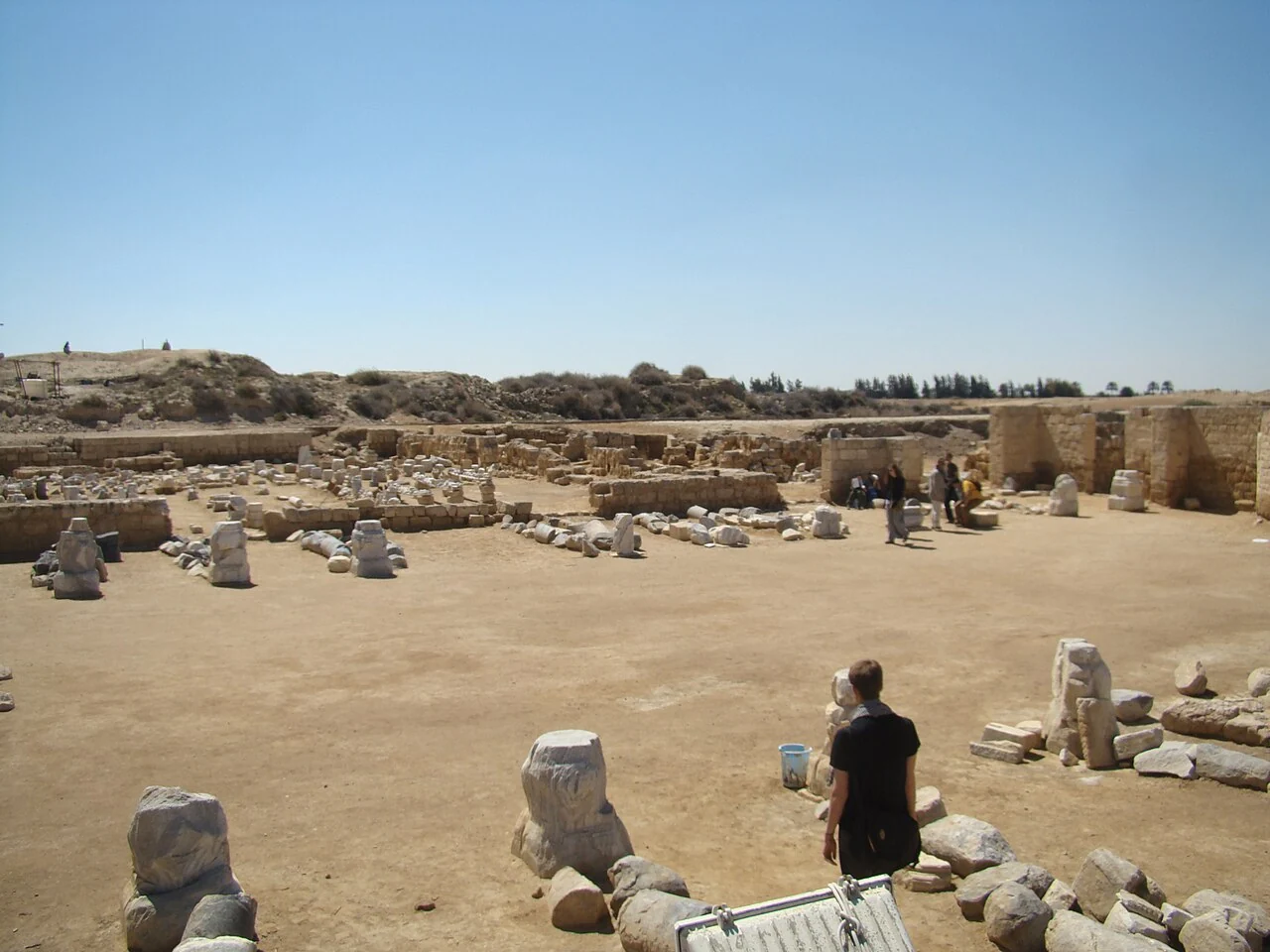
Much of the structure survives at foundation or low-wall level. A photograph of column fragments is valuable evidence of material and space, but it cannot recreate the precise height, roof profile or painted decoration without additional records. Reconstruction drawings, where used, must be explicitly labelled as hypotheses. The authentic ruin is often more informative than an attractive but unexplained virtual restoration.
How the tomb church and crypt shaped pilgrimage
A shrine built around a revered burial place was central to the visitor experience. UNESCO identifies the tomb church and cave of Saint Menas within an interconnected sacred building ensemble. This configuration helps explain why the site drew people from beyond the local settlement: the religious focus was a particular place connected to the martyr, not simply a parish congregation.
The crypt and adjacent churches also remind researchers of a basic archaeological problem. Different periods can reuse a focal burial place while rebuilding walls and adding circulation routes. A surviving doorway or floor should be dated from its construction evidence, rather than automatically assigned to the saint’s lifetime. The tradition about burial and the archaeology of the later complex can illuminate each other while remaining distinct categories of information.
An original photograph of the Basilica of the Crypt, included below, helps locate the surviving stone fabric. It is described as a photograph of the ruins at Abu Mena; it is not evidence that the saint’s body has been independently identified by modern science. Accurate captions protect both archaeological clarity and the integrity of religious interpretation.
Baptistery, pilgrims’ court and shared space
Abu Mena’s organization included more than churches. The Egyptian Ministry describes a baptistery, pilgrim quarters and a gathering court bounded by porticoes with marble columns. Those spaces suggest movement between worship, lodging, communal assembly and services. They also show how a pilgrimage destination could become a functioning settlement rather than an isolated sanctuary in the desert.
The architectural details have practical implications. A covered or colonnaded court provides a place where visitors can gather. Baths and accommodation require water, maintenance and workers. Routes through a complex need to handle arrivals while protecting the most sacred area. It would be speculative to calculate the number of pilgrims from a court’s appearance alone, but the surviving layout shows investment in accommodating more than the shrine’s permanent residents.
UNESCO’s inventory also includes other churches in separate parts of the settlement. The wider sacred landscape therefore has multiple centers of activity. A site map is best read as a record of these different functions and periods, not as evidence that all buildings were simultaneously occupied at one fixed peak capacity.
Workshops, baths and the economics of a holy city
UNESCO lists workshops, public baths, cisterns and productive installations associated with olive oil, raisins and wine, as well as pottery production. This is an unusually valuable kind of evidence: it connects a religious center with tangible work, food processing, storage and exchange. It also complicates the misleading picture of a monastery or shrine as a place apart from economic life.
Pilgrimage generates ordinary needs. Food, water, shelter and containers must be provided, while buildings require repair and materials. Some workshop output may have served visitors; other production can belong to the surrounding local economy. Without a securely proven workshop-to-market chain, it is safer to distinguish plausible economic relationships from archaeologically demonstrated distribution. This is particularly important when dealing with souvenirs and devotional vessels.
A production area should not automatically be called a factory in the modern industrial sense. The evidence points to craft and agricultural processes using period technologies. Ancient infrastructure is better understood in its own context, with attention to the different materials and scales of surviving remains rather than romantic or industrial language imposed by modern visitors.
Saint Menas flasks: small objects with a wide story
Small ceramic vessels associated with Saint Menas are among the best-known portable objects linked to his cult. They appear in collections far beyond the archaeological site and help researchers study how devotional identity could travel. The familiar presentation of the saint and related motifs made such vessels recognizable, although individual object dates, forms and provenances vary. Any image used to illustrate a specific flask must be tied to its actual museum record.
These objects encourage a more precise understanding of pilgrimage. A visitor could carry a vessel, inscription or token away from the shrine; the resulting archaeological distribution creates potential evidence for movement and reputation. But finding one Menas flask in a distant museum is not in itself proof that its final owner personally traveled to Abu Mena. Objects move by sale, gift, collection and secondary reuse.
The same caution applies to material claimed to have been contained in the vessels. Historical traditions connect them with blessed liquids and the saint’s cult, but we should not pretend to know the contents of every excavated example. Object-centered research makes the movement of ideas and goods visible without replacing evidence with a single appealing travel anecdote.
Construction materials and Mediterranean connections
UNESCO describes principal monumental buildings made with dressed limestone masonry and lime mortar, with marble columns and traces of mosaic decoration. Less formal structures used mudbrick with plaster. These different building choices matter for conservation and interpretation. They show investment in monumental display alongside ordinary building technologies and help archaeologists distinguish types of space.
Architectural comparisons suggest connections with wider Mediterranean Christian building traditions while retaining distinctive Egyptian practices. UNESCO specifically recognizes this combination as part of the site’s outstanding value. Similarities of form are not, however, a license to claim that every column or decoration was imported from a particular European city. Provenance requires material studies, inscriptions or documented movement.
A monastery and pilgrimage site can reveal cultural exchange without being described as a simple copy of another place. Abu Mena’s surviving plan, relationships between buildings and local terrain explain why the UNESCO inscription emphasizes architecture as well as religion. Material remains provide the evidence from which broader cultural history should be carefully developed.
Archaeological rediscovery and what is still visible
The Egyptian Ministry identifies the German archaeologist Carl Maria Kaufmann with the site’s early twentieth-century rediscovery and archaeological investigation. Later missions associated with Egyptian museums researched residential areas and additional buildings. These campaigns helped transform a largely forgotten ancient settlement into a documented archaeological landscape. But excavation history has its own limits, and earlier field methods do not always provide the contextual precision expected today.
UNESCO’s authenticity statement draws attention to original materials, low surviving structures and a recognizable urban plan. The value of the site is therefore not measured by how many complete walls still stand. Plans, foundations and traces of space can preserve relationships among worship, lodging and craft activity even when roofed buildings have disappeared. A modern visitor should not expect an intact Byzantine town with furniture and fully painted interiors.
Historic photographs record particular conditions at particular moments, while conservation and vegetation clearance may change the view. Our images show documented remains, not a claim that the ruins will look exactly the same at the time of a future visit. Responsible interpretation makes photographic dates visible and leaves room for the continuing work of conservators.
Why groundwater became the central preservation threat
The most consequential modern threat to Abu Mena was rising groundwater associated with irrigation and changing conditions around the property. Saturated soil can undermine archaeological foundations, while salts and moisture damage historic building materials. UNESCO placed the site on the List of World Heritage in Danger in 2001 after serious concerns about the water table and structural losses. This was a conservation classification, not removal from the World Heritage List itself.
The preservation challenge is technical as well as administrative. Lowering groundwater requires functioning drainage or pumping systems, monitoring and maintenance, while standing masonry may need stabilization and careful control of vegetation. A temporary improvement without a lasting management system could leave the archaeology exposed to future damage. UNESCO’s documented response therefore discusses infrastructure, conservation planning and responsibilities rather than a single cosmetic renovation.
An important editorial distinction is that a site can be removed from the Danger List while remaining sensitive to environmental threats. The correct question is not whether the problem has disappeared forever, but whether verified measures are operating and authorities continue to manage the site.
What changed in 2025, and what UNESCO said in 2026
In 2025 the World Heritage Committee removed Abu Mena from the List of World Heritage in Danger. The formal decision, 47 COM 8C.2, records that change. UNESCO cited improvements including an operational groundwater control system, stabilization of remains and more detailed conservation planning. This status update corrects older web pages that still describe Abu Mena as currently on the danger list without noting its removal.
The story did not end with that decision. The World Heritage Committee’s 2026 decision 48 COM 7B.2 welcomed continuing work on groundwater monitoring, archaeological stabilization, vegetation clearance and a robust emergency backup system. It also addressed boundary definition and protection, financial planning and a proposed data-management framework. The committee requested a further conservation report by December 2027. This is an ongoing stewardship process, not an unconditional declaration that every risk has vanished.
For accuracy, sources must be dated. A 2024 decision retained Abu Mena on the danger list, whereas the 2025 decision removed it. Both documents are authentic, but describing only the earlier one in a 2026 article would produce an outdated and misleading answer. Readers should check the year and decision number whenever they encounter conflicting summaries.
What UNESCO recognition does and does not mean
Abu Mena entered the World Heritage List in 1979 under criterion (iv), which addresses its outstanding architectural and historical significance. The designation recognizes an early Christian pilgrimage and monastic center with a rich mix of ceremonial, residential and productive architecture. It is not a modern guarantee of unrestricted access, nor does inscription imply that every preserved object is safe from all future threats.
The property is also embedded in local religious life. UNESCO notes the continuing spiritual importance of the site for Egypt’s Coptic community. A responsible encyclopedia therefore treats Abu Mena as both an archaeological record and a heritage place with living significance. Those perspectives can coexist without blurring material evidence, faith traditions and current management decisions.
For context, Kemet Vault also examines the Red Monastery’s surviving Byzantine-era murals and Saint Catherine’s monastery in Sinai. Their architecture, geography and preservation histories differ from Abu Mena’s, making them useful comparisons rather than interchangeable examples of Egyptian Christianity.
How to interpret Abu Mena before visiting
A successful site visit begins with the archaeological facts. Expect ruins and a broad landscape, not an intact monumental city. Distinguish the ancient pilgrimage center from modern religious buildings in the area, and avoid treating photographs of one as a view of the other. If a particular church or excavation zone is closed for preservation, that restriction is not proof that the site has disappeared.
The Ministry of Tourism and Antiquities maintains an official Abu Mina archaeological-site listing and a World Heritage overview, while UNESCO maintains the formal inscription and conservation decisions. These are better places to verify access and heritage status than an undated social media itinerary. The ministry may revise opening arrangements, and our article deliberately does not claim guaranteed entry, fixed ticket prices or availability of any guided visit.
Abu Mena’s strongest story is the intersection of belief, building, migration and conservation. The ancient settlement reveals how a cult place became a regional center with an economy and monumental architecture. The recent UNESCO decisions show how much technical work is required to preserve that layered history for people who have not yet seen the site.
Verified primary institutional sources
Site identification, architectural features and historical traditions were checked against the Egyptian Ministry’s Abu Mina archaeological description and official World Heritage summary. UNESCO’s World Heritage property record explains its outstanding value and original materials; the 2025 removal from the Danger List and 2026 conservation decision establish its updated status. Other reliable comparisons on this website include Saint Catherine’s and the Red Monastery.