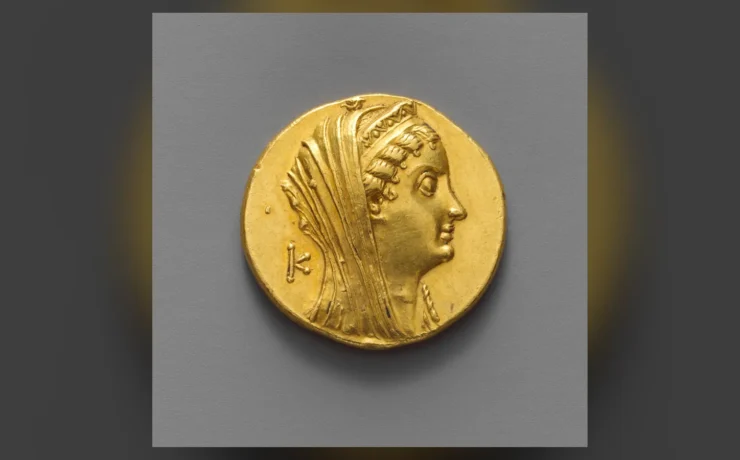
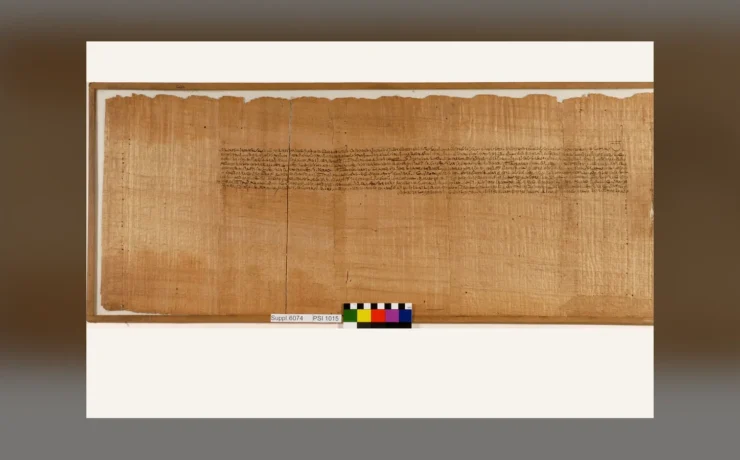
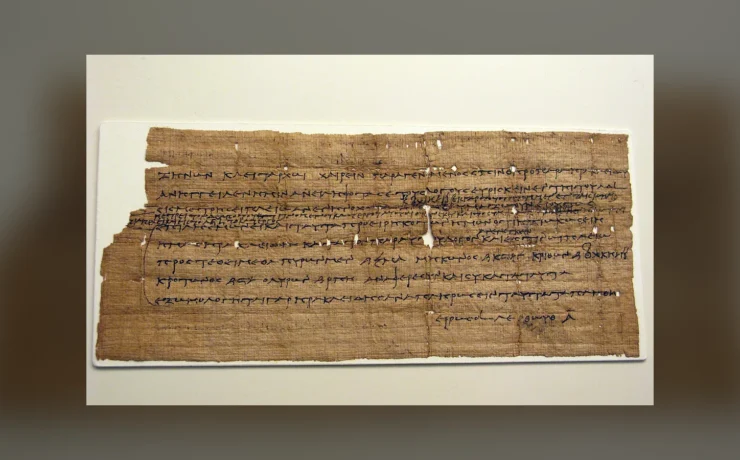
When was the Temple of Horus at Edfu built? The principal surviving Ptolemaic temple was begun in 237 BCE under Ptolemy III and completed in 57 BCE under Ptolemy XII, according to Egypt’s Ministry of Tourism and Antiquities. The approximately 180-year sequence explains its extensive late Egyptian reliefs, not a single pharaoh’s instant construction.
Edfu is one of the clearest surviving demonstrations that monumental Egyptian temple culture continued under Greek-speaking dynasties. The great façade, court, columns and sanctuary carry rich religious inscriptions and processional imagery. Their preserved condition has also encouraged exaggerated claims about secret machines or universal knowledge hidden on the walls. A more useful approach is to start from dated construction, read the building as ritual space and compare its actual inscriptions with the broader Ptolemaic sacred landscape. This study remains a historical dossier rather than a current ticket guide, so changing costs or opening arrangements are left to official visitor channels.
Read the separate the deity Horus and his changing iconography and the Hathor temple at Dendera and its original inscriptions for mythology and comparison; those pages answer related but different questions.
Edfu in Upper Egypt: place and historical landscape
Edfu stands on the west bank of the Nile in Upper Egypt, between the great archaeological centers of Luxor and Aswan. Its surviving temple forms part of a longer local religious history, but the monumental building visible today is best understood through the Ptolemaic construction sequence. The ancient town was known in Greek contexts as Apollonopolis Magna, a name connected with the identification of Horus and Apollo. That cross-cultural name is evidence for changing administration and interpretation, not proof that the cult abandoned all Egyptian traditions.
Even a very well preserved monument is not a frozen picture of a whole ancient town. Nearby occupations, later settlements and archaeological disturbances complicate the reconstruction of its original surroundings. The Ministry of Tourism and Antiquities identifies Edfu as a temple on the Nile’s western bank, while UNESCO’s research overview places it within a group of significant Ptolemaic and Roman temples. Those institutional records make a better starting point than modern tourist photographs that erase the layers of the settlement.
237 BCE: the foundation under Ptolemy III
Egypt’s monuments authority dates the start of construction to 237 BCE under Ptolemy III Euergetes. The precise foundation belongs to a documented royal building program, although it should not be imagined as a modern ribbon-cutting ceremony. Temple inscriptions and ancient construction phases provide the basis for dating, while modern historians reconcile those records with calendars and dynastic chronology. Ptolemaic rulers employed pharaonic forms to express legitimacy and fulfill sacred obligations in their Egyptian domains.
Recognizing Ptolemy III as founder does not make him the sponsor of every relief visible today. A major stone sanctuary could be constructed, decorated and extended across generations. Some inscriptions identify later rulers and ceremonies. The public story is more complex than one king commissioning a magnificent set of carvings: artists and priests participated in the continuing production of a religious landscape that successive patrons maintained and expanded.
57 BCE: completion under Ptolemy XII
The ministry dates the completion of the surviving temple to 57 BCE in the reign of Ptolemy XII, almost 180 years after the start of work. Completion in such an account refers to the overall building sequence rather than the end of all ritual use, modification or later repairs. UNESCO notes that the temple’s history also includes an earlier dedication of its central structure in the second century BCE, demonstrating how a partially functioning sanctuary could precede the final completion.
This span should be placed within the changing political context of Ptolemaic Egypt. Different rulers governed under pressures from dynastic rivalry, local institutions and eventually Rome. Yet the temple’s traditional Egyptian forms endured through those changes. The date range allows visitors to connect carvings with particular reigns, but no one should describe the building as a single-year artifact or automatically attribute all of its decoration to one period.
What the massive pylons reveal
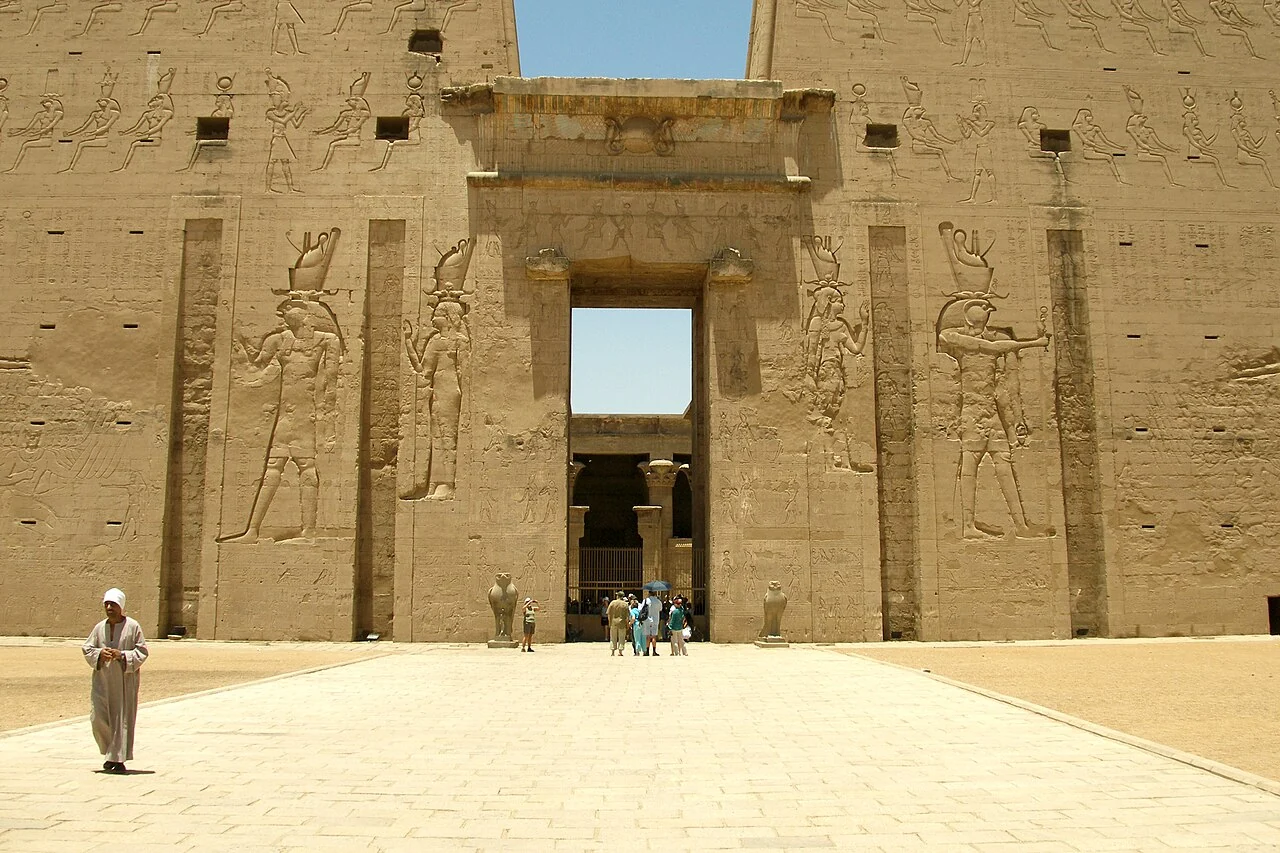
Two towering stone pylons form the monumental façade, with reliefs showing royal action and offerings to deities. The ministry describes scenes associated with Ptolemy XII on the towers. Egyptian temple pylons functioned both as architectural entrance structures and visual statements about order, royal duty and the sacred landscape. Their proportions can overwhelm a modern viewer, but their imagery follows conventions with a history far older than the Ptolemies.
Images of a ruler defeating enemies, for example, should not be used as eyewitness documentation of a specific military victory unless the associated inscription provides such identification. Monumental smiting scenes often express ritual and political ideals. The Edfu reliefs are valuable because they show how those inherited visual formulas were used at a late date. A photograph can reveal the scene’s location and scale, while a translation still requires knowledge of the actual Egyptian text.
The peristyle court and columned halls
Passing through the façade leads into a court bounded by columns. Further inward, the temple contains hypostyle halls and smaller chambers associated with processions, offerings and the movement of priests. The ministry’s route through Edfu highlights how the spaces become increasingly enclosed as one approaches the sanctuary. This sequence is a form of religious architecture, not simply a collection of rooms arranged for modern tourists.
Columns with decorated capitals and inscribed surfaces add detail about divine identities and royal patronage. Different walls may record different ceremonial acts; an attractive carved figure does not automatically explain what the entire temple was used for. The building’s spatial layout helps us ask how people and sacred objects moved during temple life, even though access to inner areas was regulated and the surviving monument cannot tell us the exact experience of every ancient participant.
The falcon statues and the identity of Horus
Falcon statues outside and within the temple make the local dedication to Horus visually unmistakable. The ministry identifies two granite falcon statues associated with the pylons. A photograph of a statue is direct evidence that this sculpted form survives at the monument, but it is not a portrait of an actual bird worshipped in the temple. Egyptian divine imagery uses recognizable animal attributes to identify beings whose mythological and cult roles require textual explanation.
Horus also appears in multiple local and theological forms across Egyptian history. The Edfu traditions emphasize particular relationships and stories, while other Horus cults could express different aspects of kingship, the sky or protection. For a general study of the god’s iconography, the site’s existing Horus dossier is a better destination. This article uses the Edfu temple as an archaeological and ritual context, avoiding a duplicate page that merely retells the myth of Horus and Seth.
Hathor’s journey and the festival of the beautiful reunion
Edfu’s ritual texts and scenes connect Horus with Hathor of Dendera. The wider festival tradition, often called the Beautiful Reunion, involved the arrival of Hathor to encounter Horus and expresses relationships between two significant temples. The Egyptian Ministry notes reliefs illustrating a journey with a sacred bark. UNESCO’s late temple overview likewise situates Edfu and Dendera within a network of religious practices that continued under Ptolemaic rule.
The festival scenes are evidence for ritual representation and prescribed ceremony, not a calendar of every annual event that can be reconstructed in modern detail. Processions, divine boats and offerings appear in pictures and inscriptions, but interpretation must distinguish what was ritually imagined from what individual people did on a given date. A source-based article can explain why the festival matters while leaving room for variations in performance, timing and historical recording.
What the inner sanctuary was for
At the center of the temple lay a sanctuary associated with the divine image and sacred activities. The architectural journey inward passed through spaces that were progressively more restricted. Temple worship involved officials and priests with specific responsibilities, and not every visitor entered the innermost rooms. Reading the spatial sequence helps explain why an outer court and a sanctuary fulfilled different ritual purposes.
A modern museum-style photograph of the sanctuary can document stones and decoration that survive, but it cannot restore every lost textile, lamp or movable object once used there. Sacred furniture, divine images and offerings could be removed, altered or destroyed over time. For that reason, an account of religious function combines architecture with inscriptions and comparative evidence, rather than assuming that all visible stone represents the complete original contents.

Inscriptions and the sacred drama of Horus
Edfu’s walls preserve a large body of hieroglyphic writing, including ritual and mythological material. Scholars discuss a sacred drama centered on Horus and Seth, linked to royal and cosmic order. The presence of a story in temple texts is not proof of a literal historical battle between supernatural beings. It is religious literature and ritual communication carved on architectural surfaces.
To read the inscriptions, Egyptologists must identify the text’s location, date, scribal conventions and relation to its accompanying scene. A generic transcription pasted under an unrelated photograph can mislead even when the Egyptian signs look convincing. What makes Edfu especially important is the density of surviving material within a well-preserved building. It provides an opportunity to compare texts in their actual architectural settings, rather than treating one isolated image as a complete explanation.
Why Edfu is so well preserved
The ministry explains that the temple was covered by accumulated occupation debris for centuries before modern clearance revealed much of it. Burial beneath later material helped protect large parts of the architecture and decorative surfaces. The nineteenth-century archaeologist Auguste Mariette cleared and restored portions of the temple around 1860. That recovery history means the monument’s visible state is not simply the untouched ancient original exposed to the sky for two millennia.
Archaeological clearance can recover important information, but early methods sometimes differed from contemporary conservation standards. Interpreting older photographs alongside current records requires attention to what was excavated, rebuilt or cleaned at each stage. Describing the temple as ‘perfectly preserved’ ignores damage, losses and the work of conservators. Its completeness is exceptional by comparison with many monuments, but not absolute.
Edfu compared with Dendera and Esna
Edfu, Dendera and Esna all preserve substantial late Egyptian temple art associated with Ptolemaic or Roman rule. Their shared chronological setting makes comparison useful, but they are dedicated to different local cult traditions and occupy distinct places. Dendera is strongly associated with Hathor and astronomical ceilings, Esna with Khnum and recently conserved painted surfaces, and Edfu with Horus and extensive ritual reliefs.
Mixing photographs of those three temples undermines historical explanation. A circular zodiac displayed at the Louvre originated from Dendera and should not appear under a caption describing an Edfu pylon. Likewise, an Esna ceiling photo is not a substitute for an Edfu sanctuary image. Good digital museum practice identifies where an image was made, which object it shows, and how the record supports interpretation.
Visitor context without invented access information
Modern travelers often encounter Edfu on routes between Luxor and Aswan, but visiting conditions change with transport arrangements, restoration work, weather and official scheduling. A historical research article should not promise that tickets, opening hours or guided experiences will be available at a particular price months from now. The ministry maintains a visitor listing that should be checked close to a planned visit.
The strongest historical way to experience Edfu is to read the building from its entrance toward the sanctuary, looking for changes in scale, decoration and access. Respecting barriers and protecting relief surfaces are more important than recreating a dramatic photograph. A short visit can be enriched by understanding the nearly two-century construction sequence and recognizing that the images were created for Egyptian religious purposes, not modern entertainment.
A monument, not a coded modern technology manual
Online material sometimes presents late Egyptian reliefs as diagrams of modern machinery or as proof of scientifically impossible ancient equipment. Edfu demonstrates why that interpretation is weak: scenes belong to recognizable architectural and ritual programs, often supported by accompanying texts. The presence of unusual symbols or complex processions does not justify removing a scene from its original wall and assigning it an unrelated contemporary meaning.
A stronger question is what the inscriptions say in context and how their themes compare with parallel temples. Egyptian religious texts could express cosmology, theology, political patronage and sacred order at once. Edfu’s preservation makes those sources accessible to serious study, but not self-translating. The value of the temple is the historical complexity that survives, rather than a claim that its priests secretly anticipated the modern world.
Evidence table: what can be identified with confidence?
| Record | What it supports | What it does not prove |
|---|---|---|
| 237 BCE foundation | Construction began under Ptolemy III | Not the date of every architectural phase |
| 57 BCE completion | Major building sequence ended under Ptolemy XII | Ritual use and later changes continued |
| Pylon reliefs | Rulers and deities represented in sacred ideology | Not automatically records of real battles |
| Falcon statues | Real sculpted forms connected with Horus | Not living animals or modern reconstructions |
| Festival inscriptions | Ritual narratives link Edfu and Dendera | Actual performance details require contextual research |
Official records and specialist references
This interpretation distinguishes original reliefs from later excavation, historical religion from externally verified events, and photographs of real surviving fabric from invented reconstructions. Sources reviewed 4 November 2026.