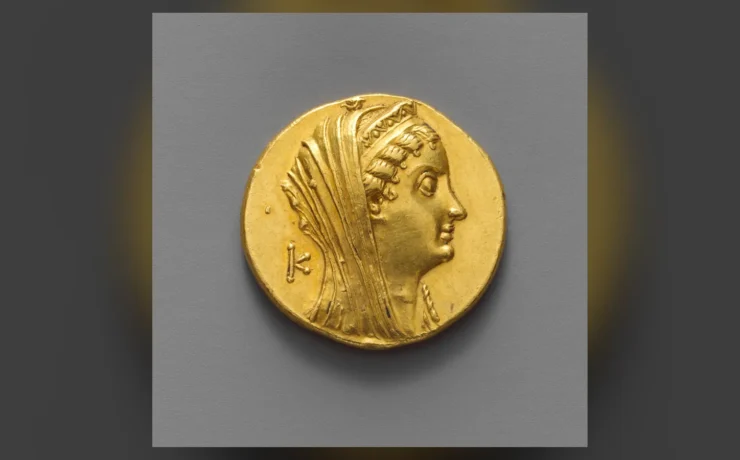
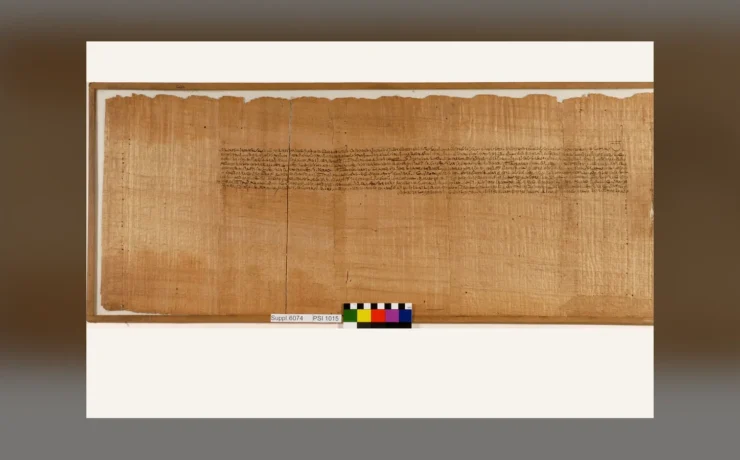
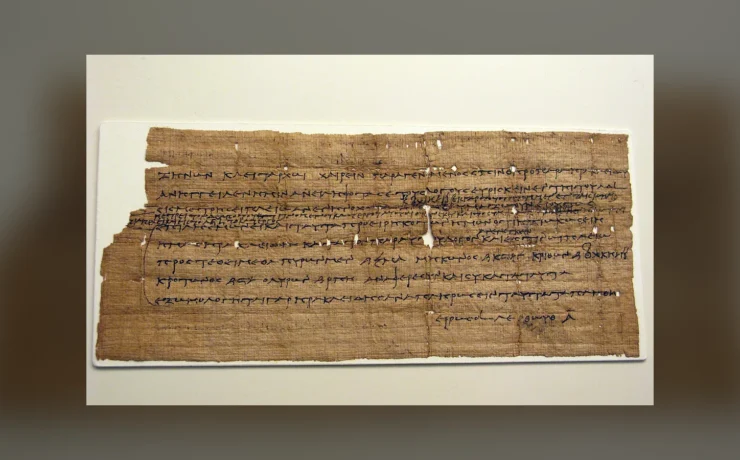
The Temple of Hathor at Dendera is one of Egypt’s great survivors of Ptolemaic and Roman religious architecture. Its Hathor-headed columns, surviving blue astronomical ceilings and famous circular Zodiac make it a remarkable monument. Yet the original Zodiac is now in the Louvre, not on the same temple ceiling that appears in modern photographs. Understanding Dendera means distinguishing those objects and reading the sacred images through archaeology and inscriptions rather than turning them into myths about electricity or a modern horoscope.
This evidence-led study examines the site’s long religious history, the building phases, Hathor’s theology, the sky imagery and roof rituals, the original Zodiac’s modern journey and current conservation. Four authentic documented photographs show three different parts of the temple plus the genuine Zodiac object at the Louvre.
Dendera as an Egyptian sanctuary, not an ancient observatory
The Temple of Hathor at Dendera preserves architecture, inscriptions and colors that make it one of the clearest surviving examples of sacred space in late ancient Egypt. A visitor sees the goddess’s face on enormous column capitals and elaborate imagery of the sky over the rooms below. These features are often presented online as evidence of a mysterious scientific facility or an unchanged monument built in one royal reign. The physical evidence supports a richer history. The temple was an active religious institution during the Ptolemaic period and continued to receive decorations under Roman rulers. Its paintings transformed architectural space into the representation of a sacred cosmos, with signs of hours, gods, astronomical cycles and ritual. The actual circular Zodiac came from an Osiris chapel on the roof and is now in the Louvre, separate from the hypostyle astronomical ceiling still present at Dendera. Egypt’s Ministry of Tourism and Antiquities and the Louvre supply complementary evidence for these different parts. Understanding them requires distinguishing a building from a detached museum object and differentiating approximate historical dates from modern exposure dates of photographs.
Qena and the sacred geography of Hathor’s city
The Dendera complex stands near modern Qena in Upper Egypt on the western side of the Nile’s valley. Its local Egyptian traditions are older than the stone sanctuary that visitors see today. Official Egyptian monument records associate the place with a long Hathor cult and refer to older evidence reaching toward Old Kingdom king Pepy I. That does not date every surviving column to the Old Kingdom. Sacred sites were often rebuilt while their local deity remained central, allowing worship and patronage to continue through different political systems. Archaeologists have to establish separate dates for reused foundations, standing chambers and individual reliefs. The Greek name Tentyra appears in accounts of the region, reflecting another linguistic layer rather than a change of the entire local religious tradition. Dendera’s position within Egyptian settlement and agricultural landscapes mattered for provision of offerings and maintenance of temple personnel. The temple was not an isolated desert experiment disconnected from communities, even though its modern tourist photographs often focus on architecture with few people visible. Historical place and religious identity are best explained through inscriptions, dated phases and archaeology together.
Hathor and the meanings of music, motherhood and sky
Hathor held several overlapping positions in Egyptian religious thought. The Egyptian Ministry’s description emphasizes her associations with music, dance, motherhood, joy and the heavens. She could participate in royal ideology, solar myths and religious protection without being confined to a modern one-line label such as “goddess of love.” Her face on Hathoric capitals was a visual statement about the deity’s presence and the identity of the temple. Sistrums, the rattling musical instruments associated with her cult, provide a link between sacred sound and painted or carved symbols. We do not know every melody performed in the surviving halls, but we can understand that ceremonial music belonged to more than entertainment. Different mythological titles emerged through contexts and centuries; they should not all be attributed to one anonymous inscription. Temple decoration was created for ritual interaction between human communities and the divine rather than for casual museum display. Studying the goddess’s multifaceted roles helps explain why astronomy and festival imagery could coexist within a temple dedicated to a single main deity.
Older cult, Ptolemaic stone and Roman additions
The present main Hathor sanctuary was constructed mainly in the Ptolemaic era, with further building and inscription activity in Roman times. Different summaries of the complex sometimes name different Ptolemaic monarchs as builders because they refer to distinct parts or stages, making it hazardous to assign all visible stone to one king. The Ministry’s research and conservation accounts also identify Roman rulers including Augustus, Tiberius and Nero as represented making offerings to Egyptian gods. They appear within the conventions of Egyptian royal ritual. Their presence on walls does not prove that the rulers visited the building or wore those costumes in everyday life. The art expresses sovereignty and devotion through a language inherited from earlier Egyptian temples. Equally, a Ptolemaic royal name does not mean the building was Greek in overall architectural conception. Egyptian builders used inherited religious and technical traditions while patronage operated under a changing political framework. The site therefore provides direct evidence for continuity within historical change: ancient Egyptian temple religion was not abruptly abandoned when Greek or Roman rulers gained power.
The spectacular entrance and its six Hathor-headed columns
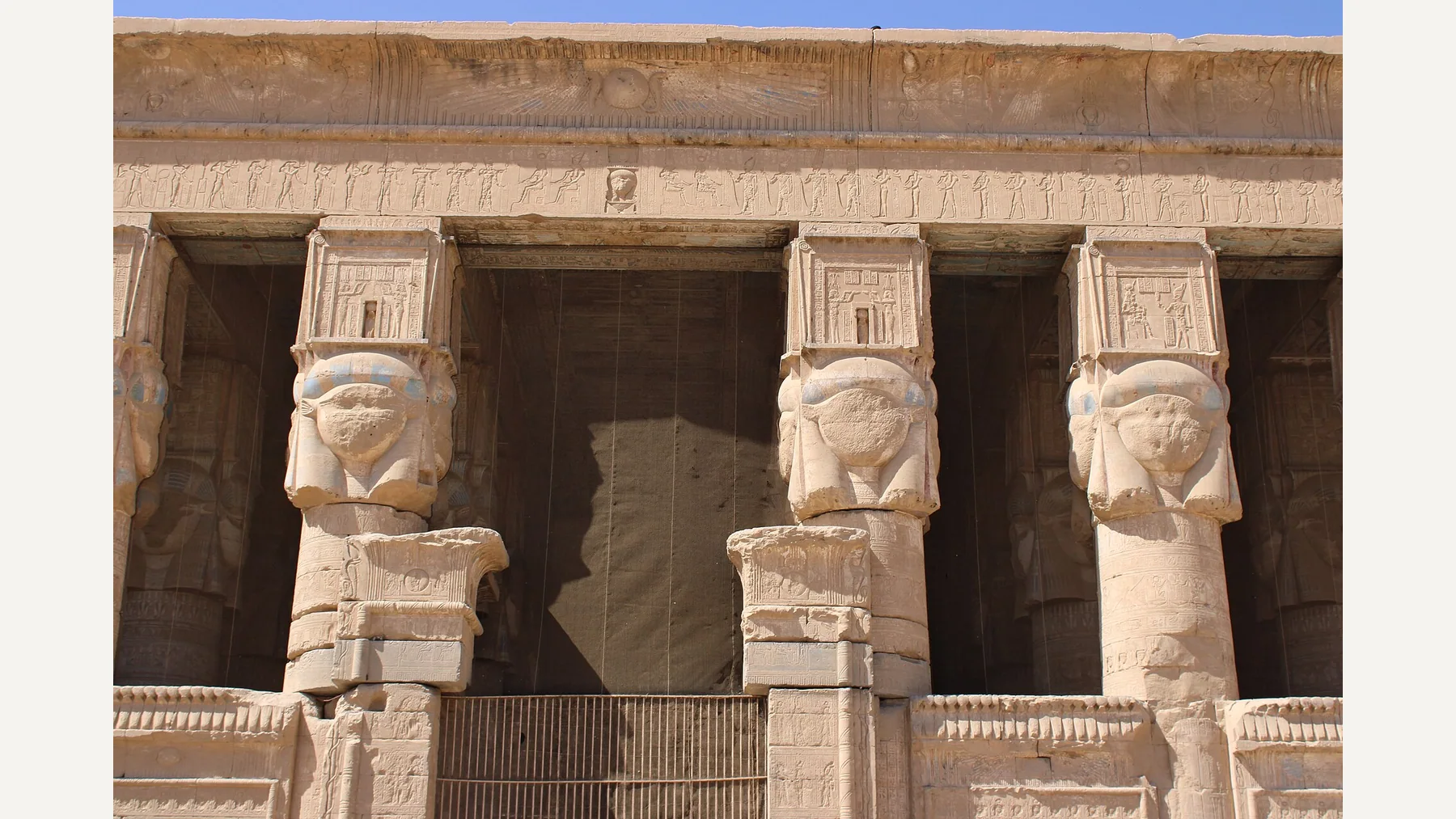
The facade is among the temple’s most memorable features. The entrance is marked by six large columns topped by representations of Hathor’s face, which Egypt’s monuments authority calls a defining feature of the site. The scale of the stone demonstrates the demanding labor of quarrying, transport, shaping and carving. The combination of column form and divine representation integrates a recognizable goddess with architecture. A visitor does not simply pass a sculptural museum display before entering; the divine image helps define the precinct being entered. The facade’s modern appearance includes environmental wear and conservation, so a photograph cannot establish that every ancient pigment or carved detail survives perfectly. The source-linked 2025 photograph provided here shows the real temple rather than a computer illustration. It captures the monumental arrangement that can be independently matched to official site descriptions. Its value is documentary, even though its artistic composition belongs to the photographer. The temple’s full program continues beyond the entrance through other rooms and roof-level ritual spaces, each with its own historical evidence.
Inside the hypostyle hall: columns supporting a sacred world
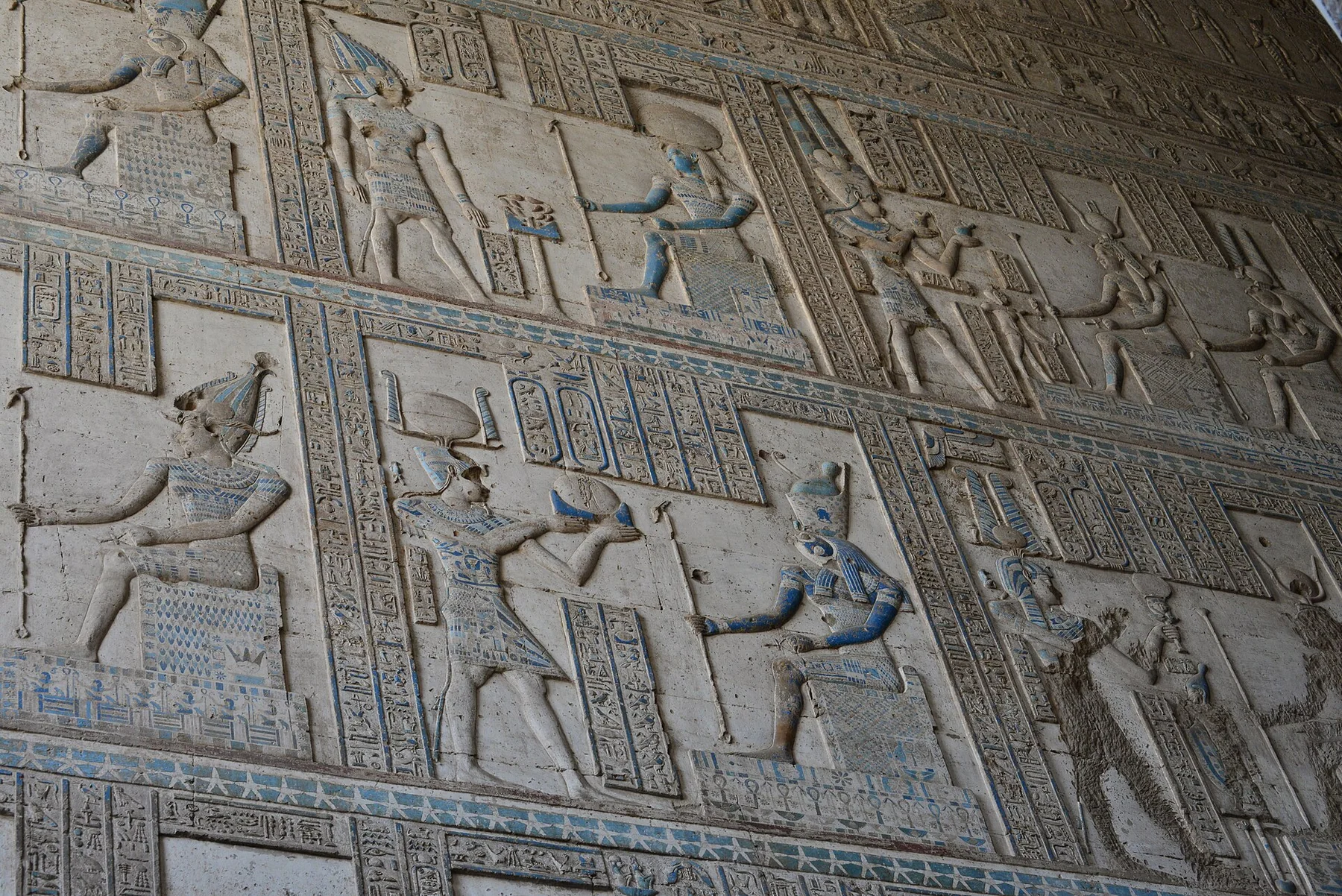
The hypostyle hall is far more than a forest of supports. Columns carry decorated ceilings, inscriptions and carefully arranged images in an architectural system intended for ritual use. Looking from a different part of the hall changes how the viewer sees the relationship between painted celestial scenes and the great carved capitals below. Some representations invoke the sky and the passage of sacred time, while the surrounding walls address ceremonies and royal offerings. Museum-grade interpretation therefore includes plans and locations rather than relying only on a few close-up photographs. The actual hall has undergone cleaning and conservation, revealing pigment that was previously difficult to see. The 2015 original photograph shown here is an authentic record of a specific conservation-era appearance, not a rendering of how a priest saw the room two thousand years ago. The architectural space also speaks to specialist craft. Different groups of artisans must have coordinated major stonework, relief planning and painting, though the exact names and working contracts are seldom preserved. The finished effect was designed to integrate physical support with theological imagery.
Astronomical ceilings and the difference between image and instrument
Dendera’s ceiling decoration includes gods, celestial signs and representations of parts of the Egyptian system for conceptualizing time. Scholars identify forms linked with hours, decans, constellations and recurrent cycles. The astronomical content may be sophisticated without turning the temple ceiling into a scientific instrument that priests read like a telescope display. Specialist research on religious astronomy argues that such spaces symbolically mapped the heavens into the temple’s interior and supported ritual encounters with the divine. Several images also incorporate traditions that interacted with the broader Mediterranean world during Egypt’s late periods. The exact reading of every sign depends on inscriptions, placement and comparative evidence, not on resemblance to modern star maps alone. The original blue-ceiling photograph included in the article shows the rectangular hall ceiling, which remains at Dendera. That is not the circular Zodiac currently at the Louvre. This distinction is repeatedly lost in unsourced image collections, causing visitors to misunderstand what is actually present at the Egyptian monument. The surviving ceiling deserves to be studied on its own terms.

Decans, lunar cycles, stars and Egyptian concepts of time
Egyptian astronomical traditions involved observation of recurring stellar and solar patterns, and some later temple depictions incorporated zodiacal imagery familiar from Greco-Roman settings. Decans are a particularly important indigenous sequence of star groups used in the structuring of nocturnal time, although their names and images vary historically. The presence of stars and personifications does not establish that every relief was made to predict an individual person’s future. A modern zodiac horoscope is not an adequate guide to all ancient Egyptian astronomical symbolism. Ritual calendars depended on observation, calculation and inherited literary traditions, while decorated ceilings performed a visual and theological role. The Astronomy Society of the Pacific’s study of temple skies explains that technical celestial information could be embedded in buildings dedicated to ritual rather than scientific observation. This allows a careful interpretation that acknowledges knowledge of the heavens without importing contemporary equipment or assumptions. When a temple uses the sky as a roof image, its meaning lies partly in the relationship between human ritual below and divine or cosmic processes represented above.
The people who carved and painted the cosmic ceiling
An intricate hypostyle ceiling required trained stoneworkers, relief carvers, plaster and pigment specialists, labor organizers and people able to plan the inscriptions. The art did not appear when one ruler personally decided to paint a blue sky. Its technical achievement should be interpreted alongside the labor and materials that made it possible. Huge stone supports were erected before decoration could be completed, and different surfaces could receive finishing work at different phases. An inscription carrying a ruler’s cartouche helps date royal patronage, but rarely supplies a full account of wages and named painters. Modern preservation adds another layer: ancient colored pigment may have been obscured by dark deposits and revealed through conservation. A photograph taken after cleaning is evidence of what remains, not evidence that the pigment was placed there recently. It is also not proof that all other surfaces were originally the same shade. Archaeologists distinguish stone carving, pigment traces, restoration records and modern photographic color processing. These material distinctions make the monuments more historically fascinating than an unsupported claim about a single mysterious ancient painter.
The circular Zodiac belonged to a rooftop Osiris chapel
Dendera’s most celebrated movable object is the circular Zodiac, originally part of a ceiling in a roof-level chapel associated with Osiris. It was not the same object as the long painted astronomical registers above the hypostyle hall. The Louvre’s present collection records identify the original as a sandstone relief, inventory E 13482, dated around 50 BCE. Its figures include zodiacal constellations, decans and representations of the celestial order supported by divine beings. As a room ceiling, its placement carried architectural and ceremonial significance. Looking at a photograph of the isolated round panel in Paris reveals much of the relief but cannot fully recreate its original position overhead within the Egyptian chapel. The context helps explain why sky imagery could participate in religious ideas about death, renewal and cosmic stability. Museum records also distinguish the original from casts or replacements. A responsible historical article must identify which version a photograph shows. Our Louvre photograph is of the original sandstone relief, which is no longer part of the Dendera building fabric.

A real museum object: Louvre E 13482
The Louvre catalogue lists the circular Zodiac’s inventory number as E 13482 and records its dimensions, sandstone material and archaeological origin in the rooftop Osiris chapel. Its dating to roughly 50 BCE situates the object in the late Ptolemaic period rather than in the earliest era of the Egyptian state. Older symbols may appear in much later works, so the antiquity of a celestial motif is not the date of the surviving stone carving. The relief’s round form makes it easy for modern commentators to call it a map of the universe, but its inscriptions and religious location must inform interpretation. A museum photo shows a real sculpture while an astronomical reconstruction would be a separate analytical product. The license-identified picture in this article was taken by a Commons photographer in 2013 and shows the Louvre’s original Zodiac. It should not be mislabeled as a section of the Hathor Temple still lying in Qena. A current collection record is especially important because old tourist literature may not accurately describe where historical objects are now held.
1799, 1821 and the object’s journey to France
The Louvre’s online history identifies attention to the Zodiac during the French expedition to Egypt in 1799, followed by efforts to obtain and remove the carved ceiling. Its catalogue records removal from the temple in April–May 1821, with authorization linked to Muhammad Ali, and its subsequent journey into France. These events are part of the modern history of Egyptian heritage, not a hidden ancient disappearance. Documentation of permission and purchase tells us about nineteenth-century political and collecting practices, but does not remove the ethical questions raised by separating an architectural ceiling from its site. A historian should describe what the museum records and avoid inventing a dramatic tale of secret theft unsupported by those documents. Since the object came from an Osiris chapel, its removal altered how that room can now be experienced and studied. The relief remains available as a museum artifact in Paris, while the Egyptian temple preserves associated architectural spaces and imagery. Both contexts belong to its biography and should be presented accurately.
What the Zodiac really says about Egyptian astronomy
The circular Zodiac includes Egyptian sacred figures together with forms associated with zodiacal systems circulating around the Mediterranean. Historians of astronomy analyze its constellations and placement, but the design is not an exact modern sky atlas intended for day-to-day navigation. The astronomical significance lies alongside a broader ritual and cosmological program. Its symbols and figures were carved for a specific room and cultural setting, not for a twenty-first-century horoscope reading. The temptation to use the panel as proof of an impossibly ancient date for the standing temple comes from confusing the longevity of a tradition with the age of one artifact. Louvre scholarship dates the actual stone to around 50 BCE. That does not diminish the depth of Egyptian astronomical knowledge over the preceding centuries. It merely anchors this surviving version to its material chronology. Ritual and observational knowledge can coexist without being identical in function. A useful interpretation explains what is securely represented, what scholarly identification is possible and what would require evidence beyond the carving itself.
The roof stairways and processions of Hathor
The Hathor Temple also preserves evidence of ceremonial movement through its architecture. Egypt’s Ministry describes stairs decorated with images of processions in which the goddess’s image was carried toward roof-level ritual activities and New Year celebrations. Such scenes help connect the sanctuary below with higher sacred spaces, including the Osiris chapels. The building was designed for religious actions in particular places and sequences, not for a single static view from the entrance. A visual tour that moves from hall to stairway to roof may be useful, but we should not assume that ancient access rules matched modern visitor circulation. Different ritual participants likely had different roles, while the exact details require inscriptions and study of liturgical evidence. The processional imagery demonstrates how architecture and text operated together. It also reinforces why the Zodiac’s original roof location was significant. A detached relief can be studied as sculpture and astronomy, but understanding the temple requires considering how people and sacred objects moved through its rooms.
Cleopatra, Caesarion and late Ptolemaic patronage
Relief images associated with Cleopatra VII and Caesarion form part of the wider Dendera complex, illustrating how rulers in the last years of the Ptolemaic dynasty continued using established Egyptian ritual images. The figure of a ruler before a god is not a candid historical photograph; it is a ceremonial depiction with inherited conventions. Cleopatra’s association with Dendera should not be enlarged into the claim that she constructed every standing wall. The chronology reaches across several reigns and even into Roman rule. Comparing individual cartouches, styles and architecture can help specialists date decorative phases, but a visitor cannot accomplish that by looking at the most famous royal name. The site’s value for history is precisely that it records continuities in temple religious language as state leadership changed. For broader background Kemet Vault has a Ptolemaic Alexandria encyclopedia, which treats royal politics and intellectual institutions separately from Dendera’s distinctive Hathoric cult and architecture.
Roman emperors as Egyptian pharaohs on the temple walls
After Egypt became a Roman province, temple imagery continued to represent emperors in positions previously occupied by Egyptian kings. Ministry conservation materials mention Augustus, Tiberius and Nero among rulers depicted making offerings. This is an important distinction between political administration and religious visual tradition: Egypt did not cease using pharaonic iconography simply because the ruler governed from Rome. The standard offering scene displayed lawful or ideal royal participation in maintaining the divine order. It does not show that every named emperor physically stood at Dendera or personally directed the carving. Building phases and inscriptions can demonstrate continued investment and ritual importance. They also help explain why some monuments that look conventionally pharaonic were actually completed in the first centuries CE. Historical labels should therefore include dynastic or imperial dates rather than rely on how “old” hieroglyphs look. The wider Greco-Roman period was a complex phase of Egyptian history worthy of study in its own right, not an artistic afterthought.
The Dendera ‘light bulb’ claim and why context defeats it
Certain crypt reliefs at Dendera show imagery involving a snake, a lotus and an elongated enclosure that can remind modern viewers of a glass light bulb. Proposals that this depicts functioning ancient electrical equipment do not come with a demonstrated archaeological chain of generators, wires, sockets or bulbs from Egyptian contexts. The associated inscriptions and motifs instead belong to religious concepts involving Harsomtus, divine emergence and symbols such as the djed pillar. A shape that resembles a modern object does not automatically depict that object historically. Researchers evaluate the relief within its room, temple texts and the iconography used elsewhere in Egyptian religion. This is a good example of why spectacular claims should not be given priority over contextual evidence. The actual ritual scenes are complex and meaningful, and reducing them to a supposed electric technology ignores the very writing carved alongside them. The appropriate encyclopedic approach is to describe the modern claim, explain the lack of material support and return to the Egyptian religious source context without mocking the ancient artisans’ genuine skill.
Crypt rooms: sacred storage and controlled ritual access
The temple contains crypts and smaller spaces associated with sacred equipment and images. Their inscriptions and reliefs provide evidence for different activities from those represented in the public monumental halls. A concealed chamber is not automatically a secret laboratory. Its layout and relationship to the sanctuary suggest functions connected with protecting and using ritual objects. Archaeologists analyze specific passages and inscriptions rather than applying one unsupported explanation to every niche. The crypts are also part of the building’s conservation and management problem, because restricted spaces can be vulnerable to humidity, visitor pressure and surface wear. Modern ticket categories and access policies may change, so this historical article deliberately does not promise visitors that every chamber is always open. For interpretation, the essential point is their integration into a large Egyptian religious precinct. Hathor’s cult involved varied spaces, with different visual and liturgical programs that should be understood on their own terms. The temple’s astronomical ceilings, crypt reliefs and processional stairways share a setting but are not the same artifacts.
Restoration, preserved pigment and the visual memory of blue
The surviving color at Dendera has become famous through modern photographs, particularly where conservation has removed dark deposits. Egypt’s Ministry reports work to conserve painted walls, columns and architectural surfaces. Cleaning an original ancient blue ceiling does not make the decoration a new invention, but conservation inevitably changes how an old surface is experienced today. The photographic record can document areas before, during and after treatment, while scientific reports explain the methods used. A careful caption should therefore state when an image was taken and what part of the monument it depicts. Our hall photograph dates to 2015 and the ceiling detail to 2017. Both are genuine, but neither shows exactly what the priests of the Ptolemaic period saw. Lighting, wear and restoration affect the visible tones. Preserving pigment requires balancing public access with scientific protection, and interpretations should acknowledge lost or damaged areas rather than paint them back with confident words. The visible color is a major part of the sanctuary’s significance, and its history of survival is as interesting as its initial execution.
What the complex teaches about continuity in Egyptian culture
The Temple of Hathor demonstrates an extended history of Egyptian religion, craftsmanship and royal patronage across different political eras. Its stone architecture was planned and decorated mainly in Ptolemaic times while Roman emperors later continued the religious language of Egyptian kingship. It preserves a striking relationship between ritual space and representations of the cosmos. The circular Zodiac, now at the Louvre, adds a modern story about the movement of architectural heritage and the importance of current museum metadata. Looking closely at the temple challenges easy contrasts between “native Egypt” and “foreign rulers,” since art and ritual practices could continue under changing imperial structures. Yet continuity does not mean nothing changed. Styles, texts, patronage and interactions with Mediterranean astronomical traditions evolved. Dendera is therefore an excellent case study for students who want to understand how later Egyptian sanctuaries worked. For a comparison with another cult center see Philae and Isis in Ptolemaic and Roman Egypt. The two temples share broad historical contexts while preserving different sacred geographies and local theologies.
A historian’s checklist for photographs and surviving objects
When studying Dendera, begin with the official site name, the exact room and the current location of the object. A photograph of the hypostyle ceiling is not the circular Zodiac; a relief in a crypt is not a Hathoric entrance capital; a replica is not the original stone. Link the object’s museum inventory when it has been removed, as the Louvre does for E 13482. Check photographer and license separately from archaeological identity. One can have permission to use a photograph while still mislabeling what it shows, which is why both kinds of review belong in a publishing workflow. The four images in this feature document the real 2025 facade, a 2015 hall view, the still-in-situ 2017 ceiling and the actual 2013 Louvre Zodiac. Each photograph records surviving evidence at a modern date. Its ancient chronology comes from inscriptions, architecture and published museum scholarship. This distinction is essential for an encyclopedia that aims to be useful to archaeologists and careful travelers rather than simply dramatic.
Architecture, chronology and object location at a glance
| Evidence | What the sources establish |
|---|---|
| Hathor cult center | Older sacred site in Qena, with traditions long predating preserved temple |
| Standing Hathor temple | Primarily Ptolemaic building with Roman additions and inscriptions |
| Hathor capitals | Monumental goddess faces on entrance and columns |
| Blue hall ceiling | Still present at Dendera, with celestial religious reliefs |
| Original circular Zodiac | Sandstone E 13482, ca. 50 BCE, now Louvre in Paris |
| 1821 | Original Zodiac was removed from Egyptian roof chapel |
Sources and independently licensed historical photographs
Source 1: academic or official record; Source 2: academic or official record; Source 3: academic or official record; Source 4: academic or official record; Source 5: academic or official record; Source 6: academic or official record; Source 7: academic or official record. Four different original photographic sources are credited with author and license in figure captions. The Louvre is primary for the original circular Zodiac’s object identity, date and location, and the Egyptian Ministry primary for the temple. Research reviewed 25 October 2026.
Frequently asked questions about Dendera Temple
Where is Dendera?
It is near Qena in Upper Egypt and was a major center of the goddess Hathor.
Where is the circular Zodiac today?
At the Louvre, accession E 13482. The original was removed from Dendera in 1821; other celestial ceilings remain on site.
Did ancient Egyptians depict electric bulbs there?
No verified electrical technology is associated with the reliefs. Their context concerns Egyptian ritual imagery of serpent, lotus and divine emergence.
Is the standing main temple from the Old Kingdom?
No. Although the site had older religious importance, the preserved main Hathor Temple belongs principally to the Ptolemaic period with Roman additions.