What is the Papyrus of Ani? It is a richly illustrated ancient Egyptian funerary papyrus made for Ani, a named official of the Nineteenth Dynasty, and his wife Tutu. It contains a selection of compositions from the wider Book of the Dead, not the only or original version of that collection. The British Museum preserves its surviving sections under accession series EA10470.
The Papyrus of Ani is one of the best-known surviving manuscripts of the ancient Egyptian Book of the Dead. Its painted scenes do not tell an ordinary story of a single journey. Instead they equip a named deceased man, Ani, with carefully selected texts and images intended to secure his identity, movement, protection and renewal beyond death. The manuscript dates to Egypt’s Nineteenth Dynasty and is held in the British Museum as the EA10470 series of numbered frames. It is a historical object with a documented collection history, not a modern compilation of every funerary spell.
This guide follows the actual manuscript: who appears in it, what its visual episodes mean, how to read its famous judgment scene, and how much confidence we can place in nineteenth-century translations. Egyptian religious expectations are described as ancient beliefs, not verified supernatural events. The starting point is the museum record, supported by a close review of the Arabic volume Kitab al-Mawta al-Firawni, a translation associated with Budge’s treatment of Ani.
Papyrus of Ani at a glance
Period: New Kingdom, Nineteenth Dynasty, around the thirteenth century BCE. Material: painted and written papyrus. Findspot recorded by the British Museum: Tomb of Ani at Thebes. Museum collection: British Museum, reference EA10470, divided into individually catalogued frames. Principal named individuals: Ani and his wife Tutu. Religious tradition: spells for coming forth by day, now commonly grouped under the Book of the Dead.
An important distinction is that the British Museum assigns modern frame and inventory numbers to surviving sections. Likewise, familiar spell numbers are tools of modern scholarship. Neither should be mistaken for a numbered chapter system personally chosen or stamped onto the ancient scroll by Ani.
What makes this manuscript different from the Book of the Dead as a whole?
The Book of the Dead was a collection of compositions used in varying selections and orders. The surviving papyri do not contain one universal, fixed edition. A spell found on another person’s papyrus may be absent from Ani, and a famous picture might accompany a text differently in another copy. This is why the expression “the Book of the Dead says” requires care: which manuscript, which date and which composition?
Ani’s papyrus deserves its own study because the named owner, painted vignettes and surviving arrangement allow close reading. A consulted Arabic edition has a useful editorial distinction: its pages 171–175 list compositions assigned to Ani, whereas pages 176–188 provide a broader list of Book of the Dead chapters. Taking the second index as a complete inventory of Ani would create false statements. That difference shapes the entire editorial method used here.
The traditional English title is convenient but potentially misleading. Many compositions concern restored faculties, the rising sun, passing thresholds and returning to the living world by day. The Egyptian expression conventionally translated as Coming Forth by Day captures an aspect of that hoped-for freedom much better than an imagined encyclopedia of death.
Who were Ani and Tutu?
Ani identifies himself in the papyrus through scribal and religious titles; museum records also identify Tutu, his wife, in inscriptions and representations. He was not a pharaoh. His ability to commission an elaborate funerary manuscript points to participation in an elite literate and religious environment, but illustrations should not be treated as documentary portraits of his home, personality or every act of his life.
Tutu is not an anonymous decorative extra. She is named in British Museum entries for the manuscript and appears beside Ani in scenes of worship and judgment. This offers a useful corrective to modern retellings that turn her into an invented character or omit her entirely. The scenes establish a relationship documented in the object; they do not give us a continuous biography of the couple.
For example, British Museum frame EA10470,1 records both Ani and Tutu and identifies Spell 15, a hymn to the rising sun. The relationship between a name, an image and a particular formula is the evidence we can actually cite.
Where was the papyrus found, and why is it in London?
The British Museum records the findspot as the Tomb of Ani in Thebes and the accession as a donation by E. A. Wallis Budge in 1888. These catalogue facts should be distinguished from a fully documented archaeological excavation: nineteenth-century collecting frequently lacks the site records modern researchers would expect. Rather than embellish the discovery with a dramatic scene of a sealed chamber, the accurate approach is to state precisely what the institution records and acknowledge what the records do not establish.
The manuscript is now catalogued across separate mounted frames. That museum arrangement improves access and conservation but should not be imagined as the way its ancient owner turned pages. Ancient funerary rolls were made from papyrus sheets joined for writing and painting. Their order, orientation, scale and relationship between columns and vignettes are essential to interpreting the work.
Some frames may be displayed while others are not. Exhibition labels and public galleries change, so a visitor should check the individual object records rather than assume that every section can be seen together. An online photograph is an aid to study, not a substitute for understanding the object’s dimensions, pigments and damaged edges.
How to read Ani’s illustrations without inventing a story
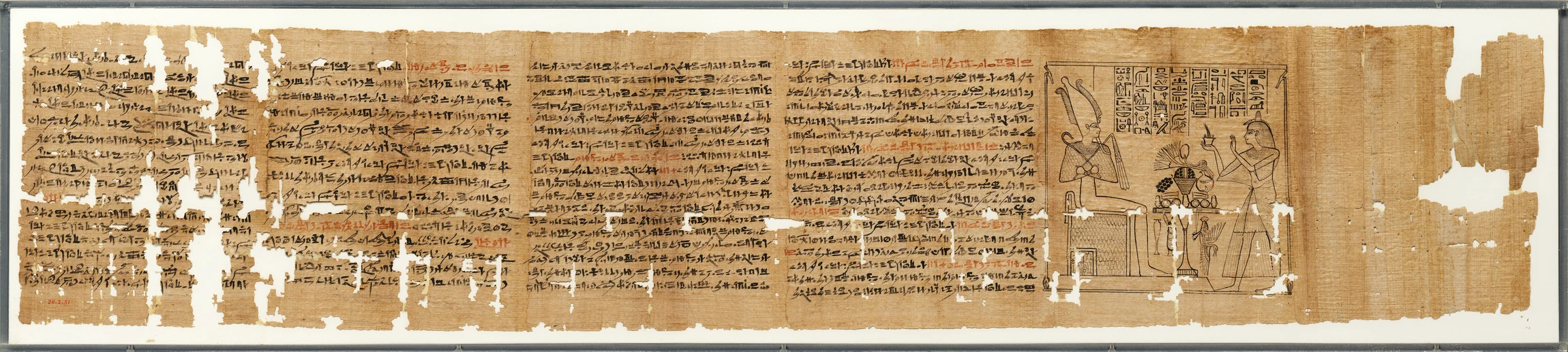
A vignette is a painted scene accompanying a funerary composition. The figures can be arranged in registers, juxtaposed with columns of writing, or shown in ritual postures. Start by identifying the museum frame and the spell named by the cataloguer. Then look for the owner’s name, the label of each god, the direction in which figures face, and any symbolic objects they hold. Only after that should the accompanying text be used to interpret the image.
This discipline prevents several errors. The same figure may perform a different role in another composition. A divine form may be composite, mixing human and animal features. A represented boat need not mean that Ani literally travelled by water to a geographically recoverable destination. Depictions express ritual knowledge, claims and expectations, sometimes combining several ideas in one visual space.
The British Museum labels frame EA10470,27 with multiple transformation spells. It is therefore a better place to study that group of images than borrowing a generic bird illustration from a different owner’s manuscript and calling it “Ani’s transformation.”
The opening hymns: why sunrise mattered after death
The Arabic translation begins with material invoking Ra and Osiris. Within the wider tradition, the rising sun was associated with renewed existence and recurring movement through the cosmic cycle. The deceased hoped not merely to remain inert in a tomb but to participate in forms of life and motion described through divine imagery.
The British Museum identifies EA10470,1 as including Spell 15, a hymn to the rising sun. Another frame, EA10470,2, includes a sunrise vignette and a hymn to Osiris. These scenes caution against treating solar and Osirian religion as competing systems with a single winner; afterlife hopes could draw on both.
Sunrise in such a composition does not prove that Egyptians claimed deceased bodies would physically rise each morning. The language is ritual and theological. A careful translation must distinguish the divine sun’s daily cycle from the hoped-for power of the dead to emerge, see, speak and live again.
Spell 1: the funeral procession is not just a decorative picture
Frame EA10470,5 preserves a richly described funeral procession. Oxen haul the sledge bearing the coffin while a leopard-skin-clad priest turns back with incense and libation equipment. The bier incorporates boat imagery, and figures of Isis and Nephthys stand near the coffin. Other mourners and possessions complete the scene.
The museum’s description records Tutu mourning beside the bier. Her gesture belongs to Egyptian conventions of grief rather than to an invented modern drama. The accompanying text is associated with Spell 1. The processional image provides strong evidence for how an elite funeral could be imagined and represented, while it cannot prove that every Egyptian burial followed exactly this illustrated sequence.
Notice how ritual and material culture intersect. The coffin, jar chest, carrying case and scribal palette are recognisable objects. Their placement on the painted roll, however, serves a religious function. The tomb equipment is rendered as part of a continuing relationship between the deceased, the mourners and the gods.
Ani’s judgment scene: reading the balance from left to right
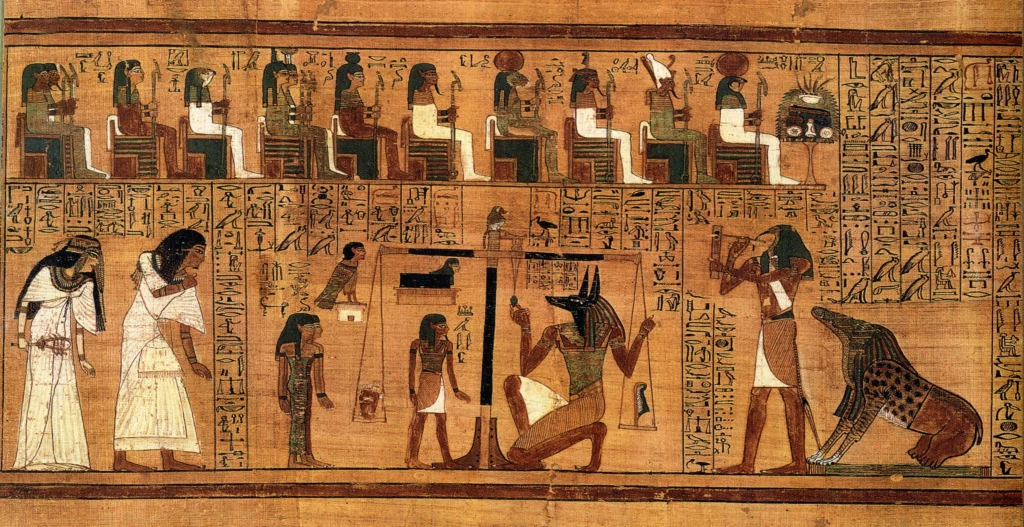
The most famous picture associated with Ani is the weighing of the heart. The British Museum describes a balance with the heart in one pan and a feather representing Maat in the other. Anubis steadies the balance, Thoth records the proceeding, and the hybrid monster often called Ammit waits near the scales. Ani and Tutu approach a divine assembly. This visual narrative is powerful because several distinct questions are compressed into one tableau.
The feather refers to Maat, a principle associated with truth, right order and justice. The heart was implicated in memory, intention and identity. The picture is not a reconstruction of a machine used in Egyptian courts, nor scientific evidence that hearts were physically measured after burial. It depicts a supernatural judgment imagined by practitioners of the funerary tradition.
The museum’s detailed reading also identifies a baboon form of Thoth near the top of the balance, the god in ibis-headed scribal form, and Ani’s ba-bird waiting for the outcome. To learn the scene, identify each participant’s placement and job before memorising labels. A single god may be present in more than one visual manifestation; this is not necessarily a scribal mistake.
An important limitation is that the balance image and Spell 125’s declarations are related but should not automatically be collapsed into a single text. Some museum frames present the picture; others preserve formal declarations. They work together within a belief system but are distinct kinds of evidence. See the British Museum’s illustrated cataloguing of Ani’s judgment scene.
The forty-two assessors and Spell 125
In the so-called negative confession, the deceased addresses a succession of divine assessors while declaring freedom from wrongdoing. The formula addresses listeners by their titles and sometimes by places associated with them. Repeated denials concern killing, theft, deceit, ritual impurity and other forbidden conduct. The structure matters at least as much as a modern list of short morals: it is a performance of justified identity before beings who can grant or obstruct access.
The Arabic volume begins this part on PDF page 117, under the heading for the negative confession, and continues with a sequence of numbered addresses. A useful example is a denial of stealing, but quotations from that modern Arabic translation cannot be treated as if they were the untouched ancient Egyptian wording. The translator’s choices and the papyrus’s textual variants remain part of the discussion.
UCL Digital Egypt’s chapter 125B comparison provides a crucial control: its translated sequence is based on the papyrus of Maiherperi, not Ani, and it explicitly notes variations in the sequence and in the number of declarations. One other papyrus there preserves thirty-two. This makes viral claims that Egypt had one universal “42 commandments” list misleading.
The British Museum catalogues EA10470,30 as the start of Spell 125, and EA10470,31 as preserving part of the negative confession. Those are object-specific references and therefore preferable to a list circulated online without a manuscript attribution.
What happens after the scales?
The narrative logic of the famous judgment image involves risk and hoped-for admission. Ammit’s threatening position represents the dreadful possibility of failing the test, while the continuation of the scene presents the deceased entering the presence of Osiris. British Museum frame EA10470,4 is catalogued as the conclusion of judgment with Ani introduced to Osiris.
This is not identical to a modern courtroom transcript, nor does it reveal what ancient people thought happened to the soul of every person. The formula, divine characters and outcome are part of a protective funerary manuscript intended to favour its owner. Reading the painted outcome as proof of a biographical event would confuse ritual representation with eyewitness testimony.
The shift from the scales to Osiris also explains why the god appears as much more than a name in a general pantheon. In this imagery, Osiris anchors the hope of acceptance and continuing existence beyond burial, while Anubis and Thoth have their own indispensable duties.
Why the heart, voice, name and body mattered
Egyptian funerary manuscripts often seek to preserve several capacities that living people take for granted. The deceased needed to speak, breathe, move, recognise names, and retain a heart that would not testify against its owner. The words aim to make someone effective beyond death, not merely comfortable inside a coffin.
The Arabic book devotes portions of its early and middle sequence to the restoration of a mouth, speech and heart. Such phrases should be interpreted alongside temple and burial practices, but a spell written on papyrus is not itself evidence that a physical medical procedure worked. Text and archaeology address different questions.
The ba is commonly represented as a human-headed bird and concerned with mobility and personal existence. Yet translating it simply as a “soul” can import modern assumptions. Egyptian religious categories are not interchangeable equivalents of later theological vocabulary. Their relationships are better explained through the particular text and image in which each occurs.
Transformation spells: changing form without losing identity
Several compositions describe becoming or appearing in particular living or divine forms. Birds, serpents, lotus imagery and other beings appear not as a children’s catalogue of magical animals but as vehicles of movement, protection, renewal and divine association. This is one of the visually richest portions of the funerary corpus.
Ani’s EA10470,27 is especially instructive because the museum identifies Spells 78, 87, 88, 82, 85 and 83 on one frame. A student can trace a set of transformations in one specific object, instead of combining illustrations from different centuries and claiming they depict the same manuscript.
The famous lotus and bird motifs can be compared with other Egyptian art, but similarity alone does not establish identical meaning. A sacred animal may carry several associations depending on period, context and accompanying inscription. The decisive question is what the image and text do together in the papyrus.
The Field of Reeds: why an ideal afterlife still contained farming
For a source-specific explanation of the depicted canals, crops, fields and boats, continue with the Field of Reeds and Spell 110 illustrated research guide. This focused article examines the agricultural afterlife without repeating the whole manuscript’s history.
The Arabic volume reaches chapter 110 on PDF page 109. Its accompanying discussion moves into blessed fields, food, drink and continued activity. These details are important because they challenge the popular idea that the ancient Egyptian afterlife was imagined only as a dark underground tribunal. For the deceased, success could include a sustained, meaningful existence with nourishment and familiar forms of productive life.
Spell 110 pictures an aquatic agricultural landscape, not an archaeological map waiting to be surveyed. Water separates fields; cultivated land is worked; gods and boats anchor the scene in sacred geography. The British Museum’s educational notes on other Book of the Dead papyri likewise describe ploughing, reaping and the Field of Rushes or Field of Offerings as recurring features.
The Egyptian world of the dead was not one uniform place across all periods and manuscripts. Words translated as “Field of Reeds,” “Field of Rushes” or “Field of Offerings” require attention to the source language and the author’s terminology. The agricultural landscape expresses desired survival, not evidence that actual fields were discovered in another dimension.
Gates, divine names and knowing how to pass
Beyond judgment and farming, the texts imagine barriers, guardians and places whose correct identification could matter. The power of naming an entity or recognising a threshold was embedded in the ritual language of access. Such passages are best read as part of a written and visual technology of protection for the deceased.
This does not turn the papyrus into a reliable map of tunnels beneath modern Egypt. Neither the Arabic volume nor the original funerary tradition provides physical evidence for secret underground gates that can be located using a tourist map. Statements about supernatural doorways belong to ancient religious imagination, even when painted beside familiar plants, waterways or buildings.
The modern spell index in the Arabic translation provides leads to further passages, but the broader index must not be treated as proof that every gate text appears in the surviving Ani papyrus. Each proposed subtopic should be checked against the manuscript-specific inventory and the museum frames.
A museum-frame reading map for students
The table below lists verified British Museum object descriptions, not an invented reconstruction of the scroll’s complete original layout. Each link leads to the museum record for a specific frame. The catalogue makes it possible to tie interpretation to an actual ancient object and to inspect associated names and passages.
| Museum frame | What the catalogue identifies | Research question |
|---|---|---|
| EA10470,1 | Spell 15, hymn to rising sun | How did sunrise support hopes for renewed life? |
| EA10470,5 | Spell 1, funeral procession | Which ritual actions and burial objects are pictured? |
| EA10470,27 | Transformation spells | Why could the deceased take several sacred forms? |
| EA10470,30 | Opening of Spell 125 | How is the judgment formula introduced? |
| EA10470,31 | Part of negative confession | What does the repeated denial structure achieve? |
| EA10470,4 | Ani before Osiris after judgment | How does the picture visualise successful admission? |
The limitations of older translations
The uploaded Arabic book is valuable because it preserves a sustained Arabic presentation of this tradition, its illustrations and extensive explanatory material. Its preface identifies reliance on the work of E. A. Wallis Budge. Budge made Egyptian texts accessible to many readers, but his spell divisions, vocabulary choices and mythological interpretations cannot simply be repeated as the final word of present-day Egyptology.
The history of decipherment has developed, and textual relationships between papyri are understood through wider corpora. Even basic choices such as “heart,” “soul,” “spirit,” “truth,” “field” or “eternity” can hide differences between ancient terms and later religious concepts. A responsible English article distinguishes a translation from the hieroglyphic reading and identifies which manuscript is being used.
A student comparing two English versions should ask four questions. Are they translating the same Egyptian passage? Do they rely on the same manuscript? Is a modern editor supplying numbers or titles? Has an explanatory note been mistaken for words spoken by Ani? Those questions often resolve apparent contradictions without forcing competing texts into a fabricated single narrative.
What the pictures can prove, and what they cannot
The surviving papyrus proves that a particular community produced and valued ritual words and images relating to divine judgment, protection and renewed existence. Its pigments, writing, names and condition can be documented and tested. The British Museum’s records identify painted frames, measurements, exhibition histories and conservation observations: these are material facts about an ancient object.
The papyrus cannot prove that Ammit devoured a heart, that a supernatural court met in a measurable place, or that transformation into a bird physically occurred. Those scenes are invaluable precisely because they reveal what people believed and hoped for. Separating an ancient claim from present-day verification does not make the belief unimportant; it makes the historical reading honest.
Likewise, the existence of repeated motifs in other manuscripts does not authorize relabeling a photograph. A papyrus made for Nesiamun or Khamhor is not an image of Ani’s papyrus. Museum IDs, credit lines and dates belong next to the relevant object, even if a comparison looks visually similar.
Frequently asked questions
What is the Papyrus of Ani? It is a nineteenth-dynasty Egyptian funerary manuscript commissioned for Ani and associated with Tutu, now catalogued in separate British Museum frames. It is one particular Book of the Dead papyrus rather than the original or mandatory copy of that entire textual tradition. Explore the Book of the Dead as a whole for the broader history.
Is the Papyrus of Ani the original Book of the Dead? No. It is an important Nineteenth Dynasty manuscript within a much larger, changing tradition. Other Book of the Dead manuscripts feature different combinations and orders of spells.
Was Ani an Egyptian king? No. He was a named individual with scribal and religious titles. The papyrus also names Tutu, his wife, who appears in several painted scenes.
Where is the Papyrus of Ani today? The British Museum holds the manuscript in catalogued frames under EA10470. Whether any specific section is on public display should be checked through its current object record.
Did the papyrus contain forty-two laws? The well-known declarations belong to an ancient funerary ritual formula, often called the negative confession. Their wording and even their count vary across sources. They should not be presented as one universal legal code.
Can the Field of Reeds be visited in Egypt? No archaeological location is known for the supernatural landscape described in the spells. Its importance is as a religious vision of continued existence and agricultural abundance.
Compare manuscript, not just illustrations: The British Museum identifies frame 30 as the start of Spell 125 and frame 31 as continuing the negative confession. These are physical catalogue records; they should not be confused with the numbered spells themselves. Explore the wider Book of the Dead corpus for comparison of texts belonging to different owners.
Primary records and research references
British Museum EA10470,1, Spell 15 and the named owners; EA10470,5, funeral procession; EA10470,27, transformation spells; EA10470,30 and EA10470,31, Spell 125; EA10470,4, admission to Osiris. For comparison of the confessions and their variants: UCL Digital Egypt, Book of the Dead chapter 125B.
Editorial source reviewed: Arabic Kitab al-Mawta al-Firawni, based on the Papyrus of Ani and the work of E. A. Wallis Budge, PDF pages 1–6 (translation history); 7–17 (hymns and weighing); 19–52 (opening compositions); 53–108 (faculties and transformations); 109–116 (Spell 110); 117–128 (negative confession); 171–175 (Ani inventory); 176–188 (general spell index). References to PDF pages are for the scanned edition used for this analysis, not original papyrus folio numbers.
Featured image documentation: “BD Weighing of the Heart.jpg,” Wikimedia Commons, public-domain reproduction of the historical judgment scene from the Papyrus of Ani; British Museum original object group EA10470. The picture is an authentic manuscript image, not an AI reconstruction.