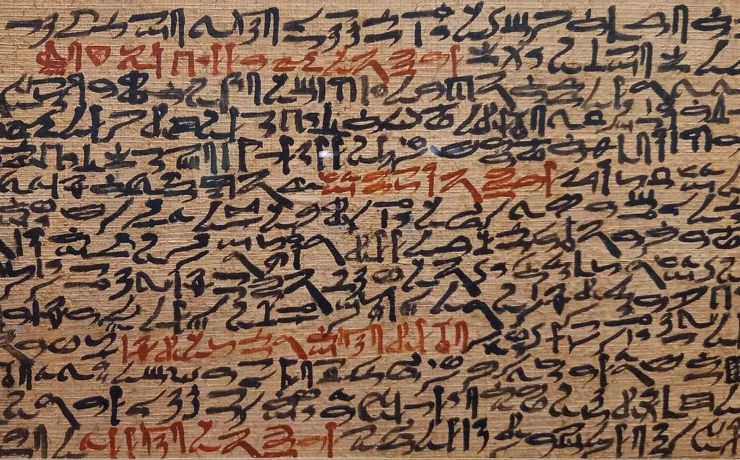
What is the Kahun Veterinary Papyrus? UC 32036 is a late Middle Kingdom Egyptian manuscript concerning animal healing, recovered from the wider Lahun settlement corpus and catalogued through UCL’s Petrie Museum records. It must not be confused with UC 32057, the separate Kahun Gynaecological Papyrus. The surviving document is fragmentary and does not establish a modern veterinary profession.
This source-led research study discusses the physical papyrus, excavation record, writing system and the limits of modern interpretations, with genuine historical plates rather than invented ancient scenes.
What the Kahun Veterinary Papyrus actually is
The Kahun Veterinary Papyrus is an ancient Egyptian manuscript concerning the treatment of animals, associated with the Middle Kingdom town near modern Lahun. University College London’s Digital Egypt catalogue identifies it as UC 32036 and describes it as the only surviving veterinary papyrus in the ancient Egyptian language. It is important to preserve that qualification. The statement concerns a particular type of known written source, not proof that no other ancient society cared for sick animals or that Egyptian animal healers left no other evidence. The document belongs to a landscape where written records also illuminate household affairs, state administration and human healing. It is sometimes summarized as ‘the world’s first veterinary textbook,’ but that modern title assumes a completeness and purpose that the surviving fragments cannot establish. The safer description is an exceptional surviving veterinary manuscript from the late Middle Kingdom. The evidence lies in its script, archaeological context and surviving text, not in a romantic scene of a pharaonic animal hospital.
Where Lahun is and why its town archives matter
Lahun is in the Fayum region, near the pyramid complex of Senusret II. Its settlement archaeology supplies unusually rich evidence for a late Middle Kingdom community of about 1850–1700 BCE. The UCL Digital Egypt project describes the town as one of the best preserved Egyptian settlements for that period and notes excavations beginning in 1889. The papyri found there range across accounts, letters, mathematics, hymns and healing texts. This variety helps explain why a document about animals should not be isolated from the rest of community life. People depended on working animals, food production, religious institutions and practical knowledge; the archaeological records offer glimpses of those interrelated concerns. The exact place where every fragment was used or discarded was not always recorded to modern excavation standards. That limitation matters: one cannot reconstruct the veterinary manuscript’s original owner or the precise room where a treatment took place simply because the papyrus comes from Lahun. The setting is strong evidence, but it does not supply a complete biography for its scribes.
The discovery of papyri between 1889 and 1899
Excavations around Lahun recovered a substantial group of Middle Kingdom papyri over the last years of the nineteenth century. UCL divides the discoveries into records associated with the cult of Senusret II and other manuscripts cleared from the town area, including material gathered during Flinders Petrie’s work in 1889. These find groups were subsequently dispersed among institutions, including the Petrie Museum and Egyptian museums. It is therefore misleading to speak as if every ‘Kahun papyrus’ were one scroll discovered in a sealed chest or as if the entire Lahun archive were housed in one gallery today. The veterinary document represents only one portion of that much larger written record. Museum numbers and the history of excavation are essential for separating the pieces. A photograph of a plate reproduced in a nineteenth-century publication is evidence that a particular text was documented and studied, but it does not show how the document appeared during an ancient treatment. Archaeological publication and ancient use belong to different periods of its history.
UC 32036 and the unusual cursive hieroglyphic script
UCL specifically describes UC 32036 as written in cursive hieroglyphs rather than the more common administrative hieratic associated with many Middle Kingdom papyri. That feature has invited discussion about the manuscript’s status and purpose. A script choice can be an important clue, but it does not by itself prove that a papyrus belonged to a temple, served as a priestly manual or was read by a named professional. The distinction between Egyptian writing systems is crucial. Monumental hieroglyphs, cursive hieroglyphs and hieratic forms all belong to the history of Egyptian written communication, yet their conventions and social contexts varied. For a broader introduction, see our study of Egyptian scribes and writing. The veterinary manuscript is a valuable case study because it connects a practical subject with a script form that cannot be reduced to generic office paperwork. It invites researchers to examine how specialized knowledge was selected and transmitted.
Animal health without the modern veterinary profession
The word veterinary is a useful modern translation for the subject of the text, but it does not establish that ancient Egypt had the same professional training, licensing, hospitals or diagnostic terminology used today. The surviving manuscript records Egyptian ways of discussing animal conditions and responses. Researchers must interpret words and symptoms within their ancient linguistic and social context. A phrase translated as a disease name may refer to a sign of illness rather than a condition defined by modern laboratory methods. We should also distinguish evidence for caring for animals from an institutional history of veterinarians. Animals were central to Egyptian economies and religious practices, but this single papyrus cannot tell us exactly who administered every remedy or how widely the recommendations were followed. Recent scholarship has specifically asked whether Egyptian care for humans and animals shared personnel or knowledge. These remain research questions rather than facts to fill in with a fictional description of a royal veterinary academy. The surviving fragment is remarkable enough without embellishment.
What the surviving veterinary text can and cannot tell us
A papyrus carrying technical instructions provides a valuable type of evidence: it documents that someone recorded concepts about particular animal ailments and approaches to treatment. However, a written procedure does not prove a treatment was universally employed or effective. The text has also survived incompletely, so modern summaries can create a false sense of precision by omitting missing passages. A cautious scholar asks which words are legible, how they have been transcribed and whether competing translations exist. A claim that one ancient Egyptian recipe cured a modern named illness would require evidence outside the document and cannot be established from its wording alone. The research value includes language, the organization of specialized knowledge and the social setting of literate care for animals. The physical document is primary evidence; modern explanations are interpretive scholarship. Avoid treating a modern translation as if it were the ancient author’s own explanation in contemporary scientific terminology. This distinction applies throughout the history of ancient medicine.
How the veterinary papyrus differs from the Kahun Gynaecological Papyrus
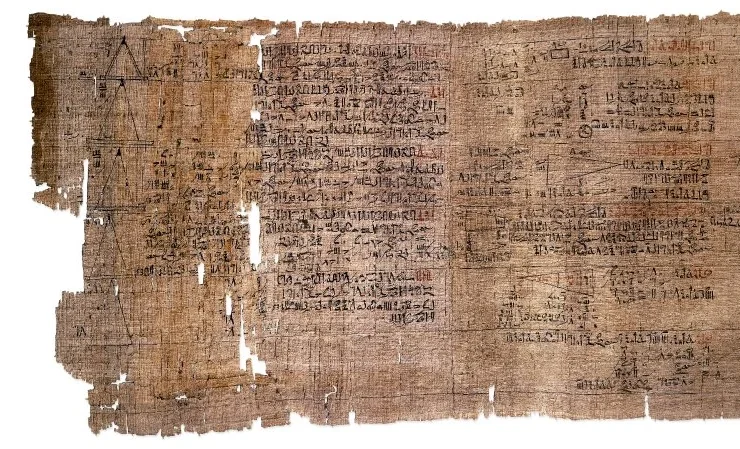
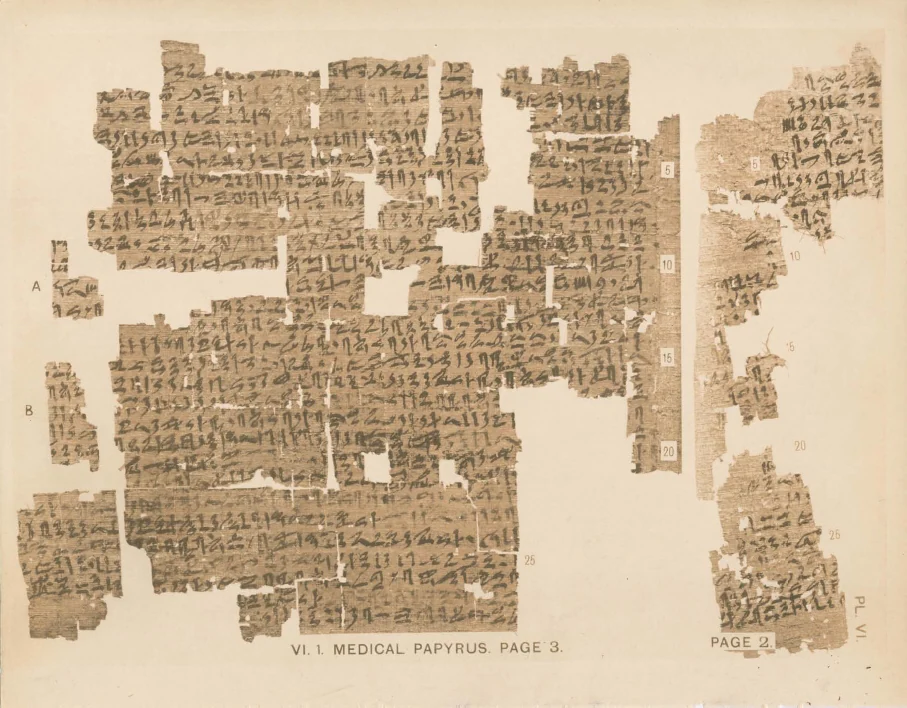
The veterinary text UC 32036 is often confused with UC 32057, popularly known as the Kahun Gynaecological or Kahun Medical Papyrus. UCL identifies both as late Middle Kingdom manuscripts associated with the Lahun town, but their subjects and catalogued objects differ. UC 32057 concerns women’s health and includes much-used papyrus sections, while UC 32036 concerns animals. The fact that they were found within a broader group does not make one a chapter of the other. Their physical condition and textual organization must be investigated separately. The second illustration in this article shows a historic reproduction of parts of the gynaecological papyrus as a comparison. Its caption clearly says it is a different medical document, not the veterinary manuscript. This comparison is useful for teaching because it makes visible both the abundance and the specificity of Lahun’s written evidence. Confusing them creates errors in dates, patient types, manuscript labels and interpretations of ancient healing.
The relationship between human and animal healing
University College London’s survey of healing manuscripts lists UC 32036 alongside human health papyri but keeps the objects distinct. A scholarly chapter published online by Cambridge University Press in October 2026 discusses the possible links between animal and human healing in ancient Egypt. It poses questions about whether the same personnel treated humans and livestock and whether approaches informed one another. Such questions are productive precisely because the surviving evidence does not allow easy answers. The coexistence of documents on different subjects in the Lahun corpus suggests a society where multiple kinds of practical knowledge could be recorded, but it cannot prove one standardized professional curriculum. Comparing the texts requires attention to their language and specific recommendations rather than claiming that one was copied from the other. A good article therefore distinguishes well-attested manuscript locations from hypothetical relationships among their scribes and users. Even an intriguing scholarly possibility should not be narrated as a witnessed ancient event.
The first image: an actual archival plate of the veterinary document
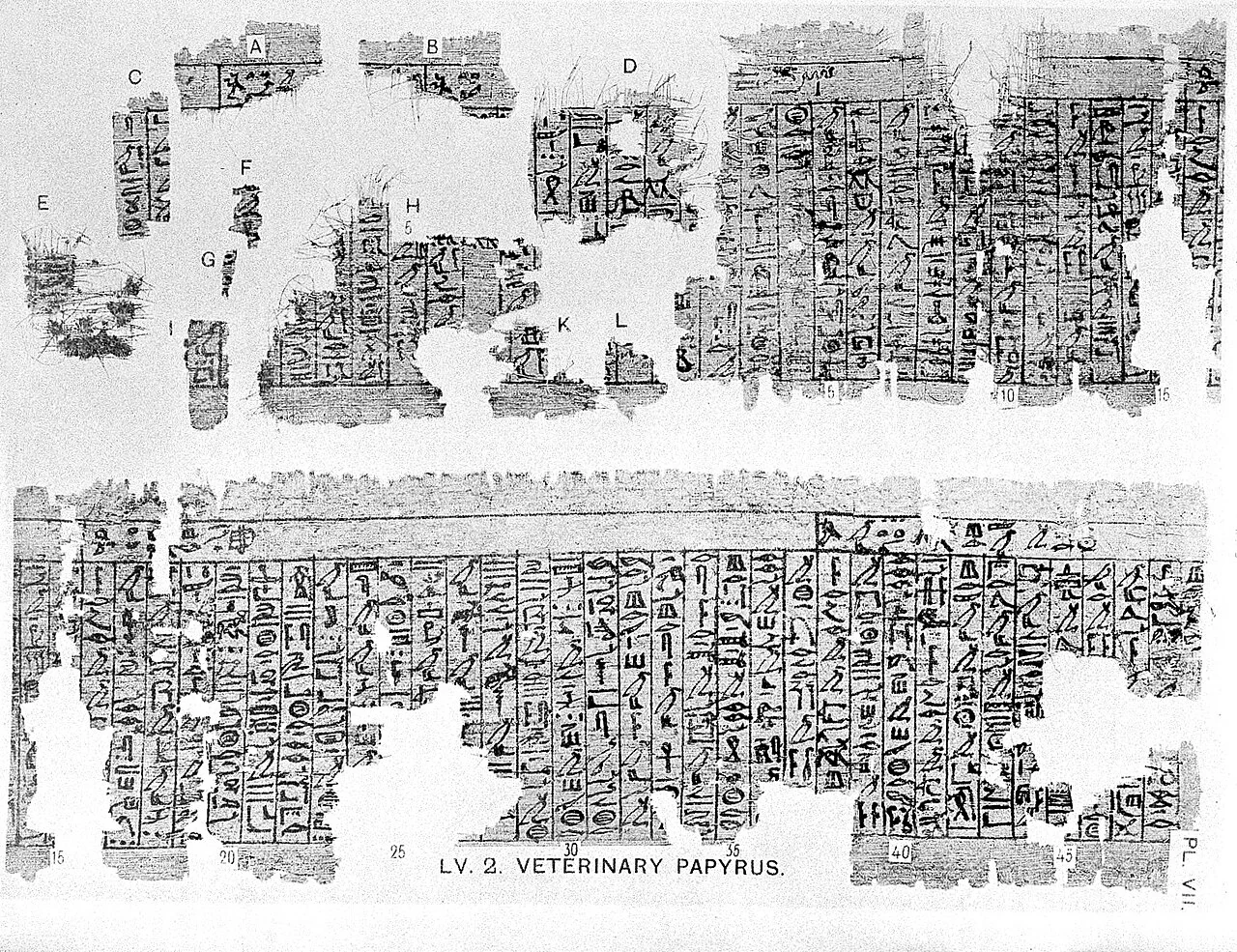
The first reproduced plate is the genuine historical image identified by the Wellcome Collection as L0001026, presenting the veterinary text in a nineteenth-century publication associated with the Petrie Papyri. The image is an archival reproduction, not a photograph taken at the moment of excavation and not a newly invented papyrus. Its scientific value comes from the visible script and the documented source information. The archival page has its own later publication history, distinct from the original Middle Kingdom manuscript. This dual history is characteristic of Egyptian papyrology: a fragment is found, documented, photographed or drawn, edited and later reinterpreted. The plate may make some signs easier to recognize than a damaged object viewed in a display, but it is not a replacement for a full scholarly edition. The CC BY 4.0 reuse terms require the appropriate attribution. Kemet Vault does not claim ownership of the archaeological text or misrepresent the modern reproduction as a freshly photographed original manuscript.
Why nineteenth-century editions still need critical reading
Early excavators and Egyptologists performed indispensable work recovering and publishing texts, but their publications should not automatically be treated as final translations. Methods for recording findspots, restoring papyrus fragments and analyzing Egyptian language have developed. An old printed plate can remain extremely important evidence for the recorded state of a manuscript while later scholarship improves its interpretation. The names Kahun and Lahun themselves reveal a history of modern terminology: Petrie’s familiar name for the town is not the only spelling in research. A student seeking the veterinary text should search for UC 32036 and the Lahun corpus, not simply trust a search snippet for ‘Kahun papyrus.’ Compare the physical identifiers, the transcript and the interpretative explanation. A historical edition can be an entry point into modern scholarship while retaining its own biases and limitations. This is not a reason to dismiss the original publication. It is a reason to distinguish the ancient document, its first modern edition and new arguments based on subsequent study.
A connected Middle Kingdom evidence network
The Lahun texts connect with other forms of Middle Kingdom evidence explored across Kemet Vault. Our Lahun planned-town study discusses settlement layout and other material evidence. The Senusret II pyramid article supplies the wider architectural context without making the veterinary papyrus a royal tomb inscription. The Edwin Smith Papyrus study addresses a different healing text with human trauma cases and should not be blended into a generic ‘first medical book’ narrative. These internal links are designed to let readers move between distinct questions: life in an excavated town, a king’s funerary complex, a human healing manuscript and an animal-focused document. An encyclopaedia gains value through those verified relationships, not by publishing four versions of the same article with new keywords.
What do ancient images of animals prove?
Ancient Egyptian tomb paintings, sculptures and inscriptions frequently depict cattle and other animals, but they are not automatically illustrations of the Kahun veterinary procedure. A painted herd may represent economic wealth, ritual practice or idealized estate life rather than disease treatment. When studying the veterinary papyrus, textual evidence should remain the primary source for claims about animal healing. Images from unrelated periods can offer broader cultural context only if their place and date are identified. The archaeological and historical distinction is easy to lose in online articles that place a stock photograph of a cow next to an invented translation. This dossier instead illustrates the actual source text and a clearly labelled comparison manuscript. Readers can inspect how specialized written materials survive without being given an unreliable visual reconstruction of an operation or animal clinic. Where direct physical evidence is absent, the correct choice is to state that limitation rather than invent a photorealistic historic procedure.
The physical history of the papyri and museum attribution
Museum collections hold the surviving fragments and related records under modern accession numbers. UCL’s Digital Egypt project references UC 32036 and links the Lahun papyri to the Petrie Museum. Such cataloguing enables scholars to distinguish a particular fragment from other manuscripts with similar popular names. An accession number identifies a collection object and its institutional documentation; it does not prove every detail of archaeological provenance or the owner’s identity in antiquity. The Wellcome Collection’s openly licensed reproductions add another documented visual layer, associated with the historical publication of the papyrus. Each source should be cited for what it can establish. The object record anchors identity, the archival plate shows signs as recorded, and analytical scholarship explores what those signs mean. Responsible publication must also respect copyright in modern photographs or digital reproductions, even where the ancient manuscript is thousands of years old. That is why separate media source records accompany this article.
The wider significance of animal care in an ancient economy
Studying animal medicine adds an essential perspective to Egyptian history that is often hidden behind royal portraits and pyramids. Agriculture, food supply, transport and religious activity all depended in different ways on animals. It follows that maintaining animal health could be a meaningful practical concern, but the veterinary papyrus alone cannot reveal the full scale of such practices. Archaeological bone assemblages, settlement remains and texts may provide complementary evidence, each with its own limits. The manuscript illustrates literacy applied to a specialized subject outside the standard modern image of scribes calculating taxes or commemorating kings. Its significance is intellectual as well as economic: it preserves an ancient attempt to organize information about animal conditions. Describing that achievement accurately does not require attributing modern microbiology, anesthesia or veterinary qualifications to its authors. The most useful conclusion is that ancient Egyptians left written evidence of animal-focused healing knowledge in a society whose daily life was much broader than its royal monuments.
Sources, dating and what remains uncertain
The foundation of this account is the UCL Digital Egypt survey of healing papyri, which identifies UC 32036 as the exceptional veterinary document and distinguishes it from UC 32057. The UCL Lahun Papyri collection history and town archaeology introduction provide the archaeological setting and excavation limitations. The 2026 Cambridge-hosted research chapter frames the debated relationship between human and animal healing. For the documentary plates see the Wellcome-associated licensed Commons files linked in the captions. The dating is a broad late Middle Kingdom range rather than a precise ancient day. No individual animal diagnosis is translated into modern instructions, and no unsupported claim is made about the papyrus’s named author or the historical effectiveness of its remedies.