The famous golden mask was the most intimate visible layer in a remarkable series of protections around Tutankhamun's mummified body. Four gilded shrines occupied much of KV62's burial chamber; within them a red quartzite sarcophagus held three anthropoid coffins, the innermost in solid gold. This original object-led investigation uses Christiane Desroches Noblecourt's Tutankhamun: His Life and Death as a historical starting point, then checks the burial sequence, materials, inscriptions and 1925 mummy examination against Egyptian museums, the Metropolitan Museum and Oxford's original excavation archive. Both source photographs show authentic objects or places and explicitly distinguish ancient evidence from modern camera views. The user-supplied Arabic documentary is linked as supplementary viewing; no independently verified narration transcript was accessible for this release.
Editorial standard: This original research article takes the user-supplied Arabic edition of Christiane Desroches Noblecourt’s Tutankhamun: His Life and Death as its historical starting point and independently checks archaeological details against Carter’s original journals at Oxford, Egyptian museum records and other primary research. Real documentary photographs are credited individually and never presented as reconstructions. The linked Arabic-language video is supplementary viewing only; a verbatim transcript was not independently available when this article was researched.
A face made to outlive a body
The golden mask of Tutankhamun draws visitors toward a human face that has survived more than three thousand years. Yet its expression does not mean the craftsman was making a portrait in the modern sense. The object covered the mummified head and shoulders of a dead king, and its imagery belonged to a program intended to secure protection and renewed existence after death. Blue and gold were not simply a fashionable palette. Together with a cobra, vulture, collar and ritual inscription, they expressed divine transformation and royal identity.
Christiane Desroches Noblecourt's Tutankhamun: His Life and Death treats the burial objects as evidence for the king's final religious setting. Her richly illustrated narrative gives the cultural question its force. The more precise answer begins with the physical mask now documented by the Grand Egyptian Museum, where it appears as an original object rather than a modern replica. We then follow its position among nested coffins, a stone sarcophagus and enormous wooden shrines. The king's body sat at the center of a carefully designed protective sequence, not in a single freestanding golden box.
Start in the burial chamber, not the museum showcase
Tutankhamun's small royal tomb KV62 has several rooms, but the burial chamber housed the main funerary assemblage. Egypt's Ministry of Tourism and Antiquities describes an unusually modest architectural space containing extraordinary objects. A protective system occupied much of that room. Four large gilded wooden shrines were placed one inside another; a stone sarcophagus contained successive anthropoid coffins; the mummy lay inside the innermost one with a gold funerary mask across the head and shoulders.
This sequence matters when modern pictures are used. The mask photographed alone on a museum plinth cannot show its original location inside multiple protective shells. Equally, a contemporary photo of the decorated burial chamber and stone sarcophagus is not a period image of Carter discovering the gold. Excavation removed layers of equipment over many seasons and thereby altered the visible room. To reconstruct the ancient arrangement, we need Carter's plans and object cards as well as the museum's catalogued objects. A visually compelling article must keep archaeological context ahead of spectacle.
Four shrines, one room almost filled
The four outer wooden shrines were covered with gilded surfaces, inscribed and arranged concentrically. The Metropolitan Museum states that they almost completely filled the burial chamber. This was not merely excessive packaging for valuables. Protective ritual texts and divine images created an enveloping environment around the king. Each opened barrier revealed another boundary until the sarcophagus and coffins could be approached.
The shrines were large objects built from numerous components, and the excavators had to plan their dismantling and recording. A museum display today may show an individual panel or whole reconstructed shrine without restoring exactly the original handling sequence. Different barriers also carried different decoration and sealing states. The Met notes that sealings of the second and third shrines raised hopes that the central burial remained undisturbed even though outer parts of the tomb had been entered in antiquity. The source therefore supports a nuanced claim: protection worked to a remarkable degree, but the tomb was not an absolutely untouched chamber. The very architecture of containment preserved evidence for its own history.

Quartzite around wood around gold
Inside the shrines stood a monumental red quartzite sarcophagus. The Egyptian antiquities authority identifies winged protective goddesses at its four corners and describes the chamber as roughly six by four meters. Stone gave the king a massive, lasting container. Within it were human-shaped coffins that brought the face and body of the deceased into an increasingly intimate ritual setting.
It is easy to confuse the terms sarcophagus, coffin, shrine and mask when a video cuts rapidly from one glittering image to another. They refer to different objects and materials. The sarcophagus is the stone container; the anthropoid coffins fit within it; the innermost coffin is solid gold; and the mask covered the king's wrapped remains. These nested components were the material context of the body's transformation. An exact modern list of weights, dimensions and materials must be tied to a reliable object record for each component, not copied from a social-media graphic with no museum citation.
The inner coffin: a body-shaped work of royal gold
The three coffins were not identical. The Metropolitan Museum distinguishes the innermost solid-gold coffin from the outer examples, which used gilded construction. The king's form, regalia and protective symbolism varied across the group. The famous mask was a separate piece associated with the mummy, not an easily removed faceplate from the solid-gold inner coffin. Confusing these two masterpieces produces a basic archaeological mistake.
Gold also carried meaning beyond monetary value. Its resistance to corrosion and luminous appearance suited a religious vision in which a king could acquire imperishable divine qualities. But a precise statement about what every artisan personally believed cannot be read straight from the material. The objects were commissioned and interpreted within royal funerary institutions, and their inscriptions and iconography help define their ritual role. Their survival does not require modern myths about secret alchemy. A workshop of highly skilled Egyptian craftspeople could transform metal, stone and glass into an exceptionally sophisticated system of royal imagery.
The mask's materials and dimensions
The Grand Egyptian Museum identifies the mask as made of gold with glass, lapis lazuli, obsidian, carnelian, faience and quartzite components. It catalogues the width as 39.3 centimeters. The Global Egyptian Museum records its height as 54 centimeters and inventory number JE 60672. Those identifications are preferable to endlessly repeated unsourced figures about its price, mythical rarity or exact worth on a modern bullion market.
The mask's visual language is just as precise as its materials. A striped nemes headdress frames the face, while the uraeus cobra and vulture at the brow protect royal authority and associate the king with the Two Lands. Eyebrows and eyes are worked with dark and bright inlays; the collar joins the head to the broader protective image. A genuine high-resolution photograph lets readers observe technique and color but cannot reveal the full sequence of manufacturing operations. That requires the study of joins, hammered gold, inlay settings and restoration history. A museum object is a research source, not merely a beautiful thumbnail.
What does a funerary face represent?
The museum explains that the face identifies Tutankhamun while also assimilating him to Osiris and the solar god Re. This is not the same as a modern assertion that every feature was cast from the dead king's exact face. Egyptian funerary images could idealize and transform. Their power resided in convention, text, materials and ritual understanding. Recognizability and divine perfection were not mutually exclusive goals.
A broader question follows: how can an object be both individual and formulaic? Cartouches and royal names identify the particular king, while facial types and regalia can be compared across Eighteenth Dynasty representations. Scholars debate the reuse and alteration of some objects found in Tutankhamun's burial, so simple claims that every object was originally manufactured for him need evidence. The mask itself should be studied on its documented properties rather than reduced to rumors that a different monarch's face was merely replaced. We can recognize meaningful historical uncertainty without pretending that every attractive theory is an established museum finding.
The inscription behind the image
The reverse of the mask bears writing meant to provide protection. The Grand Egyptian Museum explains how the inscription associates individual parts of the royal head with particular gods and sacred concepts. The Global Egyptian Museum links the mask's funerary function with the broader Book of the Dead tradition. These descriptions reveal why the object is more than a golden portrait. Words, materials and form worked together in an intended religious transformation.
The inscription also gives visitors a way to read an object that often seems entirely visual. A photographed back of the mask can contain hieroglyphic lines, but a random online translation may mix spells, omit grammar or present one editorial rendering as the only possible wording. The safer route is to consult a museum text or scholarly translation and distinguish the ancient inscription from a modern paraphrase. We do not reproduce a lengthy modern copyrighted translation here. Nor do we imply that a spell printed in a papyrus was copied verbatim onto every Egyptian mask. The link is historical and functional rather than mechanical identity.
What the painted walls add to the story
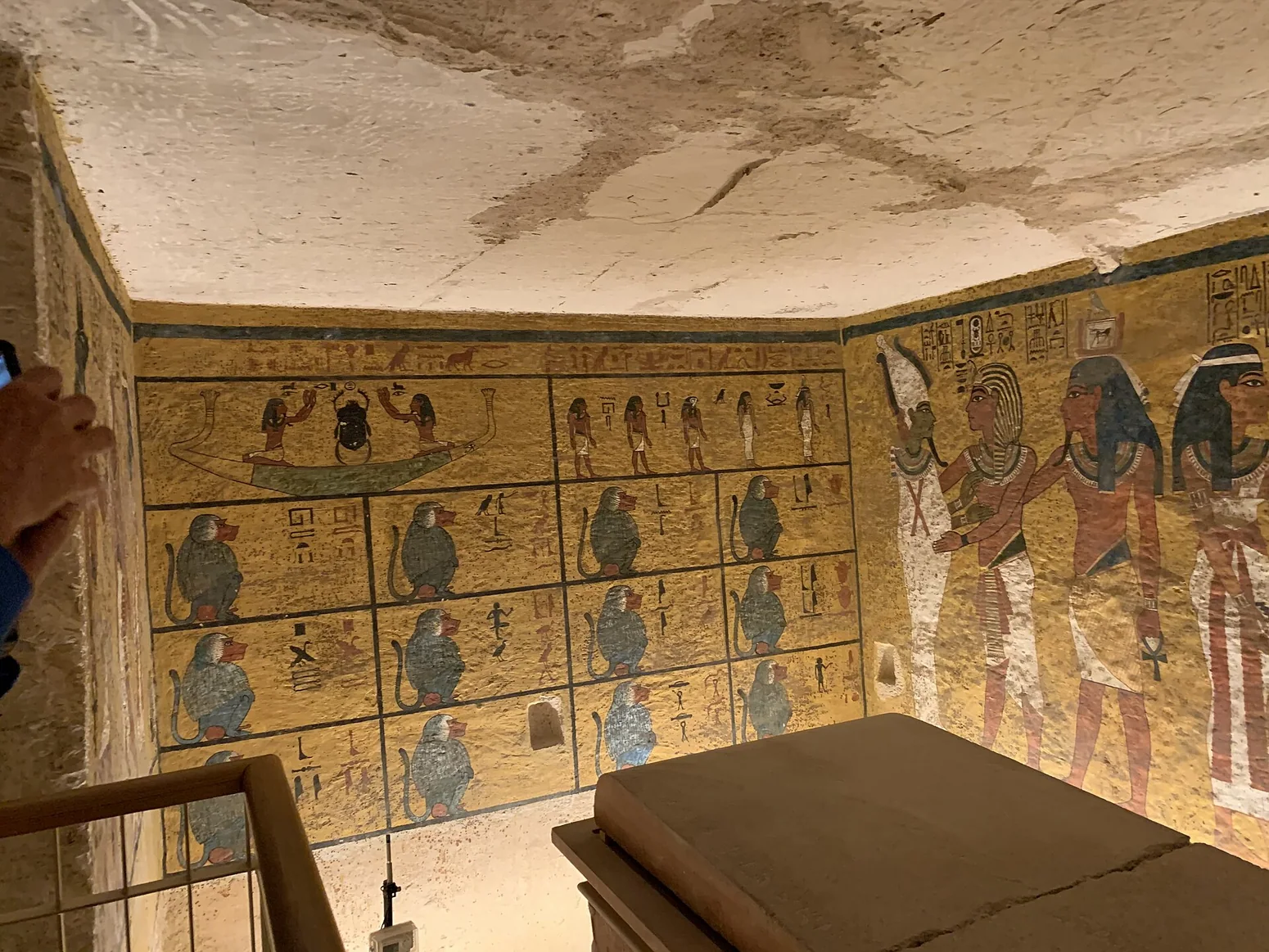
The walls of KV62's burial chamber preserve scenes of the king with deities and funerary rituals. Egypt's Ministry points out that only this chamber received painted decoration and that just one scene from the Amduat appears among the imagery. This is a striking difference from larger royal tombs whose extensive corridors carry elaborate netherworld books. The relatively compressed program has encouraged theories about the burial's hurried preparation, but such interpretations need careful architectural and archaeological evidence.
One authentic photograph accompanying this article shows the burial chamber and stone sarcophagus in their present condition. It documents actual material remains rather than one imagined night of royal embalming. The wall scenes support the connection between the objects and a conception of life after death, but paintings are symbolic programs. We should not turn the image of the successor Ay performing the Opening of the Mouth into a literal photographic report of a ceremony, complete with invented witnesses. Ancient royal art presents ideal religious action. Studied alongside the mask and coffins, it helps reconstruct belief without collapsing representation into event.
The work of unwrapping and scientific inspection
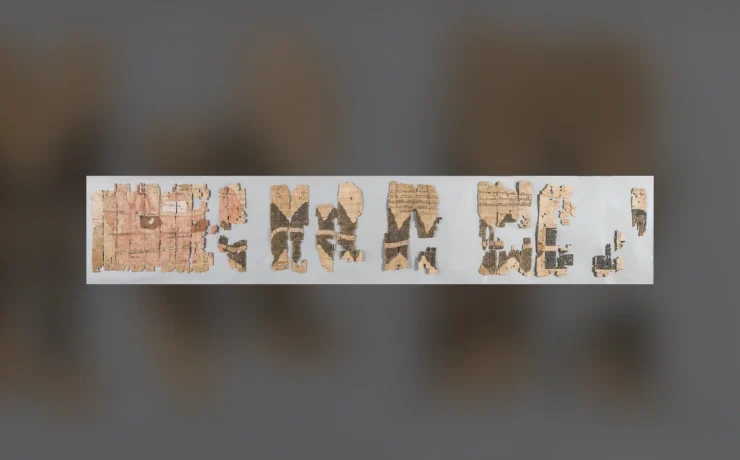
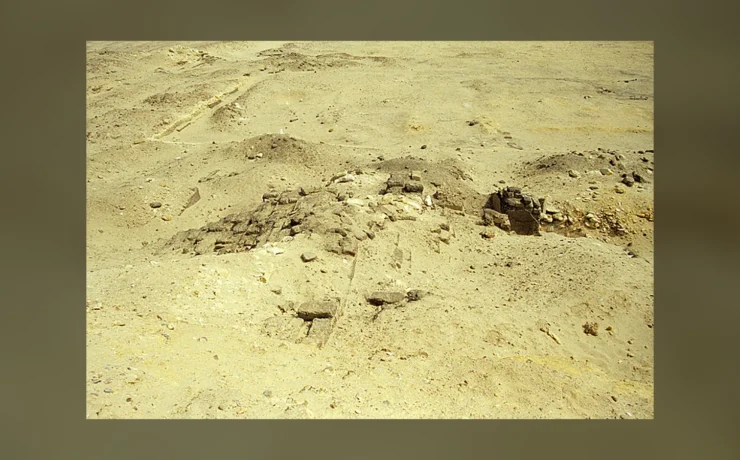
In November 1925, Carter's team undertook the unwrapping and examination of the king's mummy. The Griffith Institute has brought a substantial part of the documentation of this episode together in the Tutankhamun Spatial Archive. The 1925 sequence includes notes, diagrams and photographs that record objects associated with the body. It should not be confused with the first opening of KV62 in November 1922 or the first breach of the burial chamber in February 1923.
The historical procedure also raises questions that modern archaeologists would approach differently. The desire to record jewelry and amulets had to be balanced against the physical condition of the remains and the conservation knowledge available at the time. A contemporary article should neither romanticize every intervention as flawless nor dismiss the surviving records. Their detail remains essential for understanding what was observed. Oxford's present digital project improves access to that information while making clear that connected spatial reconstruction is an ongoing research undertaking, not a time machine that can answer every question automatically.
The treasures that were ordinary things before burial
It is tempting to call each object in KV62 a treasure simply because it belongs to a world-famous tomb. But the assemblage included clothing, boxes, furniture, chariots, containers and devices of daily or ceremonial life. Some items were specially adapted for funerary use, and others may have had earlier histories. This variety is why the tomb provides evidence beyond the gold mask: objects illuminate craft specialization, royal domestic expectations, material supply and the religious transformation of possessions.
The Metropolitan Museum's research places these categories within the four rooms' recorded find positions. A photograph of a disassembled chariot in the antechamber can answer a different question from a protective image on a coffin. One tells us about transport equipment and its deposition; the other addresses divine identity and the funerary body. The historian's task is to connect them without assuming a single object embodies the entire civilization. The richness of the burial is not merely the amount of gold. It is the extraordinary survival of hundreds of different types of information in one archaeological context.
Two real photographs and one visual rule
The first high-resolution image on this page is a genuine 2015 photograph of the actual funerary mask by Tarekheikal, released under CC BY-SA 4.0. It depicts the museum object itself, not a cast or a generated approximation. The second, taken in 2020 by Romagy, records the surviving burial chamber and stone sarcophagus of KV62. It is a modern picture of an authentic site, not a photograph of an intact arrangement of nested shrines before Carter removed them.
These two views should be spectacular because their subjects are spectacular, not because their origins are disguised. The article's gallery preserves the color and form of the object without editing it into a fictional archaeological scene. Separately commissioned visual reconstructions can be useful for audience engagement if clearly labeled 'artistic reconstruction,' but they are not accepted as evidence for the exact face, garments or surroundings of Tutankhamun in life. Oxford's historic Harry Burton negatives remain linked through the institution that conserves them, rather than republished as unrestricted photographic stock.
The famous mask is an opening to a deeper history
The best question is not how much Tutankhamun's gold would sell for. As a national heritage object and irreplaceable archaeological document it cannot be reduced to a commodity. The better question asks how the mask's religious meanings, materials, precise position and later excavation all formed one history. The face became globally familiar only through a chain of events: the royal burial, ancient intrusions, the discovery in 1922, opening of inner layers, photography, study and museum display.
Desroches Noblecourt's treatment of the young king's life and death provides a framework for that extended story. The Egyptian antiquities authorities and museum collection records anchor individual objects, while Oxford's archive preserves the actions and observations of Carter's team. The result is not another list of 'secret powers' attributed to a golden face. It is a source-led account of how religious protection became physical craftsmanship, and how excavation turned those objects into modern historical evidence. The deeper one studies the nested burial, the less the mask seems like an isolated trophy and the more it reveals a carefully constructed ancient vision of eternal kingship.
Evidence at a glance
| Evidence | What can be concluded |
|---|---|
| GEM catalogue object 8 / JE 60672 | The authentic gilded funerary mask, its original find position over Tutankhamun's wrapped head and shoulders. |
| Outer shrines | Four enormous gilded wooden shrines enclosed the stone sarcophagus. |
| Stone sarcophagus | Red quartzite with protective female divine figures around the four corners. |
| Three coffins | Anthropoid coffins nested within the sarcophagus, innermost solid gold. |
| November 1925 | Mummy unwrapping and recording took place after the 1922/1923 initial openings. |
| Two real photographs | Museum mask and surviving KV62 room, each with creator and license; neither is a reconstruction. |
Frequently asked questions
Was Tutankhamun's golden mask his inner coffin?
No. The mask covered the mummified king's head and shoulders inside his innermost gold coffin.
How many coffins and shrines were in KV62?
There were three nested anthropoid coffins within a stone sarcophagus enclosed by four large gilded wooden shrines.
Does the mask depict Tutankhamun exactly as he looked alive?
It identifies Tutankhamun but is also an idealized funerary and divine image; it should not be treated as a clinical portrait.
Where can the original mask be studied?
The Grand Egyptian Museum provides a current catalogue record in its Tutankhamun galleries, including its materials and funerary interpretation.
Are the two images real?
Yes. Both are photographs of authentic ancient material or the surviving archaeological site, with openly recorded modern dates and Creative Commons licenses.
Sources and image provenance
This article uses the historical source listed in the bibliography as a research starting point, specifically PDF pages Christiane Desroches Noblecourt, Tutankhamun: His Life and Death (Arabic supplied scanned 340-page edition), study of the king's funerary setting and discovery as a historical interpretive framework; object's latest descriptions independently checked against GEM and Oxford.. Its historical rhetoric and older interpretations are not treated as conclusive archaeological evidence. The external museum and research records below are linked for independent checking.
- Grand Egyptian Museum official catalogue entry: The Golden Burial Mask of Tutankhamun, GEM object 8
- Egyptian Ministry of Tourism and Antiquities: KV62 actual burial layout and painted scenes
- Metropolitan Museum: 4 shrines, 3 coffins, outer stone sarcophagus and archaeological discovery
- Oxford Tutankhamun archive: 1925 unwrapping and preservation of source documents
- Global Egyptian Museum: original funerary mask JE 60672 and ritual symbolism
- Egyptian antiquities ministry: conservation account of the large gilded coffin
- The Metropolitan Museum: Tutankhamun's Tomb, The Thrill of Discovery book
- Verified original Commons photograph of Tutankhamun's mask, CC BY-SA 4.0
- Verified original Commons photograph of the actual KV62 burial chamber
- The user-supplied Arabic Tutankhamun documentary, verified title and public description, no verified narration transcript
- Photograph: The original Tutankhamun golden funerary mask, photographed 23 December 2015 by Tarekheikal, CC BY-SA 4.0. A genuine museum object, not a replica or AI visualization., Tarekheikal, authentic 23 December 2015 photograph of the original Tutankhamun funerary mask, CC BY-SA 4.0
- Photograph: The authentic decorated burial chamber and quartzite sarcophagus in KV62, photographed by Romagy in January 2020, CC BY-SA 4.0. The nested wooden shrines were removed during excavation and are not shown in their original arrangement., Romagy, 6 January 2020 original archaeological photograph of KV62 burial chamber, CC BY-SA 4.0
Watch the related Arabic documentary
Open the original Arabic documentary on YouTube. The published description concerns the 1922 discovery and the tomb treasures. The video is a viewing companion, not a verified narration transcript or primary archaeological source.