Senet, commonly translated as “passing,” was played in ancient Egypt over a remarkably long period. Archaeologists have recovered decorated boards, boxes and gaming pieces, while tomb scenes offer glimpses of the game’s meaning. Yet there is no complete surviving rulebook. Modern versions that promise the one authentic set of ancient rules are reconstructions, not direct translations of instructions. An evidence-led history of senet has to combine objects, images and funerary traditions while keeping these differences clear. The result is more interesting than a simple guide to moving pieces: senet offers a way to study Egyptian leisure, craft, cultural change and ideas about the afterlife.
The distinctive thirty-square board
The most familiar senet design has three rows containing ten squares each. The grid offers a physical framework in which pieces could move, but its geometry does not settle all the rules. The Metropolitan Museum of Art describes a path that proceeds across the rows in an alternating, S-shaped sequence. Other aspects of play have been reconstructed through images, game pieces and later evidence. The board design is much more securely known than the full pattern of permitted moves and scoring. This distinction should appear near the beginning of any serious explanation of the game.
Surviving boards vary considerably. Some were elaborately constructed and decorated; others appear as simpler grids scratched into available surfaces. Differences in quality should not be read as automatic proof that one game belonged only to royalty and another only to poor people. A beautiful box in a tomb was chosen as funerary equipment, and may have been specially made for that context. Informal play in homes or workplaces could have left fewer durable traces. The familiar thirty squares provide the common visual language, while manufacture and surviving context show the wide variety behind it.
How old is senet?
The Metropolitan Museum places senet within a long tradition extending from Egypt’s early archaeological periods to at least the Late Period. The earliest surviving representations or boards need not date the actual invention of the game. Games can be played on surfaces that leave little or no archaeological record; a preserved board may belong to a well-established tradition. Assigning an individual inventor or a single founding year would require evidence that does not exist. The historical task is to examine changing examples across periods, not to turn a broad timeline into an origin myth.
Later boards may show different signs, materials or funerary associations from earlier ones. That variation suggests senet’s meaning and presentation were not fixed for thousands of years. Religious texts associated with the afterlife became especially important to some New Kingdom interpretations, but a board from an earlier period should not automatically be given the same symbolic interpretation. Chronology makes it possible to discuss cultural continuity without assuming that every generation played under identical conditions. Readers comparing museum objects should record each object’s attribution and findspot before treating apparent similarities as decisive.
Playing pieces, throwing sticks and chance
The game is generally understood as a contest in which two players moved pieces according to the outcome of thrown sticks, knucklebones or similar devices. The Metropolitan Museum’s educational reconstruction describes competition, blocking an opponent and the movement toward a final square. This is a helpful model, but it is still a model. The archaeological remains do not include a universally complete explanation of every possible move. Modern playable rules often resolve uncertainty by making consistent decisions where the evidence remains incomplete.
Gaming equipment offers a different type of evidence. Cone-shaped and spool-shaped pieces have been found with some boards, while throw sticks and bones could produce movement values. Not all components survive in every excavated example. Wooden or organic equipment may decay, be removed or have been replaced before burial. A box associated with gaming pieces can help explain storage, ownership and craftsmanship without revealing exactly how players decided a winner. When teaching the game today, it is useful to mark the difference between observed artefacts, scholarly inference and modern playability. A reconstruction can be educational without masquerading as a recovered ancient rulebook.
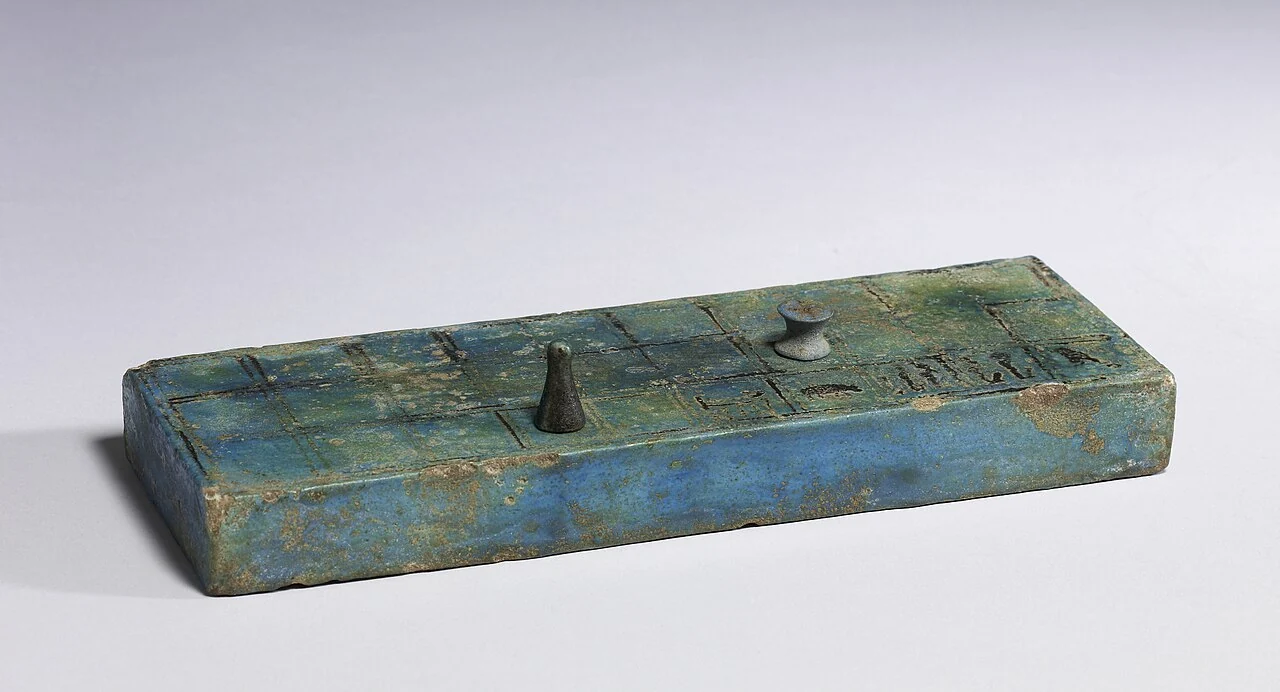
An actual senet board at the Walters Art Museum
The Walters Art Museum preserves a faience senet board catalogued as accession 48.408. Museum documentation attributes it to a period within the New Kingdom and connects the game with the later symbolic journey through the underworld. Its rectangular pattern and material are directly visible in collection photographs. Such an identifiable object provides a better starting point than a modern illustration copied from an anonymous website. The museum record can also tell us about modern collecting history, which should not be confused with the object’s ancient use.
Both the front and reverse views are instructive. A photographic angle may hide wear, edges or signs of restoration, while conservation work can change what looks complete at first glance. We should not assume that every inlaid square preserves original pigment or every displayed gaming piece was found together. The board’s colour, texture and proportions are specific to that object, not proof that all senet boards looked alike. Comparing it with examples from the Metropolitan Museum reveals what features recur and which were local or chronological variations. Serious object study rests on these distinctions.
A box with two games, not one
The Metropolitan Museum’s game box 16.10.475a, dated to the late Second Intermediate Period or early New Kingdom, is designed for two games. One surface carries the thirty-square senet layout; the other has a twenty-square design associated with a gaming tradition of wider Near Eastern circulation. Museum documentation states that some of the box’s wooden structure was reconstructed, while ancient ivory and copper-alloy fittings survive. The box offers a particularly useful case study in the difference between ancient fabric and modern restoration.
An online photograph of one side can easily be mislabelled as senet even when it shows the twenty-square game. The number and arrangement of squares are the first clues. The box’s double function also shows a practical solution to carrying and storing gaming equipment. Yet the existence of two different boards does not mean that both games shared rules. They were distinct traditions, and movement systems should not be transferred from one to the other without evidence. A responsible caption identifies the exact surface shown and makes the conservator’s interventions visible in the explanation.
Senet as recreation in Egyptian society
Games offer a reminder that ancient Egyptians were people with leisure, competition and social interactions, not only subjects of kings and builders of monuments. The evidence is uneven: burial equipment and decorated tomb walls survive much better than everyday wooden boards or informal scratches on floors. This biases the modern picture toward elites and religious contexts. A royal gaming box may be famous because of the quality of its construction and preservation, not because senet was restricted to the wealthy. Material wealth shaped how a game was represented, but may not have determined whether it was played at all.
Social reconstructions require restraint. A surviving grid does not tell us which family members used it or whether a particular person regularly won. Some popular narratives attach detailed anecdotes to anonymous objects, creating a fictional intimacy that the sources cannot support. Better questions concern the materials used, how objects were transported, and why games were included in graves. Kemet Vault’s daily-life history places leisure beside food, work and family, allowing senet to be understood within a wider social landscape without duplicating those general topics.
Nefertari and the changing funerary meaning
A celebrated painting in the tomb of Queen Nefertari shows her playing senet. The setting is fundamental to interpretation: it is a tomb decorated with ideas about the afterlife, not a casual photograph of a leisure activity. During the New Kingdom the game could symbolise movement through obstacles on the route beyond death. The Metropolitan Museum links this use to funerary beliefs and images. The painted scene demonstrates that senet could carry meaning far beyond entertainment, but it does not tell us precisely how often Nefertari played the game in life.
Images within a royal tomb were designed according to religious and artistic conventions. A figure’s pose, the selected objects and their relationship to accompanying texts matter more than modern assumptions about the scene. An artist could show an idealised act rather than an event remembered from a specific afternoon. The development of funerary meaning should also not be projected unchanged onto boards from centuries earlier. For the wider religious landscape, readers can consult Kemet Vault’s Book of the Dead article and compare how surviving texts and images construct journeys after death.
Tutankhamun’s gaming equipment

Tutankhamun’s burial contained several game boxes, illustrating how gaming equipment could be selected for a royal funerary assemblage. The Metropolitan Museum’s overview mentions multiple examples. This should not become a universal claim about what every Egyptian household possessed. An elite tomb is a highly selected deposit with unusual conditions of preservation; people who played on simpler boards may have left very little behind. Even within a royal context, pieces and boxes could be stored, repaired or used in different ways before burial.
The story becomes more revealing when the excavation and the object’s present museum state are distinguished. Photographs made at different times may show equipment before conservation, after restoration or arranged for display. A modern museum presentation can group objects for explanation in ways that do not exactly recreate an excavation arrangement. Count and material descriptions should be taken from the specific catalogue, rather than repeated from a souvenir label. The presence of gaming equipment in a burial is evidence of choices surrounding that burial, not a complete inventory of the ruler’s everyday recreation.
Decorated end squares and special moves
The last five squares on some senet boards bear symbols whose interpretation is especially important to reconstructions. The Metropolitan Museum identifies the nefer sign and a water-related sign on particular positions of one board and explains possible advantages and hazards within its playable model. These examples are not proof that every surviving senet set preserved an identical code for all thirty squares. Signs might be worn away or absent from earlier versions, and restorations can obscure uncertainty. A labelled museum object should always be identified before its decorations are interpreted.
Modern charts offering one religious explanation for every square can be attractive but often combine evidence and speculation without warning. The sounder method is to begin with observable motifs, ask when they occur, and compare them with funerary images and texts of approximately the same period. Symbols could influence how the game was understood even as practical play continued. The result is neither a purely secular game nor a religious scripture carved into a board. It is a material tradition whose associations and possible rules changed through history.
Senet, mehen and the game of twenty squares
Senet is not the only ancient Egyptian game. Mehen is associated with a coiled-snake board; the game of twenty squares used a different grid and had connections beyond Egypt. Museum studies describe these traditions separately, and their objects should not be combined into one fictional national board game. Similar gaming pieces or throwing devices do not settle the identity of a game. Board geometry, dating, excavation context and decorative signs all contribute to identification. A mislabelled photograph can therefore undermine an otherwise useful popular explanation.
The wider history of board games also reveals cultural exchange. The twenty-square game appeared in several Near Eastern contexts and could be adapted with Egyptian symbols on surviving Egyptian boards. This does not prove that all traditions moved along one simple route or that players in distant regions always used the same rules. Archaeology can establish distributions and relationships without preserving the details of every interaction. A comparative approach helps readers appreciate both local Egyptian practices and connections with neighbouring societies, while avoiding unsupported claims about cultural ownership or an original inventor.
Can historians recover the exact rules?
No complete universally accepted ancient senet rulebook survives. Historians reconstruct possibilities by comparing objects, images and texts, and playable versions must make decisions about the missing information. A school demonstration can be educational if it announces which version is being used. A modern product marketed as the only authentic ancient set of rules should be viewed more critically. The board’s thirty squares are a stronger fact than the exact number of pieces that every player used; a known museum object is stronger evidence than a contemporary illustration without provenance.
The most responsible presentation therefore has two layers. It lets readers explore how game equipment was made and used, and then explains how religious meanings emerged in funerary settings. Neither layer requires inventing dialogue or a false ancient scoring chart. To understand the afterlife dimension in a related but distinct context, visit Kemet Vault’s Field of Reeds study. Senet’s enduring value lies in how a recreational practice could become a symbol of passage, not in the claim that historians have recovered every move made thousands of years ago.
Documentary sources
The Metropolitan Museum’s study of Senet and Twenty Squares, its catalogue of the two-sided board, and the museum’s overview of board games anchor the historical account. Photograph identifiers and licences must be checked against the Walters Art Museum’s original object records and their exact Wikimedia Commons pages before publication. Where the original rules are unknowable, their proposed reconstruction is explicitly identified as such.