In 1744, Abd al-Rahman Katkhuda transformed an intersection in Cairo into a place for drinking water and elementary education. His Sabil-Kuttab on al-Muizz Street reveals the social history of Ottoman Egypt through copper screens, marble basins, Ottoman floral tiles and an upper schoolroom. Far from a footnote to the rulers of Istanbul, the monument documents Cairo’s local patronage and the practical work needed to sustain public charity. It also asks how historians move from one splendid surviving building to the people who actually used it.
A fountain in the center of a changing Ottoman city
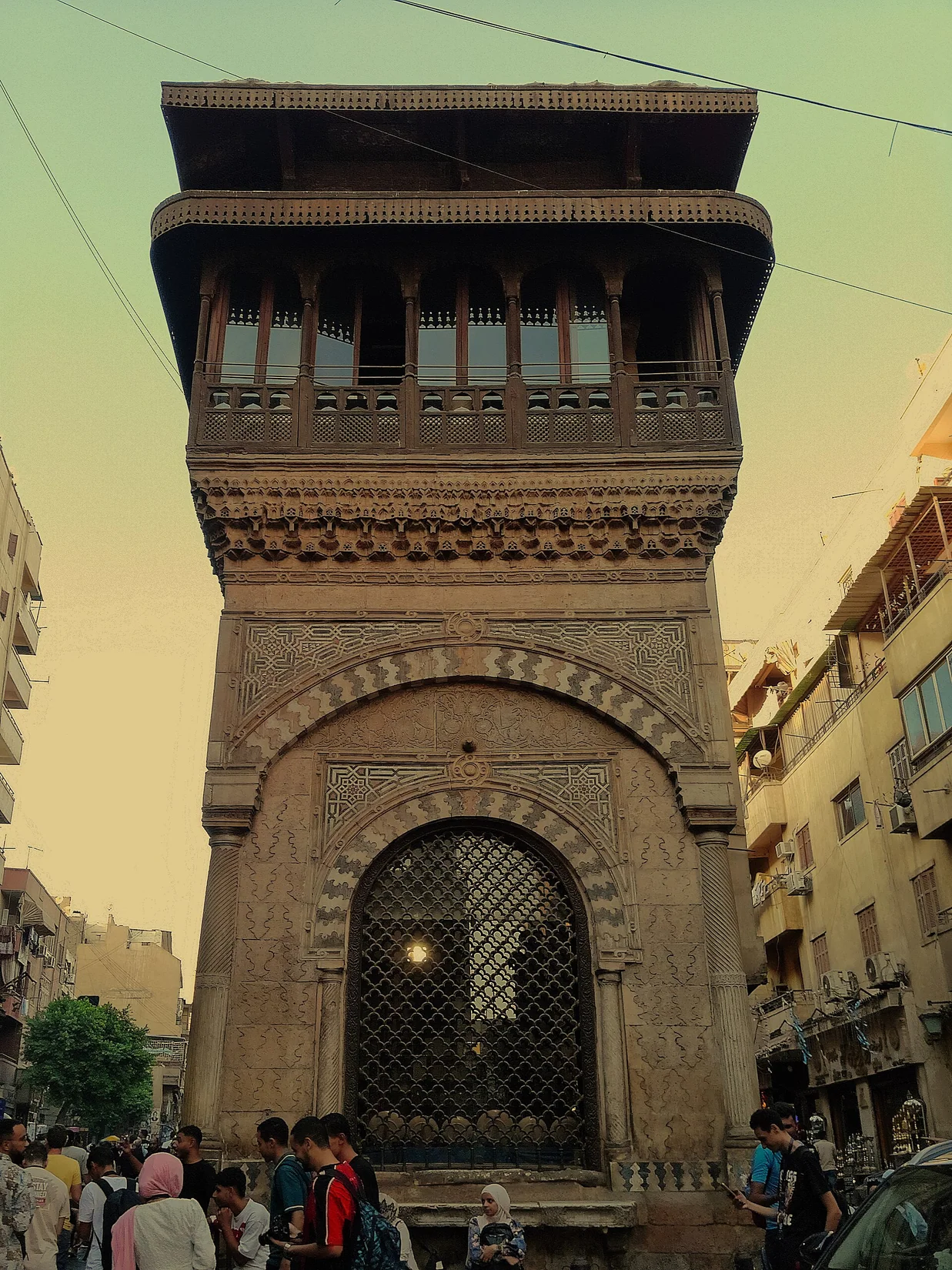
The Sabil-Kuttab of Abd al-Rahman Katkhuda stands where al-Muizz Street meets Tambakshiya Street in Historic Cairo. Its location helps explain its purpose: a public water facility was most useful where people already moved through a busy urban district. The structure combined a drinking-water distribution room at street level with an upper educational space. That union of charity and teaching was an established architectural tradition in Cairo rather than a novel scheme imported from Istanbul in the eighteenth century. What makes this particular monument historically valuable is the quality of its surviving fabric and the unusually specific information supplied by its foundation inscription. Modern photographs show the very building in the Ministry’s monument inventory, but the images also display later conservation and changes in surrounding street life. A reader should treat the old and new layers separately. The historical setting was Ottoman sovereignty; the urban forms and building labor, however, emerged from long Cairene traditions. The monument offers a way of studying how local patrons displayed status by supplying shared amenities. It cannot by itself establish that every citizen received water without interruption or that the city’s infrastructure was universally equitable.

1744 and the patron Abd al-Rahman Katkhuda
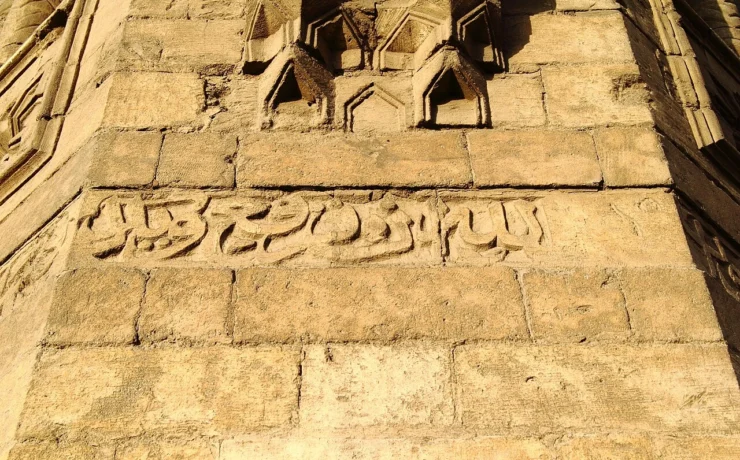
Egypt’s Ministry of Tourism and Antiquities dates the foundation to 1157 AH, corresponding to 1744 CE, and identifies the patron as Prince Abd al-Rahman Katkhuda al-Qazdagli, an Ottoman-period military figure. That attribution is particularly valuable because it rests not solely on later chronicles or modern guidebook lore. The building’s entrance inscription gives a patron and date in a poetic text. Inscribed foundations are a form of public self-representation: they state what a benefactor wished passers-by to remember. Yet inscriptional claims should not be mistaken for a biography of all users or builders. Craftspeople who worked on stone, copper screens, marble and wood are rarely identified individually by the surviving inscription. Katkhuda belonged to networks of military and local elite power that operated under Ottoman authority. Investment in water provision, prayer complexes and educational spaces could reinforce social standing and religious prestige. The interpretation that charitable building linked wealth to legitimacy is plausible across Ottoman urban history, but precise motivations are not written on every surface. We can securely date and name this foundation while acknowledging gaps in the record of labor, funding and everyday operation.
What was a sabil? Water as a civic service
A sabil was a place where drinkable water could be dispensed to the public, commonly supported by charitable endowment arrangements. Water mattered in Cairo because the Nile was nearby but clean drinking water did not automatically appear at every front door. Fetching, filtering, storing and distributing water required workers, vessels and maintenance. At Katkhuda’s structure, the Ministry describes a rectangular chamber and three street-facing façades. Each façade incorporated a copper window; outside, marble basins were provided to hold cups for drinkers. The physical layout illustrates the separation between water-handling space and public approach. An observer can see how architecture facilitated repeated small acts of distribution without opening the whole chamber to pedestrians. Such facilities were not modern water-treatment plants, and the existence of basins should not be used to infer a quantified daily throughput. Nor does one foundation establish how frequently supplies failed in hot seasons. A valuable history of infrastructure begins by asking who financed the water, who carried it and how residents actually reached the windows. The surviving windows are compelling evidence for intended function; the lives of water carriers and attendants require additional archival research.
The kuttab upstairs: schooling and charity
Above the water distribution space was a kuttab, a schoolroom linked to elementary religious education. The Ministry specifies that Katkhuda’s kuttab served Muslim orphans and taught Qur’anic material and prophetic traditions. This is an unusually clear statement of the intended users and curriculum for one monument. But its historical significance extends beyond the repeated word “school.” It represents the organization of teaching within a charitable built environment, physically elevating education above water service. Children would encounter the public life of the district while learning in an upper room shaped by wooden construction, light and airflow. We cannot reconstruct the individual pupils’ names or their exact timetable simply from the building. Literacy rates are not calculable from a photograph of an upper gallery. Nor should the eighteenth-century curriculum be described as identical to that of a modern Egyptian primary school. Understanding the kuttab requires attention to teachers, reading practices, charity and neighborhood access. The building shows what a patron intended to provide and what spaces were created; records of actual attendance would be different kinds of evidence.

Three façades and a triangular urban problem
What makes the structure visually striking is its position within an intersection and the façade treatment that addresses more than one direction of pedestrian movement. The sabil below includes three outward-looking fronts, creating a compact volume that responds to a difficult urban plot. Copper windows, marble basins, decorated stonework and an upper wooden gallery integrate function with the visual identity of the street. These details reward close looking: a building can offer a public service while announcing that service through conspicuous architecture. The monument’s preservation also warns against easy chronological shorthand. Al-Muizz Street contains monuments from different Islamic dynasties, some far older than Katkhuda’s foundation. Standing in a historic street does not make every adjacent façade Ottoman. Architectural vocabulary was inherited, changed and reused. Stone carving and woodwork can resemble earlier Mamluk craftsmanship while belonging to an eighteenth-century commission. A careful museum caption therefore states the date of the specific object rather than the age of the neighborhood. The true complexity is more interesting than claiming a single uniform style swept away everything that came before it.
Tiles, floral ornament and Meccan imagery
Inside the sabil, the Ministry records ceramic panels with Ottoman floral decoration. Some depict the Great Mosque in Mecca alongside Qur’anic inscriptions. This decorative program reminds us that a public utility could also be a devotional and prestigious environment. Water, benefaction and sacred texts belonged to overlapping practices of charity. The images on the tiles, however, should not be casually described as exact eighteenth-century aerial photographs of the holy sanctuary. Decorative representation follows conventions and artistic choices. The placement of inscription and image creates a message directed toward visitors who might receive water and recognize the religious associations of the act. In the wider city, tile production and exchange connected Cairo to craft networks and changing fashions. Imported designs and locally made objects can coexist, and origin should be established by technical examination rather than presumed from the word “Ottoman.” The building’s layered surfaces also bear the effects of conservation. A bright tile today may have been cleaned or reset, which does not make it meaningless as evidence but requires attention to its restoration history.
Poetry over the doorway: the foundation inscription as evidence
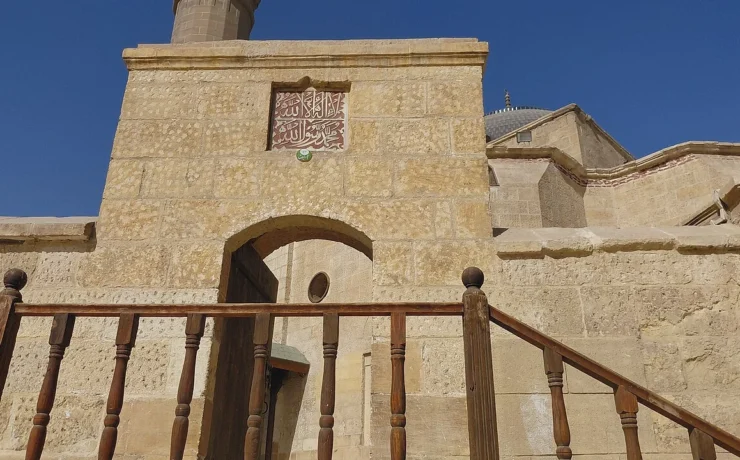
A foundation inscription identifies the patron and records completion in 1744. The Ministry describes verses of poetry inscribed above the entrance overlooking Tambakshiya Street. Such inscriptions give historians a firm point of chronological reference amid buildings that were repaired and modified over generations. But they are more than numbers. Verses could celebrate virtue, piety, the public benefit of water and the prestige of the founder. Their content is framed for an audience, and that public self-presentation forms part of the monument’s function. When studying an inscription historians ask whether the stone is original, whether the text was moved, how its date was expressed and which letters can still be read. Transliteration may differ between modern publications. A visitor who sees the date in a modern signboard should be able to trace that assertion back to the official monument record. The presence of words also reminds us that writing was not exclusively the domain of books. Ottoman Cairo’s walls communicated charitable claims, ownership and dedication through durable public text.
Waqf, servants and the hidden economy of public generosity
The sabil-kuttab belongs to a larger history of charitable foundations often sustained through waqf, endowment arrangements supporting religious, educational and social functions. Yet a broad statement about waqf institutions should not be treated as proof that a particular surviving endowment deed has been examined. Where documentary records exist, they can identify properties whose rents financed water, staff salaries and repairs. Where they do not, the physical monument can still demonstrate the intention to maintain a service but not its exact annual budget. Supplying water demanded physical work: carrying, storing, guarding and cleaning. Teaching demanded teachers, materials, supervision and schedules. The expensive visible façade depended on a less visible network of labor and finance. Those workers deserve historical attention even when the patron’s name dominates the inscription. The charitable foundation also helps interpret elite politics under Ottoman Egypt, where local authority, military networks and urban patronage were closely connected. Buildings offered practical benefit while making the benefactor a lasting part of the city’s memory. To understand the people inside the urban elite’s domestic world, compare Kemet Vault’s Bayt al-Suhaymi architectural history. The two monuments show different kinds of infrastructure within one city.
The related Mosque and Sabil of Shaykh Ali al-Mutahhar
Katkhuda was associated with more than one Cairene foundation. The Ministry also records the Mosque and Sabil-Kuttab of Shaykh Ali al-Mutahhar on al-Muizz Street, built in the same year, 1157 AH / 1744 CE, under Abd al-Rahman Katkhuda’s patronage. The surviving account describes a mosque prayer hall, a public water function and a kuttab, plus a memorial association with Shaykh Ali al-Mutahhar and the patron’s mother. This connection helps prevent the historian from treating one structure as a curious isolated work. Several foundations formed part of the patron’s charitable and political presence in Cairo. But the two sites should not be confused. An image of one building cannot be captioned as the other simply because both carry Katkhuda’s name and date. The shape of a façade, intersection location and monument registration provide ways to distinguish them. Studying two separate foundations also broadens questions about how public water and elementary schooling were located within the city, and why an elite patron selected particular neighborhoods for architectural investment. A source-led article should use the Ministry’s individual monument pages instead of blending their descriptions into one fictitious complex.
Public memory, restoration and Historic Cairo today
Today’s preserved sabil-kuttab is both an eighteenth-century foundation and a modern heritage attraction. Conservation of masonry, copperwork and timber is necessary because dense-city pollution, changing moisture conditions and physical wear can damage structures that have stood for centuries. The aim of preservation should not be to erase the building’s history of use or turn it into a theatrical re-creation of a permanently clean Ottoman street. Its relevance lies in the relationship between public service, small-scale education and political display. The water facility no longer has to play exactly the same role it did in 1744 to communicate how people once approached drinking water as a civic need. Similarly, the surviving upper room speaks about a history of religious education even if the daily pupils’ voices are lost. Egypt’s antiquities ministry is the most appropriate source for current visitation access, but tickets and hours can change and should be checked at the time of travel. The historical study here deliberately does not promise a fixed price or uninterrupted access. For broader context, the Ottoman Egypt encyclopedia explains the political and commercial world within which Katkhuda’s patronage developed.
Quick facts and evidence table
| Feature | Verified evidence |
|---|---|
| Foundation | 1157 AH / 1744 CE, Abd al-Rahman Katkhuda |
| Location | Intersection of al-Muizz and Tambakshiya Streets |
| Lower level | Water distribution room, three façades, copper windows and marble basins |
| Upper level | Kuttab intended for religious education of Muslim orphans |
| Dating evidence | Entrance poem with patron’s name and completion date |
Historical sources and image licensing
Official primary monument reference: Egyptian Ministry of Tourism and Antiquities, Sabil-Kuttab of Katkhuda. Comparative official reference: Mosque and Sabil-Kuttab of Shaykh Ali al-Mutahhar. Larger conservation setting: UNESCO Historic Cairo listing. The three photographs show the actual eighteenth-century monument at modern photographic dates, not staged Ottoman residents or conjectural original decoration. Historical review October 2026.
Frequently asked questions
When was the sabil-kuttab built?
It was founded in 1744 CE (1157 AH), under the patronage of Abd al-Rahman Katkhuda al-Qazdagli.
What were the two functions of the building?
Providing water to people at street level and providing a kuttab for religious education above.
Is the building from the Fatimid period?
No. Al-Muizz Street has monuments from several periods, but this documented building is an Ottoman-era foundation.