Why is the Temple of Esna famous? The surviving Temple of Khnum at Esna is especially known for its late Egyptian and Roman-period hypostyle hall, richly carved columns and astronomical ceiling. Egyptian-German conservation has revealed pigments and details formerly hidden under soot and deposits.
Located south of Luxor, Esna offers a different type of historical evidence from the better-known royal temples of the New Kingdom. Its surviving hall displays the continuity of Egyptian religious imagery under Greek and Roman rule, while its cleaning program reveals how conservation changes what present visitors can see. This study distinguishes the original temple surfaces from modern restoration work and from photographs taken before the cleaning campaigns.
For related historical context, compare the Dendera astronomical ceiling study and Roman-era urban life at Alexandria. The object and monument records below distinguish physical evidence, scholarly interpretation and modern presentation.
Esna on the Nile and the surviving temple building
Esna is a Nile Valley town south of Luxor with an archaeological history extending across more than one era. Its surviving temple hall is associated with the ram-headed deity Khnum and retains extensive late Egyptian religious inscriptions. Unlike a site where an entire ancient sanctuary stands free of surrounding structures, the present monument lies within a living urban environment. The visitor encounters a surviving part of a much larger religious complex, surrounded by a modern city that has changed in both level and layout.
Understanding the setting prevents two common mistakes. First, the surviving hall is not identical to the original temple in full. Second, a photograph taken from the monument cannot prove that all adjacent streets or buildings date to the period when the hall was decorated. Archaeology reconstructs the ancient complex from architecture, epigraphy and historical sources, while city life provides the present context in which conservation and visitor access must operate.
Khnum and the religious character of the sanctuary
Khnum was an Egyptian god represented in ram-headed form and associated in various contexts with the Nile, creation and the shaping of life. Worship of Khnum at Esna belonged to local traditions with distinct names, cult relationships and ritual texts. It should not be reduced to a single universal myth known equally throughout Egypt. Late temple inscriptions may preserve complicated theological associations that require philological reading as well as iconographic identification.
The dedication of the monument is part of the reason the painted ceiling and columns matter. Images of deities were not purely decorative illustrations. In a temple setting they participated in sacred space and in the ordering of ritual knowledge. A colored ram-headed figure in a photograph may look immediately familiar, but its exact title and action must be read from nearby inscriptions. Late religious language borrowed from earlier traditions and could elaborate them in new ways under Roman rule.
Why the hall belongs to late Egyptian and Roman history
Esna’s surviving decoration is a valuable source for studying Egyptian temple culture under the Ptolemies and Roman emperors. The fact that classical political dynasties ruled the country did not mean that temple walls suddenly stopped bearing Egyptian writing or imagery. Priests and artisans continued to use inherited religious forms, sometimes adapting them to their current patrons. The surviving hall helps historians explore that continuity without imagining that there was no change in political authority or urban society.
Roman-era dating should be applied to the specific carved and inscribed surfaces to which it belongs. A building may incorporate earlier foundations, later repairs and still more recent conservation. For that reason it is too simple to call every visible stone ‘the temple of one Roman emperor.’ The chronological discussion should ask which parts of the architectural record are datable by texts and who sponsored different inscriptions, while marking uncertainties rather than inventing a single construction day.
The hypostyle hall and its decorated columns
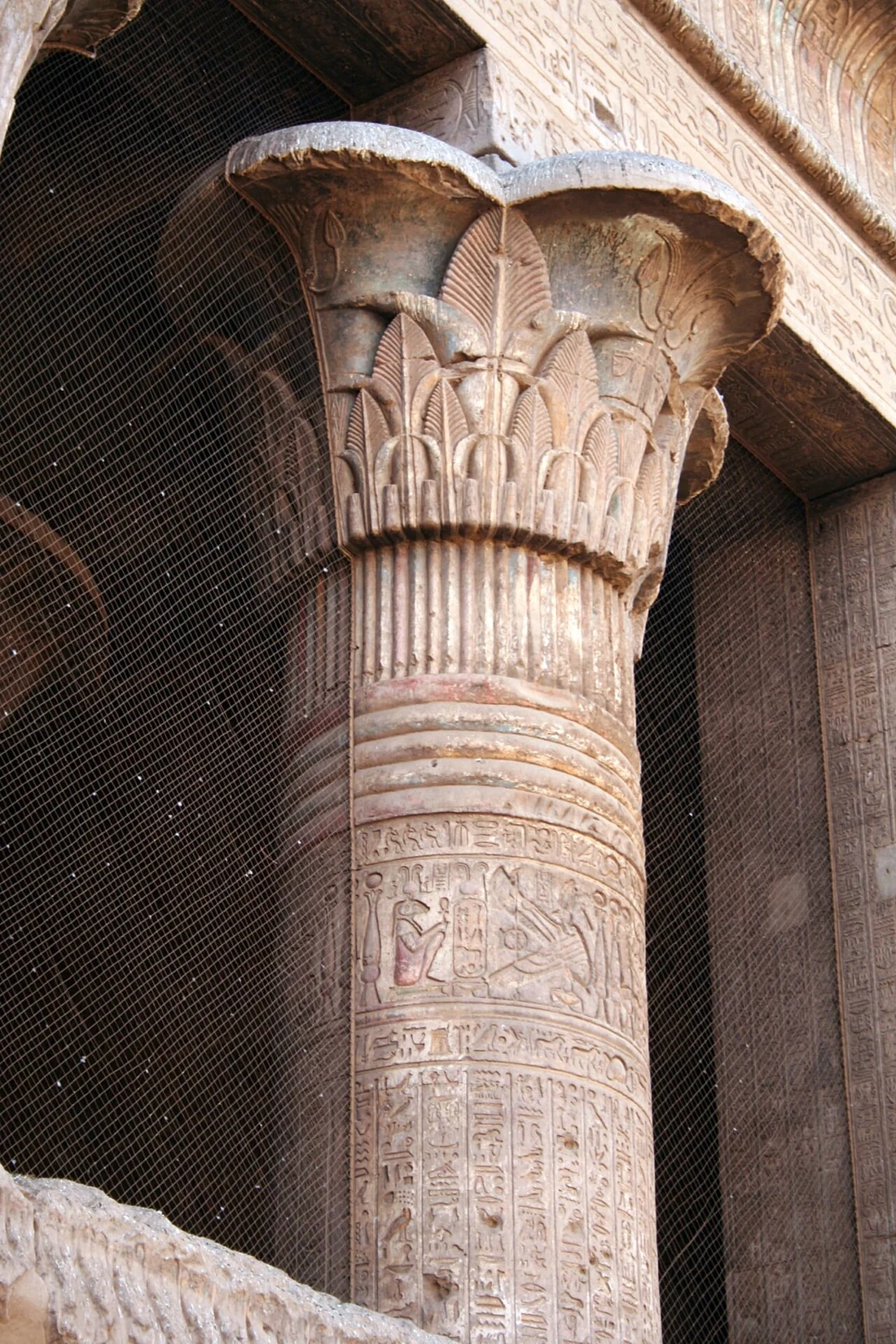
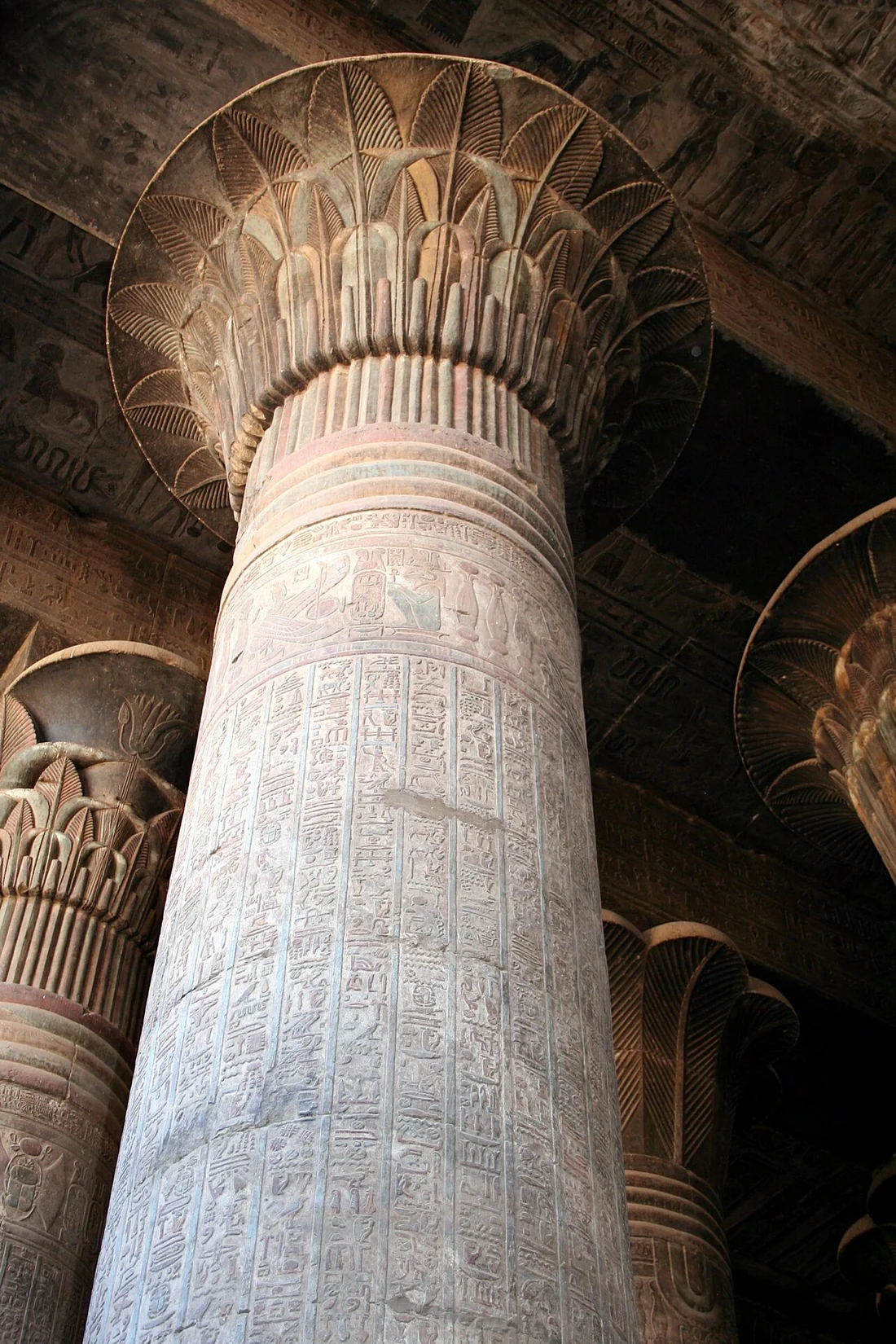
The surviving hypostyle hall stands out for its monumental columns, capitals and densely inscribed relief surfaces. A hypostyle building is structured around columns carrying a roof, and that design produces numerous faces for images and text. The arrangement requires a visitor to look upward as well as across the walls. On a stone surface, a combination of painted pigments, incised signs and surviving carving can form a unified sacred composition, although each layer may have weathered differently.
The Egyptian government’s 2025 report noted that cleaning work had been completed on eighteen of the hall’s twenty-four columns at the time of inspection. That figure is a project-status record from October 2025, not an assumption about the present condition in late 2026. Visitors should look at current official updates to know which areas are ready to view. The important archaeological point is that conservation improves the legibility of particular original surfaces rather than manufacturing an entirely new temple.
What the astronomical ceiling actually records
Ceiling scenes at Esna contain Egyptian astronomical and religious imagery including stars, celestial representations and divine figures. These scenes belong to a long tradition in which the sky formed part of ritual knowledge and sacred order. The use of astronomical subjects does not make the hall a modern planetarium or prove that every symbol is an exact measurement of a present-day constellation. Egyptian religious astronomy and modern stellar classification use different historical frames of reference.
The restored astronomical ceiling has become a focal point because surface cleaning revealed colors and decorative details previously obscured. Reporting on the monument in October 2025, Egypt’s State Information Service described the recovery of the original painted surfaces as an ongoing conservation achievement. Those statements concern observable pigment and inscription preservation, not an authoritative modern translation of every ceiling panel. Specialists need to record the location, text and relationship of each figure before interpreting the whole composition.
The problem of soot, dirt and apparently vanished colors
Before conservation, layers of soot and other deposits could obscure painted surfaces. Darkened stone does not necessarily mean a sculptor intended a black-and-white monument. Where pigments survive beneath later accumulation, careful treatment may make ancient design decisions newly visible. But cleaning is not simply a dramatic ‘before and after’ reveal. Conservators must distinguish deposits from unstable pigment, repair materials and original carved surfaces before any intervention. A wrong treatment could remove material that the project is supposed to protect.
Esna demonstrates the importance of technical conservation reporting. A brightly colored modern photograph and an older darker photograph may show the same ancient surface at different conservation stages. That distinction should appear in image captions. A visitor should not conclude that one image is fake or that all colors seen today were repainted without examining the project records. The conservation process itself becomes part of the monument’s recent history.
Egyptian-German collaboration and documentation
The recent restoration has involved cooperation between Egyptian authorities and German academic and conservation specialists. Public reporting focuses on careful cleaning, recording and recovery of pictorial details, including on ceilings, columns and walls. This is not simply a cosmetic project. Preserving and documenting faint inscriptions can change what scholars can read, and identifying pigments may refine understanding of artistic techniques in late temples. Each result needs a dated project record to distinguish a new observation from a new interpretation.
An older article might state that the ceiling was still entirely blackened, while another might announce that every surface is now restored. Both can become misleading if they lack dates. Egypt’s 4 October 2025 report provides a useful dated checkpoint: the astronomical ceiling work was visible and eighteen columns were reported cleaned. The exact status of the remaining areas should come from a later institutional update rather than assumptions based on photographs shared without dates.
Esna compared with Dendera, not confused with it
The Temple of Hathor at Dendera is another important late Egyptian religious monument with striking astronomical decorations. Online picture collections often confuse its famous zodiac and blue ceiling with Esna. That is an avoidable provenance problem: the temples have different dedications, sites, inscriptions and excavation histories. A circular zodiac scene at the Louvre, for example, belongs to Dendera, not Esna. Research benefits from keeping original site names and object locations attached to every image.
The comparison is nonetheless productive. Both temples demonstrate that complex Egyptian religious imagery continued during periods of Greek and Roman political control. Both require readers to distinguish original monument from modern reconstructions and detached museum objects. Esna is most useful here as evidence for a particular Khnum sanctuary and its recently conserved architectural surfaces, while Dendera needs its own study of Hathor and the astronomical ceiling traditions.
How to examine the column inscriptions responsibly
Visitors can approach the hall like a written archive. A good observation begins by recording which wall or column a relief occupies, whether the sign is carved or painted, and whether an accompanying cartouche or offering scene helps establish context. Modern interpretations should refer to the inscription being described, not a generic list of Egyptian gods. The same visual motif may occur in other temples, but its wording, placement and period can still matter substantially.
Photographs are especially valuable where conserved pigment highlights symbols that were harder to read before cleaning. Yet an image alone cannot establish a translation. One must consider hieroglyphic signs, the orientation of the text, lacunae and the historical language of temple inscriptions. A responsible digital guide can explain method and point toward published epigraphic work without presenting speculative ‘secret codes’ or using the photographs as automatic AI translations.
The modern city and heritage conservation
Esna temple is inseparable from its present urban environment. Historic neighborhoods and contemporary livelihoods surround the monument, making conservation different from work at an isolated desert site. Protecting original surfaces requires the cooperation of specialists, authorities, site workers and local communities. The value of a restored hall is not just its ability to impress visitors. It can support education, responsible cultural tourism and better knowledge of a town that remains inhabited.
At the same time, archaeology should not be used to erase the living city or promise that every new cultural project benefits all residents automatically. Cultural heritage planning requires consideration of access, maintenance, visitor movement and how the site is presented. Historic Cairo and Egypt’s other urban monuments illustrate similar tensions between old structures and ongoing city life. Esna is distinctive because the conserved Roman-era temple stands within a Nile Valley community.
Practical advice for the scholarly visitor
Anyone planning to see Esna should verify current entry arrangements, conservation closures, opening hours and prices using an official Egyptian source close to their travel date. Conditions can change, and a blog article cannot guarantee that a particular ceiling section or column remains available on the day of a visit. The site’s urban position can make the temple a meaningful stop within a wider Upper Egyptian cultural trip, but travel times and tickets should not be invented.
A useful visit focuses on identifying the physical hall, viewing the columns from several sides, and paying attention to the difference between old and restored surfaces. Avoid touching fragile stone or moving through restricted restoration areas. Historical comparison works best when followed by a separate study of Dendera or a Roman Egyptian urban excavation, because neither temple represents the entire religious world of Egypt under Roman administration.
What historic images can and cannot show
The two source photographs in this article were taken at Esna in 2006, long before the 2025 conservation update. They are real field photographs, correctly credited and licensed, and they illustrate an actual historic monument. They are not passed off as freshly cleaned ceiling photographs or as evidence that all pigment was visible in 2006. Using pre-restoration photographs beside documented later reports helps explain why surface condition matters to historical presentation.
Attributing a photograph also means preserving the photographer’s name and Creative Commons terms. Converting a permitted original to WebP does not remove that obligation. A well-documented image can anchor the identity of the photographed building, but it cannot independently prove which nearby relief was restored in a later season. For those questions, the reader should rely on dated institutional information and published specialist records.
Why Esna changes the story of Roman Egypt
Esna shows how a Roman-period setting can preserve distinctly Egyptian forms of worship, architecture, images and writing. That observation is more substantial than the popular claim that Egypt lost its identity after a change of rulers. The record demonstrates ongoing temple traditions, though it cannot by itself describe every Egyptian’s religion or political loyalties. It also illustrates the ongoing work of conservation, where modern treatment can increase access to original colors and details.
The strongest interpretation distinguishes three layers: the ancient building and its texts, centuries of alteration and deterioration, and the careful modern process of documentation and cleaning. All three are part of the monument’s history. Continuing into Dendera’s astronomical ceiling and the urban remains of Alexandria helps place Esna within a wider set of Roman Egyptian cultural landscapes rather than treating one spectacular hall as an isolated curiosity.
Evidence compared: what the sources actually establish
| Record | Secure conclusion | Important limit |
|---|---|---|
| Roman-era relief and inscriptions | Egyptian religious imagery continued under changing imperial rule | Not a proof of uniform belief across Egypt |
| Astronomical ceiling | Complex celestial and sacred imagery is preserved | Not a modern star chart with one automatic meaning |
| 2025 government restoration report | Colors exposed and 18 of 24 columns cleaned at the reported inspection | Does not establish status of every surface in November 2026 |
| 2006 documentary photographs | Actual Esna temple visible before recent conservation | Not images of the restored 2025 ceiling |
| Dendera comparison | Shared late temple traditions | The sites and objects must not be interchanged |
Primary records and institutional references
This article separates original historical evidence from modern research and avoids presenting an artistic image or an old photograph as proof of today’s conditions. The publication has been source-reviewed in November 2026.
- Egypt State Information Service, Esna restoration inspection, 4 October 2025
- Egyptian Ministry of Tourism and Antiquities, monument heritage portal
- University of Tübingen, research portal
Continue with the Dendera astronomical ceiling study and Roman-era urban life at Alexandria for separate evidence types. Historical dates and readings should be checked against named objects, not copied from isolated social-media images.