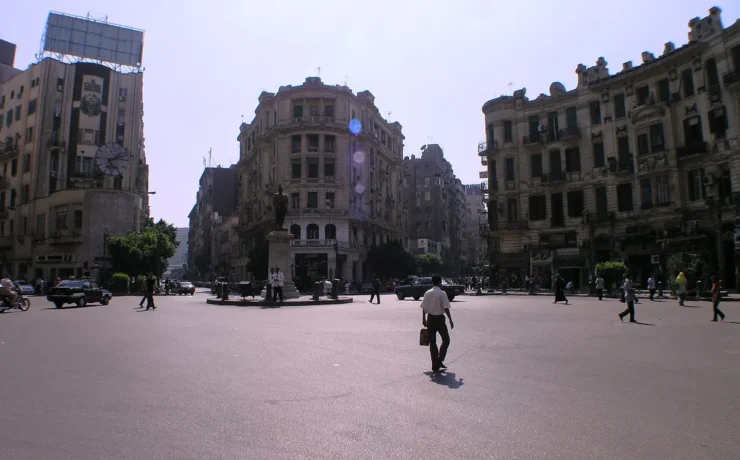
The Egyptian Museum facing Tahrir Square is more than a storehouse of ancient objects. Opened in 1902, its purpose-built galleries, monumental entrance and long institutional history form part of the history of modern Egypt and modern archaeology. Its collections illuminate thousands of years, but the building itself belongs to a distinct story about cultural policy, urban change, collecting practices and the institutions that shaped how antiquities were studied and displayed. That story is sometimes confused with the newer Grand Egyptian Museum at Giza or the National Museum of Egyptian Civilization at Fustat. Each is a separate institution, and understanding the original Tahrir museum requires its own historical account.
Before Tahrir: the creation of an Egyptian antiquities collection
The museum’s institutional history did not begin with the famous 1902 building. Earlier collections and museums occupied different sites, including Bulaq and a palace at Giza. The expansion of excavations and antiquities administration created persistent problems of storage, display and preservation. Egypt’s modern archaeological institutions developed within complicated political relationships involving Egyptian officials, European scholars and an international market for antiquities. An account that lists only the names of famous foreign directors would miss the wider administrative and labour networks that made collecting, documentation and conservation possible.
The Egyptian Museum’s official history explains how the growing collection encouraged a proposal for a new purpose-built structure. The move to Tahrir was therefore an institutional and architectural project as well as a change of address. Earlier museum buildings were not interchangeable with the present one, and their locations matter for reconstructing the history of Cairo. Collecting practices also reflected the unequal power relations of the late nineteenth century. A scholarly account should avoid portraying the collection as if objects simply appeared in a museum without excavation, acquisition, preservation or disagreement over their movement. The building’s foundation makes sense only against this longer institutional background.
A competition for a modern museum
The Egyptian Museum’s institutional account records that an international architectural competition was announced during the 1890s and that the design by French architect Marcel Dourgnon was selected. The official Egyptian ministry similarly dates the competition to 1895. International competitions were mechanisms through which public authorities selected a design and sought to express cultural ambitions. They were also part of a period when European architectural languages often shaped major public buildings in Cairo. Winning a design competition does not mean that one architect alone carried out every technical, construction and curatorial task that followed.
The competition provides a useful starting point for examining what a museum was supposed to do. The brief was not simply to make an impressive façade. Galleries needed spaces for objects, visitors, storage and staff, while the building’s public image had to communicate the role of antiquities in modern Egypt. The choice of a neoclassical architectural language was a decision embedded in contemporary international conventions, not a direct reproduction of an ancient Egyptian temple. The question for visitors is how that design affected the presentation of ancient material. A modern building tells one historical story while the objects inside belong to many others.
Marcel Dourgnon and the architecture of the building

The museum is widely associated with Marcel Dourgnon’s neoclassical design. Official accounts also identify engineer Giuseppe Garozzo in the construction history, while the museum’s own archive records contributions from multiple specialists. This matters because architecture involves structural and practical execution as well as drawings. Egyptian archaeologist Ahmed Kamal also appears within the early photographic and institutional record. Credit should therefore be understood as distributed among designers, administrators, engineers and museum professionals rather than compressed into one heroic name.
The main façade is symmetrical and monumental, with architectural details intended to create an authoritative civic presence. Inside, a system of galleries and central spaces made large-scale display possible. Yet a museum designed at the end of the nineteenth century did not have the same accessibility standards, environmental systems or visitor expectations as a contemporary new-build museum. Later renovations and conservation work have changed aspects of use and presentation. It is misleading to describe every visible display arrangement as exactly how visitors experienced the museum in 1902. The building is a historical object in its own right, and its relationship with changing museum practice deserves explicit attention.
Foundation stone, construction and opening in 1902
The Egyptian Museum’s official history dates the foundation-stone ceremony to 1 April 1897, in the presence of Khedive Abbas Hilmi II. It notes that some objects were placed in showcases in May 1900, before the building’s final public opening. Cairo Governorate and the museum’s own account identify the formal opening date as 15 November 1902. These dates reflect distinct stages of a complex project: ceremonial beginning, collection installation and official inauguration. They should not be confused or used to suggest that the museum was completed in a single construction season.
The 1902 opening made a conspicuous statement about state cultural institutions in the centre of Cairo. It occurred during British occupation and within the political circumstances of the khedivate, so any celebration of modernity should recognise competing interests and unequal power. Egyptians contributed to the emerging institutions of archaeology even when foreign-language histories gave greater prominence to European directors. An opening ceremony is evidence of public presentation, not a comprehensive report on conservation quality, labour conditions or the future of the collection. The building’s long life makes it possible to study how those aspirations developed, changed and sometimes came under criticism.
Tahrir Square and the museum’s changing urban setting
The museum was built at what was formerly Ismailia Square, now Tahrir Square. The museum’s official history places the chosen site in relation to the Nile and nearby Qasr el-Nil barracks. This matters because the location joined antiquities with the modern city’s administrative and civic landscape. The square has changed substantially since the building’s construction. Streets, public spaces, traffic and political meanings surrounding the museum are part of Cairo’s modern history, not features that existed unchanged when the architect submitted his plan.
Historical photographs can reveal an earlier urban setting that visitors today might struggle to recognise. A Matson collection image from the early to mid-twentieth century shows the building in a context already different from its opening moment, while modern photographs document further change. Images must therefore be dated and interpreted as evidence for their own time. The museum’s placement helped make it a familiar landmark, but its history should not be reduced to the events of the square outside. The institution, architecture and surrounding city developed together while retaining separate identities and priorities.
The façade as a programme of cultural authority
The Egyptian Museum’s façade combines a formal neoclassical arrangement with details linked to its archaeological mission. Cairo Governorate notes carved decoration and sculptural figures at the main entrance, while the museum’s archive identifies work by sculptor Ferdinand Faivre. The use of European formal vocabulary in a building displaying Egyptian antiquities invites a useful historical question: how did administrators at the turn of the twentieth century imagine a national or international museum should look? The façade was a cultural statement shaped by architectural fashions, political authority and the expectations of its patrons.
This question should not be answered by assuming that every decoration carries one simple ideological message. Design details can serve several audiences. The architectural composition was made to be seen from the public square, and the large entry draws attention toward the interior collection. Its present appearance reflects conservation as well as the original design. Comparing documented period photographs with modern views can reveal changes and continuities in the façade, but exact dates of surface restoration need appropriate records. The exterior is not a disposable wrapper around ancient masterpieces; it is part of the museum’s own historical material.
Galleries, collections and the experience of display
The museum contains material from different periods of ancient Egyptian history, ranging from prehistoric objects to Greco-Roman antiquities. Egypt’s Ministry of Tourism and Antiquities highlights collections including the Narmer Palette, material from the pyramid-building kings, the funerary assemblage of Yuya and Thuya, objects from Tanis, and papyri, coffins and jewellery. Such groups are historically diverse. The fact that they share a museum building does not imply that they belong to one age or one cultural tradition. Good interpretation helps visitors move between time periods while preserving the distinctions that give each object meaning.
Collection displays have changed during the museum’s life. Objects may be moved for conservation, loans, redistribution or curatorial planning, and some famous assemblages now feature in other museums. Therefore, a historical article should avoid guaranteeing that a particular case will always be in a precise room. Equally, it should not imply that an object loses importance when transferred. Museum practice involves balancing public display, research, preservation and space. A visitor who understands this context can appreciate the museum’s galleries without confusing a changing arrangement of cases with the permanent contents of an ancient tomb.
Egyptian archaeologists and the people behind the institution

Popular histories often centre early archaeology on European names. The museum’s records provide opportunities to recover a more complicated story involving Egyptian scholars, officials, workers, conservators and visitors. Ahmed Kamal Pasha is one prominent figure whose work belongs to the development of Egyptian Egyptology and museum practice. The institution cannot be understood through the architect’s drawings alone. Cataloguing collections, moving large artefacts, guarding objects, repairing them and communicating research required sustained collaboration and professional knowledge.
The archive’s historical photographs provide material for investigating these roles, but a photo caption should distinguish a recorded individual from unnamed people working in the background. A photographic portrait cannot reveal the entire professional structure of the museum. The best scholarly approach joins biographical records with institutional decisions and object histories. It also remains alert to the politics of collecting and access to scholarship under occupation. This is not a reason to simplify all professional relationships into an unchanging conflict; it is a reminder that authority, opportunity and collaboration varied over time. A modern museum history should make room for the labour and expertise that traditional narratives often overlooked.
Collections, relocation and the 2021 royal mummies parade
The museum’s changing role became especially visible in April 2021, when twenty-two royal mummies were transferred to the National Museum of Egyptian Civilization in Fustat. Egypt’s official ministry identifies this departure as a significant moment in the museum’s recent history. It illustrates how major cultural institutions can be reorganised while the original museum continues to have its own important collection and architectural identity. Moving objects is not the same as closing an entire museum. Visitors should not confuse a particular transfer with the disappearance of all exhibits or the end of the Tahrir institution.
The Grand Egyptian Museum in Giza also belongs to the broader landscape of modern Egyptian museum development, but its visitor information, opening arrangements and collection display are separate questions. Kemet Vault already provides a Grand Egyptian Museum guide and an NMEC study. This article is not a duplicate of those pages. Its purpose is to tell how the original Tahrir building emerged and how it remained historically significant as collections moved, institutions evolved and expectations of archaeological museums changed.
Using historical photographs responsibly
The Library of Congress Matson collection preserves valuable photographs of the Egyptian Museum, including views of the façade and a documented 1934 interior. These images are useful because they make museum history visible through the changing display of halls, objects and architectural space. However, a photograph produced decades after 1902 does not prove what the galleries looked like on opening day. The photograph’s catalogue date and viewpoint are part of its meaning. A high-resolution scan may also show later retouching, reproduction damage or annotations that should not be mistaken for original architectural details.
A carefully illustrated article can juxtapose the historic exterior with an interior view to reveal how the building represented and organised its collection. Such images have verifiable source records and public-domain reuse information; they should be credited accordingly. Modern gallery photos may provide another perspective but require separately verified licences. Images of the Grand Egyptian Museum should not be substituted because they are newer or more spectacular. Accuracy is more important than visual novelty. When visitors read the museum building as part of modern Egyptian history, each dated photograph contributes a piece of evidence rather than an anonymous decoration.
Why the building still matters
The museum’s historical importance goes beyond its opening date and famous treasures. It provides a material record of how archaeology, public architecture and cultural administration developed in modern Cairo. Its neoclassical design, central location and continuing life as an institution connect the late nineteenth-century project to later generations of visitors and scholars. The building also reveals changing ideas about national heritage and who has authority to collect, interpret and display antiquities. Those questions cannot be answered by a simple list of the most photographed artefacts.
The most useful approach is to separate three timelines: the age of the ancient objects, the history of collecting and museum administration, and the physical history of the 1902 building. Those timelines intersect but do not coincide. A sculpture thousands of years old may have entered the museum decades after the building opened; a display case may be modern; the façade may preserve original design features while incorporating conservation work. Recognising these different dates allows the Egyptian Museum in Tahrir to be appreciated as a historical subject in its own right rather than an older version of a newer museum.
Sources and editorial cautions
The Egyptian Museum’s own institutional history records the competition, construction and collection history. Cairo Governorate supplies complementary details about the museum’s architecture and opening, while Egypt’s Ministry of Tourism and Antiquities provides the current institutional context. Historical photographs from the Library of Congress must be labelled with their actual dates and credited to the Matson collection. No ticket prices, exact current gallery locations or unsupported total collection figures are treated as permanently fixed facts.