In September 2026, Egyptian archaeologists announced a pyramid-shaped Roman-period tomb in Dakhla Oasis containing a rare nineteen-line Greek funerary poem and ancient Egyptian imagery of the Amduat. The find at Bir al-Shaghala is more than a dramatic desert structure: it offers physical evidence of the different religious, linguistic and architectural traditions that could meet within one Roman Egyptian burial. The temple-style entrance, two burial chambers, offering equipment and a coin of Constantine all require separate interpretation rather than a sensational single story.
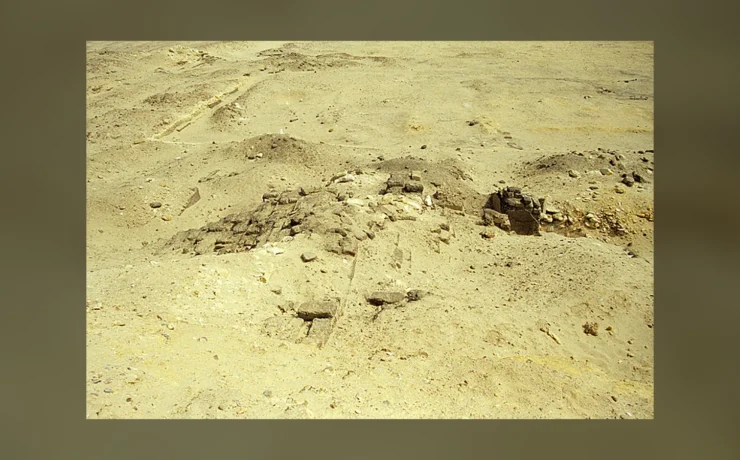
Photographic evidence: This page now uses a real photograph of the Bir el-Shaghala archaeological site (2013) instead of an invented pyramid illustration. The newly found tomb’s official excavation images remain available through the 2026 Egyptian State Information Service announcement. The historic site photograph is not falsely represented as an image of the latest excavation.
A Roman-period tomb with a pyramid-shaped roof in Egypt’s Western Desert
The September 2026 archaeological announcement from Bir al-Shaghala in Dakhla Oasis is remarkable for its combination of architecture, languages and ritual forms. An Egyptian Supreme Council of Antiquities mission uncovered a mudbrick tomb with a pyramid-shaped superstructure. Its layout was intended for the burial of a man and a woman, while its sandstone doorway carries imagery rooted in long-established Egyptian traditions. A stone funerary stele contains an elegy written in Greek, and objects recovered from the site include a coin bearing the image of Constantine.
The initial announcement was made on 24 September 2026. It describes the newly studied complex and its objects, not a newly discovered Old Kingdom pyramid or a lost royal burial. A small tomb built in the Roman period can adopt a pyramid-shaped exterior without belonging to the age of Khufu. The word ‘pyramid’ describes a form here; it is not a date.
What makes the find intellectually valuable is that the architecture and texts are not confined to a single cultural category. Egyptian funerary protection, Greek-language commemoration and Roman-era material history meet in a local oasis cemetery. Each is real evidence; the precise story of the people commemorated still requires study.
The discovery in brief
Site: Bir al-Shaghala, Dakhla Oasis, Egypt’s New Valley Governorate. Announcement: 24 September 2026. Period: Roman Egypt, with principal features dated to the late third or early fourth century CE. Architecture: mudbrick superstructure with a pyramid-shaped outline, stairway, sandstone entrance, vaulted hall and burial chambers. Texts: Egyptian protective imagery plus a 19-line Greek funerary lament. Objects: stele, offering table, purification basin, pottery and a bronze coin bearing Constantine. These categories come from Egypt’s official State Information Service release and contemporary archaeological reporting.
Dates should not be collapsed into one number. The tomb’s construction, the date of the poem and the deposition of a Roman coin are separate questions. Without a complete excavation sequence, a coin from the site does not establish that every piece of masonry was erected during Constantine’s reign.
Where Bir al-Shaghala fits into the history of Dakhla Oasis
Dakhla lies within Egypt’s Western Desert oasis system. Its ancient settlement networks connected agriculture, trade routes and administration far from the Nile Valley. Bir al-Shaghala formed part of the funerary landscape associated with ancient Mothis, near modern Mut, a significant settlement during the Ptolemaic and Roman periods.
The oasis location matters because Egyptian religion did not simply vanish once Egypt came under Roman rule. Local populations continued using Egyptian architectural signs and protective formulae, sometimes while choosing Greek for a personal memorial inscription. The 2026 tomb offers an example of how these traditions could coexist in a single burial setting.
Nothing in the discovery establishes that all residents of Dakhla shared the same religious preferences or could afford monumental tombs. The monument reflects the resources and choices of a particular family, viewed through an incomplete material record.
Fourteen steps to a remarkable sandstone entrance
The excavators describe a staircase of fourteen steps leading to the entrance. The doorway is built of sandstone rather than the mudbrick used for the larger structure. Its design includes sunken hieroglyphic inscriptions, protective spells and motifs recognisable from much earlier funerary monuments.
A cavetto cornice features a winged solar disk with cobras, symbols associated with divine protection and authority. Other architectural decoration evokes bundled plant forms. Such choices demonstrate continuity of a visual religious vocabulary even as local patrons lived under Roman administration.
A painted or carved religious symbol must be read in its immediate context. The winged sun disk is neither proof of an otherwise unknown god nor evidence that this tomb belonged to a pharaoh. The archaeological report places it within the doorway’s funerary protective programme. Its role is to create a ritually guarded threshold between ordinary space and burial space.
The seventh hour of the Amduat appears on the lintel
One of the most extraordinary reported elements is an image referring to the seventh hour of the Amduat, an Egyptian composition concerned with the sun god’s nighttime journey through the world beyond death. The 2026 report identifies the scene above the tomb’s entrance as an unusual example within this cemetery.
The Amduat is not a generic synonym for every Book of the Dead composition. It has its own visual and textual history, originally especially associated with royal New Kingdom tombs and later reused in other funerary settings. Its appearance in a Roman-period oasis monument raises questions about ritual transmission, local craftsmen and continuing access to religious models.
The significance is not that Egyptians had just invented an underworld story in Roman times. Instead, images rooted in older sacred writings were adapted to the needs of people living centuries later. Readers can compare the wider corpus through Kemet Vault’s guide to Egyptian afterlife books without confusing the Amduat with the Book of the Dead.
A Greek poem preserved in red: the 19-line funerary elegy
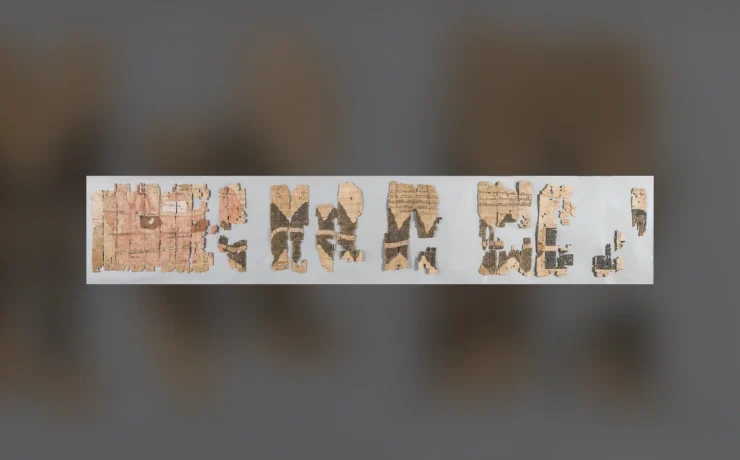
The discovery’s most personal feature is a stone stele carrying nineteen lines of an elegiac inscription in Greek, reportedly written in red. The text commemorates a man whose name has been rendered in different English reports as Pisechtes, Pisechthis or Psychtis. Initial analysis suggests that he may have held a judicial position, though that identification should be treated as provisional.
A funerary elegy is a commemorative poem, not automatically a direct diary of the deceased person’s life. Greek could serve as a literary language within Roman Egypt without proving that the person was ethnically Greek or that the family abandoned Egyptian religious identity. The placement of this text beside Egyptian ritual imagery is the actual evidence.
Different transliterations arise because the ancient name is being mediated through Greek spelling, editorial reading and modern English reporting. Kemet Vault will not manufacture a definitive family biography from a preliminary translation. The reliable claim is that a 19-line Greek funerary poem was recovered and an individual’s name appears in the reports; the role and identity merit further philological publication.
The tomb was built for a couple, but who else might be involved?
The main burial structure includes a vaulted transverse hall and two plaster-coated mudbrick burial chambers. Reports indicate that the tomb was used to bury a man and his wife. The upper pyramid-shaped form would have marked the burial externally, while the entrance and hall controlled access to the chambers.
Archaeologists also reported a later mudbrick chapel above the entrance with a small funerary shrine supported by four square columns. This suggests more than one building or use episode. The distinction is essential: features visible together today need not all belong to the tomb’s original construction.
Additional architecture could represent later reuse, commemoration or repair. Establishing which came first requires excavation records, construction joins and associated deposits rather than a single photograph of the exposed entrance.
Objects recovered: offering equipment, pottery and a Constantine coin
Among the material finds are a sandstone offering table and purification basin, along with ceramic vessels. These objects speak to rituals around provisioning and purification. Their presence does not mean that every ritual pictured or written on the walls was performed exactly as imagined, but the objects help locate the burial within long-standing funerary customs.
A bronze coin bearing the image of Emperor Constantine offers chronological evidence, yet coins can circulate, be deposited later or enter disturbed deposits. Researchers must establish where it was recovered and how it relates to other materials before using it as a direct construction date.
This is why the wording ‘Roman tomb with a Constantine coin’ is more defensible than ‘Constantine’s tomb’ or ‘tomb built by Constantine’. The emperor is the subject of the coin, not a claimed occupant of the burial.
Illustrated archaeological interpretation: what is reconstructed
The original illustration below was created for Kemet Vault as an interpretive visualization inspired by the reported architectural types. It is not an image of the newly excavated structure, and it does not claim accurate measurements or a faithful reconstruction of the inscriptions. For actual excavation photographs, consult the Egyptian Antiquities press images reproduced with attribution in the cited reports.

Egyptian, Greek and Roman traditions: three types of evidence
The stone doorway and the Amduat imagery are Egyptian in religious vocabulary. The epitaph is written in Greek, which remained widely useful as an administrative and literary language. The bronze coin belongs to Roman imperial material culture. Their coexistence should not be simplified as one tradition ‘replacing’ another.
A single tomb can reveal layered identities, patronage and continuity, but it cannot prove that every inhabitant of Roman Egypt practiced the same funerary rituals. The geographic setting also matters. Oasis communities were connected to, yet distinct from, major Nile Valley centres.
This cross-cultural evidence makes the tomb a natural companion to Kemet Vault’s Roman Egypt historical guide and the article on the Amduat tradition. One concerns political history, the other funerary textual forms; this discovery page focuses on the dated 2026 site.
Five questions that the excavation must still answer
Was the Greek elegy commissioned for the earliest occupants, or was it installed during a later use phase? What is the relationship between the Constantine coin and the tomb’s initial construction? How precisely does the seventh-hour Amduat scene compare with established textual and pictorial versions? Which plaster layers and architectural joints distinguish building phases? What does the burial’s setting reveal about the cemetery around ancient Mothis?
These are research questions, not hidden revelations. Without a full site plan or published epigraphic study, the answers are not yet fixed. The discovery should remain open to revision as evidence becomes available.
Frequently asked questions
Was an Old Kingdom pyramid discovered in Dakhla? No. The structure is a Roman-period mudbrick tomb with a pyramid-shaped superstructure, not an Old Kingdom royal pyramid.
What did the Greek stele say? Contemporary reports describe a nineteen-line funerary elegy for a man variously transcribed as Pisechtes or Psychtis. A definitive complete translation should be checked against a specialist publication.
Why is the Amduat scene important? It suggests that older Egyptian ideas about the sun’s nocturnal journey remained meaningful in a Roman-period burial context.
Does the coin prove the tomb belonged to Constantine? No. A coin’s imperial portrait does not identify the deceased, and its deposit must be interpreted archaeologically.
Can the tomb be visited? The news release documents excavations, not a confirmed public-opening schedule. Visitors should not assume the active excavation is accessible.
Primary sources and image attribution
Egyptian State Information Service, discovery announced 24 September 2026; Ahram Online, 24 September 2026; Archaeology Magazine, 25 September 2026. The original discovery photos belong to their documented rightsholders and are available through these reports. Photo attribution and reuse: Site photo: Roland Unger, BirShaghala.jpg, photographed in 2013, Creative Commons CC BY-SA 3.0; cropped and resized into WebP for Kemet Vault. It shows the actual Bir el-Shaghala archaeological site before the 2026 discovery, not the newly excavated tomb. The site’s official excavation photos can be viewed in the reports linked above.