The first great modern dam at Aswan was completed in 1902, decades before the better-known Aswan High Dam transformed the Nile. Sometimes called the Aswan Low Dam or the Old Aswan Dam, it was built as part of an effort to store seasonal floodwater and expand irrigation during the dry months. Its stone structure, sluices and navigation locks embodied new engineering ambitions, but its history also belongs to Egyptian labour, British imperial power, water policy and the lives of Nubian communities upstream.
The dam opened on 10 December 1902 and later underwent two major heightening projects. Understanding those stages is essential: photographs from 1902, 1912 and 1933 may show the same place in notably different forms. The International Commission on Irrigation and Drainage and a University of California historical photograph collection offer documentary foundations for tracing this history. This study separates the first Aswan reservoir from the later High Dam completed in 1970 and examines both technological achievement and social cost.
Why a new dam was proposed at Aswan
Egyptian agriculture had long relied on the Nile’s seasonal flood and complex networks of canals, embankments and local water management. During the nineteenth century, projects supporting more regular irrigation attracted growing attention from officials and engineers. Storing part of the flood for later use could support crops during drier seasons and alter how land was cultivated. The first Aswan Dam should be understood within these broader debates rather than presented as the first moment Egyptians tried to manage river water. It represented a change in scale and engineering method, not the invention of irrigation.
At the end of the nineteenth century, Egypt was under British occupation, and decisions about large public works were tied to imperial priorities as well as Egyptian agricultural interests. The project thus raises questions about who selected investment goals, who benefited from expanded irrigation and who bore environmental consequences. Promotional engineering accounts often emphasise technical successes, while social histories ask how the same decisions affected labourers and communities near the future reservoir. Both perspectives are needed to understand why the dam was built and why it remains a contested symbol of modernisation.
Designing a masonry gravity dam
The International Commission on Irrigation and Drainage describes the Aswan structure as a granite masonry gravity dam equipped with sluices. A gravity dam resists water pressure largely through its own weight and structural form. Sluices regulate the passage of water; the presence of navigation arrangements also reflected the importance of river movement. These elements make the Old Dam different from a simple earthen wall across the Nile. Its design had to accommodate an enormous seasonal range and the engineering challenge of building on a river with longstanding significance for communities far downstream.
Engineering history includes more than the name of a celebrated designer. ICID identifies William Willcocks as a leading designer and Benjamin Baker among the major engineers, while the photographic collection at the University of California records the roles of Egyptian public works officials and the contracting firm John Aird & Co. Differences in summaries can reflect whether they emphasise conceptual design, site supervision or construction management. Assigning all credit to one European figure would erase institutional collaboration and the labour required to build and operate the structure. A serious account documents distinct roles instead of turning the project into a single-person legend.
Construction from 1898 to the opening in 1902
The project took shape at the end of the 1890s. ICID dates the beginning of construction to 1898 and the opening to 10 December 1902. The University of California collection describes a foundation-stone ceremony in February 1899 and the official opening on the same December date. A foundation ceremony is not necessarily the beginning of all preparatory engineering work, so those accounts can be read together rather than treated as contradictory. Construction required managing river conditions, transporting large quantities of materials and coordinating numerous technical trades at a difficult location.
The UC photographic archive specifically states that Egyptian workers and Italian granite masons carried out much of the labour. This is a crucial corrective to histories illustrated only with portraits of engineers or imperial visitors. Workers faced the physical demands of quarrying, masonry, transport and site organisation. We should not invent a uniform wage or casualty total when no verified record accompanies the claim. Instead, the evidence invites further research into labour contracts, safety, skill and hierarchy. The final dam was the product of a large human effort that historical publicity often compressed into a few prestigious names.
The opening ceremony and the first reservoir
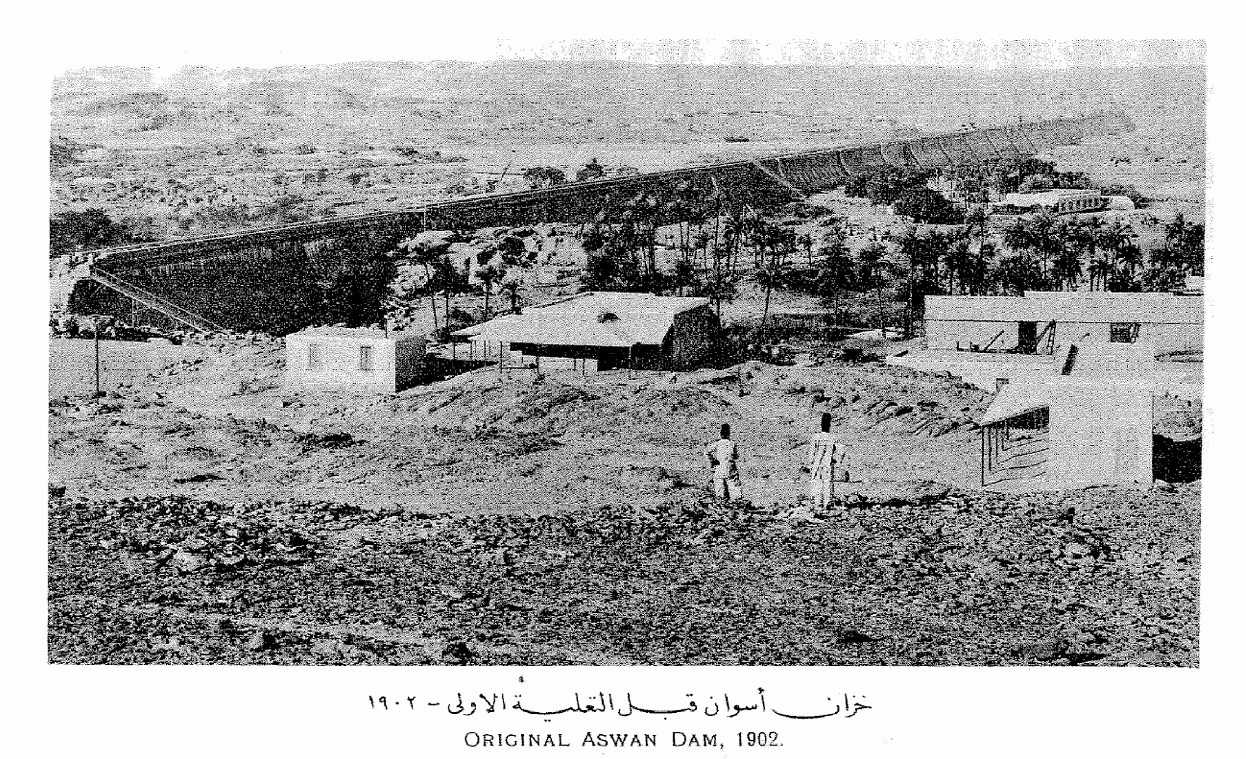
The official opening in December 1902 marked the completion of an ambitious hydraulic project. ICID reports that the first reservoir held approximately one billion cubic metres during the initial 1902–1903 storage season. Capacity is not the same as the volume of water passing through the Nile in a year; confusing the two produces wildly misleading comparisons. The reservoir was intended to shift some water availability across seasons rather than halt the natural flow of the river permanently. Its effectiveness depended on filling, releases, maintenance and agricultural demand.
Ceremonial photographs of an opening can reveal public presentation but not the full operation of the hydraulic system. A ribbon-cutting image does not demonstrate exactly how water was allocated to every district. The dam’s significance lay in giving officials greater capacity to retain and distribute seasonal water, which could support more regular irrigation. It also created a zone of inundation upstream. An engineering milestone therefore had multiple geographies: fields elsewhere that might benefit from stored water, and places in Nubia where changing water levels altered archaeological sites and everyday life.
The navigation locks and the river as a route
The dam was not built on an empty technical map. The Nile was a corridor for boats, travel, cargo and people. Engineering plans therefore had to consider navigation as well as stored water. Historical photographs show locks and related structures that made the project recognisable as a complex river installation. The existence of a lock does not guarantee uninterrupted navigation for every vessel or season. Operating a regulated river involves procedures, restrictions and maintenance. Evaluating those outcomes requires navigation records rather than an attractive photograph alone.
For readers accustomed to modern highway bridges, the locks are a reminder that river infrastructure can support or complicate different forms of movement at the same time. The dam altered flow and water levels while permitting certain journeys through controlled passages. It was part of a wider system of barrages and irrigation projects being developed across Egypt. The UC archive notes the roughly contemporary completion of works such as the Asyut Barrage. Studying their relationships makes more sense than treating the Aswan structure as the entire history of Egyptian hydraulic modernisation.
Why the dam was raised in 1912 and again in 1933
The initial storage capacity soon proved insufficient for expanding demand. ICID records a first major heightening during 1908–1912, increasing storage toward approximately 2.5 billion cubic metres, and a second in 1929–1933, increasing capacity toward about five billion cubic metres. These figures describe the changing reservoir across distinct phases and should not be attached indiscriminately to the original 1902 structure. The heightenings also explain why archival photographs taken decades apart may show different proportions and surrounding works. In this case, a monument’s appearance is itself a chronological source.
The decision to increase reservoir capacity reflects the dynamic relationship between engineering and agricultural policy. Completing a dam did not settle questions about water demand, land use or future development. Each expansion required investment and brought new consequences for the areas affected by higher stored water. Histories that mention only the spectacular 1902 opening omit much of what made the structure important in the twentieth century. A more complete account follows adaptation over time and asks who participated in decisions to alter an already substantial work.
Nubian landscapes, archaeology and human consequences
Building and subsequently raising the reservoir changed water conditions upstream of Aswan, in a region with Nubian communities, cultivated land and ancient monuments. To describe this solely as a gain in irrigation would hide the different experiences of people living near the storage zone. Flooding, changing shorelines and the vulnerability of heritage sites raise questions about whose territory was considered expendable and what records survive about compensation or adaptation. The precise impact varied by location and phase, and the early reservoir should not be confused with the much larger later Lake Nasser created by the High Dam.
Archaeological research and heritage protection also developed in response to these changing conditions. Some monuments and sites were recorded, moved, protected or affected over the course of successive projects. It is essential to date each example rather than attributing every Nubian rescue operation to the 1902 works. The massive international UNESCO campaign linked to the later High Dam belongs to a different historical phase and is explored separately in Kemet Vault’s Nubian monument study. The Old Dam has its own history of how infrastructure reshaped landscapes, archaeological priorities and local lives.
Old Dam versus High Dam: the dates that matter
The Aswan Low Dam opened in 1902, was heightened in the early 1910s and again in the early 1930s. The Aswan High Dam was a later and larger development completed in 1970, according to the University of California’s archival summary. They are different structures, despite their similar names and shared regional setting. The first represented a major early reservoir built with masonry and sluices; the later project changed the scale of water storage dramatically. A photograph identified only as Aswan Dam is not enough to determine which engineering episode it depicts.
Comparisons should avoid simplistic claims that the first dam did nothing or that the second solved every water problem. Each represented decisions taken within different economic, technical and political contexts. The reservoir capacities and regulatory possibilities differed, as did their environmental and social implications. An accurate timeline helps students study continuity and change without conflating imperial-era construction with the later policies of independent Egypt. It also prevents a very common caption error in which a nineteenth-century photograph, a 1902 dam and Lake Nasser are described as one project.
Reading the historical photographs
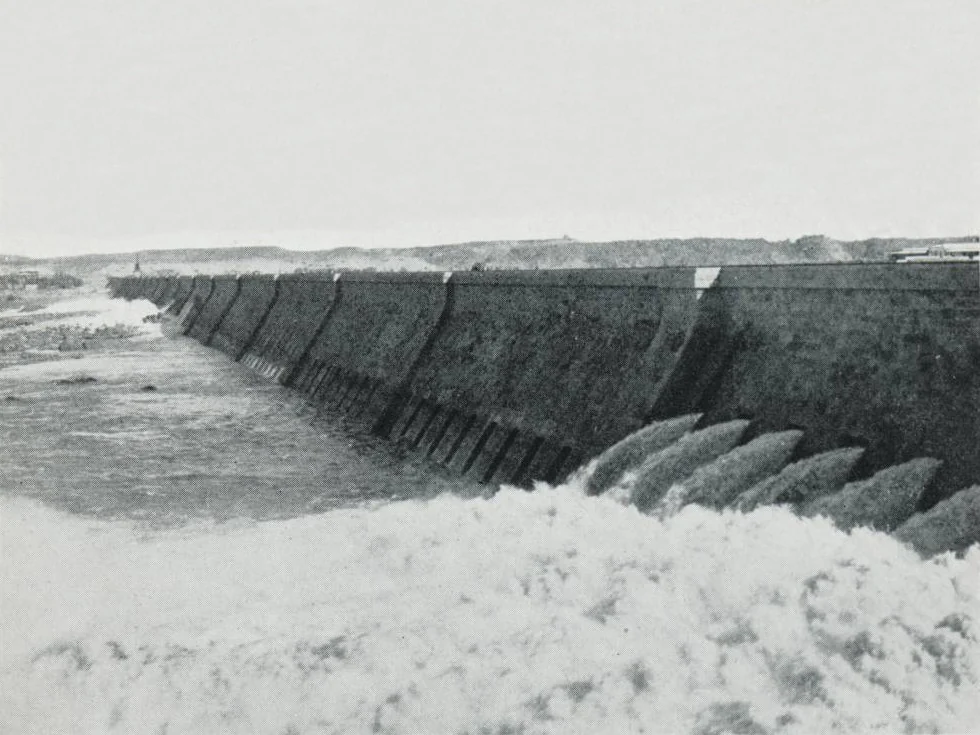
The surviving photographs and printed illustrations are unusually useful. Views of the structure before its first heightening can be compared with later images of locks and river approaches. Yet the photographer’s vantage point may make the stonework look larger or smaller than it was. Some early illustrations were retouched or reproduced in period publications, so they should be labelled as historical imagery rather than assumed to be modern digital photographs. Identifying the date, photographer or publication helps relate an image to an engineering phase.
A sound caption needs to answer at least three questions: which dam appears, when was the image made, and what part of the project does it show? Without that information, visual material can spread false impressions more quickly than text. The two documented images presented here help distinguish the original reservoir setting and an early twentieth-century view of the barrage. Their function is evidentiary rather than decorative. Readers interested in engineering should also look for sluice openings, approaches to locks, masonry and the interaction with the river’s course.
Labour, authority and the meaning of modernisation
The Old Aswan Dam was frequently celebrated as an achievement of modern engineering. That description can acknowledge real technical work without adopting the political assumptions of imperial publicity. Under British occupation, control over water and investment was connected to wider inequalities of authority. Egyptian administrators, workers and local communities were not passive background figures, even when photographs or commemorative accounts made them less visible. The history of the project must therefore include decision-making, expertise, labour and consequences together.
Modernisation is not a neutral label that automatically evaluates who gained or lost. Expanding irrigation could support cultivation and economic activity, while reservoir development could disturb land and settlements elsewhere. These results are not mutually exclusive. A balanced account follows documentary sources, measures specific outcomes where data exists, and refuses unsupported totals. The dam’s legacy is the complex interaction of improved control over a vital resource and the social choices embedded in engineering. Those questions remain relevant whenever a society undertakes large infrastructure projects.
Connected studies and research sources
For the later twentieth-century heritage context, read Kemet Vault’s UNESCO Nubian monuments rescue and the High Dam. For a different nineteenth-century infrastructure project, explore the Suez Canal construction and Egyptian workers. Both are separate historical subjects, and neither should be replaced by an Old Aswan Dam overview. Together they form a useful study path through technology, labour and imperial politics without treating every engineering scheme as identical.
The International Commission on Irrigation and Drainage’s Aswan history documents the dam’s opening, design and later storage expansions. The University of California’s Aswan Dam photograph archive details construction, labour, engineers and historical imagery. Figures and dates here are identified with their relevant phase. The photographs depict the actual Old Dam rather than an invented image of the High Dam. No unverified price, worker casualty count or individual compensation claim is presented as established fact.