What are Montaza Gardens in Alexandria? Montaza is a historic Mediterranean coastal garden estate first developed as a royal summer retreat under Khedive Abbas Hilmi II in 1892. It encompasses gardens, coast, and buildings including the early Salamlek and later Haramlek palace. The grounds evolved substantially after 1952, and access to garden areas must not be confused with access to palace interiors or private beaches.
This guide combines verified modern Egyptian history with practical cultural tourism. It distinguishes the royal building phases, explains the estate’s public transformation and uses two authentic documentary garden photographs taken in different years instead of invented palace imagery or unverified ticket prices.
What are the Montaza Gardens in Alexandria?
Montaza Gardens are an expansive historic coastal landscape at the eastern edge of Alexandria, surrounding buildings associated with Egypt’s former royal family. The Egyptian State Information Service describes a park covering around 370 acres, with trees, palms, flowerbeds and views toward the Mediterranean. The gardens’ modern role is recreational and cultural, but their origin belongs to the period when the rulers of Muhammad Ali’s dynasty developed the location as a summer retreat. These layered uses make the park a subject for both tourism and modern Egyptian history.
A visitor should not treat the name Montaza as a single palace interior. The estate encompasses gardens, shorelines, bridges, historic buildings and facilities that have changed over time. Its vast size also means that one photograph cannot represent every part of the grounds. This guide concentrates on the publicly identifiable landscape and its documented history, rather than promising entrance to private or restricted royal rooms. It draws on Egypt’s official tourism descriptions and a detailed historical survey published by the Bibliotheca Alexandrina.
How Abbas Hilmi II began developing Montaza
The Bibliotheca Alexandrina’s Montazah study identifies Khedive Abbas Hilmi II with the development of the site as a summer retreat in 1892. The Salemlek, also spelled Salamlek, was an early royal residential building at the estate. It belonged to a period when elite coastal residences were becoming important expressions of seasonal life and political prestige. The setting combined gardens, rocky coast and sea views, providing a different environment from Cairo’s ceremonial palaces.
A popular summary often calls the entire present palace complex the work of Abbas Hilmi II in one year. That oversimplifies the construction sequence. Later members of the dynasty added or modified buildings, paths, reception spaces and gardens. The history must distinguish the early Salemlek phase from the later Haramlek palace and the additions associated with King Farouk. Dates for those later works vary somewhat between official accounts, so a serious interpretation identifies the documented stages rather than inventing a single completion date for the whole estate.
Salamlek and Haramlek are different palaces
The names of Montaza’s royal buildings are frequently confused. The Salemlek was associated with Abbas Hilmi II’s early development of the gardens, while the Haramlek was a later royal palace commissioned during the reign of King Fuad I. Egypt’s State Information Service describes the Haramlek construction in the second half of the 1920s and identifies the Italian architect Ferrucci with its design. The Bibliotheca Alexandrina historical study also places the Haramlek in the later royal expansion phase.
These two buildings did not originally have identical functions, locations or architectural histories. Today travel websites may refer to the entire estate simply as Montaza Palace, which makes it easy to attribute features from one building to another. Specific photos should therefore be labelled with the correct building if it can be identified, while a garden photo should be captioned as the garden rather than falsely showing the interior of a royal palace. The current conditions of admission to either building must be checked separately from entry to the grounds.
A landscape shaped by royal summer life
The royal estate was developed not just to contain two conspicuous residences but to create an experience of the Mediterranean coast. Paths, landscaped grounds, planted areas and places to rest formed part of the broader setting. The State Information Service lists beaches, palms, trees and visitor facilities, while the Bibliotheca Alexandrina’s study documents how the resort continued to evolve in the twentieth century. The gardens therefore reflect successive decisions about leisure, access and the relationship between elite property and urban public space.
It would be misleading to imply that all trees and paths date to 1892 or that a planting visible in a 2023 photograph is an untouched specimen from the royal period. Gardens change continually through growth, storms, maintenance, irrigation and renovation. Their heritage lies partly in landscape planning and in remembered social use, not simply in the exact age of every plant. Visitors can appreciate this living quality while remaining cautious about grand claims that every footpath is historically original.
King Farouk’s additions and the famous bridge
Montaza’s later history includes structures and features associated with King Farouk’s use of the summer estate. The Bibliotheca Alexandrina survey records additions such as the Tea Pavilion and a bridge, connecting coastal views with the social life of the monarchy. Such features help explain why the site became one of Alexandria’s most photographed historic landscapes. They also show that the royal gardens were not completed in a single architectural campaign.
The bridge and pavilion should be identified on their own evidence, rather than applying the same construction date to every nearby feature. Historical photography can reveal how a structure looked at a particular time, while later maintenance or changes in access may alter what a visitor can see today. This guide does not claim that any specific royal pavilion is open for restaurant service or available for private events without a current provider statement.
What changed after 1952?
Egypt’s political transformation in 1952 altered the public status and uses of former royal property. The Bibliotheca Alexandrina’s study explains that the gardens and some beaches were opened to the public while other areas continued to serve controlled recreational or hospitality functions. This was not the same as every royal building becoming a completely unrestricted museum. Over later decades, the estate accommodated hotels, amenities and continuing changes in management and public use.
This history helps explain apparent contradictions in contemporary travel descriptions. A visitor may be able to walk through gardens and view palace exteriors without having access to particular interiors. A former royal residential building may also have been adapted for hospitality, which changes its relationship to the public. The historical fact of post-1952 opening should not be turned into a guarantee about today’s ticket conditions or private hotel facilities.
The Mediterranean setting and the estate’s beaches
The State Information Service describes the Montaza estate as overlooking several beaches along the Mediterranean. The landscape is therefore more than a large inland park: sea views, waterfront walks and the dramatic coastline help define its identity. However, a beach visible from a garden path is not necessarily a freely accessible public swimming area. Accommodation, seasonal restrictions, conservation work and safety rules can determine which shoreline facilities may be used by a visitor.
Water conditions also change. Waves, currents, wind and temporary closures are practical matters that cannot be judged reliably from an attractive photograph. Anyone planning to swim should check the current beach operator and safety instructions. A heritage visitor may simply choose to enjoy the coast from designated paths. The distinction between scenic viewing and licensed swimming prevents a leisure guide from creating expectations it cannot verify.
The gardens as part of Alexandria’s urban history
Montaza is one chapter in a much larger story of Alexandria as a Mediterranean city. Earlier archaeology, later royal projects and contemporary cultural institutions coexist across the urban landscape. The gardens show a particular strand of nineteenth- and twentieth-century elite summer development; they are not an excavated continuation of the Ptolemaic Library. Kemet Vault’s Bibliotheca Alexandrina guide explains that separate modern cultural institution.
Travel time between Montaza and central Alexandria should not be assumed to be negligible, because city traffic and the size of the estate influence the visit. The Alexandria heritage route offers wider city context, but a genuinely unhurried exploration of Montaza’s grounds may deserve a substantial part of a day. An itinerary should make choices rather than claim that every attraction in Alexandria can be covered in an afternoon.
The 2023 garden photograph and renovation evidence
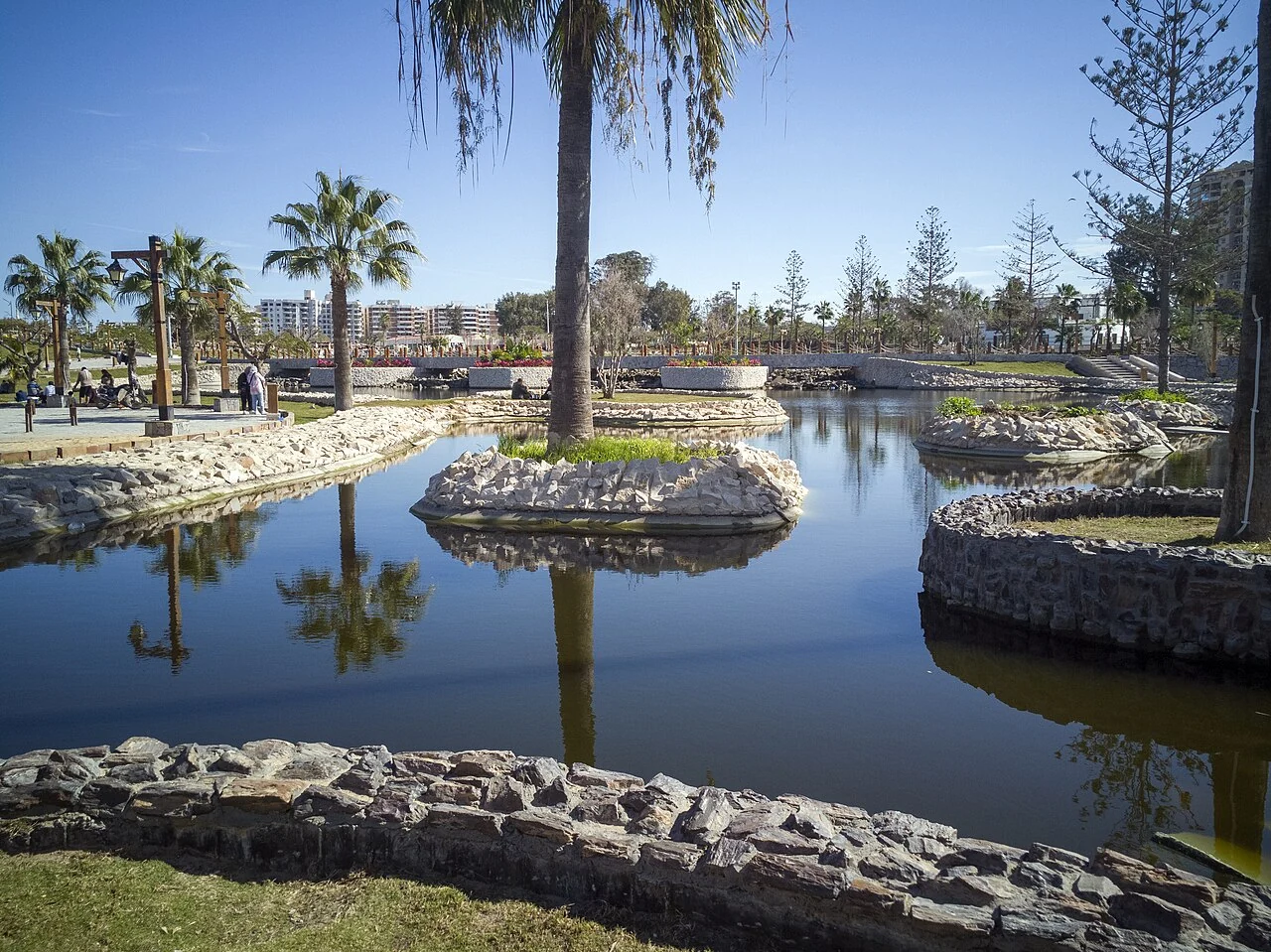
The first documentary photo here shows part of Montaza Gardens after renovation, photographed by Yasmine Abdelhamid in January 2023. Its Commons file identifies the subject, photographer and Creative Commons Attribution-ShareAlike 4.0 licence. This is a real view of the gardens following a contemporary change, not a digital reconstruction of the former royal residence. The caption deliberately includes the date because the landscape may look different after further maintenance.
The second image is a distinct older garden photograph, taken in April 2004 by Abdelrhman 1990 and also released under CC BY-SA 4.0. Its earlier view offers useful context about the changing grounds. A comparison of these two pictures does not by itself prove the extent or quality of restoration across the whole 370-acre site. It documents two particular frames from different times. The images are hosted in WebP format within the article, with source licence information retained for appropriate attribution.

Palace architecture and the danger of vague captions
The estate’s most recognisable palace architecture includes the Haramlek, whose eclectic forms draw on European and Mediterranean sources. Government descriptions attribute its design to the architect Ferrucci and discuss the royal buildings separately. A panorama of the gardens cannot establish the construction date or interior decorative programme of the Haramlek; those require the relevant architectural record. Equally, a photo of the Salemlek should not be mislabeled as the later palace solely because both stand within Montaza.
Visual accuracy is especially important for a travel guide that readers may use to recognise a building on arrival. The quality of an image depends partly on whether it really portrays the named place. Original documentary photographs and carefully qualified captions are more useful than high-gloss illustrations that merge several palaces into one impossible scene. The same caution applies to image descriptions generated by other websites without clear attribution.
Practical access, walking and accessibility
Montaza is a large landscaped area, so a satisfying visit may involve considerable walking. Footwear, shade, water and the needs of children or people with limited mobility should influence the plan. Do not assume that every path is step-free or that all internal transport, seating and toilet facilities will be available. Changes in construction, events or the season may alter what routes can be used, and a responsible guide should not promise a particular entrance or shuttle service based on an old review.
For accurate plans, check the current estate authority or on-site staff about opening times, ticket arrangements, garden areas, access to specific palaces and any separate beachfront facilities. A fee for entering the gardens does not automatically cover a hotel, private beach or royal interior. Accommodation offers and special events also operate under their own contracts. This guide intentionally avoids displaying an unverified ticket price as a permanent fact.
Responsible tourism and preserving a living landscape
Historic gardens can be vulnerable even when their plants seem less fragile than ancient stone. Walking off designated paths, damaging trees, leaving rubbish or climbing restricted heritage structures can harm the site. Visitors should respect current signs, conservation workers and areas reserved for other uses. A park is also a shared urban resource: families and local residents may be using it for ordinary recreation alongside people interested in royal history.
Photography should focus on accessible spaces and respect people’s privacy. A view of the palace does not imply permission to enter a private accommodation area, and guests of an adjoining hotel may have different access rules. The most useful cultural experience is to appreciate the real architecture and changing royal landscape, not merely to reproduce a standard photograph. Responsible tourism recognises the site’s public role and continuing care requirements.
What the official historical sources establish
The strongest shared facts are that Abbas Hilmi II began the royal retreat at Montaza in 1892, that later rulers added the Haramlek and other features, and that the gardens changed their public use after 1952. The State Information Service offers an official overview of the gardens and Haramlek, while the Bibliotheca Alexandrina published a detailed historical account of development across periods. Short official summaries can differ about exact construction dates or provide slightly different place-name spellings.
Those differences should be handled by identifying the building and phase being described, not by presenting a false precision. None of the cited historical records can guarantee a 2026 ticket price or the opening of a particular room on a chosen day. What they do establish is the estate’s value as a coastal landscape shaped by royal summer residence, later urban leisure and present-day conservation. That history is the foundation for an honest visit.
Original Egyptian heritage sources and image records
The chronology and estate history were checked against the Egyptian State Information Service Montazah Gardens record, its Haramlek Palace description, and the Bibliotheca Alexandrina historical study of Montazah. The latter distinguishes royal additions and post-1952 use. The two images document actual garden views from 2023 and 2004, with exact file-page provenance and reuse terms stated above.