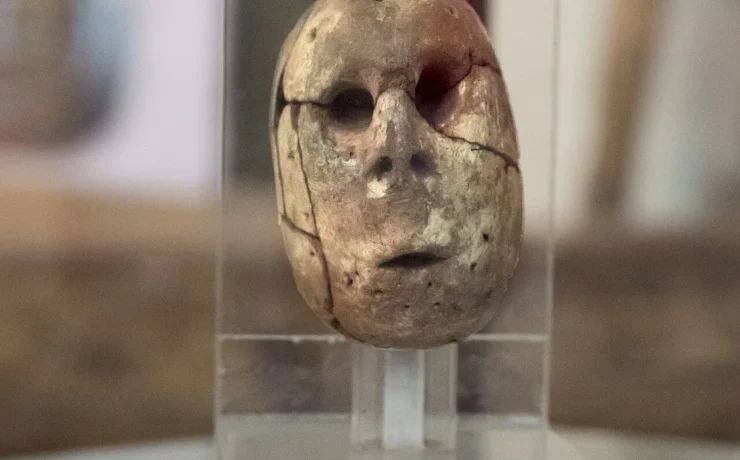
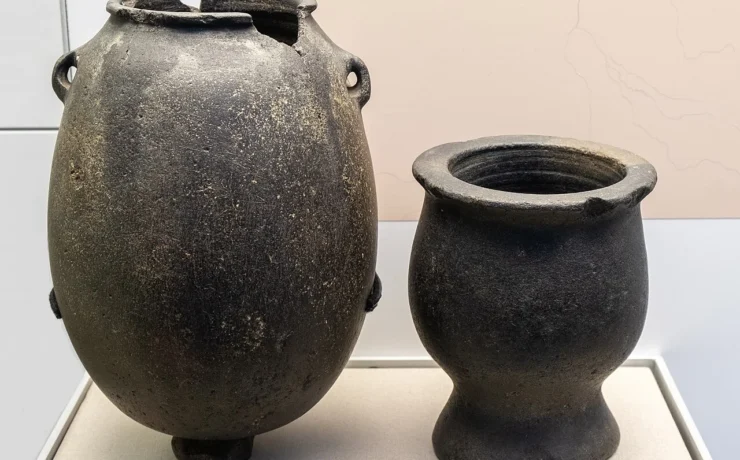
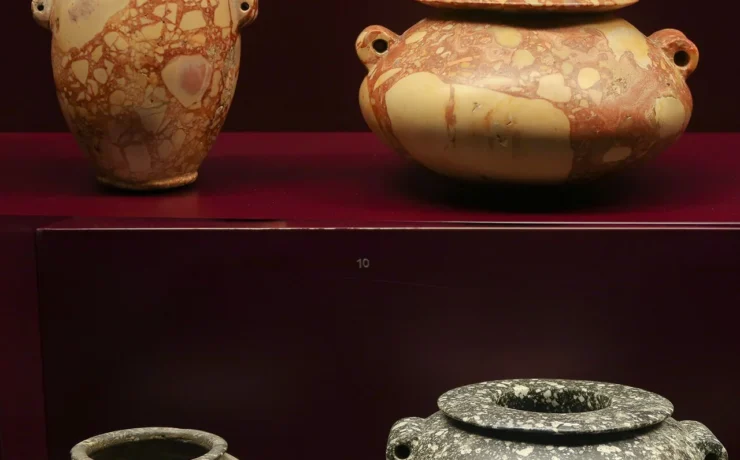
What does the Narmer Palette actually show? Carved on two faces of a large ceremonial stone palette, the Egyptian ruler Narmer appears wearing different crowns, striking an enemy, taking part in a procession and confronting a symbolic world of animals, captives and early writing. The work was found in a temple deposit at Hierakonpolis (Nekhen), and is now held by the Egyptian Museum in Cairo. It is widely associated with the formation of a united Egyptian kingship around 3100 BCE. Yet it is not a straightforward battlefield photograph or a written account that proves one decisive day of national unification. Its most valuable evidence is the combination of object, findspot, naming signs and carefully arranged relief scenes.
This illustrated guide examines each face in its own right, identifies the figures and symbols visible on the surviving object, and distinguishes museum facts from competing scholarly interpretations. Readers interested in the archaeology of the wider settlement should consult the separate study of Hierakonpolis, Tomb 100, HK6 and its breweries. Here the historical question is narrower: how does one exceptionally elaborate palette communicate the changing language of kingship?
Object record: a stone palette from Hierakonpolis
The Egyptian Ministry of Tourism and Antiquities identifies the Narmer Palette as an early royal object from Hierakonpolis, associated with the reign of Narmer. Its Egyptian Museum catalogue gives a height of 64 centimetres, a width of 42 centimetres and Gallery 43 on the ground floor. The materials are variously described as siltstone, slate or green schist in institutional publications: these historic and descriptive terms should not be treated as multiple different palettes. The physical artifact is far larger and more elaborately carved than most everyday cosmetic palettes. It has relief carving on both sides and a clearly arranged visual programme. Its archaeological origin matters as much as its appearance. It was not recovered from Narmer’s burial chamber, nor does the existence of early writing on it make it a full biography. Object, place, scale, material and collection record provide the foundation for any account of its meaning.
Why an ancient palette could become a royal monument
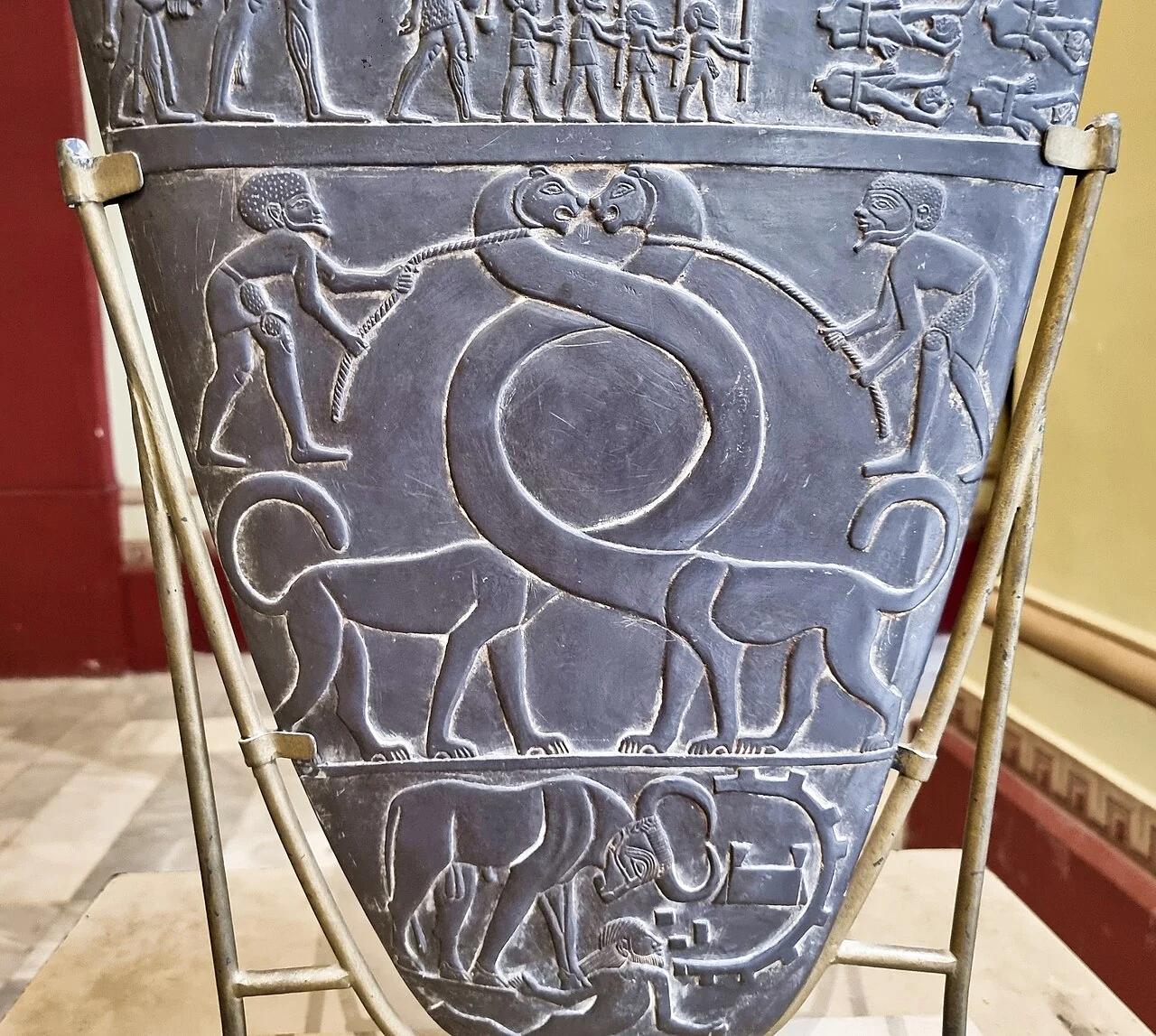
Small cosmetic palettes were made for grinding or mixing pigments in Predynastic Egypt. Such practical objects could be placed in graves, while larger decorated palettes acquired ceremonial or dedicatory roles. The Narmer Palette exaggerates the familiar shape and gives its surfaces to a complex set of human and animal scenes. On the side with two intertwined long-necked creatures, their necks frame the circular depression associated with grinding. That detail is one reason scholars discuss a possible ritual relationship with cosmetics and divine images. But a circle on the stone cannot tell us exactly what substance was mixed, on which days or for which officiant. Smarthistory’s analysis distinguishes the original functional tradition from the symbolism of this monumental example. There is no need to imagine that Narmer himself held this object at every ceremony. Its importance comes from ritual display, royal representation and eventual deposition in a sacred archaeological context.
Where the object was found, and why discovery context matters
James Quibell and Frederick Green recovered the palette in excavations at Hierakonpolis around 1897–1898. The object belonged to a deposit near the early temple of Horus, associated with other ceremonial implements. It was not a sealed royal archive offering a dated narrative of each carved episode. The discovery provides strong evidence that the artifact participated in a sacred setting, while questions about the precise period and mechanisms of its burial remain open. The Hierakonpolis Expedition situates the site’s discoveries among tombs, ritual spaces and production installations of different dates. Students should distinguish the excavated location from the location of every scene depicted in the imagery. A king wearing a crown of Lower Egypt does not prove the palette was carved in the Delta. A temple deposit at Nekhen does not make every human figure a resident of Nekhen. This disciplined separation of findspot, production place and represented events prevents the object from becoming an invented eyewitness report.
The serekh: reading Narmer’s catfish and chisel
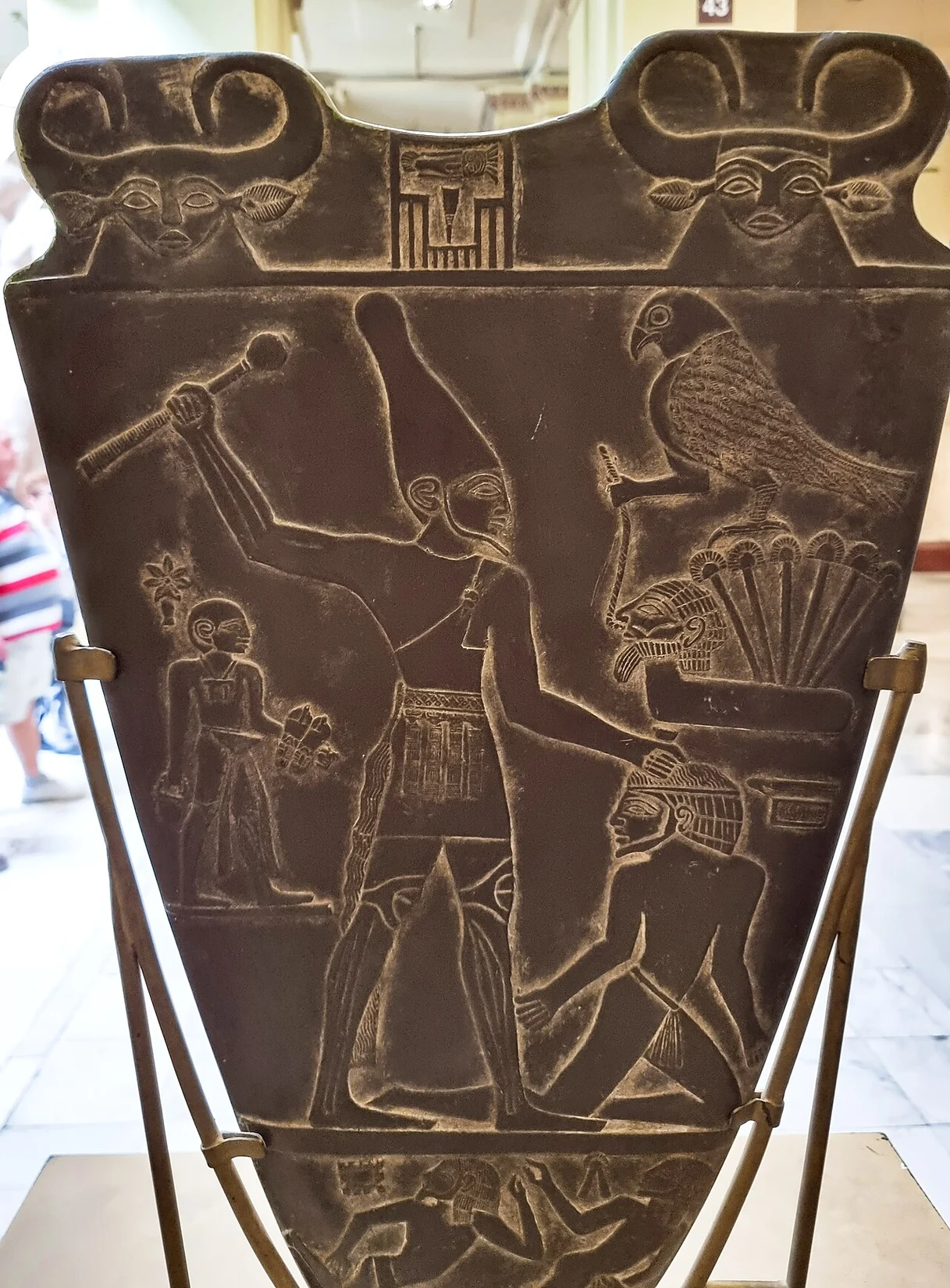
At the top of both decorated faces, the ruler’s name appears within a rectangular enclosure known as a serekh. Early serekhs have a palace-façade association and present royal names within a developing formal language of power. The signs conventionally understood as a catfish and chisel are read together as Narmer. Their pictorial appearance is not a sign that the entire palette is a modern-style alphabetic inscription. Some images stand for sounds, others participate in emblematic or symbolic composition. The pairing of name and palace structure contributes to a ruler-centred presentation without supplying a birth date, family tree or list of conquered territories. The Kemet Vault serekh study explains the wider history of early royal naming and why the serekh should not be confused with the later developed cartouche. On the palette, the name is a crucial anchor of identity amid scenes that still invite interpretation.
The smiting scene: crown, mace and captive
One face of the palette shows Narmer as an exceptionally large human figure wearing the tall White Crown associated with Upper Egypt. He raises a mace over a kneeling captive whom he grasps by the hair. This visual action, often called the smiting pose, endured as a royal convention in Egyptian imagery for many centuries. The king’s scale is a visual claim to importance, not a reliable measurement of his physical height. His defeated opponent has sometimes been described as a northern ruler, but identification of an individual captive must be based on signs and research rather than on the dramatic pose alone. An attendant follows the king, and parts of the lower composition show other defeated figures. The carving documents a concept of effective kingship: the sovereign overwhelms disorder and enemies. It does not by itself prove whether a specific battle took place exactly as presented. Many ancient images combine commemoration, ritual and ideology instead of offering neutral reporting.
Horus, the papyrus plants and the north
Beside the smiting episode, a falcon commonly identified with Horus stands above papyrus-like plants and a bound human head. This composition has been interpreted as the king’s divine patron asserting control over a region linked with the papyrus landscape of Lower Egypt. However, the exact relationship between this motif and the scene of the captive is debated. It should not be used to calculate a certain number of captured towns or people without acknowledging scholarly disagreement. The visual elements are important because they connect royal coercion with a divine framework. Later pharaohs would repeatedly deploy signs of control, divine approval and geographic dominion, but those later comparisons do not prove that every early sign had a single unchanging meaning. The image of Horus itself belongs to a growing tradition of the falcon god’s association with kingship. Compare the Horus study for the religion’s much longer development.
Procession side: red crown, standards and defeated enemies
On the other face, Narmer wears the Red Crown associated with Lower Egypt and walks in a ceremonial procession. An attendant carries his sandals while standard-bearers and other participants are arranged in order. Ahead of the procession lie enemies represented in a deliberately repetitive grouping. The crowns are key to why scholars connect the palette with the emergence of a kingship claiming both Upper and Lower Egypt. Yet the visual account does not state how many years or generations a political transition required. The following arrangement also signals the disciplined ordering of attendants, offices or ritual participants around the king. In this and the smiting face alike, visual registers divide the field into separate bands. The compositions communicate hierarchy through placement, direction and scale. Seeing the images together is more informative than treating one side as the illustration of a battle and the other as an unrelated decorative motif.
The two long-necked creatures and the circular recess
The famous intertwined animals on the procession side are often called serpopards, a modern label for creatures with feline bodies and elongated, intertwined necks. Two attendants hold them in a balanced composition whose symmetry frames the circular depression at the centre. The animals are not straightforward zoological evidence for an extinct species that Egyptian hunters encountered. They belong to a visual world in which real and composite beings could convey controlled force, unusual power or ordered relationships. One interpretation associates their intertwined necks with the binding together of Upper and Lower Egypt; another stresses the ceremonial palette’s original use and the management of dangerous or fantastic creatures. Those readings may overlap without becoming a translation inscribed on the stone itself. The museum can identify the visible bodies, collars and handlers with much more certainty than it can assign a single sentence of political meaning to the scene. Visual interpretation should preserve that distinction.
The bull and fortified enclosure: is it another image of Narmer?
The bottom of the procession face includes a powerful bull striking or breaking a fortified enclosure, with a human figure beneath. The bull is widely understood as a conventional image of royal strength, and some readings treat it as another presentation of Narmer’s victory. It may allude to conquest or the destruction of resistance. What is more secure is the scene’s emphasis on overwhelming force, especially when read alongside the smiting pose on the other face. Yet the carved enclosure is not a labelled plan of an excavated city that could simply be located on a modern map. The significance of a symbolic bull depends on the artistic programme, not on claims about the precise number of military units involved in a campaign. This type of visual evidence is central to the history of royal image-making, and it later appears in many different settings. A careful article must not mistake conventional royal strength for a battlefield eyewitness report.
Did the palette record the unification of Upper and Lower Egypt?
The use of the White and Red Crowns by the same named ruler is compelling evidence for an early royal claim that joins the symbolism of both regions. It is a major reason the object features in histories of Egypt’s political consolidation. However, the process of state formation involved communities, institutions and competing centres over time. The Narmer Palette could commemorate an event, enact a ceremonial assertion of power or express an ideology of ordered kingship that transcends one battle. Amy Calvert’s analysis compares these possibilities rather than presenting a simple unification certificate. The discovery also belongs in a landscape of earlier elite monuments and administrative signs. For background on older writing, the Abydos Tomb U-j study examines material that predates the familiar royal palette. Students should recognize the importance of the artifact without claiming it settles every question about the origins of the Egyptian state.
The invention of conventions that lasted for millennia
The large central monarch, smaller attendants, ordered registers, formal crown symbolism and smiting pose became strikingly persistent features of Egyptian state art. That persistence makes the palette historically important even if the exact battle or ceremony represented remains uncertain. Artists were communicating relationships of authority and divine order through a clear visual grammar. The same grammar was reproduced, varied and sometimes transformed during later dynasties. It would be misleading to call the Narmer Palette the first example of all Egyptian art: sophisticated visual traditions existed before it. It is better understood as unusually early and well-preserved evidence for conventions that later became recognisable across a very long history. This also helps explain why the stone belongs in discussions of art history as well as early kingship. Studying form is not a distraction from political history: the shape and arrangement of a monument can themselves be instruments for expressing political authority.
Photography, replicas and the original object’s location
Many photographs circulating online show the actual palette in Cairo; others depict replicas displayed in foreign museums. A good caption distinguishes them, because a beautifully photographed copy can still mislead a reader about the object’s current location. The Egyptian Museum and the Ministry of Tourism and Antiquities identify the original palette in Cairo. This article uses independently documented photographic views of the original in the museum; the Commons photo records identify the photographer and reuse licence. Photographs are modern records of an ancient object, not pages cut from the original excavation diary. Lighting, display glass and angle may make individual signs more or less visible. Students wanting to verify whether a shape is truly carved should compare both faces, the museum record and published archaeological drawings rather than infer details from a single compressed image. The physical object remains the primary evidence; every published interpretation is a later scholarly reading.
A visual method for reading the two faces
Start at the top of the palette and identify the serekh name and flanking bovine heads. Next, note the king’s crown on each side. On the smiting face, trace the raised mace, captive, falcon and papyrus motif; on the procession face, identify the attendants, bound enemies, interlaced creatures and bull. Record what is physically visible before assigning meaning. Separate secure observations, such as a crown or animal body, from interpretations about conquest or cosmic order. Compare the entire carved field with its excavation and museum metadata. This approach avoids reproducing popular images without context or teaching that every figure stands for one sentence in a modern textbook. It also clarifies the difference between a visual record of an ancient elite claim and proof that a particular event occurred. The separate Hierakonpolis excavation overview provides the surrounding archaeological landscape, while this page keeps attention on one monument’s images, significance and uncertainties.
Frequently asked questions
Where is the original Narmer Palette today?
The original is in the Egyptian Museum in Cairo. Replicas exist elsewhere, but their displays should not be confused with the excavated object from Hierakonpolis.
Does the Narmer Palette prove that Narmer united Egypt in one battle?
No. It depicts a named ruler wearing both Upper and Lower Egyptian crowns and presenting victory imagery. Whether this records a specific campaign or a broader royal ideology remains debated.
What is the serekh on the Narmer Palette?
The serekh is the rectangular royal-name enclosure, represented with the signs usually understood as a catfish and chisel, read as Narmer.
Primary sources and scholarly interpretation
Egyptian Ministry of Tourism and Antiquities: Narmer Palette; Egyptian Museum Cairo: object data and gallery; Smarthistory: Palette of King Narmer; Global Egyptian Museum, JE 32169; American Research Center in Egypt: Hierakonpolis Expedition. The museum object and photographs are distinguished from interpretations. Research reviewed 31 October 2026. Images reproduce the original in Cairo rather than museum replicas.