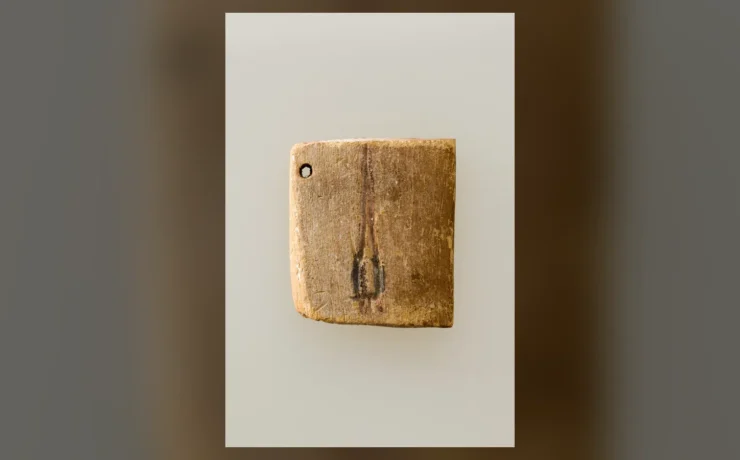
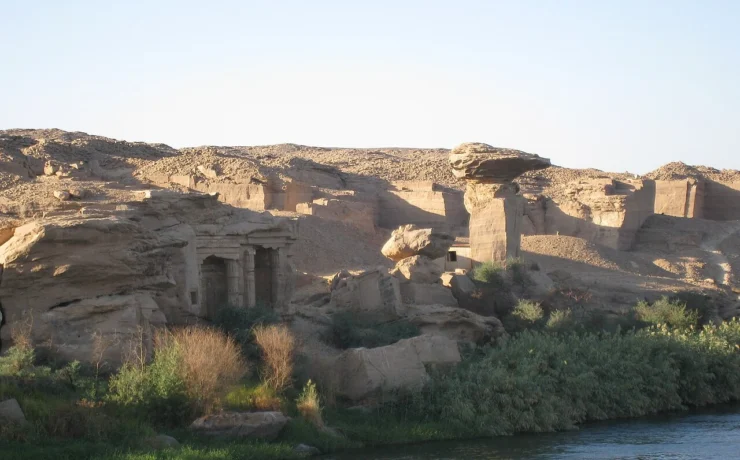
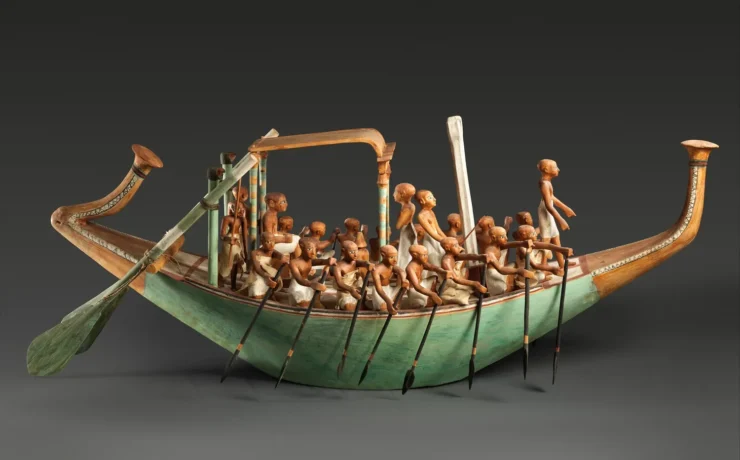
What is Hierakonpolis in ancient Egypt? Hierakonpolis, the ancient site of Nekhen near modern Kom el-Ahmar, was a major Upper Egyptian centre in the predynastic and early dynastic periods. Excavations document decorated tombs, elite burials, ceremonial spaces and evidence of organized production. Finds such as the Narmer Palette help researchers study the emergence of royal imagery, but they do not prove that Egypt’s entire state arose from one city or one event.
Hierakonpolis, the ancient Egyptian city of Nekhen, takes us to a world before the first great pyramids, when political power was being invented rather than inherited through the familiar dynasties. Along the Upper Nile, the inhabitants of this remarkable center built substantial tombs, brewed cereal drinks in organized installations, gathered in ceremonial spaces, and created images of authority that would echo through Egyptian history. Some of the most compelling evidence is not a golden treasure but a broken vat, an animal skeleton or a weathered posthole.
Here lie the archaeological roots of several features later associated with Egyptian kingship: elaborate funerary display, monumental ritual, remarkable images of royal strength and the ability to mobilize people and resources. Yet Nekhen did not become Egypt’s state in a single dramatic moment. This illustrated guide investigates the Painted Tomb 100, cemeteries HK6 and HK43, breweries at HK11C, ceremonial center HK29A, and the celebrated Scorpion and Narmer objects. It distinguishes excavated evidence from hypotheses, and authentic museum photography from historical illustrations.
Hierakonpolis at a glance: the place and the dates
| Topic | What we can say |
|---|---|
| Ancient name | Nekhen, later called Hierakonpolis in Greek |
| Location | Kom el-Ahmar near Edfu, Upper Egypt |
| Central period | Predynastic Naqada I–III and the early Dynastic transition |
| Key archaeological places | HK6 elite burials; HK43 non-elite burials; HK11C industry; HK29A ritual center; Tomb 100 |
| International research | Hierakonpolis Expedition, affiliated with the Ashmolean Museum |
| Famous objects | Scorpion Macehead, Narmer Palette, Narmer Macehead, Two Dogs Palette |
Egyptian Predynastic chronology is reconstructed mainly from excavated assemblages, pottery sequences, stratigraphy and absolute dates. Approximate markers such as 3500 or 3100 BCE should never be mistaken for precisely recorded regnal years. The site remained significant after the start of dynastic Egypt, too; later monuments belong to later chapters of its history rather than the age of Tomb 100.
Why did Nekhen become important before the pharaohs?
Hierakonpolis occupied a useful position between the Nile environment and the low desert. Water and cultivation supported settlements, while nearby desert areas offered places for workshops, habitation and extensive cemeteries. Archaeologists identify its components by locality names such as HK6, HK11C and HK29A. These labels come from modern field research; they are not the names of ancient districts recorded by the inhabitants.
It was not an isolated Egyptian island. Across the fourth millennium BCE, people in Upper Egypt and the Delta exchanged materials, ceramic styles and images. Some communities became more complex, and some households had access to far greater resources than others. At Nekhen, architecture, production sites and burial evidence reveal a concentration of labor and wealth. This is why the place features so prominently in scholarship about the rise of early political authority.
Calling it the “first capital of unified Egypt,” however, gets ahead of the evidence. We do not possess an official Predynastic register identifying Nekhen as the permanent capital of a single Egyptian state. Archaeology can demonstrate importance without proving the precise boundaries or constitutional position of a prehistoric political center.
Early investigators Frederick Green and James Quibell helped bring its celebrated artefacts to scholarly attention around 1900. Later work, including the investigations of Michael Hoffman, Barbara Adams and Renée Friedman, expanded the evidence enormously. Their findings remind us that royal artwork tells only one part of the story. Ash deposits, animal bones, postholes and damaged pottery speak directly to the activities that sustained early communities.

Naqada I, II and III: how historians date the beginnings of Egypt
The labels Naqada I, Naqada II and Naqada III refer to successive archaeological horizons, defined especially through changing pottery and burial practices. They are not named dynasties and cannot be applied at exactly the same calendar date to every corner of Egypt. Interpreting them means comparing many sites, with Nekhen providing unusually rich evidence for parts of that development.
Naqada I: variation and emerging elites
Early cemeteries reveal different grave forms, selected possessions and access to craft goods. Social differentiation is visible, but the presence of a large tomb does not automatically establish a fully developed monarchy. The relation between household influence, ritual leadership and political office remains difficult to reconstruct without texts that explicitly identify the dead.
Naqada II: skilled production and new visual languages
Naqada II includes expanding manufacture, regional contacts and elaborate figurative imagery. The decorated Tomb 100 belongs to this broad horizon. Boats, animals and human scenes offer possible antecedents of later political symbolism, but the visual similarities are not a substitute for inscriptions explaining the original meaning.
Naqada III: larger institutions and royal signs
Late Predynastic evidence documents names and emblems of early rulers, more systematic administration and increasingly formal royal imagery. The Narmer Palette belongs near this historical threshold. The move toward statehood was uneven, involving more than one regional center. The broader material culture is examined in Kemet Vault’s Naqada culture encyclopedia; Nekhen deserves a distinct site-level history.
Life in Predynastic Nekhen: houses, crafts and ordinary work
The cemetery of an elite person may survive magnificently while their home is barely visible. Everyday life is consequently harder to reconstruct than ritual prestige. At Hierakonpolis, mudbrick remains, light architectural traces, fire installations and activity areas permit questions about households and workplaces. None provides a complete photograph of a Predynastic street, but together they illuminate how production and social organization developed.
Crafts included pottery-making, bead production, stoneworking and tool manufacture. A decorated stone object could demand significant skilled labor, while utilitarian pots required large quantities of clay, fuel and organized effort. Workshops near the ceremonial area suggest that prestige production and public gathering were connected. That connection is plausible from the location and types of remains; it does not reveal an ancient contract or a named royal workshop manager.
The archaeological sample is uneven. Deserts can preserve traces differently from cultivated areas, and parts of a settlement disappear through erosion, later construction and excavation history. What survives is not a census of the whole population. That is why claims that everyone in early Nekhen lived as wealthy nobles are misleading. Ordinary production supported the elite, and the material differences between graves reveal that wealth was not evenly shared.
Changes in interpretation are common here. Some heated features initially described as kilns later appeared to belong to cereal preparation or brewing systems. This is an example of research getting more accurate, not proof that archaeology cannot distinguish technologies. Residues, stratigraphy, measurements and experimental reconstruction help determine how installations actually worked.
Hierakonpolis breweries: one of the oldest complex production systems
Excavations at HK11C identified a remarkable series of large heated vessels and associated industrial structures. In one area, rows of vats stood near features used for pottery production. Dark residues preserved inside certain vessels included evidence of malted emmer wheat. Combined with heating arrangements, this supports the interpretation of cereal processing and brewing rather than a simple household hearth.
Radiocarbon analysis of residue from a vat in Operation B produced a calibrated range of approximately 3762–3537 BCE. The excavation team considers this installation a contender among the earliest known breweries. It would be premature to declare a permanent world record, since dating ranges and definitions of brewing facilities differ. The remarkable point is the specific archaeological combination of cereal residues, vessel arrangements, heat control and associated equipment.
Other operations at HK11C found installations with firebars arranged to support vats. Modified vessel exteriors appear to have controlled exposure to heat. The excavation record suggests that technical choices were not accidental: workers experimented with containers, fuel, temperature and production methods. Beer manufacture depended on pottery makers, grain suppliers, laborers and possibly organizers of ceremonial gatherings.
Some facilities lie in the wider landscape of the elite cemetery. Researchers have proposed that production may have supplied funerary feasts and grave provisions. The hypothesis is consistent with the scale, position and broad chronology, although no surviving written order describes each batch of beer. This is how an early economy becomes visible even without royal account books.
Such evidence changes the central question. State formation is not only about who held a scepter. Institutions had to feed workers, provision gatherings, organize fuel, obtain pottery and move goods. A large production installation may therefore tell us more about the foundation of political power than one richly carved monument. The expedition’s HK11C research report documents these interpretations and dating issues directly.
Tomb 100: a painted window into Egypt before the royal canon
The Painted Tomb 100 is one of the most extraordinary Predynastic tombs known from Egypt. University College London’s Digital Egypt dates it to about 3500 BCE, in the Naqada II period. Its wall painting included boats, animals and human figures arranged in vivid, sometimes enigmatic scenes. Surviving painting fragments are preserved in the Egyptian Museum in Cairo. The familiar full-color reproductions often seen online derive from early archaeological documentation rather than representing a modern untouched photograph of the original painted wall.
What do the boats mean?
Long boats occupy an important part of the design. On the Nile, vessels could carry goods and people and serve ceremonial functions. The tomb’s boats may express travel, status or ritual movement. Yet their artistic forms cannot be treated as engineering drawings, and no inscription identifies a specific expedition or military campaign recorded by the scene.
Animals, conflict and power
Groups of animals, human action and figures controlling dangerous creatures appear alongside the boats. The arrangement invites comparison with later Egyptian motifs of mastery over disorder, particularly in royal art. Such connections are significant, but scholars cannot confidently attach a name or precisely dated battle to the tomb’s painted people.
The difference between original painting and historical copy
The broad illustration reproduced below comes from the 1902 publication by Quibell and Green. It is a watercolor documentary rendering of genuine early wall decoration, not a photograph made during a modern excavation. That distinction matters because a historical artist’s recording can emphasize or restore lines differently from the surviving fragments. An academically careful website should identify the medium instead of calling every illustration “real site photography.”

The HK6 elite cemetery: expensive graves before Egypt’s first dynasties
The HK6 elite cemetery extends into the desert west of the principal settlement zone. Its tombs and associated structures are a major reason historians describe Nekhen as a place of increasing complexity. Early burial complexes include large graves and traces of funerary construction. Later examples from the Naqada III horizon include substantial brick-lined chambers. Tombs sometimes survive badly disturbed, so excavation results must distinguish physical observations from reconstructed plans.
Michael Hoffman’s research and subsequent work by Barbara Adams and Renée Friedman showed that grave architecture mattered alongside portable objects. Timber remains, postholes and surrounding arrangements imply planning and significant expenditure. Creating large funerary complexes would have mobilized labor and materials. But one large tomb does not reveal the ruler’s jurisdiction, the exact position of the deceased or a complete royal genealogy.
The cemetery also demonstrates change. Graves belonging to different phases need not represent one continuous family, and nearby structures may have formed separate complexes. The expedition explicitly acknowledges unresolved relationships between certain animal and human burials. These are essential cautions for a site that was reused, disturbed and studied over many field seasons.
A ceramic mask from the early elite burial landscape
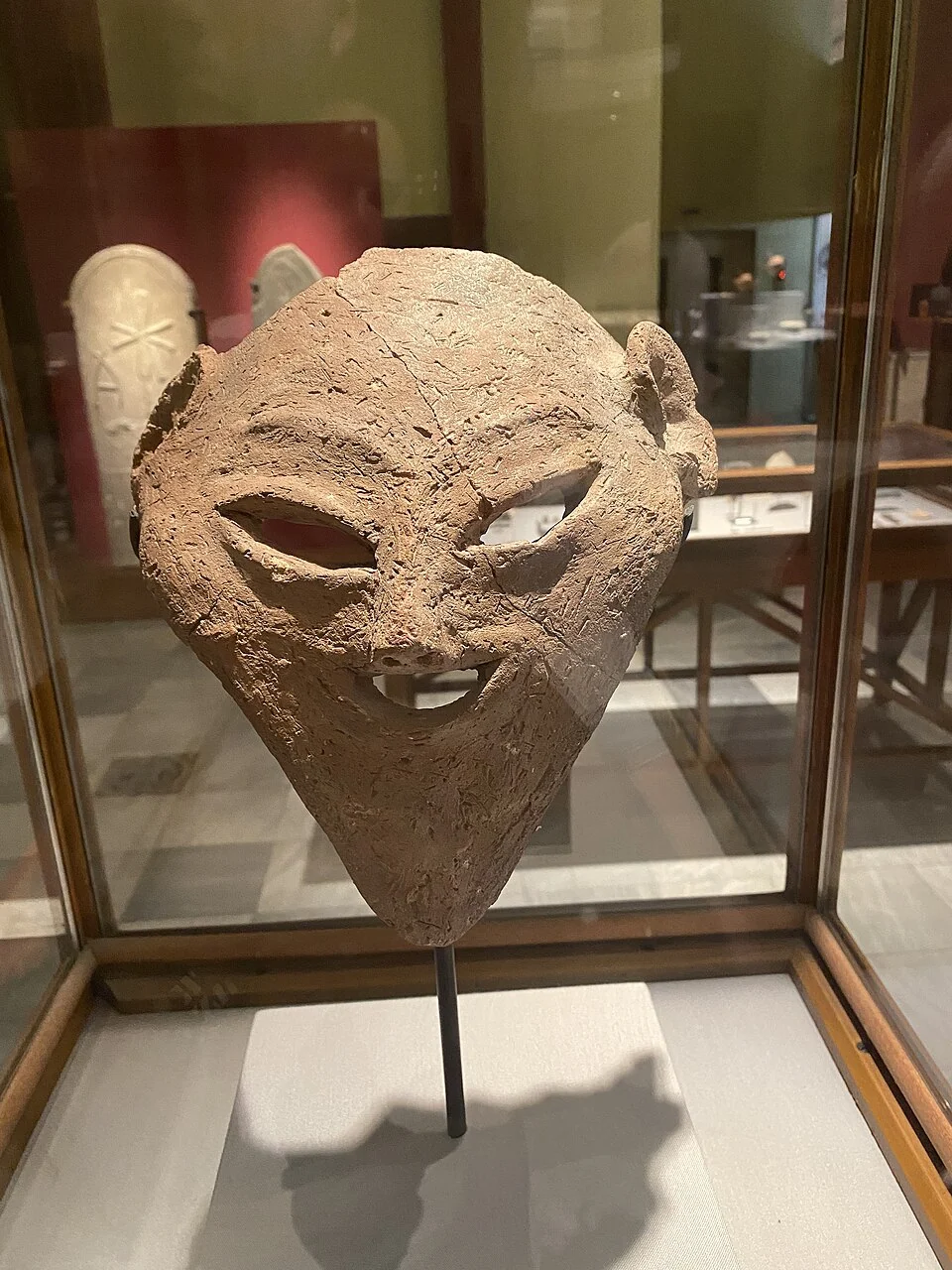
One striking object associated with the Tomb 16 complex is a ceramic face mask, preserved as an early example of anthropomorphic funerary imagery. Its form is arresting because the better-known golden masks of the New Kingdom date thousands of years later. We should not project the beliefs or techniques of those royal funerals backward onto this one. Without a contemporary text explaining how it was used, the mask’s exact ritual meaning remains uncertain.
Material, context and craftsmanship make it historically important even without a definitive explanation. It suggests how face imagery, commemoration and specialized grave objects were experimented with before later funerary conventions became established. The actual object, rather than an artist’s imagined mask, is shown below.
The remarkable HK6 animal burials: from elephants to baboons
Few discoveries from Predynastic Egypt are as surprising as the animal graves found among the elite funerary complexes at HK6. Excavators have documented domestic animals such as dogs and cattle alongside wild species including elephants, baboons, hippopotamuses, crocodiles, aurochs and a leopard. Some animals were buried individually, others in groups or close to human graves. These are deliberate archaeological contexts, not random animal bones discarded in an ordinary settlement.
A peer-reviewed 2015 study examined injuries in some wild mammals buried at HK6. Healed fractures and related skeletal changes suggest that certain animals were captured and kept alive for substantial periods before their deaths. Such evidence indicates human capacity to control difficult and dangerous species. It does not show that every animal was domesticated, well cared for or displayed to the general public.
The nickname “world’s earliest zoo” is therefore an attention-grabbing simplification. Elite menageries and prestigious animal collections may be relevant comparisons, but the archaeological evidence comes from burial complexes. The functions of keeping and burying animals could have varied among species and contexts. Wealth, ritual status, symbolic protection and the appropriation of natural power are among the interpretations discussed by researchers.
Some skeletons also reveal evidence of harsh treatment. Rather than idealize ancient animal ownership, researchers study injuries, captivity and possible restraint. The funerary significance of a captive wild creature might reflect power over nature, but such symbolic explanations do not erase the physical experience of the animals.
Domestic animals may have conveyed different meanings, perhaps provisions for the dead, companionship or displays of wealth. The interpretation must remain context-specific. The official HK6 excavation overview remains an essential starting point for understanding this unusual cemetery.
HK29A: a ceremonial courtyard where authority became visible
Excavation of HK29A revealed a large oval courtyard, approximately 45 meters long and 13 meters wide, as part of a ceremonial or administrative area. A monumental entrance appears to have included large acacia-wood pillars. The complex underwent changes over centuries, indicating an enduring social importance. The evidence gives us a building used for gatherings, but it does not identify a named king conducting a specific ceremony.
The site demonstrates how archaeological interpretation develops. Earlier reconstructions envisaged a smaller shrine in a particular area. Reassessment of the surviving posts and layout led researchers to recognize an imposing gateway. Thus, even seemingly straightforward reconstructions can change when new evidence emerges. A factual encyclopedia ought to explain these revisions rather than choose the most picturesque old illustration.
The nearby refuse pits yielded approximately 37,500 animal bones, according to the Hierakonpolis Expedition. Butchery debris, livestock, fish and wild animals provide evidence for large-scale communal consumption and ceremonial activity. The comparatively high proportion of wild species suggests meanings beyond simple domestic food preparation, potentially including displays of power over dangerous nature.
Feasting can organize communities. Producing and distributing food on such a scale may have strengthened relationships between participants, leaders and religious traditions. Yet we should not invent an exact guest list or pretend that a surviving bone deposit is a written festival calendar. The archaeological significance lies in the scale and organization of the activity, not in an unsupported reconstruction of its speeches or rituals.
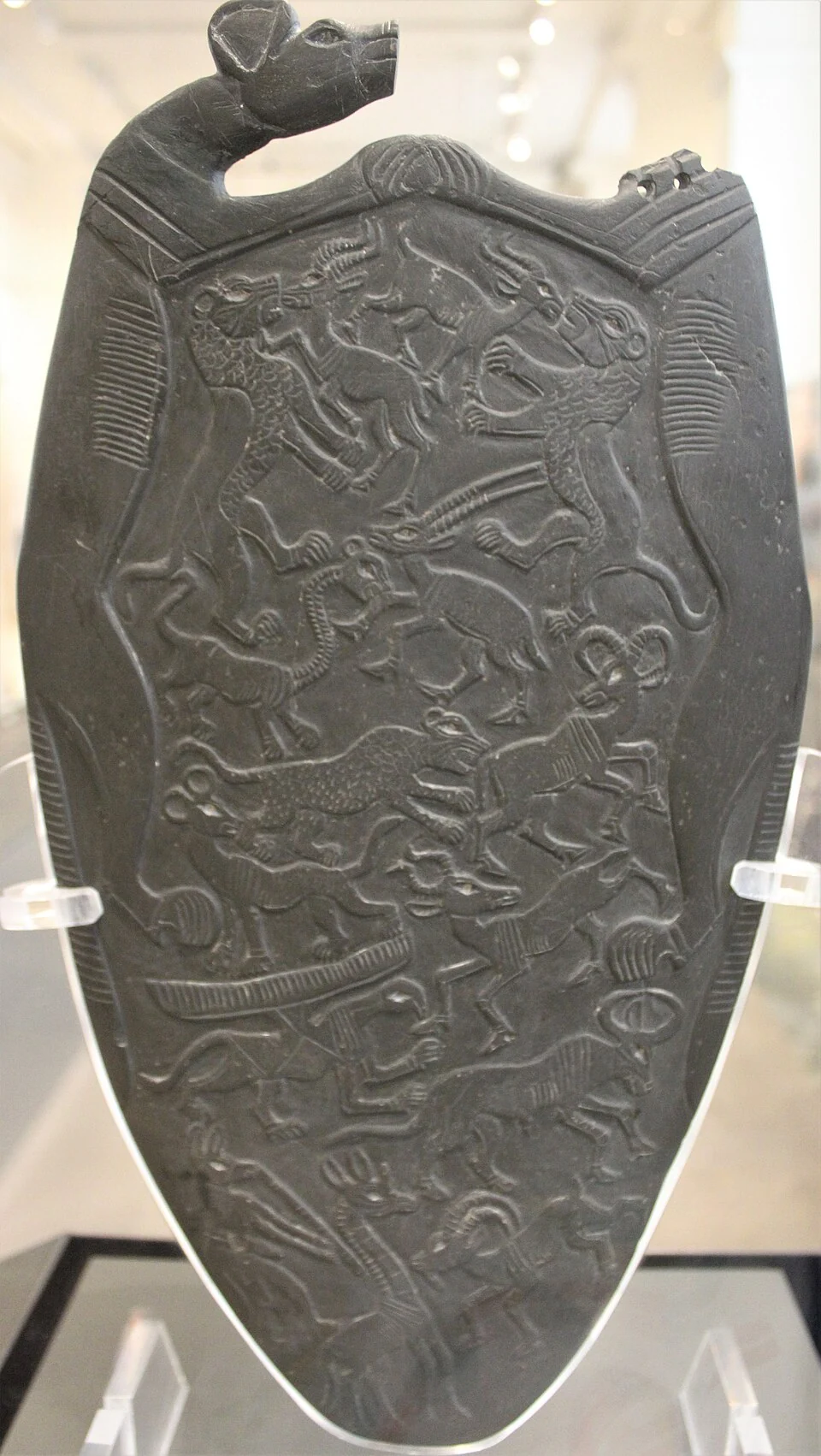
The Two Dogs Palette: wild animals and the early art of authority
The Two Dogs Palette is a beautifully carved siltstone artefact from the Main Deposit at Hierakonpolis, now in the Ashmolean Museum. Its crowded imagery combines real and imaginary animals, powerful predators and other creatures in an arrangement that suggests more than an everyday household tool. The museum dates the object to the late Predynastic or early Dynastic transition, around 3300–3100 BCE.
Images of predators dominating other animals have often been discussed in relation to concepts of control, prestige and order. Such themes later became prominent in Egyptian royal imagery. The palette therefore provides a potential visual bridge between Predynastic art and dynastic political symbolism. It does not, however, include a complete explanatory text defining the meaning of every fantastic creature.
Its discovery in a deposit also matters. Objects found together need not have been made on the same day or for the same ruler. An item might have had a long life before dedication or burial. The archaeological origin of a find is not always identical with its manufacture or its original use.
The Scorpion Macehead: an enigmatic ruler and a ceremonial act
Among Nekhen’s renowned discoveries is the Scorpion Macehead, an elaborately decorated ceremonial object showing a crowned figure and attendants. A scorpion sign near the central person inspired the conventional identification as “King Scorpion.” The figure appears to hold a hoe-like implement, a gesture often interpreted in relation to agricultural or irrigation ritual. But the surviving fragments do not provide a date, location and full written account of a specific historical construction project.
Royal imagery here appears before the long sequence of securely recorded dynastic reigns. Crowns, standards, attendants and purposeful gestures imply a language of political and ritual leadership. The precise identity and placement of the depicted Scorpion ruler remain debated. We should not confidently equate every differently dated scorpion sign with one named monarch.
The object was recovered from the Hierakonpolis Main Deposit and is held in the Ashmolean Museum. Its fragmented condition matters: missing portions have prompted reconstructions whose details cannot all be proved. Comparison with other ceremonial maceheads is informative, but it cannot restore every lost figure or label.
Its survival makes a deeper point. The early rulers were not only associated with weapons or military power; they were represented engaging in symbolic actions through which authority was displayed. That political imagery became increasingly formalized across the transition to the First Dynasty.

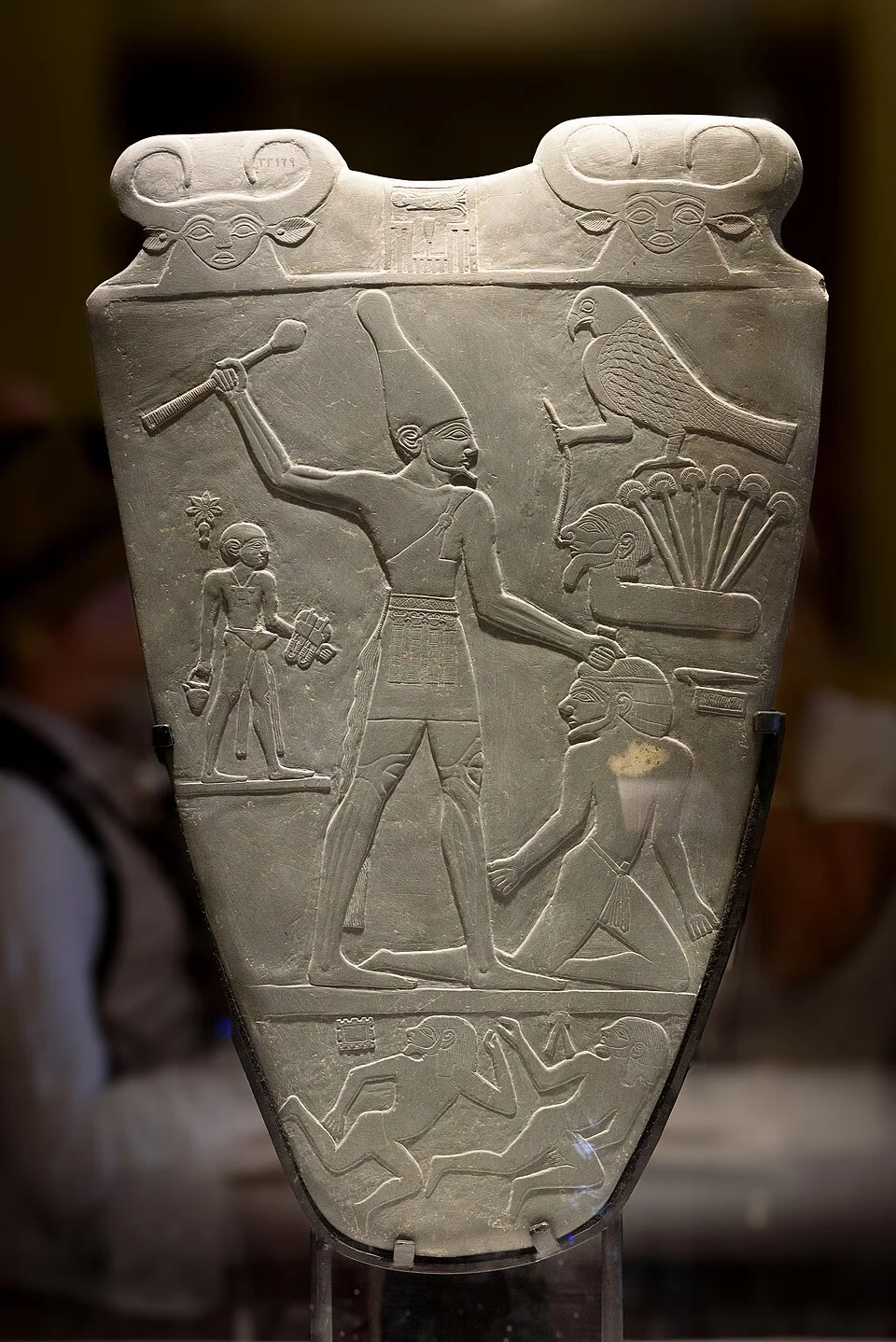
The Narmer Palette: the discovery that transformed Egypt’s early history
The Narmer Palette, discovered at Hierakonpolis, is often introduced as the record of Egypt’s unification. Its scenes show a ruler in the distinctive crowns of Upper and Lower Egypt, attendants, defeated figures and symbolic animals. It is a central source for the origins of dynastic royal art, and its findspot reveals the importance of Nekhen’s sanctuary landscape at the threshold of the First Dynasty.
Nevertheless, calling it a stone photograph of the exact day Egypt was united would be an overstatement. Political unification was likely a process involving competition, collaboration, institutions and changing territorial power. The palette may celebrate royal dominance and political legitimacy, but its visual language is ceremonial, not a complete modern history of a campaign.
Its carved scenes include the royal smiting motif, which would persist through Egyptian history. The recurring image of a king controlling an enemy offers a connection to the more ancient visual experiments of Tomb 100 and decorated palettes. But continuity in visual language does not prove that the people who created these objects belonged to one uninterrupted royal administration.
The palette is now preserved at the Egyptian Museum in Cairo. The museum photograph included here depicts the actual object. It was found at Hierakonpolis, but that is not sufficient to prove that Narmer was born there, ruled from there or carved the object personally. Objects can move, and special dedicatory deposits can bring together items from diverse places and periods.
The Narmer Macehead and what ceremonial objects reveal
The Narmer Macehead, another celebrated find from Hierakonpolis, depicts the king in a formal scene surrounded by attendants and other figures. Museum photographs reveal details of this carved composition. Yet its surviving images are open to multiple interpretations: references to festivals, presentations, royal activities or counts have been proposed, with the missing context making absolute identification difficult.
Together with the Scorpion Macehead, it illustrates a remarkable tradition of prestigious objects bearing scenes of sovereignty. These objects were not necessarily used like ordinary weapons. Their size, elaborate carving and dedicatory contexts support ceremonial significance. That does not mean they were made for identical occasions or contained identical political messages.
Comparing the objects encourages a better historical method. Archaeologists ask what is actually preserved, which signs can be read securely, where each item was recovered and how its imagery relates to other late Predynastic works. The comparison can reveal shared conventions without generating imaginary dialogues between two named kings.
Egypt’s political institutions were taking shape not only in royal symbols but in the management of people and goods. Kemet Vault explores those broader developments in the serekh and early royal identity and early Egyptian administration studies.

The people without palaces: workers’ burials at HK43
Nekhen’s less wealthy inhabitants deserve as much attention as the elite. The HK43 cemetery contains Predynastic graves from an ordinary community, providing an essential counterpoint to elaborate burial complexes at HK6. Researchers examine differences in funeral treatment and human remains to investigate social conditions, injury, work and bodily preparation. A study of kingship that leaves out the laboring population cannot explain where the resources supporting elite rituals came from.
Some preserved human remains at HK43 have contributed to discussion of early bodily preservation and funerary wrapping. Calling them “the first mummies” without explanation can mislead. Naturally desiccated bodies are different from remains showing deliberate treatment, and the elaborate techniques of later dynasties cannot be projected backward. The excavation team investigates the actual traces rather than assuming one unchanging Egyptian embalming practice.
Human skeletons also preserve evidence of injury. However, a wound cannot automatically be assigned to a political war or a battle of unification. Patterns must be studied alongside age, burial context and preservation. Such careful bioarchaeology helps reconstruct the lives of people who left few or no written names.
Was Hierakonpolis Egypt’s first capital?
Hierakonpolis was unquestionably a significant late Predynastic center, as demonstrated by its industrial facilities, ritual spaces, funerary investment and symbolic artefacts. What cannot be stated securely is that it was the single and permanent capital of a unified Egyptian state before the First Dynasty. Other places, including Abydos and communities in the Delta, played important roles in the political transformation of the Nile Valley.
The famous discoveries at Nekhen include prestigious objects associated with named early rulers, but a findspot is not an ancient address on a royal letter. Votive and ceremonial objects could be brought to sacred places, which is why discoveries at a temple deposit do not alone establish where rulers lived or administered territory.
Nekhen remained important after the first dynastic transitions. Later monuments, including the Second Dynasty enclosure associated with Khasekhemwy, reveal continued ceremonial activity. These buildings must be kept chronologically separate from much earlier painted tombs and brewing installations. Their presence demonstrates continuity of significance, not that every building belongs to the same Predynastic period.
The popular idea that one king abruptly created Egypt in one decisive confrontation is similarly inadequate. Early statehood involved changing institutions, exchange networks, royal rituals, conflict and administration. Hierakonpolis offers evidence for several of those strands but cannot on its own explain all of them.
What archaeologists know, and what remains uncertain
| Question | Supported by evidence | Not established |
|---|---|---|
| Was Nekhen important? | Exceptional archaeology documents a major early center | It was Egypt’s only major Predynastic settlement |
| Did people brew beer? | HK11C vat arrangements and residues support brewing | A universal output figure or exact ancient recipe |
| Were animals kept by elites? | HK6 burials and skeletal injuries indicate some captivity | A zoo open to a modern-style public audience |
| Does Tomb 100 show early imagery of power? | Complex boat, animal and human scenes survive | Each figure depicts a known named ruler or battle |
| Was the Narmer Palette linked to royal authority? | Royal iconography and the Hierakonpolis findspot | The exact date and details of Egyptian unification |
| Did HK29A host significant gatherings? | Monumental court and large faunal assemblage | A complete ceremony calendar or named officiant |
What makes Nekhen exceptional is the ability to study these different types of evidence together. A carved palette shows imagery; a brewery shows production; a large tomb shows inequality; and an animal skeleton can reveal captivity. None is a complete picture of government, but each helps reconstruct the social world from which kingship emerged.
Frequently asked questions
What is the difference between Nekhen and Hierakonpolis?
Nekhen is the ancient Egyptian name. Hierakonpolis is the later Greek name, often translated as “city of the falcon.” Both refer to the same historic site near modern Kom el-Ahmar in Upper Egypt.
How old is the Painted Tomb 100?
UCL’s archaeological reference places it around 3500 BCE in the Naqada II period. The broad color image frequently reproduced online comes from historical excavation drawings; the paintings’ surviving original fragments are preserved in Cairo.
Did ancient Nekhen have a zoo?
HK6 has extensive animal burials and evidence that some wild creatures were kept alive in captivity. Scholars debate how the animals were used and what their funerary roles meant. Calling the site a public zoo in the modern sense would exaggerate the evidence.
Where was the Narmer Palette found?
It was found in the Hierakonpolis Main Deposit and is preserved at the Egyptian Museum in Cairo. The discovery connects the site to early royal imagery, but it does not prove that every scene on the palette happened at Nekhen.
Can tourists independently visit Hierakonpolis today?
Hierakonpolis is a large archaeological landscape with research activities, not a standard monument with reliably published admission arrangements. Visitors should seek current information and necessary permissions from relevant Egyptian antiquities authorities rather than assume general site access.
Sources, evidence and archaeological image licensing
Core excavation evidence: ARCE Hierakonpolis Expedition; HK6 elite cemetery; HK11C breweries; HK29A ceremonial center; HK43 funerary research.
Other references: UCL Digital Egypt: Tomb 100; F. W. Green and J. E. Quibell, Hierakonpolis, 1900–1902; 2015 osteoarchaeological research on wild animals at HK6; and Ashmolean Museum collection: Two Dogs Palette.
Image standard: photographs show actual objects in museum collections, a genuine historical excavation photograph, and an explicitly labeled archival watercolor copy of the original Predynastic mural. Each caption distinguishes artifact, date and present location, identifies the visual’s author or publisher, and links to an original file and license. The publication intentionally uses no invented archaeological reconstruction as if it were a source photograph.
Reviewed 25 October 2026. This is an archaeological encyclopedia about prehistoric Nekhen, not a contemporary ticketing guide. Historical interpretations are presented with their limits.