What do Tomb U-j’s wine jars reveal about early Egyptian trade? Tomb U-j at Abydos contained large quantities of ceramic vessels and elite grave equipment, including imported or foreign-style jars associated with wine. Their presence helps archaeologists investigate valuable goods, redistribution and contacts with the southern Levant before the First Dynasty. Pottery and container history are the focus here; the earliest writing on ivory tags is covered in our separate primary study.
Tomb U-j at Abydos preserves a remarkable archaeological moment when writing, elite consumption and organized authority began to converge. This original study draws on published excavation research and makes an important distinction: modern photographs of similar objects are not automatically photographs of finds from this particular grave.
A tomb before Egypt had a First Dynasty
Egyptian writing did not arrive already equipped with the long royal inscriptions familiar from later temples. In the late fourth millennium BCE, powerful households experimented with signs, labels, seals, marks on jars and representations of authority. Tomb U-j at Umm el-Qaab, Abydos, is one of the strongest archaeological settings in which to study that transition. The German Archaeological Institute expedition led by Günter Dreyer identified the tomb in 1988, among burials belonging to a period before the conventional First Dynasty. The deceased’s name and the nature of his precise office remain uncertain, but the scale of the tomb and the quality of its furnishings place him among the leading figures of his time. The tomb cannot be read like a later inscribed biography. Its significance instead emerges from its architectural plan, offerings, imported goods and the extraordinary array of abbreviated signs. The distinction matters because it prevents archaeology from becoming an imagined tale about a named founder of Egyptian civilization. A historian asks what an object was, how it was used and where it was found before asking what broader change it might signify.
What archaeologists uncovered in Cemetery U
Cemetery U formed part of the Umm el-Qaab necropolis, near Abydos in Upper Egypt. Its long sequence of burials illuminates the emergence of social differences before unified kingship. Some earlier graves were comparatively simple, while later elite burial chambers could be divided by mudbrick walls and furnished with many more objects. Tomb U-j stood out for its scale and complex organization. Dreyer’s excavation report describes twelve chambers within a plan roughly 9.1 by 7.3 meters. Archaeologists found evidence for a wooden installation or shrine and an ivory crook-shaped staff or scepter, among numerous other deposits. Those are physical observations; they are stronger than assigning the grave to a specific ruler solely from the nickname later given to its occupant. Some modern accounts call the owner “Scorpion I.” That is a convenient but disputed identification, not a securely readable name written in a complete royal titulary. The wider cemetery also reminds us that funerary expenditure varies: elaborate graves tell us how a community commemorated particular dead people, not how every contemporary Egyptian was buried.
The ivory tags: one of Egypt’s earliest writing systems
Perforated ivory and bone labels discovered within Tomb U-j carry brief sequences of signs. Their holes indicate that they could be fastened to containers or bundles, although their precise original attachment and every intended use must be inferred from context. The marks sometimes resemble animals, plants or abstract forms later familiar in hieroglyphic writing. Ilona Regulski’s scholarship places the corpus around the formative phase of Egyptian writing and emphasizes that the earliest attested system was not designed to represent entire speeches or narratives. Signs could communicate place names, personal or institutional names, numbers and the identity of commodities. That is already a remarkable administrative development. It means containers could carry information beyond the spoken memory of the person who filled them. Yet it would be wrong to translate every small picture into a modern English word or declare that every drawing is readable with a dictionary of later hieroglyphs. Early signs were conventional to their own time, and some proposed readings remain disputed. The University of Münster’s database of Early Dynastic inscriptions helps track the change from these early experiments to better documented royal names and labels of the First Dynasty.
Writing or decoration? Why interpretation is difficult
Not every drawing on a pottery vessel is a sentence. Researchers distinguish ornamental imagery, ownership marks, numerical marks, administrative signs and writing by looking at repetition, context, placement and whether signs participate in conventional sequences. Tomb U-j is important because its evidence is not merely a set of attractive animals drawn on separate objects. Labels, painted jars and sealings formed related but materially different systems of identification in a large elite grave. Oxford’s handbook chapter on the origins of Egyptian writing stresses that only some of this material represents the formative hieroglyphic system; the other marks are significant without all being identical types of script. Archaeologists compare signs with later examples cautiously, looking for sound values or standardized combinations without presuming every picture communicated one fixed sound. The earliest written notation might have been especially useful for keeping track of products, people and places rather than recording myths. More elaborate narrative writing developed much later. This is why the dramatic question “Who invented hieroglyphs?” often has less evidentiary value than the more specific question “How was information attached to a jar?”
Imported jars and the beginnings of long-distance administration
Among Tomb U-j’s rich contents were large numbers of ceramic vessels, including jars connected through fabric, form and scientific analysis to the southern Levant. The University of Pennsylvania Museum’s discussion of early winemaking describes jar sealings with impressions, together with residues inside vessels associated with wine. The details show how long-distance exchange and elite display could overlap. Goods reached Abydos, were packed in recognizable containers and entered a funerary assemblage that also carried labels and sealings. It remains difficult to reconstruct every transaction that led to their presence. A grave deposit does not preserve a shipping manifest with every stop on a journey. Specialists examine pottery fabrics, chemical residues, seal impressions and contextual association to build a more cautious picture. Describing the containers as evidence for contacts with the southern Levant is justified; describing the deceased as the personal ruler of a Levantine city is not. The objects also illuminate consumption at the highest level of Predynastic society. The ability to assemble products from distant regions indicated networks of suppliers and intermediaries that would later become vital to the early Egyptian state.
Abydos objects in museums: a photograph is not automatically a U-j find
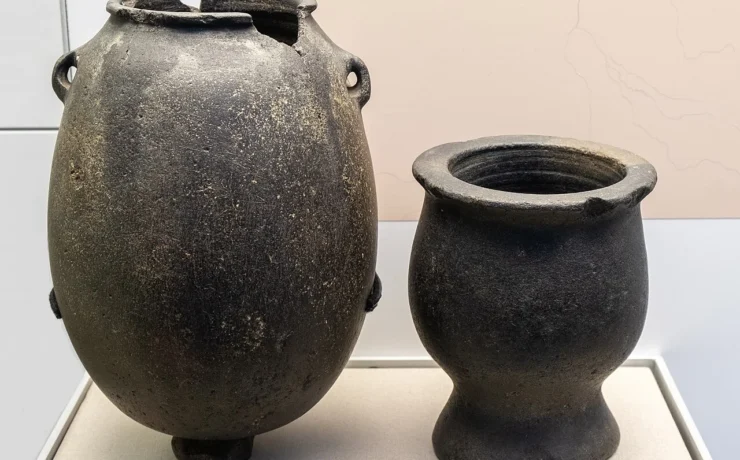
Many museum objects provide invaluable comparative evidence even when they do not come from this particular grave. One useful photograph shows stone vessels broadly associated with Abydos and dated across the late Predynastic and early Dynastic centuries, now in the Musée des Confluences. The objects demonstrate skilled manufacture and the prestige of durable stone containers. They are not catalogued as a verified set of Tomb U-j vessels, and therefore cannot be labeled as if the excavation recovered them from a specific chamber. Museum labels should preserve that provenance difference. Source photographs may be perfectly authentic yet inappropriate if captioned with the wrong archaeological context. Modern educational media often blur a broader culture, a known site and a specific tomb, thereby giving readers false certainty. Here, contextual objects are identified as comparative material, while actual claims about U-j are grounded in its excavation publications. That distinction makes the article less sensational but substantially more useful to students and teachers.

From labels to royal record keeping
Later First Dynasty ivory labels help explain why U-j matters. Tags from the burials of Djer and other early kings could be attached to vessels of valuable oil or goods, recording names, quantities and sometimes events or dating systems. Their function was changing and their content grew more complex. An early published drawing of a label associated with King Djer is reproduced below explicitly as a later comparison, not as an original object from U-j. The transition illustrates how signs moved from identification toward increasingly elaborate administrative conventions. This does not imply that a single inventor wrote all the early labels or that the state was already literate in the broad modern sense. Writing was specialized and remained restricted to particular purposes and communities. It took many generations before the system supported the long religious and commemorative texts of later Egyptian history. Comparing the earlier U-j evidence with later First Dynasty material shows a developing institution of record keeping rather than an instantaneous invention.

Was Egyptian writing invented independently?
The relative chronology of early Egyptian and Mesopotamian writing has long been discussed. Scholars now tend to emphasize that Egyptian writing developed its own graphic forms and structure, though cultural contacts and the possible circulation of ideas across regions should not be erased. The Oxford Handbook reviews the possibility of stimulus diffusion while emphasizing the locally distinctive material from U-j. Saying that Egypt invented its system independently does not require proving that no one ever heard of another way to record information. Equally, similarities between some objects of the eastern Mediterranean and Mesopotamia do not prove that Egyptians copied a ready-made set of hieroglyphs. Specific signs, dates and archaeological contexts matter more than sweeping cultural rankings. The earliest Egyptian texts were brief and formulaic; their relationship to spoken language was developing. Archaeologists and linguists study recurrent sign sequences, sign values, formalized sizes and administrative context. This evidence supports a history of experimentation, not a single document announcing the birth of writing.
Wine, elite authority and the foundations of a kingdom
Tomb U-j demonstrates that administration and status developed together. A twelve-chamber burial packed with costly materials could have required considerable planning, organized labor and people able to record or remember quantities and origins of goods. Those elements anticipate the institutional structure of early royal Egypt without proving that the deceased controlled the same territory as a later pharaoh. The political landscape of Upper Egypt included other centers, among them Nekhen/Hierakonpolis. Their evidence for large-scale brewing, funerary architecture and developing royal imagery provides a useful comparison. For the separate archaeology of that center, see Kemet Vault’s Hierakonpolis study. A broader treatment of ceramic and burial traditions is in the Naqada culture guide. Neither place should be reduced to one inevitable stage of a simple march toward Egypt’s unification. Competition, alliance, exchange and changing identities are all part of the historical picture, and the fragmentary record resists a single plot.
What Tomb U-j cannot tell us
No surviving text from Tomb U-j provides the deceased’s full biography, a royal list, the exact boundary of his authority or the names of the people who made all his funerary goods. Nor is every sign transparently legible. Some attractive graphics that circulate online are drawings from modern archaeological publications, which may still be protected by copyright; their status should not be confused with freely reusable photographs. Where documentary reproduction rights are uncertain, a reliable encyclopedia can provide links to the original publications rather than silently copying them. The biggest risk is to mistake later traditions for eyewitness evidence: mature hieroglyphic values cannot always be forced onto formative labels. Another is to turn a possible “Scorpion” identification into an undebated name. Students should distinguish date estimates, excavation observations and interpretations drawn by modern scholars. These distinctions are not obstacles to telling a powerful story. They are exactly how evidence turns small pieces of ivory, broken sealings and pottery into a genuine account of emerging Egyptian civilization.
Museum and research sources
Read Günter Dreyer’s chapter “Tomb U-j: A Royal Burial of Dynasty 0 at Abydos” for architectural, pottery and inscription evidence. Consult the Oxford Handbook study of the origins of writing in Egypt for debates about scripts and early administrative practice. The Penn Museum account of ancient wine explains pottery residues and seals; the University of Münster corpus documents early hieroglyphic signs. The illustrations below use a genuine photograph of comparative stone vessels from Abydos and an explicitly later published drawing of a Djer label. Neither is presented as a photograph of the ivory tags from Tomb U-j. For the separate origins of pharaonic identity, Kemet Vault’s study of the serekh and early royal names provides useful context. Editorial review: 25 October 2026.