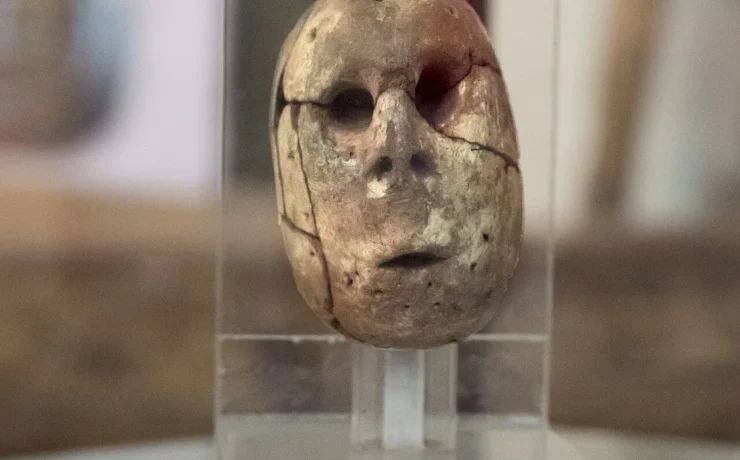
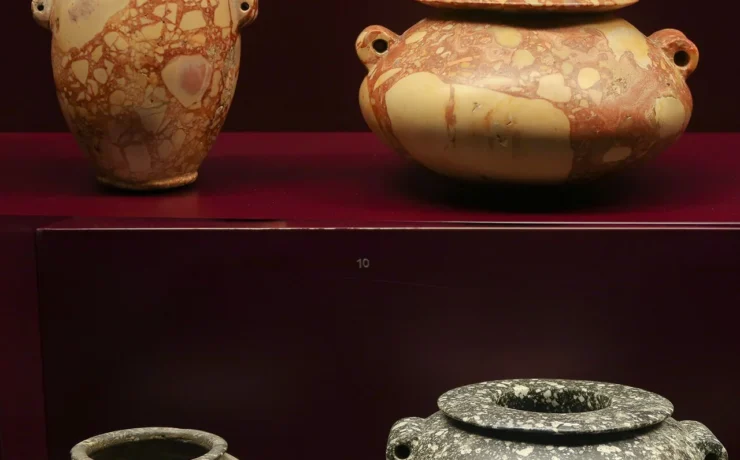
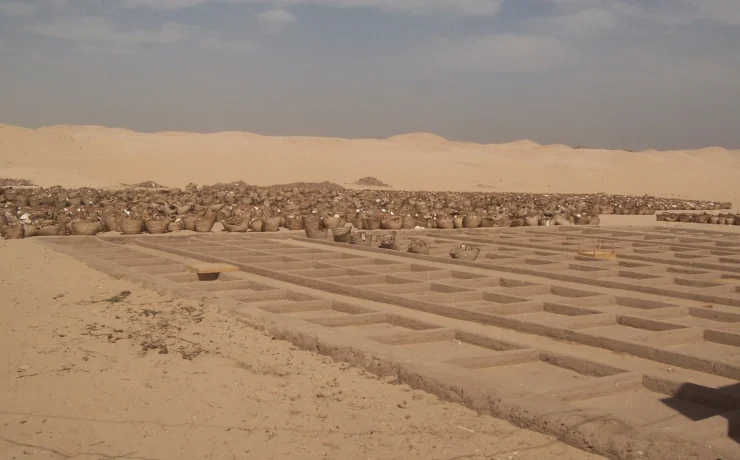
What was the Maadi-Buto culture in prehistoric Egypt? Maadi-Buto is the archaeological name for Lower Egyptian communities in the fourth millennium BCE, before the early pharaohs, documented through settlements, pottery, burials, animal bones, tools and exchange with neighbouring regions. Maadi, near modern Cairo, is the best-known type-site, while other finds from the Delta show that the broader cultural horizon was not confined to one village. Unlike the later monumental world of royal tombs, the settlement evidence concentrates on agriculture, storage, household work and local contacts. Historians must distinguish the names of archaeological cultures from the identities that ancient inhabitants would have used for themselves.
This guide draws on the University College London Digital Egypt site catalogue, peer-reviewed archaeological research and modern German Archaeological Institute fieldwork. Its two documentary object photographs are independently identified museum records, not reconstructions or images falsely described as photographs of the excavated village. The subject is different from the separate Merimde Neolithic village, Badarian Upper Egyptian burials and Naqada cultural sequence.
The fourth millennium BCE and the archaeological name Maadi-Buto
Maadi is traditionally dated to approximately 4000–3500 BCE by UCL Digital Egypt, though relative chronology and local settlement phases are subjects of continuing research. The term Maadi-Buto relates material from the Cairo-area settlement to material recorded farther north in the Delta, including Buto. It should not be treated as a kingdom whose citizens used the phrase Maadi-Buto in their own documents. The culture predates the fully developed royal inscriptions of the dynastic period. Dating relies on ceramic comparisons, stratified archaeology and scientific evidence, not on a securely surviving royal list. Researchers compare the Lower Egyptian horizon with the later stages of Naqada I and earlier Naqada II in Upper Egypt. Contemporaneity does not prove that the two areas possessed identical institutions. The UCL Maadi guide gives an accessible outline, while the review of Egyptian predynastic state formation explains why discoveries at Maadi, Buto and other northern centres are important for a less Upper Egypt-centred account of early change.
The settlement near Cairo, not the modern suburb
The prehistoric Maadi settlement occupied a place near the later suburb on the eastern side of the Nile south of Cairo. Its identification does not mean that the modern streets and houses of Maadi are remnants of the ancient village. Early investigators exposed extensive occupational areas; subsequent urban growth placed surviving archaeological deposits under considerable threat. Modern site interpretations identify light buildings, hearths, storage places and other domestic features rather than a uniform stone town of temples and palaces. A 2013 archaeological study characterises the settlement as a village with wattle-and-daub structures, fenced areas, fire places and storage pits, while reporting no established system of planned streets or defensive walls. It is therefore misleading to depict Maadi as a miniature capital awaiting unification. The village’s importance lies in its unusually informative settlement archaeology at a time when Upper Egyptian histories often rely heavily on cemetery material. Houses and pits can disclose practical choices that elaborate graves do not necessarily preserve.
Excavations from the 1930s to today’s rescue archaeology
Excavations at Maadi and the neighbouring Wadi Digla cemetery were conducted between 1930 and 1953 under Cairo University auspices, involving Mustafa Amer, Oswald Menghin and Ibrahim Rizkana. Research resumed in later decades with international collaboration and fresh questions about chronology and cultural connections. The German Archaeological Institute’s Cairo department describes fieldwork undertaken in 1999–2005 and again during 2023–2024, concentrating on remaining threatened western parts of the settlement. This is a reminder that the site is not archaeologically exhausted. New documentation can identify features that older excavation methods recorded only partially, and the surviving area has to be interpreted against the much larger landscape lost to development. It is essential to separate the date of a modern campaign from the date of ancient occupation. A photograph captioned 2024 might show a fourth-millennium deposit, but it was not taken by ancient people. The DAI’s Maadi project account records current research questions concerning spatial development, southern Levant relations and metallurgy.
Houses, semi-subterranean rooms and storage
Excavated settlement features include small domestic installations, hearths, pits, fences and a small number of distinctive constructions sometimes described as semi-subterranean rooms. Archaeologists have interpreted certain stone-lined or partly underground spaces as possible storage installations, though the specific activities within them are not always demonstrable. The idea that every such room was a house occupied year-round would be as misleading as claiming it was a temple. A 2013 detailed study notes the exceptional stone house and cave-like rooms but also warns that an overall settlement plan could not be established from the exposed remains. This limited certainty is useful rather than disappointing. Construction technique speaks to access to materials, temperature, storage and use of space, but walls do not name their owners. Soil deposits, objects found inside and the relationship to nearby installations help refine interpretation. Repeated storage facilities suggest the demands of food production and household management, not a direct demonstration that one central royal bureaucracy had already emerged.
Growing plants, keeping animals and using the Nile environment
Archaeobotanical and faunal remains connect settlement life with cereals, cultivated plants, domestic animals and fishing. UCL reports cattle, sheep, goats and pigs, alongside evidence for a donkey; the existence of a recorded early donkey specimen should not be inflated into an argument that Maadi invented donkey domestication. A scholarly settlement study lists crops such as emmer wheat, barley, pulses and flax. Their presence points to agriculture, food preparation and probably several kinds of household processing. Fishing helps explain the use of local water environments. A bone assemblage can reveal animals consumed or managed, but is not a complete census of every herd. Different houses may have performed different roles at different dates. Nor can the finds establish that every resident ate the same diet or occupied the same economic position. These ordinary remains are critical evidence precisely because a political history reconstructed only from later crowns and royal names leaves the agricultural foundation of earlier communities largely invisible.
Handmade pottery, practical shapes and the limits of style
UCL describes pottery of the Maadi culture as hand-shaped, often with dark clay surfaces, alongside large storage jars and selected objects showing contact with other cultural traditions. Useful everyday pottery cannot be treated as evidence that its makers lacked aesthetic choice or sophisticated production knowledge. A potter controlled the consistency of clay, shaping, drying and firing, all of which influenced a jar’s practical properties. Some dark or black-topped material may be discussed in relation to connections with Naqada traditions, but a colour on a photograph does not independently prove the origin of a particular vessel. Researchers examine fabrics, surfaces, form, inclusions and excavation context. Important imported vessels and locally made copies have to be distinguished. The German Archaeological Institute documents Maadi vessel assemblages that include storage and cooking shapes as part of the study of the community’s material life. A pottery photograph used in a broader predynastic study must always identify whether the objects were excavated at Maadi, at a separate Lower Egyptian site, or acquired through the antiquities market.
The basalt jars in London: what one photograph really documents
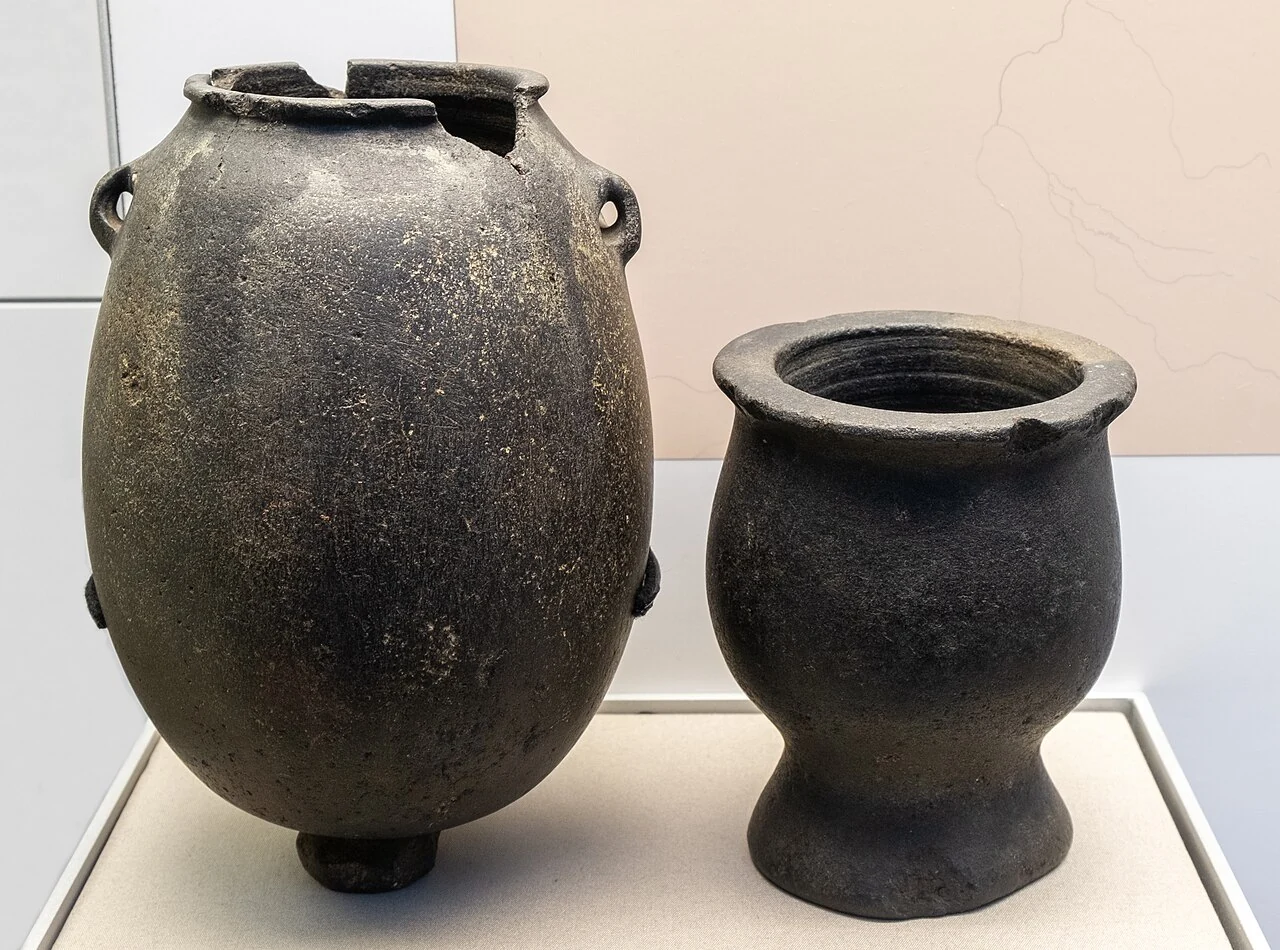
The accompanying British Museum photograph shows two Lower Egyptian basalt stone jars in forms associated with Maadi pottery, labelled by the photographer with British Museum numbers EA 34398 and EA 26654. It is a real image of catalogued museum objects, taken by Anthony Huan, not a made-up re-creation of a Maadi workshop. However, a photograph caption identifying Lower Egyptian forms cannot, by itself, establish that both jars were excavated in the Maadi settlement in a single archaeological layer. The dating in the photo description refers to the Naqada I–II period, which is a broad comparative chronological framework. Stone vessel forms are especially useful for analysing craft and exchange, but material and find context must be kept separate. A polished basalt jar is not a ceramic vessel, even if its shape resembles a pottery type. Museum numbers allow a student to examine this difference and to question labels instead of treating the appearance of an object as proof of its precise maker, function or original owner.
Copper tools and the question of specialised work
Copper objects, including adze-like tools, are part of the archaeological account of Maadi. Their presence is important for the history of technologies and links with areas where raw material or finished implements circulated. But a copper tool in a settlement does not establish that it was smelted there, or that every household possessed metal objects. Understanding production requires evidence from ore, slag, crucibles, furnace installations and the microscopic traces of working. The German Archaeological Institute identifies supposed metallurgical activities as a research question, rather than offering a definitive map of factories. Metal could have served particular tasks while flint and stone remained useful. The combination of materials is a better picture of prehistoric technology than a simplistic sequence in which the Stone Age stopped on the day someone found copper. Craftspeople made economic choices among available substances, and exchange could connect groups with different geological resources. Archaeological interpretation should stay alert to the difference between access to a finished metal object and locally controlled metal production.
Contacts with the southern Levant, and what imports can prove
The material from Maadi contains examples of imported pottery or foreign-style forms linked to the southern Levant. Such objects are significant because they complicate the assumption that Egypt was culturally isolated before its earliest kings. Movement could involve commodities, containers, objects and people, but a pottery import does not necessarily document a permanent migration of an entire community. Some forms may have been locally copied, while genuine imported wares could have served trade or social purposes that are no longer recoverable. The 2013 study of Maadi’s chronology considers its connections to the southern Levant alongside changes in pottery and settlement phases. The DAI project continues to research these relations through ceramic and settlement evidence. Careful authors distinguish the secure observation, such as a nonlocal ware, from competing interpretations of how it moved. There is no justification for reducing the story to a single foreign colony, a conquest or an established trade treaty without supporting records.
Burials at Maadi and the Wadi Digla cemetery
The nearby cemeteries offer a different kind of evidence from settlement floors. UCL describes contracted burials in oval pits, many with relatively few accompanying goods, while some infant burials are documented in settlement contexts. These practices should be considered in their chronological and regional setting. Cemetery assemblages can vary because of local traditions, preservation, differences in age and family choices, and the original excavation methods. A comparative study of Predynastic burials by Alice Stevenson emphasizes that Maadi-Buto burials in Lower Egypt commonly show less conspicuous investment in display than many Upper Egyptian elite tombs. Such a comparison does not prove that northern families lacked religious beliefs or that social distinctions did not exist. Archaeological visibility is not the same as actual social importance. Nor should one unusual burial be used to define an entire culture. The settlement and cemetery evidence together offer a more rounded account of early household and community life than either one alone.
Maadi-Buto and Naqada are contemporary but not identical
The relationship between Lower Egyptian Maadi-Buto and Upper Egyptian Naqada cultures is a major question for the formation of the early Egyptian state. Their material assemblages differ in pottery, settlement evidence and some burial customs, but such distinctions were not necessarily rigid ethnic borders. Over time, exchange, movement and political transformation changed how goods and practices appeared across regions. Archaeologists also distinguish late fourth-millennium phases when Naqada-related material expanded in the Delta; this process should not be turned into a simple story of one day’s invasion or an undoubted replacement of entire populations. A peer-reviewed overview of predynastic state formation stresses the increasingly rich evidence from northern sites such as Buto and Tell el-Farkha. The Naqada article explains Upper Egyptian cemetery and pottery sequences in their own context. Both regions contributed to the long processes that preceded kings like Narmer. Their relationship requires regional comparison rather than assigning every invention to one victorious culture.
A Louvre object from Maadi, but from a later period
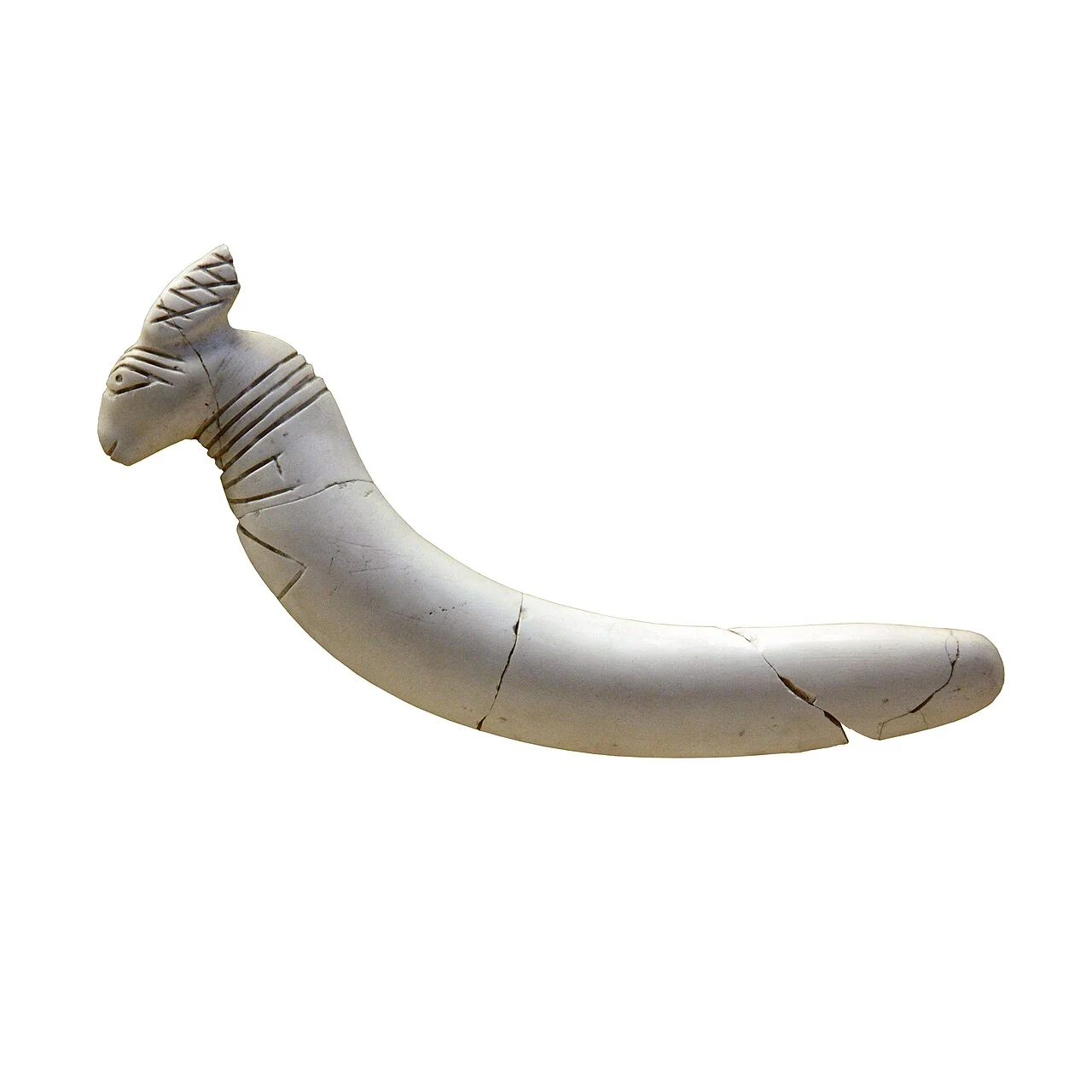
A second documentary photograph illustrates an ivory pair of clappers in the Louvre, accession E 13920, with Maadi recorded as its place of discovery. The institutional object metadata dates the item to the Early Dynastic period, approximately 3100–2700 BCE, later than the conventional Maadi-Buto cultural phase outlined in this article. This difference is worth showing explicitly. The clappers can illustrate that an archaeological findspot is not a timeless culture label: objects of different periods can come from a geographical area later associated with a named prehistoric site. It would be misleading to present the clappers as a typical 3800 BCE Maadi-Buto household tool. The image is a genuine photograph by Rama, with a verifiable Creative Commons license and Louvre accession number. It also demonstrates why museum context, object date, provenance and reuse rights must each be verified independently. The most useful historical photographs are not always interchangeable with one another, and a caption can prevent misleading conclusions even when the objects are visually compelling.
Why the site matters for understanding early Egyptian history
Maadi shows what can be learned about prehistoric Egypt without relying solely on royal tombs, monumental images or later written records. Agriculture, ceramics, toolmaking, storage and connections with nearby regions are visible in the excavated material. Together with other northern sites, the settlement challenges histories that treat the entire Delta as an empty margin awaiting southern kingship. Its significance also rests on the modern history of archaeology: researchers working in a densely populated modern city face practical difficulties protecting and studying the remaining deposits. Archaeological interpretation is therefore provisional, shaped by what has survived and what can still be excavated. The evidence supports an active, connected Lower Egyptian community; it does not reveal a named dynastic capital, an exact administrative constitution or a single ethnic identity. The Hierakonpolis study and the separate Narmer Palette analysis continue the story in other places and periods without collapsing them into Maadi.
Frequently asked questions
What is the difference between Maadi-Buto and Naqada?
Maadi-Buto refers to an archaeological horizon in Lower Egypt, while Naqada is associated with Upper Egyptian sites and traditions. The two overlapped in time, exchanged materials and changed over generations. They are not simply two names for one cemetery or village.
Were the Maadi houses underground?
Most identified settlement features were light constructions and associated pits. A small number of exceptional partly subterranean rooms and a stone structure have been documented; their precise functions are still researched, and not all buildings were underground.
Was Maadi a capital of a united Egyptian kingdom?
No excavated evidence securely identifies Maadi as a capital of a unified dynastic state. The site is most informative about earlier Lower Egyptian settlement, craft, farming and regional exchange.
Source notes, museum records and licensing
Key research: UCL Digital Egypt, Maadi; German Archaeological Institute’s Maadi field project; peer-reviewed survey of predynastic state formation; 2013 archaeological study of Maadi chronology and southern Levant connections; Alice Stevenson on Predynastic burials. The British Museum and Louvre object photographs have separate cataloguing identities and are not presented as images of a single excavation layer. Last reviewed 31 October 2026.