Cleopatra VII ruled Egypt from 51 to 30 BCE during the last decades of the Ptolemaic monarchy, while Roman civil wars increasingly constrained Egyptian sovereignty. The queen was a real administrator and dynastic diplomat, not simply the romantic figure created by hostile Roman propaganda and centuries of entertainment. This article follows her changing co-regencies, alliances, temple representations, military defeat and the Roman annexation.
Three original object photographs document what the historical world actually left: a marble portrait, a Dendera relief with Caesarion, and a tetradrachm showing Antony and Cleopatra. Sources come from academic history and museum records, with uncertain motives and legendary details clearly identified rather than presented as verified dialogue.
Cleopatra VII: a ruler rather than a Roman legend
Cleopatra VII Philopator ruled Egypt from 51 to 30 BCE. Ancient Roman polemics and much later fiction turned her into a character defined almost entirely by romance, but that is not an adequate explanation of twenty-one years of government. She inherited a state with agricultural wealth, dynastic instability and substantial vulnerability to Roman military influence. Her diplomacy was aimed at preserving the dynasty, building alliances and maintaining a viable succession. Historians can debate her judgment without claiming to know private emotions from hostile political writing. Oxford’s Cleopatra biography studies these decisions in their political setting, while Oxford Bibliographies traces how the victorious Romans reshaped the queen’s reputation. This page uses institutional records, authentic period objects and carefully labelled ancient testimony so readers can distinguish what happened from what later writers wanted their audiences to believe.
Macedonian ancestry and Egyptian royal identity
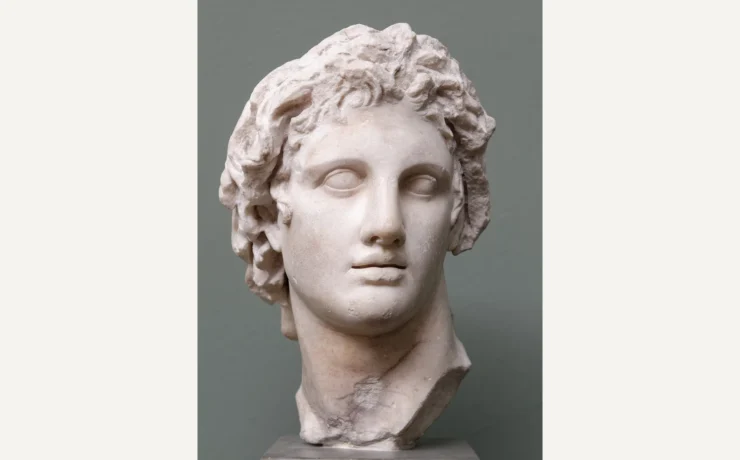
Cleopatra descended from the Ptolemaic royal house created by Macedonian successor rulers after Alexander’s death. Ptolemy I became satrap in 323 BCE and assumed kingship in 305 BCE, long before Cleopatra was born. She therefore inherited an established Hellenistic monarchy rather than creating a newly Greek kingdom. Her ancestry cannot be translated into a fully established modern ethnic label for every ancestor, because some genealogical details remain uncertain. Ancient subjects could understand her in multiple ways: as a Greek-speaking dynastic monarch, as the ruler of Egypt and as a figure depicted in local temple imagery. The Metropolitan Museum’s overview demonstrates artistic continuity and interaction across the era. A responsible history rejects both claims that a Macedonian-descended monarch could not be an Egyptian pharaoh and the opposite idea that taking Egyptian royal titles proves one simple genetic ancestry.
The court and Roman pressure when she inherited the throne
Cleopatra succeeded her father Ptolemy XII in 51 BCE amid heavy Roman political influence and rival interests in Alexandria. Earlier royal debts, military interventions and dynastic arrangements meant that the kingdom’s freedom of action was constrained. These pressures were institutional, not merely the result of one queen’s personality. The Nile valley supplied valuable grain and revenue, but that wealth was contested through taxation, property and court competition. The Oxford Classical Dictionary traces the chronology of Cleopatra’s early rule and rivalry with her brother. It is misleading to invent an exact modern-dollar value for her treasury or state that every Egyptian village experienced prosperity or collapse in the same way. Studying monarchy means asking how decisions were imposed, who collected resources and which groups could participate, not assuming that palace wealth directly described household life.
Ptolemy XIII and the struggle for a shared crown
Cleopatra initially ruled jointly with her younger brother Ptolemy XIII, a dynastic arrangement that did not produce political harmony. Palace advisers, armed factions and royal relatives disputed control, and Cleopatra temporarily lost her position around 49–48 BCE. Co-regency titles should not be confused with equality in practical authority. The kingdom also lay close to a Roman conflict that could transform its political situation at any moment. UCL’s documented chronology distinguishes the joint accession, displacement and later restoration, which is much more helpful than fictional conversations explaining the entire struggle through jealousy alone. Egyptian royal succession and Roman civil war became linked because different actors saw advantage in different outcomes. Cleopatra was a political participant in that crisis but did not control every Roman commander or court faction.
Caesar’s entry into Alexandria and the Alexandrian war
Julius Caesar entered Egypt while pursuing Pompey during the Roman civil war, after Pompey was killed on reaching the kingdom. Caesar became involved in Cleopatra’s succession dispute and later military fighting in Alexandria. Accounts of how Cleopatra was smuggled into the royal residence vary in later literature; the precise prop used in those anecdotes is less secure than the political fact of Caesar’s intervention. The subsequent conflict helped restore Cleopatra to the throne while Ptolemy XIII died following defeat. The Oxford critical overview explains the strategic dimension of her partnership with Caesar. Claiming she simply won back Egypt through charm is a modern retelling that removes soldiers, constitutional arrangements, diplomacy and coercion. The historical sequence contains real danger and violence, not merely an entertaining palace encounter or a timeless morality play about seduction.
Ptolemy XIV and the meaning of restored co-rule
After Ptolemy XIII’s death Cleopatra ruled alongside another younger brother, Ptolemy XIV. The formal arrangement preserved the structure of dynastic legitimacy while Cleopatra’s authority increased. His death in 44 BCE was followed by a changed succession in which her own son gained royal status. Later authors assign motives to individuals in the court, but not every alleged secret poisoning or conversation is established by independent primary evidence. Oxford’s account traces the sequence of ruling partners and cautions against flattening the queen’s position into continuous solitary rule from 51 BCE onward. The official titles mattered for how documents and temples represented sovereignty. Cleopatra’s political agency can be described without ignoring the legal names of the other people included in the monarchy at different stages.
Caesarion: succession, paternity and the final royal generation
Cleopatra’s son Ptolemy XV Caesar, known as Caesarion, was presented as the child of Julius Caesar. His royal role became increasingly important after Caesar’s assassination and Ptolemy XIV’s death. The claim of paternity belonged to a real political environment: Rome’s leading commanders could gain or lose legitimacy through the memory of Caesar. Historians should identify the ancient assertions and their status instead of claiming access to a modern genetic test. University College London documents Caesarion’s co-regency in the final phase, and his fate under Octavian. Describing Cleopatra as the last Ptolemaic queen is accurate, but the shorthand “last pharaoh” requires acknowledging her son as a final co-ruler. Otherwise a convenient slogan erases one of the most consequential figures in the dynasty’s closing years.
Cleopatra’s presence in Rome and Caesar’s death
Cleopatra visited Rome during Caesar’s period of ascendancy and departed after his assassination in March 44 BCE. Her presence reflected royal diplomacy and the political connection of two ruling centers; it was not merely a vacation or a private love story. A queen whose throne had been restored through Roman intervention needed to respond when the Roman political structure changed abruptly. The evidence does not establish every speech supposedly delivered in Caesar’s villa or reveal her private thoughts at the moment news of the assassination arrived. Oxford’s source discussion helps readers compare ancient Roman stories with the more securely dated public events. Her return to Egypt, the changed co-regency and the subsequent search for allies illustrate adaptive statecraft under pressure, not a guarantee that any chosen strategy would ultimately succeed.
Temple reliefs: Cleopatra as pharaoh at Dendera
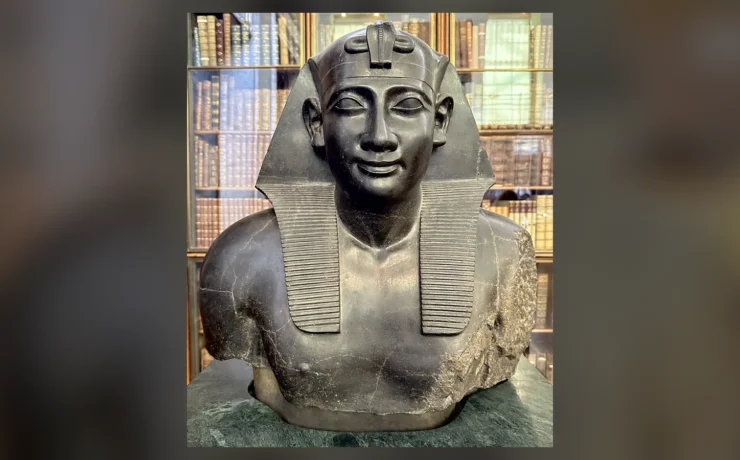
One of the strongest pieces of direct Egyptian evidence for Cleopatra is monumental art. Reliefs at the temple of Hathor at Dendera depict the queen with Caesarion in the visual language of pharaonic royal ritual. These works demonstrate that Egyptian cult frameworks remained politically important in the final Ptolemaic reign. They do not reproduce everyday clothing or reveal whether each local inhabitant approved of the royal court. The UCL educational record identifies Dendera and other monuments associated with Cleopatra, while the Kemet Vault study of Dendera explains the temple’s layered construction history. The surviving stone is a primary material source for public representation. Its carved scene cannot supply an authentic transcript of the queen’s thoughts, nor should a modern photograph be misdated to her lifetime.

What her genuine portraits can and cannot tell us
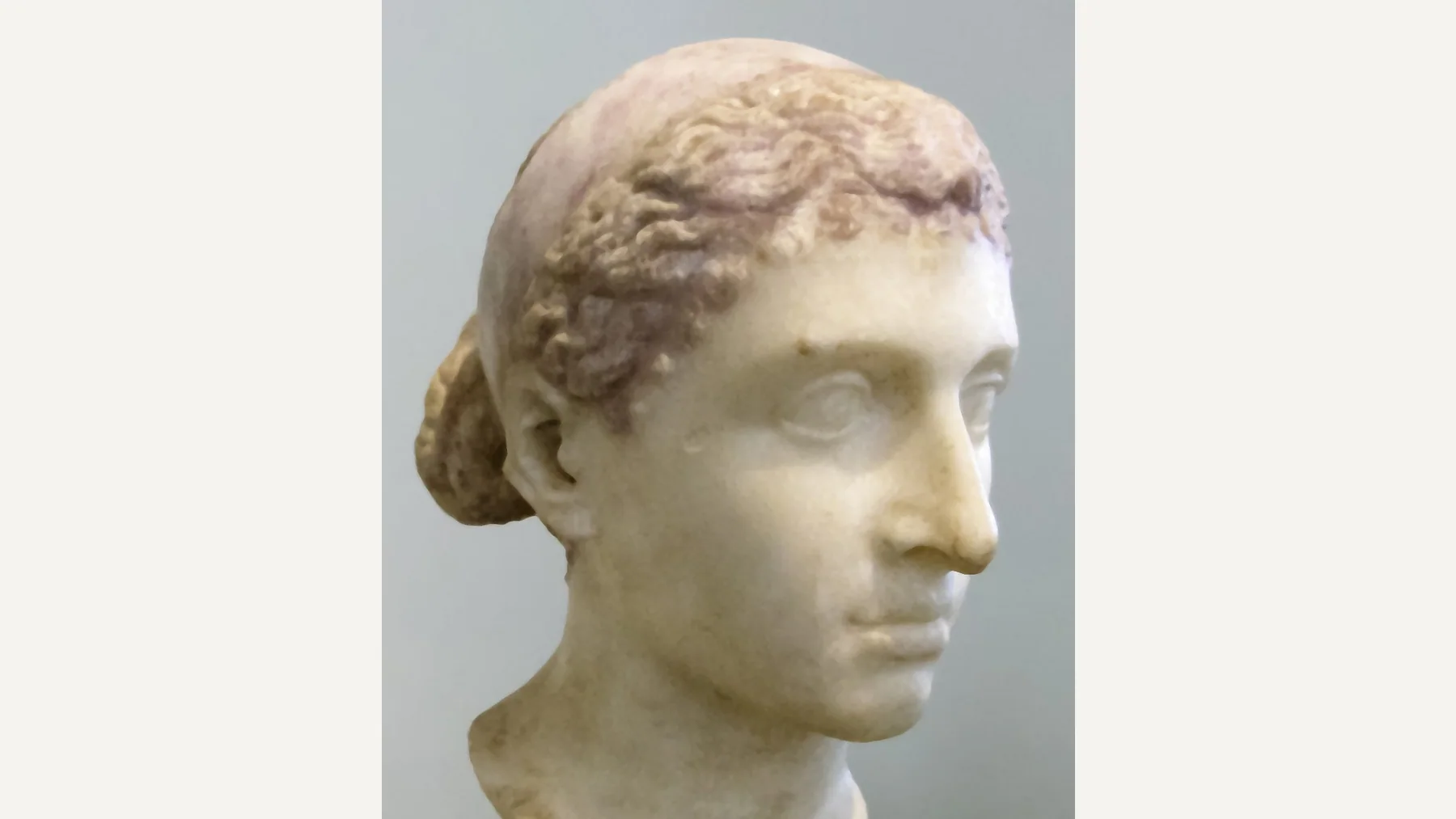
A marble portrait displayed in Berlin is traditionally identified as Cleopatra VII and dated around 40–30 BCE, within the closing years of her reign. It carries a Ptolemaic royal diadem and was found in a Roman villa near the Via Appia, making its later findspot part of a cross-Mediterranean history. Ancient sculpture and coinage may reflect a recognized royal portrait type, but they were crafted and selective representations, not photographs. The modern image reproduced here is itself a documented photograph of the physical sculpture. Museum-based material history helps explain how Greek and Egyptian forms existed simultaneously in the dynasty. Claims that Cleopatra looked exactly like any modern actress or that her personal beauty can be statistically reconstructed from a sculpture’s measurements are unsupported and add nothing to understanding her rule.
Languages, education and uncertain biographical claims
Ancient writers describe Cleopatra as able to address people in different languages and as an unusually effective speaker. That tradition is valuable because her court and kingdom interacted with Egypt’s own linguistic communities and the wider Mediterranean world. Yet popular biographies frequently repeat an exact list of languages without tracing it to a preserved ancient text, then turn those claims into a complete modern educational résumé. The responsible approach is to identify language traditions as transmitted testimony and distinguish them from independently authenticated recordings or documents. We have no contemporary examination certificate specifying her fluency in each language. Her political achievements and public role can be assessed without inventing the name of a school, a private teacher or every book she allegedly studied. Evidence about education should be treated with the same caution as evidence about war or diplomacy.
The meeting with Antony at Tarsus in 41 BCE
Cleopatra met Mark Antony at Tarsus in 41 BCE while he held enormous influence in the Roman eastern provinces. Ancient descriptions emphasize an impressive ceremonial arrival, but their literary detail may have been shaped by retrospective judgments of both rulers. The practical stakes included Egypt’s resources, Roman military alliances and the protection of Cleopatra’s throne. Reducing the relationship to a seduction story conceals these interests and repeats one dimension of politically interested Roman writing. Oxford Bibliographies describes how the alliance began as a strategic arrangement before becoming personally entangled. Antony did not cease to be an ambitious Roman politician, and Cleopatra did not cease to govern. Their interests overlapped without being identical, a tension that later became particularly dangerous during wars among Roman factions.
The queen’s alliance with Antony and dynastic children
The relationship between Cleopatra and Antony produced children who later figured in political plans for the eastern Mediterranean. Their twins Alexander Helios and Cleopatra Selene were born around 40 BCE, and another son, Ptolemy Philadelphus, followed around 36 BCE. Naming children, awarding titles and staging public ceremonies were acts of dynastic symbolism as well as family life. The Oxford biography discusses these offspring in connection with territorial strategies. The queen’s public policies should therefore be studied as those of a monarch attempting to extend or protect influence, not simply as gifts from a lover. Conversely, announcing an entitlement to a region did not always mean that a working administration or army had secured it. The difference between proclaimed authority and effective control matters across the surviving sources.
The Donations of Alexandria: claims were not always control
In 34 BCE Antony and Cleopatra staged the Donations of Alexandria, a public distribution of royal titles and projected territories among Cleopatra and her children. The ceremony communicated dynastic ambition and the prospect of a reshaped eastern political order. Yet an announcement did not automatically establish practical possession of every country named. Some regions were disputed, or beyond the control of the Alexandrian alliance. Encyclopaedia Iranica documents how the projected role of Alexander Helios in Armenia, Media and Parthian territories intersected with larger power struggles. Roman opponents could represent the ceremony as proof that Antony had transferred his loyalty away from Rome. Historians must keep the different perspectives visible rather than either accepting Roman accusations as neutral testimony or treating the ceremonial map as territory that Cleopatra actually governed in full.
How Octavian used anti-Cleopatra propaganda
Octavian sought political advantage in his struggle with Antony and could present a foreign queen as a dangerous influence on Roman decision-making. This narrative helped frame the war as a defense of Roman society rather than an internal conflict among leading Roman politicians. Cleopatra’s alleged luxury, sexuality and exoticism became rhetorical tools whose influence survived long after her death. Oxford’s historiographical guide explicitly identifies the hostile Roman literary tradition as a major determinant of her reputation. Recognizing propaganda does not mean denying Cleopatra’s risky decisions or the alliance’s defeat. It means testing the specific charge against dated policy and material evidence before repeating an insult as an objective account of character. The same method should be applied to flattering portraits written by admirers or used in later national commemorations.
Coins with Antony and Cleopatra: what the object establishes
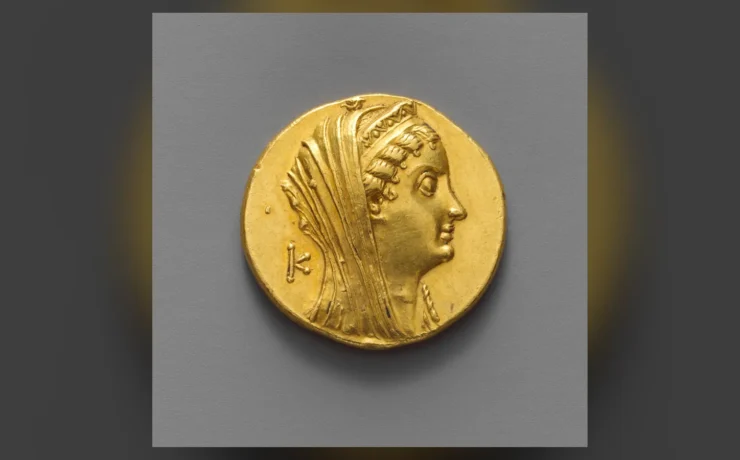
A genuine silver tetradrachm attributed to Seleucis and Pieria in Syria depicts Antony and Cleopatra on opposite sides. The object shows how their political association could be circulated through coinage and read by people far from Alexandria. A coin portrait is a representation of authority, not a photograph of a private meeting or proof that the two rulers personally designed every device. Its region of minting must be retained in its caption. The photograph reproduced here was taken at the British Museum and carries a public-domain release. That documentation makes it a stronger illustration than later romantic painting, because the object is from the historical political world itself. Careful numismatic reading also reminds us that coin faces, dates, legends and mint origins should not be inferred from visual resemblance alone.

Actium was in 31 BCE, not the year of Egypt’s annexation
The naval battle of Actium occurred on 2 September 31 BCE off the western coast of Greece. Octavian’s forces defeated the alliance of Antony and Cleopatra, gravely weakening their position. Alexandria did not fall on the same day, nor did Egypt formally become a Roman province at that moment. Further campaigns continued into 30 BCE. The Oxford account makes the distinction clear, a basic fact that popular narratives frequently compress. Some ancient battle descriptions disagree over how Cleopatra’s squadron moved and what it meant for the larger fleet. It is not responsible to reduce the defeat to a single unverified accusation that a queen abandoned her allies out of cowardice. Decisions in a naval battle must be studied through the limits and biases of the surviving military narratives.
After Actium: the last struggle for Alexandria
The final conflict continued after Actium. Octavian advanced while Antony and Cleopatra attempted to retain forces, negotiate or reposition their claims. Alexandria fell in 30 BCE, ending the Ptolemaic monarchy as a state independent of direct Roman rule. The queen’s practical choices became extremely narrow, but precise details of private negotiations remain known chiefly from later sources. Neither a triumphant Roman account nor a modern dramatic retelling should be treated as a transcript of every last meeting. The scholarly chronology distinguishes military defeat, final conquest and the deaths of the rulers. Understanding this sequence restores the months of pressure after the naval battle and prevents a false impression that the entire kingdom disappeared instantly in Greece during September 31 BCE.
Cleopatra’s death and the questionable asp story
Cleopatra died in 30 BCE, generally understood as suicide following Octavian’s victory and the death of Antony. The familiar image of a venomous snake emerging from a basket belongs to ancient literary tradition, with versions that do not provide a definitive contemporary forensic record. Suggestions involving a mixture of poisons or other methods are also difficult to establish. A historical account can state the accepted core outcome while marking the manner of death as uncertain. UCL’s Cleopatra chronology records her death in the final conquest, and Oxford’s historical bibliography helps trace what later authors said. The question is not which method makes the most dramatic illustration, but what the evidence actually proves. Artificially confident claims about a particular cobra or a precise final speech should be omitted.
Caesarion and the end of the Ptolemaic succession
Caesarion, the royal son of Cleopatra and traditionally identified as Caesar’s child, represented a surviving dynastic claim after the queen’s military position collapsed. Ancient evidence reports that he was killed under Octavian. His final movements and the precise sequence of the succession should be handled carefully, because ancient accounts are selective and politically interested. The Petrie Museum chronology identifies his co-regency and fate. He is essential to understanding why Cleopatra is more accurately described as the last reigning Ptolemaic queen rather than as if no other royal name existed during the kingdom’s closing years. The end of the dynasty cannot be understood as a purely romantic tragedy. It was a political transfer of sovereignty in which the survival of rival royal heirs had genuine strategic importance to the conqueror.
Roman Egypt did not erase the country’s society
Octavian’s annexation placed Egypt under Roman imperial power. That transformed the authority responsible for taxation, military oversight and appointments, but Egyptian languages, temples, settlements and many social practices continued. Political conquest and total cultural replacement are different claims requiring different kinds of evidence. Kemet Vault’s history of Roman Egypt examines the new provincial administration and social conditions, while the Metropolitan Museum synthesis traces continuities of Egyptian artistic traditions. A history ending abruptly with Cleopatra’s death leaves the Egyptian population out of its own story. The subsequent province experienced negotiations over property, religion and local governance that evolved across generations. Neither Roman writers’ praise of Augustus nor later nationalist anger supplies a complete description of those experiences.
Women, power and the limitations of the sources
Cleopatra ruled a complex kingdom as a woman in a world whose surviving written testimonies often originated among male elite political actors. Her gender influenced Roman rhetoric and later cultural representation, but that fact alone should not be made into an unsupported claim that every Roman criticized her solely because she was a woman. Political rivalry, foreign kingship and civil war were also central to the narratives. The Oxford critical literature identifies how the portrayals were shaped. A careful account compares policies and primary material evidence with literary stereotypes, without reversing them into an equally simplistic account of flawless rulership. This makes Cleopatra historically interesting as a decision-maker whose strategies can be assessed, whose failures were real, and whose surviving voices do not provide a complete picture of every ordinary Egyptian’s life.
Her lost burial and modern sensational discoveries
The location of Cleopatra’s final tomb has not been identified in a universally authenticated archaeological discovery. Ancient traditions link her burial with Antony in an Alexandrian context, but the exact complex and surviving remains are unknown. Modern excavation news can be valuable even when it has not found the queen’s tomb. A tunnel, temple structure or statue fragment should not be promoted as definitive evidence of her burial without an inscription or securely published contextual proof. UCL’s page explicitly marks the burial place as Alexandria while stating that its exact location is not identified. Museum-quality history does not confuse a plausible hypothesis with an established find. This principle applies equally to supposed reconstructions of her face, unverified luxury objects and attractive but misleading photographs labeled as Cleopatra’s personal possessions.
A real Egyptian queen with a complicated legacy
Cleopatra’s legacy belongs to Egyptian, Greek and Roman historical narratives, not exclusively to theatrical romance. She presided over a long, contested reign and actively sought to sustain dynastic independence while military power shifted toward one Roman rival. Her association with Egyptian royal temple imagery, coinage, diplomacy and succession offers a richer collection of evidence than a few hostile ancient quotations. Oxford scholarship and the Met’s object-centered history should be read together because one follows policy while the other foregrounds surviving artistic material. A responsible evaluation can recognize agency and the limits of her control. It should also explain that Roman victory shaped which stories circulated afterward, without treating all alternative interpretations as equally well supported or pretending history needs a moral verdict on her private life.
Timeline and how to check the ancient evidence
A sequence of securely located dates helps separate the first Ptolemaic co-regency from Cleopatra’s later alliance with Antony and the final wars. The table below distinguishes actions in 31 BCE from the fall of Alexandria in 30 BCE, and it includes her son among the royal heirs. Historical claims should be cross-checked with independent museum and scholarly records, while stories about her appearance or final words require explicit warnings about their transmission. Coins, temple reliefs and later biographies serve different evidentiary functions. A coin documents a political image; a temple relief documents royal cult representation; an ancient historian’s story is testimony written for a particular audience. Neither source type authorizes us to invent a modern transcript, medical examination or direct record of private intentions.
| Date BCE | Event | Evidence note |
|---|---|---|
| 51 | Cleopatra becomes co-ruler with Ptolemy XIII | Recorded dynastic chronology; power contested |
| 48–47 | Caesar in Alexandria, civil war and queen restored | Roman narratives; dates stable |
| 47 | Birth of Caesarion | Ancient dynastic claims of paternity |
| 44 | Caesar assassinated; change in royal co-rule | Roman and Ptolemaic chronology |
| 41 | Meeting with Mark Antony at Tarsus | Ancient authors embellish details |
| 34 | Donations of Alexandria announced | Territory claimed is not necessarily governed |
| 2 September 31 | Battle of Actium | Naval battle near Greece, not final annexation |
| 30 | Fall of Alexandria, death and Roman takeover | Exact method of death and tomb site unconfirmed |
Frequently asked questions about Cleopatra VII
When did Cleopatra reign? From 51 to 30 BCE, with changing arrangements of co-rule. Was she Egyptian? She belonged to a Macedonian-descended dynasty ruling Egypt and was represented with Egyptian royal titulary; some genealogical particulars remain debated. Was she the last Pharaoh? She was the final reigning Ptolemaic queen, and her son Caesarion held royal status too. Did she lose Egypt at Actium in 30 BCE? Actium was fought in 31 BCE; Alexandria fell in 30 BCE. Did a cobra definitely kill her? The precise method of death is not established, although suicide is generally accepted. Is her tomb identified? No, the exact location remains unverified. Are the illustrations actual artifacts? Yes: an ancient Berlin portrait, genuine Dendera relief and museum coin, not invented scenes.
Research review: 26 October 2026. Dated documentary facts, ancient royal imagery and retrospective Roman political writing are treated separately. Photographs reproduce actual museum objects or original temple relief, with individual attribution, license and historic production date rather than generated portrait art.