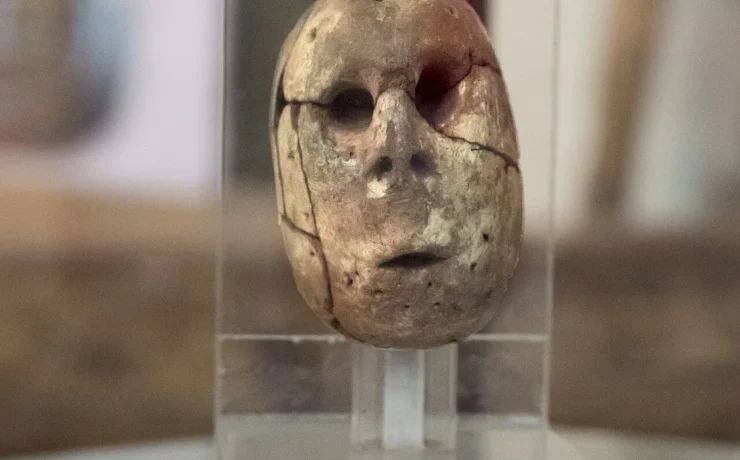
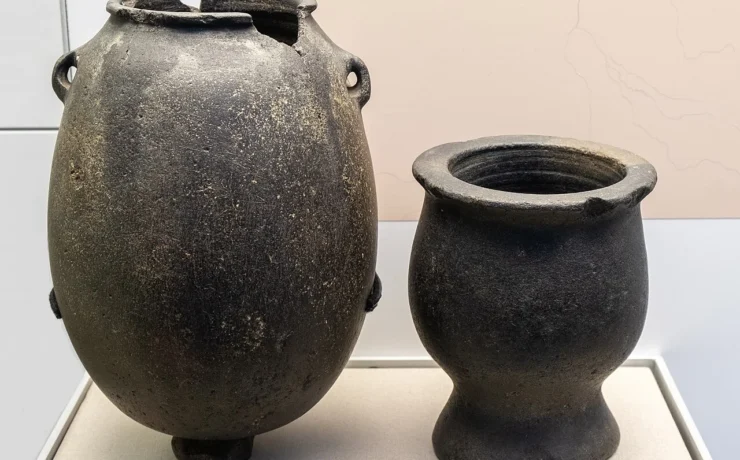
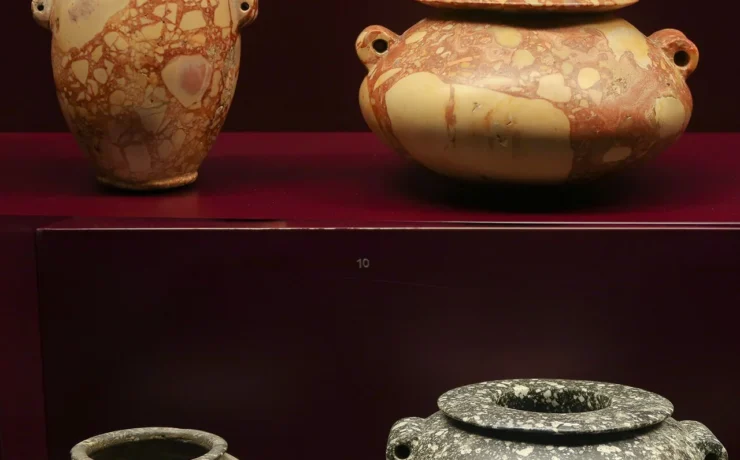
Why is Tomb U-j important to the history of Egyptian writing? The tomb at Abydos preserves very early incised ivory and bone labels, painted jar signs and seal impressions that help scholars study the formation of Egyptian writing in the late fourth millennium BCE. The labels are short marks connected with goods or elite administration, not complete historical narratives. Their exact readings and the identification of the tomb’s owner remain disputed.
Tomb U-j at Abydos, dating to about 3300 BCE, changed how archaeologists understand the beginnings of Egyptian writing. Excavated at Umm el-Qaab in 1988, the tomb held large quantities of burial equipment, ceramic vessels and small ivory or bone tags carrying some of the earliest evidence for a developing hieroglyphic system. Who was buried there, what did the signs mean and how did an elite tomb become a crucial record of administration? This original, evidence-led study distinguishes excavation findings from later royal claims and compares securely identified objects rather than passing off pictures of other tombs as U-j.
Before the pharaohs: an unusually large burial at Umm el-Qaab
Egyptian writing has a history before the familiar monumental inscriptions of the pyramids. One of its decisive archaeological contexts is Tomb U-j at Abydos, excavated in 1988 under Günter Dreyer of the German Archaeological Institute. Situated in Cemetery U at Umm el-Qaab, the tomb belongs to a period of emerging elite power near the end of the fourth millennium BCE. Its size, multiple chambers and exceptionally rich grave provisions distinguish it from ordinary burials, but no contemporary text tells us in an unambiguous sentence who the owner was. Calling the deceased a proto-king or powerful regional ruler is an interpretation based on architectural and funerary evidence. It should not be confused with possessing a secure royal biography. The discovery matters because short signs appear not only on a ceremonial monument but on materials connected with deliveries and goods. The significance is in the relationship between recording, authority and resources. The burial reveals how a powerful household might draw objects and products from a network larger than a single village. To understand the first use of writing we need to read labels, pottery, sealings and contexts together rather than search only for a dramatic “first word.”
Where is Tomb U-j and how was it excavated?
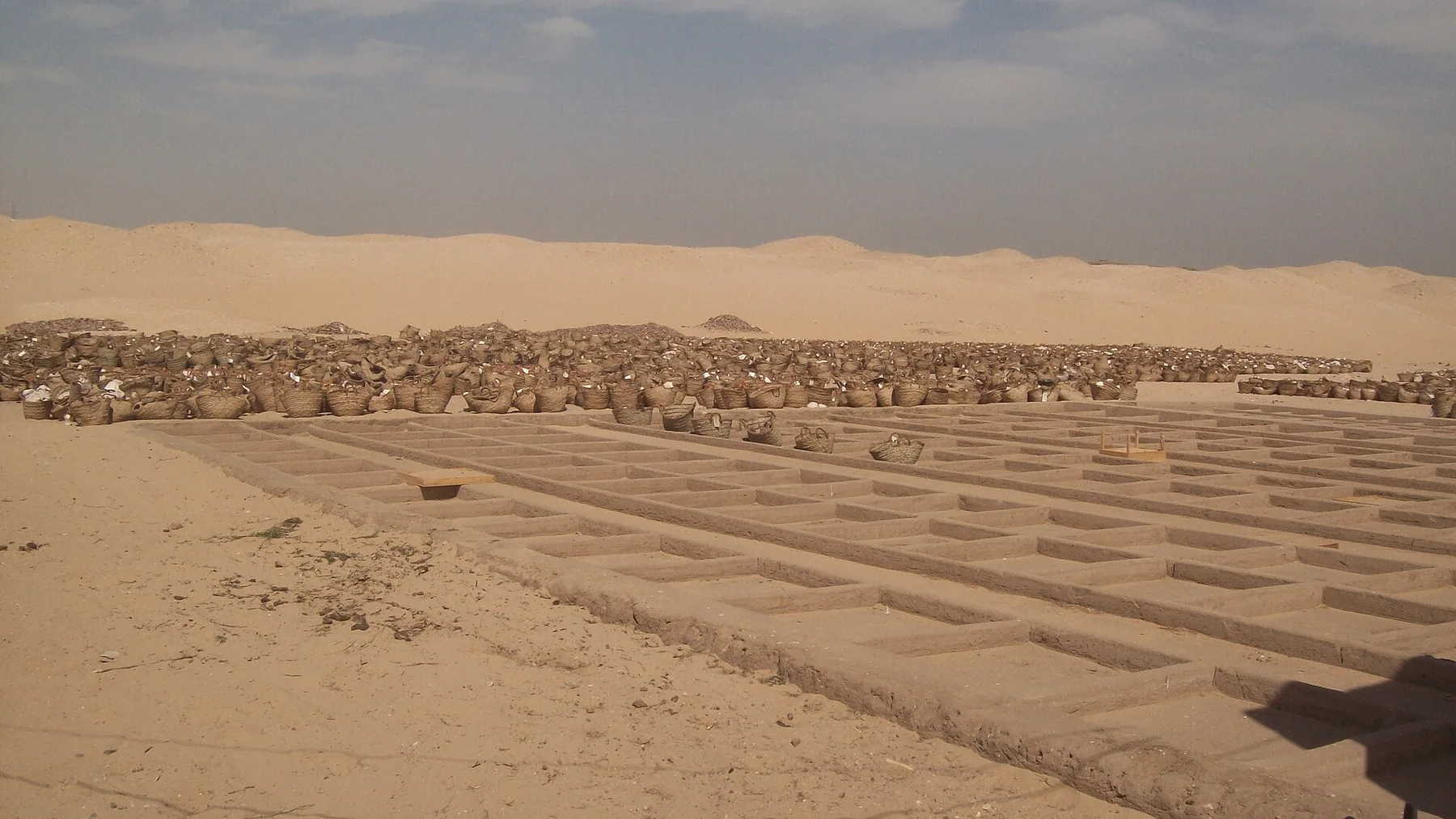
Abydos lies in Upper Egypt, near modern al-Balyana in Sohag Governorate. Its ancient cemeteries served different communities and, later, the earliest dynastic rulers. Tomb U-j is a particular Predynastic complex in Cemetery U, not a room in the later temple of Seti I and not the tomb of King Den. The designation is a modern archaeological identifier. Excavation revealed a large mudbrick-built burial arrangement with multiple compartments for the dead and grave goods. Contemporary excavation records are important because many objects would be difficult to interpret once separated from where they were discovered. Stratigraphic position, room distribution, pottery style and scientific chronology contribute to the approximate date. Scholars commonly place the tomb around 3300 BCE, with some treatments giving approximately 3320 or 3250 BCE. Those differences reflect methods and ranges, not evidence for a precisely dated inauguration. The site’s surrounding royal cemetery was also altered by later burials and disturbances, another reason archaeologists are cautious about assigning every nearby find to U-j. Above all, readers should distinguish actual documentation of this particular excavation from generic pictures of ruins at Abydos. Our site photograph below shows real archaeological work in the broader necropolis, and its caption clearly states that it is not a photograph of the interior of Tomb U-j.
Ivory labels: tiny objects with enormous consequences
Small perforated tags made from bone or ivory helped establish Tomb U-j’s place in the history of writing. Some carry miniature signs, including animals, trees and other marks. Their holes suggest that they were attached to containers or the goods to which the signs referred. Archaeologists have proposed that some sequences identify places, domains or commodities, while others include numerical information. There is active scholarly debate about the exact reading of individual signs: it is not appropriate to announce that a drawing of a bird must be the name of a modern town. The tags are fascinating partly because their marks are so unlike later continuous literature. They do not preserve an extended story, royal decree or conversation. Instead, they seem to have helped people identify and manage valuable deliveries in the context of an elite burial. The Oxford Handbook’s synthesis emphasizes that some U-j labels already use two-consonant phonograms and rebus-like principles associated with hieroglyphic writing, yet the full later system of phonetic complements was not present. A script can develop incrementally through limited specialist use. Even tiny tags can therefore document a transformation in administration, symbolism and the ability to associate marks with language.
Three ways of marking goods, not one complete alphabet
Evidence from Tomb U-j includes several different marking practices. Large signs were painted onto pottery vessels; seals may have identified packages and their handling; and small carved signs appeared on the perforated labels. The techniques should not be collapsed into one “first alphabet.” Ancient Egyptian hieroglyphs were not an alphabet in the modern sense, and the earliest attestations could not represent long spoken discourse as later writings would. Some marks may have been read as names or values; others may have operated as identifying emblems. Context decides what can reasonably be claimed. Consider a jar with a sign and a separate perforated tag bearing several marks. The two items need not have served identical functions merely because both are ancient signs. Different surfaces, labor investment and attachment methods point toward different practices of control. The Oxford discussion also highlights signs of coordinated label production: some labels may have been inscribed in groups before being cut apart. That raises the possibility of an administrative workshop or central receiving operation. Yet a complex label system at one elite grave does not prove that the whole population could write, or that scribal schools already looked like those of the New Kingdom.
Imported jars and long-distance connections
Among the burial provisions were numerous large ceramic vessels, including evidence of imported wine containers from the southern Levant. This is a vital part of the story because writing developed in a world of circulating goods. The presence of vessels associated with regions beyond the Nile Valley suggests that elite exchange and access to prestige products were already substantial. But the wording matters: a jar’s imported origin does not prove that its eventual contents came from exactly the same place, nor does the assemblage show that ordinary households enjoyed equivalent imported supplies. Pottery fabrics, shapes and traces of contents are different lines of investigation. Scholars use petrographic analysis and comparisons with regional collections to identify origins more carefully than visual resemblance alone would permit. Wine also had ritual and status associations in elite burials, making it a plausible reason for controlling quantities and sources. This is one of the reasons U-j is historically distinctive: the writing-like signs and the movement of high-value material are encountered together. In a burial context the goods were dedicated to a deceased person, while the records reflect organizational tasks performed by the living. The object and its label belong to both a social world and a symbolic world.
Was the owner ‘King Scorpion’?
Some accounts identify the owner of U-j as “Scorpion I” or an early king conventionally designated Scorpion. Such proposals attempt to link signs and elite political traditions across the late Predynastic landscape. They are not equivalent to finding a securely preserved full royal name in an inscription identifying the buried person, his reign and his parentage. It is reasonable to explain why an exceptionally large burial suggests high-ranking authority; it is not reasonable to treat a modern nickname as a contemporary Egyptian king list. There is a separate famous Scorpion Macehead found at Hierakonpolis, and its surviving imagery belongs to a later or differently documented context. The two should not be casually equated. Readers should also avoid linking U-j directly to Narmer simply because both belong to the era before or around the beginning of the First Dynasty. Archaeologists reconstruct political development from a range of sites, including Nekhen, Naqada and Abydos. The question of how authority spread and consolidated remains much bigger than any one grave. These complexities make the history more interesting, not less. They ask us to see leadership taking shape through funerary investment, specialist craft and control over deliveries before the archive becomes more explicit.
Is this the oldest writing in the world?
Calling U-j “the world’s first writing” goes beyond what can currently be established. Writing emerged in several ancient societies, with important early evidence also coming from Mesopotamia. Dating the earliest systems is difficult because surviving finds are incomplete and criteria for identifying writing differ. A mark that identifies a workshop is not necessarily a phonetic writing system, and a short text may express only a limited part of spoken language. The Institute for the Study of Ancient Cultures presents U-j as central to the independent emergence of Egyptian writing, while the Oxford Handbook discusses both the strength and uncertainty of early phonetic evidence. An accurate account can say that U-j contains among the earliest secure attestations of the developing Egyptian hieroglyphic tradition. It need not announce a global contest with a winner. The significance extends beyond chronology. The labels show that Egyptian rulers and administrators were creating practices that could connect names, goods and controlled production. This early administrative function existed alongside display and funerary meaning. Much later, Egyptians used writing for poetry, prayers, royal annals and long narratives, but those achievements were not fully present in the short marks from U-j.
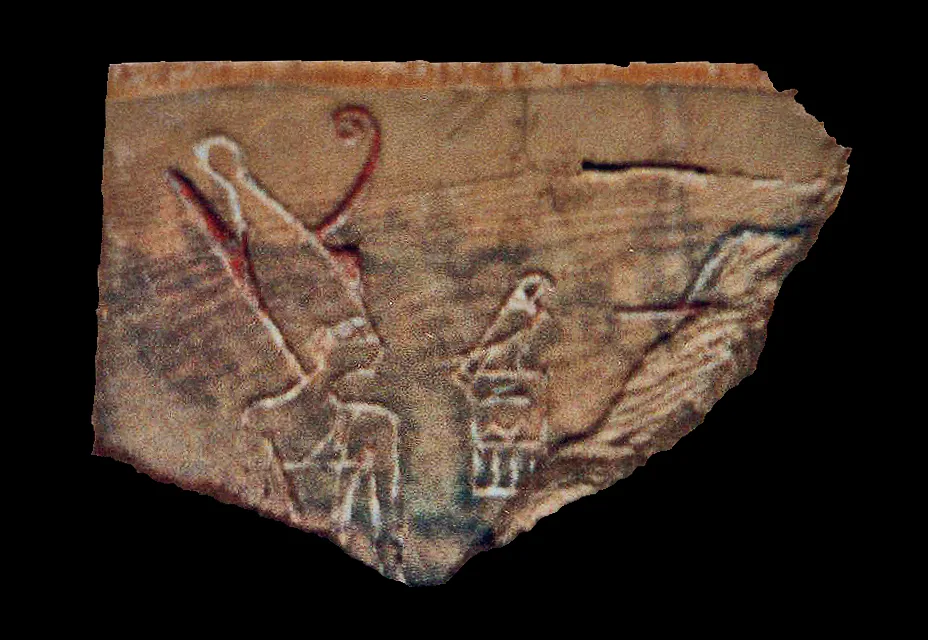
A real later ivory tag from Abydos: useful comparison, different tomb
The photograph here depicts a genuine ivory label of King Den, a ruler of the First Dynasty. It comes from Den’s tomb T at Abydos, not from U-j. The figure is included because it lets readers inspect an original ancient label with royal signs while respecting museum and image-license restrictions. It illustrates how marking practices and royal imagery continued and changed as Egyptian state institutions developed. King Den is chronologically later than the estimated date of U-j. His label should not be used as an image of the earliest signs themselves. The distinction between object identity and illustrative value is fundamental to curatorial quality. A reader may compare the physical size, carved lines and symbolic complexity, but should then return to excavation reports and museum catalogues for the exact U-j tag inventory. Similar problems occur with pottery from different tombs: finding a photograph of a beautiful early Egyptian jar does not make it one of the hundreds of vessels excavated from U-j. Precise labels protect the meaning of archaeological objects and allow later research to correct errors.
From commodity tags to a durable writing tradition
Egyptian writing did not stop at Tomb U-j. Within later Predynastic and Early Dynastic contexts, names and marks were placed on tags, vessels and seals linked with royal households and their administration. Over time, the repertoire of signs and phonetic possibilities expanded, and Egyptian scribes developed conventions capable of transmitting much more complicated messages. The changes were not perfectly uniform and surviving material is unevenly distributed. Abydos and Saqqara are particularly important partly because their excavated elite contexts preserve materials that other environments did not. It is possible that writing occurred on perishable media that have not survived, so the first surviving example is not necessarily the moment writing was invented. This archaeological asymmetry matters. A written mark from a tomb records what elites chose to commission and preserve, not the entirety of an ancient community’s communication. To explore the wider transformation see Kemet Vault’s Naqada culture study and Hierakonpolis before the pharaohs. The complementary early Egyptian bureaucracy encyclopedia examines what later royal tags and sealings reveal about government.
What evidence remains open to debate?
Several important questions remain unresolved or dependent on interpretation. How much territory did the person buried in U-j control? Exactly which groups of signs name people, commodities, places or numbers? To what extent did Mesopotamian innovations influence Egyptian elites, if at all, beyond a general awareness that signs could be used to record information? Did the makers of the tags use conventions that would be recognized by later scribes? The responsible answer is not to invent certainty. Scholars can compare hands, signs and manufacturing traces, conduct new residue analyses on vessels, improve scientific dating and reconsider published excavation contexts. Such work changes what can be said about the origin of the writing system. The tomb demonstrates early organized administration and an elite burial network, but whether every interpretation will endure is another matter. Modern encyclopedias should make the sources and their limits visible. A date range, a carefully named object and an honest admission of uncertainty are often more valuable than an attractive myth about the first Egyptian word.
Further reading, object provenance and research notes
Research sources: Oxford Handbook, Origins and Early Development of Writing in Egypt; Institute for the Study of Ancient Cultures, The Invention of Writing; ISAC Visible Language: Tomb U-j labels; UCL Digital Egypt, Abydos. The images show archaeological work in the wider Abydos necropolis and a separately identified, later Den label. Neither is described as the original U-j grave interior or one of its tags. Research review: October 2026.
Frequently asked questions
When was Tomb U-j discovered?
It was excavated in 1988 by the German Archaeological Institute team led by Günter Dreyer. Its material is broadly dated to around 3300 BCE.
Does Tomb U-j contain the first complete hieroglyphic texts?
No. The tags and markings are extremely short, with emerging phonetic signs. Long continuous texts belong to a later development of Egyptian writing.
Did King Den own this tomb?
No. Den was a later First Dynasty ruler with a separate tomb at Abydos. His photographed label is included only as an accurately identified comparison.