When was the Egyptian National Library founded? Dar al-Kutub was established in Cairo on 23 March 1870 by a decree of Khedive Ismail, with Ali Pasha Mubarak playing a central organisational role. Its first home was in Mustafa Fadel’s palace; the historic Bab al-Khalq building opened to the public in 1904. The library is an institution with multiple premises, not simply one old façade.
This documented history traces its founding, collections, changing names, buildings and preservation work through official Egyptian and UNESCO sources.
An institution founded in 1870, not a single unchanged building
Dar al-Kutub, Egypt’s National Library, was founded in Cairo in 1870 under Khedive Ismail. Its name and premises changed repeatedly, and those changes are essential to a proper history. The original Khedivial Library was not created inside the surviving Bab al-Khalq building, which opened to readers decades later. The distinction is confirmed by the national institution’s own historical overview and UNESCO’s account of its manuscripts. A modern visitor who sees an early twentieth-century façade may therefore be looking at the second major architectural chapter of an institution established in the nineteenth century. The library’s importance lies not only in its building but in the assembly, preservation and study of books and manuscripts that had previously been dispersed across religious foundations, schools and private collections. The story also raises a difficult historical question: how could a state gather texts while respecting the history and ownership of the collections from which they came? This dossier examines the archive, the people who proposed it and the public buildings that helped it develop.
Ali Mubarak, Khedive Ismail and the founding decree
Ali Pasha Mubarak was an influential administrator associated with education and public works under Khedive Ismail. Official Egyptian accounts credit his proposal to create a central library capable of preserving valuable manuscripts and giving readers access to them. Cairo Governorate’s historical record dates the founding decree to 23 March 1870 and notes that the plan drew on the example of European national libraries. UNESCO’s institutional summary also associates the project with the wider intellectual work of Rifa’a al-Tahtawi, naming his suggestion and Mubarak’s supervision. These accounts are not identical in the way they allocate personal initiative; neither justifies erasing the other figure. The strongest point of agreement is that the state established a public institution in 1870 to gather and protect books, maps and manuscripts. The idea should not be reduced to one administrator’s personal collection. It required government authority, premises and ongoing staff work. The decision is part of Egypt’s nineteenth-century educational reforms, but the actual use of the collection developed over a longer period.
The first location in Mustafa Fadel’s palace
The new Khedivial Library began in the palace of Prince Mustafa Fadel at Darb al-Gamamiz in Cairo, according to UNESCO and the Egyptian institution’s own histories. This first home matters because it was not a purpose-built monumental national library. It was a reused palace setting adapted to an expanding collection, with the institutional identity developing alongside the material problem of storing and consulting texts. In later decades the holdings and readership outgrew the available space. Dar al-Kutub’s official overview documents changes within the original complex before the decision to establish new premises. Treating those transitions as a single event would conceal how the needs of readers and curators shaped the institution. The first location should not be confused with the later Bab al-Khalq landmark or the modern building near the Nile Corniche. Each site belongs to a different stage of the national library’s physical development. The founding palace also illustrates a wider urban pattern: modern public cultural institutions sometimes began by adapting royal or elite property before gaining their own independent architecture.
From dispersed manuscripts to a public collection
Before the library’s foundation, Egypt’s written heritage was preserved in a wide variety of settings. Cairo Governorate describes manuscripts and books held in mosques, educational institutions, religious foundations, elite households and other repositories. The founders sought to gather valuable materials so they would be less vulnerable to dispersal or neglect and more accessible to scholars. That aim is historically significant, but it should not be translated into a simplistic claim that everything previously held in those institutions was endangered or disordered. Local collections had their own forms of stewardship and scholarly use. The new library represented a change in institutional organisation, classification and public service. Texts that had circulated within religious and private settings entered a growing state collection with new readers, cataloguing practices and preservation obligations. The physical transfer of a book is not the same as the creation of the intellectual tradition inside it. Studying the library means acknowledging both the earlier communities that preserved texts and the later professionals who worked to maintain, document and share them.
Why Bab al-Khalq became the next home
As the holdings expanded, the original premises proved increasingly unsuitable. The official historical record traces proposals for a larger building under Khedive Abbas Hilmi II and the choice of Bab al-Khalq as an important civic location. The institution describes the placing of a foundation stone in 1899 and the library’s opening there on 5 March 1904. The building was conceived in association with the House of Arab Antiquities, the institution later known as the Museum of Islamic Art. This combination is instructive: written heritage and material art were treated as related parts of a broader cultural project, even when managed through distinct collections and display spaces. Bab al-Khalq is therefore not merely a backdrop in a nostalgic Cairo photograph. It marks a stage when state cultural institutions were gaining purpose-built urban architecture. The date 1904 refers to this opening, not the establishment of Dar al-Kutub itself. Any guide that announces the library was founded in 1904 is confusing building history with institutional history.
Architecture and the neighbouring Museum of Islamic Art
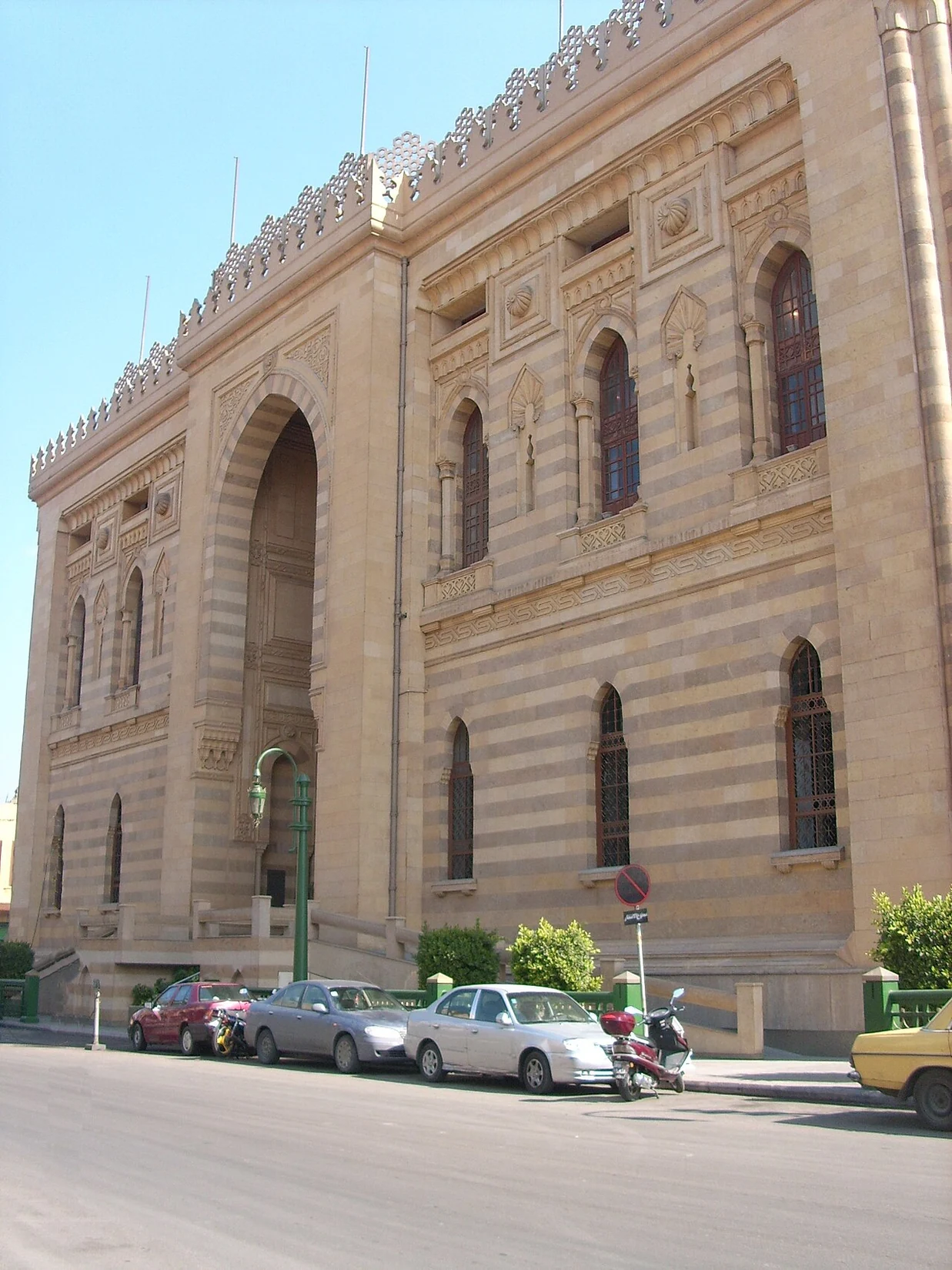
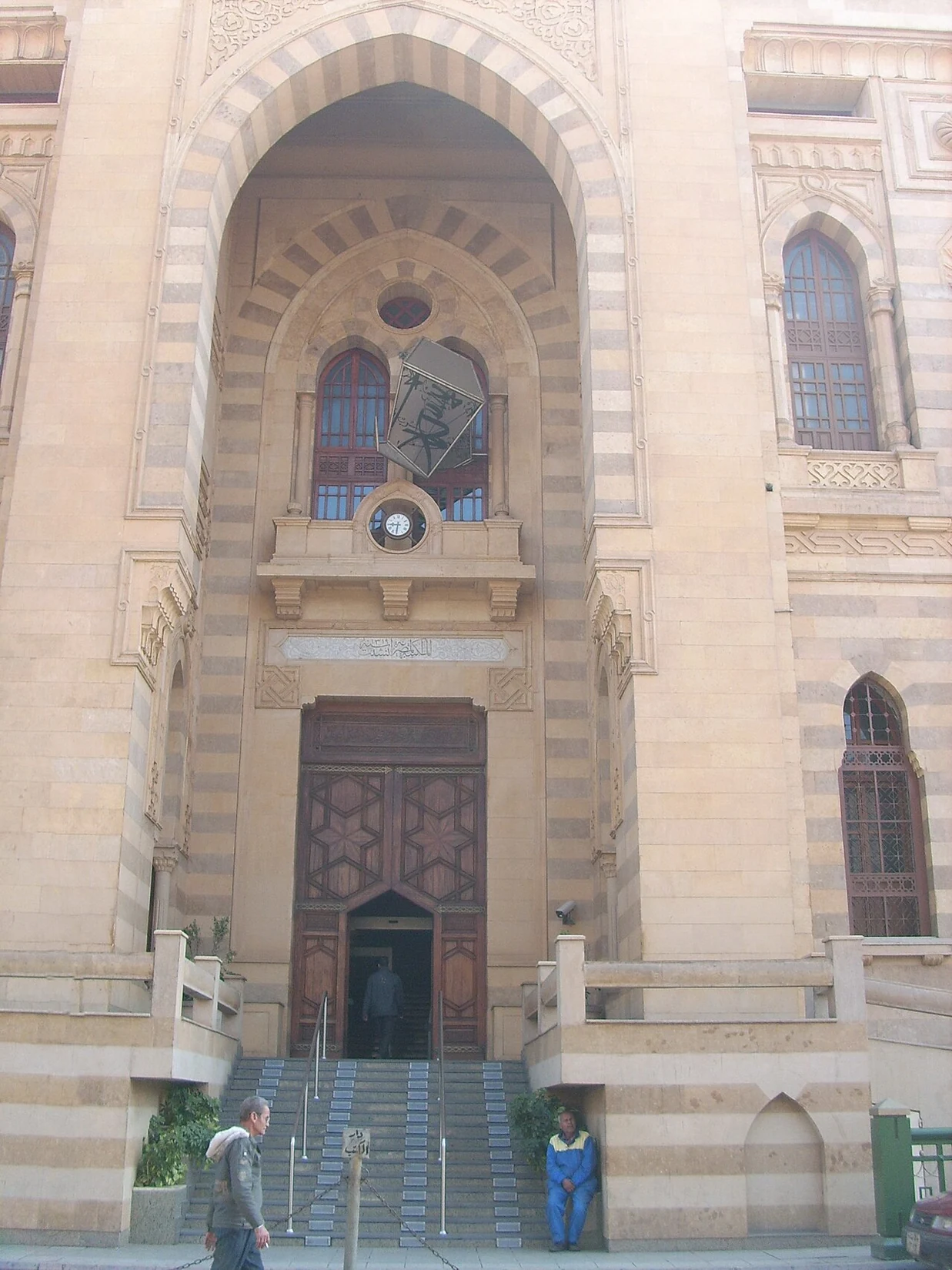
The Bab al-Khalq complex brought library spaces into an architectural relationship with collections of Islamic art. Egyptian official histories describe the new building as housing the library alongside the House of Arab Antiquities with separately arranged spaces. This physical adjacency did not make the museum and library the same institution, nor did it mean that every manuscript in the library was permanently displayed to the public. Their proximity does reveal an approach to heritage in which documents, calligraphy, decorative objects and historical scholarship were mutually reinforcing. The two genuine photographs reproduced in this article show the actual exterior of the historic library building, rather than a romantic reconstruction of a nineteenth-century reading room. Architectural features visible today belong to a building developed around the turn of the twentieth century. They cannot prove what the original Mustafa Fadel palace looked like in 1870. A careful historical account connects the structure to the institutions it housed while keeping the relationship between appearance, function and ownership precise.
Manuscripts, maps and the wider documentary collection
UNESCO describes Dar al-Kutub as holding important collections of manuscripts alongside books, maps and other scholarly material. A national library is not simply an archive of old novels or a museum where every precious object sits behind glass. Its responsibilities can include acquisitions, cataloguing, preservation, reading services and digitisation. Different materials require different conservation and description practices. A manuscript copied by hand has physical evidence in its paper, binding, inks and scribal notes; an old printed book has another production history; a map may document the geographical knowledge and political assumptions of the era in which it was made. The institutional collection includes Arabic and other manuscript traditions, not merely Egyptian-language papyri from antiquity. Its breadth makes clear why Dar al-Kutub belongs to modern Egyptian cultural history even when the documents it protects are much older. Modern stewardship can help specialists study medieval and Ottoman intellectual traditions, but the library’s founding should not be mistakenly relocated to the periods represented by its holdings.
How the national library changed names
The successive names of the institution track changes in Egyptian government and constitutional status. The official historical overview lists the Khedivial Book Collection at foundation, then names associated with the Khedivial, Sultanate and Royal periods, followed by Dar al-Kutub al-Misriyya and later national library and archives formulations. Names are institutional evidence, not proof that the original collection was repeatedly destroyed and rebuilt. They remind readers that an organisation can persist while its constitutional setting and administrative attachment change. A historical photograph captioned ‘Khedivial Library’ may therefore refer to the same line of cultural institutions later called the Egyptian National Library. At the same time, one must not assume that every branch, collection or archival service had identical functions at each date. Political transitions, ministry structures and conservation needs affected administration. Using the name appropriate to a document’s date helps researchers avoid anachronism and improves the precision of archive searches.
The Nile-side building and the question of multiple premises
Egypt’s national library eventually needed facilities beyond the original Bab al-Khalq site. The State Information Service notes that a new national library building overlooking the Nile was officially opened in 1971. The old structure was later subject to further restoration projects and renewed cultural use. A visitor in contemporary Cairo may encounter references to Dar al-Kutub in several places, including the historic Bab al-Khalq address and newer organisational premises. The same institution does not necessarily offer identical services at each location. Catalogues, conservation departments, visitor exhibitions and document consultation can be distributed across buildings. That is why this article treats the institution’s history as separate from a single visitor itinerary. Someone interested in seeing a landmark façade has a different need from a researcher seeking a specific manuscript or document. Before travelling, check the official department, appointment procedure and access rules for the material you need. An old photograph of Bab al-Khalq is not evidence that every manuscript is currently served from that building.
The 2014 damage and the restoration of Bab al-Khalq
In January 2014, a bombing near Cairo Security Directorate damaged the nearby Bab al-Khalq cultural buildings. Contemporary reporting documented damage to the historic library’s collections and infrastructure and the restoration work that followed. The Bab al-Khalq building later underwent a major rehabilitation supported by Sharjah. The restoration history is a reminder that collections face modern threats as well as the slower challenges of age, moisture and handling. This modern event should not be transformed into a claim that the entire national library collection was lost or that all manuscripts were irreparably damaged. Conservation projects involve detailed condition assessment and selective treatment, and the institution’s public reports are the appropriate reference for specific object losses or repairs. For a visitor today, the restored exterior may look stable while evidence of the work is preserved in technical documentation. Responsible cultural reporting keeps the distinction between the building, its holdings and temporary service arrangements visible.
UNESCO and the international significance of the manuscripts
UNESCO’s project profile identifies Dar al-Kutub as an important Middle Eastern national-library collection, established in 1870, and discusses the conservation and study of manuscripts. Its institutional history is useful because it independently confirms the basic chronology and public mission. International recognition, however, does not replace the collection’s own catalogue or give every individual manuscript a verified history. A reader must still ask where a text was copied, how it entered the library, whether scholars agree about its date and what physical evidence supports an attribution. Celebrating the collection is compatible with careful provenance study. The library’s value also depends on working professionals who preserve fragile materials, prepare records and help scholars access them safely. A historic institution remains culturally relevant only if its materials are documented and cared for beyond an anniversary ceremony. A responsible museum or library article should not describe international status as a substitute for item-level research.
Preservation and digitisation: the work behind a library visit
The Egyptian institution describes services including microfilm, digital access, conservation and consultation. For researchers, the process of identifying an item is often more important than the photograph of an elegant hall. A catalogue entry can distinguish a manuscript from several copies of the same text, record collection history and help specify which version scholars have consulted. Microfilm and digitisation reduce handling of fragile originals, although images cannot always capture every feature of paper, binding or ink. Conservation decisions balance continued access with long-term stability. A visitor hoping to see an illuminated manuscript should not assume that every fragile object is on public display. Researchers should use the institution’s official service information and contact the relevant department before travel. The wider Digital Heritage of Egypt portal provides another route into national cultural collections, but an online record is not necessarily a permission statement for reproducing an image commercially. Scholarly access, exhibition access and digital reuse are different questions, especially when unpublished records or rights restrictions are involved.
How Dar al-Kutub fits the story of modern Egyptian culture
The national library developed alongside other major modern Egyptian institutions of education, engineering, publishing and cultural production. The direct connection is not that every later writer worked inside its rooms. It is that a durable state collection created a place where texts could be gathered, classified and preserved across political change. The nineteenth-century foundation sits in a different cultural phase from the Egyptian Radio launch of 1934 and the growth of Egyptian cinema in the early twentieth century. Together, such histories show multiple kinds of modern public culture: manuscript stewardship, broadcast communication and filmed entertainment. A library also reaches back into older epochs through the texts it holds. For physical context, compare the Coptic Museum’s documented collections; both are cultural institutions, but their collections and founding narratives should not be merged. This network of linked histories is more useful than a generic timeline that lists dates without explaining each institution’s distinctive work.
Reading an archival photograph without inventing its contents
The two documentary photographs of the Bab al-Khalq exterior illustrate an actual cultural building. They do not show the 1870 palace, the 1904 opening ceremony or the manuscript holdings that were later conserved inside. Each photograph has its own Commons author and reuse licence. The visible façade helps readers understand the architectural setting of the library’s later history. It would be wrong to replace those photographs with a generated Victorian interior and label it an original historic scene. The distinction is particularly important for search and Discover where large images can quickly become detached from their captions. An accurate caption identifies place, subject and the limits of what the image demonstrates. A photo of the front entrance is evidence of the architecture’s appearance in the photographer’s period; it is not proof about a founding decree. When combined with the original government and UNESCO documentation, the images enrich rather than replace historical research.
Primary sources and the limits of the story
The institutional chronology follows Dar al-Kutub’s own historical overview, including the founding in 1870, later names and the 1904 Bab al-Khalq opening. UNESCO’s manuscript project profile independently confirms the establishment and early collection history while using slightly different language about who initiated the proposal. The Cairo Governorate history gives useful administrative and urban context, and Digital Heritage of Egypt’s institutional catalogue provides a current public cultural entry point. These independent sources support the dates and roles described above; they do not establish the provenance of every individual manuscript. The article avoids inventing an exact present-day admission fee or manuscript consultation procedure. Local services can change, and the official library remains the appropriate authority for current access.