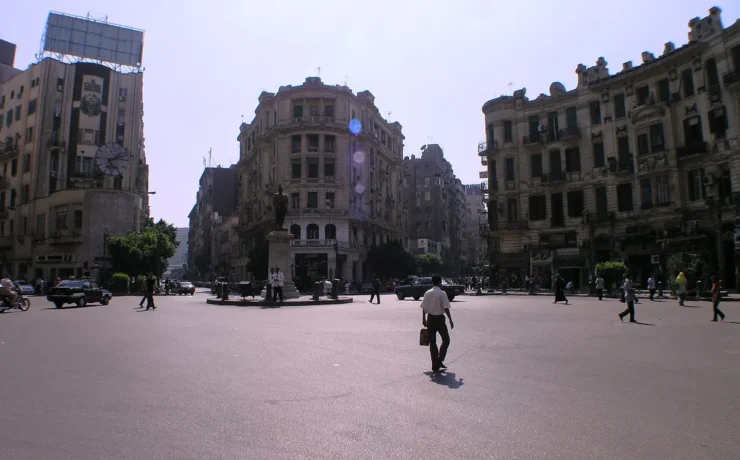
Egypt’s 1919 revolution was a national movement of streets, institutions, villages and workers, not only the story of Saad Zaghloul. Following the arrest and exile of Wafd leaders, protests spread from Cairo across the country. Students, professionals, rural communities, workers and women acted through demonstrations, strikes, boycotts and political organizing. Their aims and experiences were not all the same, but the movement transformed debates about independence, representation and constitutional government.
This evidence-led history reconstructs March 1919 and its aftermath through peer-reviewed Cambridge scholarship, a historical nonviolent-action database, Egyptian historical timelines and genuinely contemporary archive photographs. Images are captioned to distinguish what can be seen from what later editorial descriptions suggest. The later 1922 declaration and 1923 constitution are examined as contested political changes rather than an instantaneous end to British influence.
Why Egypt’s 1919 revolution cannot be told through one portrait
The Egyptian revolution of 1919 was a mass movement against British rule that connected Cairo’s students, public employees and urban neighborhoods with villages, towns and social networks across the country. A photograph of Saad Zaghloul or a scene outside a palace can illustrate one side of the event, but neither explains why rail workers, women, peasants, professionals, religious communities and local organizers took part. The movement began in a particular political crisis after the First World War. Egyptians and their representatives sought the ability to make a case for national self-determination at international negotiations, while British authorities restricted travel and political organizing. The arrest and exile of nationalist leaders in March 1919 became a catalyst for demonstrations and strikes. Scholars have emphasized that the revolution’s significance lay in the unprecedented breadth of participation across regions, occupations and religious communities, even though participants did not share identical politics or expectations of the future. Treating the event as one leader’s achievement erases the work of large numbers of people whose names rarely appear in formal diplomatic records. This article follows the social history of collective action, the limits of the visual archive and the constitutional changes that followed. It is a historical study, not a campaign statement or a ranking of modern political actors.
Before March: the wartime British protectorate
Egypt had experienced British military occupation since 1882, but the formal legal context changed during the First World War. In December 1914 Britain proclaimed Egypt a protectorate, ending its remaining formal Ottoman relationship and intensifying wartime control. This distinction matters because descriptions of the revolution as a response to “Ottoman occupation” mistake the political situation of 1919. Egypt’s wartime society also experienced pressures affecting labor, agriculture and daily supplies. Imperial war demands, recruitment practices and political restrictions contributed to dissatisfaction, while different social groups faced the costs differently. The British occupation and protectorate existed alongside Egyptian political institutions whose powers were constrained. Nationalist leaders debated how the country might secure formal independence and representative government without simply reproducing earlier unequal arrangements. The postwar international language of self-determination offered an opening but not an assured path. Egyptian political activists interpreted the moment as a chance to press longstanding claims. The wartime background explains why a decision about passports and travel could become a national crisis rather than a narrow dispute over a diplomatic invitation. Understanding this setting prevents the story from beginning too abruptly with street protests and also avoids making the false claim that all grievances were new in 1919.
November 1918: a delegation to represent Egypt
On 13 November 1918, shortly after the armistice ending the main fighting of the First World War, Saad Zaghloul and fellow nationalists including Abdel-Aziz Fahmi and Ahmed Shaarawi met with British High Commissioner Reginald Wingate. They argued for permission to represent Egypt at the anticipated peace negotiations and to present demands for self-determination and national independence. The Arabic word wafd means delegation and became associated with the movement organized around this claim. Egyptians supported it through signed authorizations, petitions and public discussion. The collection of signatures was important because it tried to establish a popular mandate rather than a purely elite entitlement to speak for the country. Yet the precise extent of support cannot be determined by assuming each collected signature represented an equal, unrestricted political choice. Women, rural communities and people outside established political institutions had varying means of participation. Britain’s refusal to permit travel intensified conflict over legitimacy and authority. The campaign of 1918–1919 therefore combined formal constitutional language with grassroots organization. Petition forms were not mere decoration in the story; they show how writing, printing, clerical work and local social networks could turn a political demand into a national mobilization. In this sense the delegation’s authority was contested both in administrative offices and in the streets.
8 and 9 March 1919: arrest, exile and the start of protests
On 8 March 1919 British authorities arrested Saad Zaghloul and several nationalist colleagues and deported them to Malta. Cambridge scholarship identifies the event as the immediate catalyst for the revolution; demonstrations began in Cairo around 9 March and rapidly spread. Accounts vary slightly in the exact number of leaders arrested in the first group, so treating that number as the central historical fact obscures the shared chronology. Students were among the early organizers, and the movement soon involved workers, civil servants, professionals and people outside Cairo. The decisive historical change was the spread of collective action beyond the leadership circle. Police and military responses included coercion and violence, and civilians and members of the occupation forces were killed. Exact casualty totals differ across accounts and periods; a responsible summary should not silently borrow one figure from an anniversary article and present it as an uncontested audited count. Demonstrations also varied locally, from public marches and boycotts to attacks on transport infrastructure and confrontation with authorities. It is misleading to describe every action as completely nonviolent or every protest as a planned military operation. The revolution was a diverse national episode whose methods and consequences changed over its course.

The students: university and religious institutions in the streets
Students from the Egyptian University and al-Azhar participated in early demonstrations, providing social networks that could mobilize people quickly. These institutions were not interchangeable: they had different curricula, histories and connections to the city. Yet their involvement shows that anti-colonial mobilization bridged kinds of educational space often separated in simplistic narratives of modernity versus tradition. Student marches were visible to authorities and able to attract others who were already dissatisfied with British control. The process by which a campus gathering spread into street action, however, differed from locality to locality, and the surviving records favor events noticed by police or newspapers. Some narratives make the mistake of treating the students as the entire revolution because their involvement is easy to date. A fuller history asks how student action interacted with transport strikes, market closures, public employees and neighborhood groups. Education mattered not only because it produced speakers and slogans but because students could print notices, form committees and participate in petition campaigns. The presence of both university and al-Azhar students also illustrates overlapping forms of religious and national identity. A modern editorial should avoid using their appearance to prescribe the politics of present-day students. The documented historical fact is their participation in a broad and contested movement in 1919.
The women of March 1919: leadership and visibility
Women’s participation is one of the best documented and most frequently simplified aspects of the revolution. Organizers associated with prominent nationalist families, including Huda Shaarawi and Safiya Zaghloul, helped create a visible women’s movement after the deportations. A landmark Cairo demonstration occurred on 16 March 1919, while women’s activism continued beyond that particular day through petitions, boycotts and additional public events. Cambridge research emphasizes that women’s experiences varied by class, occupation and residence. Elite women could gain access to named committees and public memory, while poor and rural women might support boycotts, demonstrations, supplies and other action without leaving comparably detailed personal records. The revolution therefore did not create Egyptian women’s political agency from nothing; women had engaged in earlier forms of organizing and social reform. It altered the visibility, scale and organizational consequences of their activism. The familiar story of a single heroic march should be placed beside those longer histories. In addition, public protest did not immediately produce equal political rights or an end to all restrictions on women’s participation in formal government. The years after 1919 saw further organizing around political representation and rights, indicating both the significance and limitations of the revolutionary moment.
How a 1919 newspaper pictured Egyptian women’s public speech
A genuine archival image published by The Madison Journal in June 1919 presents Egyptian women addressing an audience. Its headline used terminology reflecting the social and editorial assumptions of an American newspaper at the time. The original text suggested that Egyptian women had only just been permitted public speech, a sweeping assertion that should not be reproduced as a historical truth. Women had participated in intellectual, charitable and political life before the revolution, albeit under widely different conditions. The photograph and its accompanying newspaper framing are evidence for international public perception of the events, not an exact census of Egyptian women’s prior opportunities. It is also important not to caption a June newspaper image as indisputable photographic coverage of the 16 March procession if the publication does not establish the camera’s original exposure date. The image belongs in an encyclopedia because it allows readers to examine the mediation of historical events through contemporary journalism. It should be read alongside locally produced accounts and subsequent academic studies that restore the agency of women omitted from sensational foreign captions. Historical photos are valuable precisely when their source, date and editorial limitations are made explicit.

Work stoppages: railways, government offices and economic pressure
Strikes and interruption of public services helped transform the uprising from a sequence of marches into a national political crisis. Transport workers, civil servants and professional groups participated in different forms of stoppage and refusal. Railways were particularly important because they linked cities and rural districts and also served the occupation’s administration. Changes to rail service could affect commerce, food supply and official mobility, making transport a central arena of political pressure. Yet damage to railway infrastructure and disruptions to passenger services had real civilian consequences as well as strategic impact. A historical account should avoid romanticizing every interruption as cost-free. The Swarthmore Global Nonviolent Action Database records boycotts, strikes and forms of non-cooperation as important tactics, while also noting episodes of violence. The mixture of methods complicates any simple label attached to the whole revolution. Government employees faced decisions about work, pay and administrative obligations, while merchants and transport staff had different forms of leverage. Not every person who ceased work did so voluntarily; business closure and coercion could also shape participation. The economic history of 1919 must therefore remain attentive to the ordinary people who bore costs during the campaign, even if the best preserved archives are the orders and replies of officials.
Religion and the national movement: crescent and cross
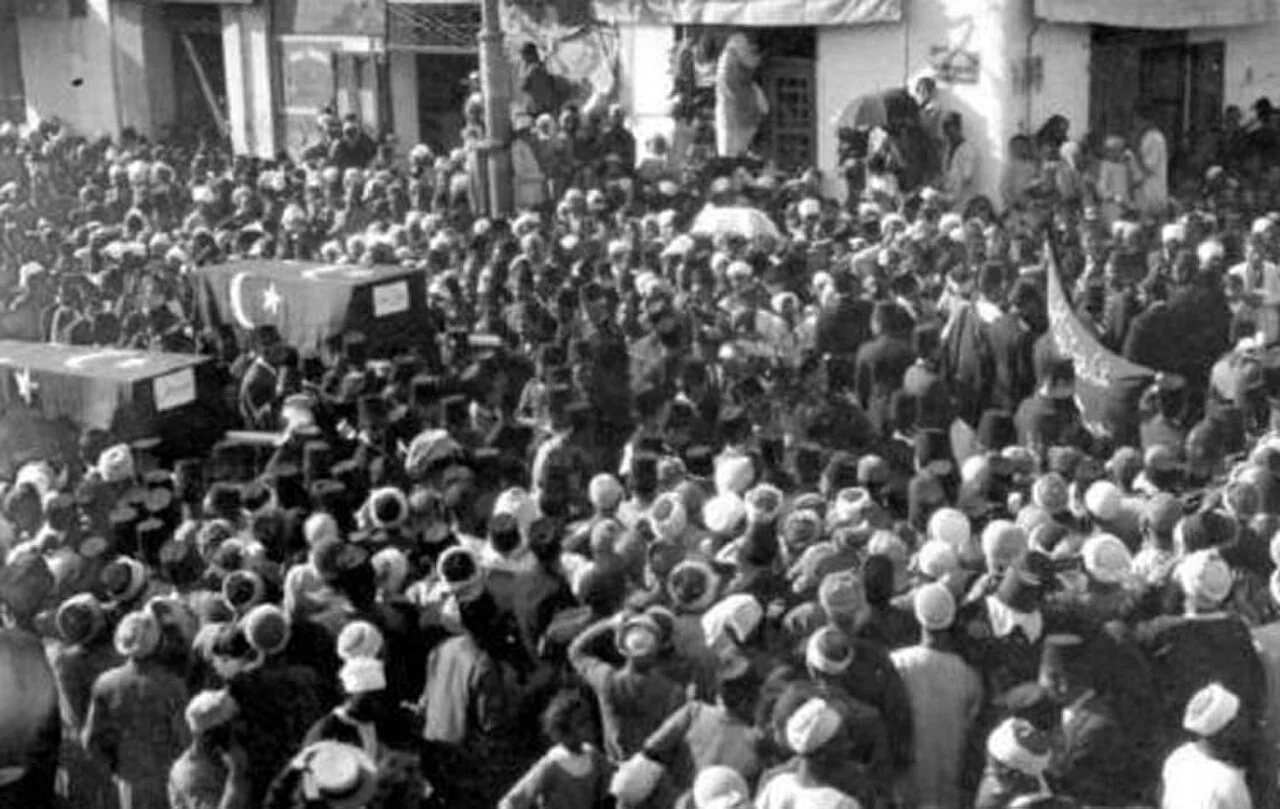
Photographs, flags and nationalist rhetoric from 1919 often emphasized Muslim–Coptic cooperation. Cambridge scholarship identifies religious communities as participants in a movement that transcended some of the boundaries political authorities might otherwise have exploited. A familiar symbolic pairing of crescent and cross expressed a claim that national belonging could encompass citizens of both major religious communities. Like all symbols, it is evidence for aspiration and public communication rather than proof that prejudice or disagreement disappeared from Egyptian society. The historical research becomes stronger when it examines who used these emblems, in what contexts and with what objectives. A photograph of demonstrators carrying a flag can help document the public performance of solidarity, but it does not tell us the individual beliefs of everyone pictured. Nor does participation in one protest demonstrate that all organizations shared the same view of constitutional government. The variety of religious leaders, students and lay participants matters because it broadens the story beyond one speech or party. This is a specific history of alliances under British rule in 1919, not a claim about present-day religious relations or a simplified moral contest between communities.
Villages and smaller towns: why Cairo was not the whole country
The revolution spread beyond Cairo to towns and rural districts. Zefta, in the Nile Delta, is remembered for local organizing that asserted political independence during the uprising. Local historical traditions refer to an episode associated with Yusuf al-Jindi and other activists, sometimes styled the “Republic of Zefta.” Such descriptions need care: they reflect a localized challenge to British and government authority, not an internationally recognized sovereign state with a stable constitutional system equivalent to an independent country. Regional action mattered partly because railway routes, markets and family networks connected villages with larger political events. People outside the capital could organize protests, cut communication links, refuse cooperation or negotiate with occupying forces. The effects varied; rural families could face violence, insecurity and disruption to livelihoods. Archival photographs attributed to demonstrators in Zefta are useful, but some have been republished long after 1919 and do not retain fully documented original photographers or exact exposure dates. Those limitations should appear in captions. Studying smaller towns also corrects the bias of archives: a political movement that becomes nationally important is often represented chiefly through capital-city newspapers and prominent leaders, while locally organized action requires deliberate recovery from regional sources.
British military and administrative responses
British authorities responded to the wave of protest through policing, military force, arrests and political negotiation. Edmund Allenby was appointed Special High Commissioner and recognized the difficulty of maintaining colonial authority through repression alone. Cambridge research traces the interaction of these decisions with the release of nationalist leaders and permission for their travel to Europe. However, changes in administrative position were not gifts bestowed independently of the continuing movement; they were part of a contested situation involving British calculations and Egyptian demands. There were fatalities and injuries in different parts of the country, and the coercive environment affected civilians, transport and daily life. The historical record contains differing estimates of casualties and conflicting depictions of who initiated particular violent encounters. Scholarly analysis should distinguish official claims, contemporary press and later research rather than silently selecting the most emotionally useful number. Military responses also highlight differences between national protest leaders’ plans and actions taken by local participants, which were not always centrally controlled. This matters when assigning responsibility or interpreting one photographed scene of confrontation. There was no single event that neatly describes the entire relationship between the occupation and Egyptian society in spring 1919.
Paris 1919: a diplomatic campaign in an unequal international order
The release of Zaghloul and his colleagues and their ability to travel for diplomatic campaigning became important developments, but recognition of Egyptian independence at the Paris peace conference was not straightforward. The postwar negotiations were shaped by major powers and imperial interests; invoking self-determination did not ensure that colonial territories would be treated alike. The Egyptian Wafd confronted this gap between international promises and the practical balance of influence. Protest at home and diplomatic lobbying abroad therefore operated on connected but distinct tracks. A national delegation could articulate claims in political language while workers and local groups maintained pressure through collective action. This dual character is central to the historical significance of 1919. Presenting the story only as a rejected petition would understate the mass movement, while depicting street protest as operating wholly without political leadership would ignore organized negotiations. Researchers continue to examine the relationship between popular claims, leaders’ strategies and British policy. The documentary evidence shows repeated political attempts, setbacks and renegotiations rather than a victory obtained immediately after one march. In this context, documents and telegrams are as important as a photograph of flags or a portrait of Saad Zaghloul.
From Milner to 1922: political negotiations did not end in 1919
The British government sent a mission led by Alfred Milner in late 1919 to examine the crisis and possible arrangements for Egypt. Later talks involved Egyptian political actors with differing strategies, and the negotiations did not satisfy every independence demand. On 28 February 1922 Britain issued a unilateral declaration ending the formal protectorate and recognizing Egypt as independent while reserving key matters to British discretion. The reserved subjects concerned security of imperial communications, defense against foreign interference, protection of foreign interests and minorities, and Sudan. The result represented a legal change but not unrestricted control over every area of policy. Contemporary nationalists differed over whether the declaration should be accepted, rejected or used as a step toward further concessions. It would therefore be historically inaccurate to write that the 1919 uprising ended with Egypt becoming fully sovereign overnight in 1922. The relationship between protest, diplomacy and constitutional development continued. Constitutional arrangements, the monarchy, parliamentary politics and continuing British presence created a complicated political landscape. A balanced account can present the dated legal documents and the reservations without handing down an editorial ranking of historical factions or replacing their documented arguments with present-day preferences.
The 1923 constitution and the unfinished meaning of representation
Egypt adopted a constitution in April 1923 that established a framework for parliamentary and constitutional politics. Cambridge scholarship treats the constitutional debates of 1919–1922 as an important history in their own right, not merely an epilogue to street demonstrations. The constitutional system reflected tensions among the monarchy, political parties, occupation authorities and people seeking broader political representation. Formal institutional change did not distribute influence equally across class and gender, and it did not automatically remove British power from reserved matters. The years following the revolution saw elections, ministries and conflict over the limits of representative institutions. Women who helped make national claims visible in 1919 continued organizing, but public political participation did not immediately translate into equal voting rights. Keeping those strands visible avoids portraying the revolution as a perfectly completed constitutional project. The key question is how claims to national sovereignty, popular mandate and individual rights were translated into laws and practices that could still be challenged. A research article should identify the constitution’s historical date and documented structure while avoiding the temptation to classify a century-old political figure as a simple heroic or villainous type. Institutions evolved through competing priorities and changing circumstances.
Women’s organizations after the revolution: political participation continued
One of the most durable developments linked to the mass mobilization of 1919 was greater public organization among Egyptian women. The Wafdist Women’s Central Committee, associated with Huda Shaarawi and other activists, provided an institutional form to campaign work. The Egyptian Feminist Union was established in 1923 as part of the next phase of women’s organizing. Scholars have shown that nationalist and feminist demands overlapped but did not always receive equal emphasis in the agendas of male-led political institutions. That creates an important distinction: participation in a national movement can increase visibility without immediately granting formal representation or policy influence. Women from different social classes experienced these changes differently. Wealthy organizers are well represented in memoirs and group photographs, while working-class and rural women often appear only in brief references. A rigorous account should avoid stating that a small named elite acted alone on behalf of all women, or that later disagreements erase their contribution. The most useful lesson is historiographical: who gets named in commemorations is not identical to who participated. The Cambridge book chapter on women’s national struggles offers a substantial scholarly discussion of those differences and how the history was subsequently remembered.
Reading photographs without inventing history
An image caption can quietly distort an entire historical episode. Photographs of the 1919 movement may show demonstrators, flags, a crowd near a railway station, or a newspaper’s portrayal of women addressing listeners. Those are distinct events and source types. The physical camera records whatever was in front of it, but exposure date, original caption, publisher and later cropping can all affect interpretation. For example, a photo labeled “Cairo Demonstrations 1919” may be securely described as an archival protest image but does not identify every person or exact hour. The Madison Journal’s depiction of women’s speeches is a contemporary published clipping whose headline reflects a particular American editorial perspective, not a universally true description of Egyptian women’s history. The Zefta photograph has a later period attribution and should not be used to claim that a named organizer is standing in a particular part of the frame. Such caveats are not boring footnotes. They protect the evidence on which future interpretations depend. The same caution applies to fictional colorized scenes or AI renderings: they may be legitimate artistic interpretations when labeled, but they should not replace verifiable photographs in a documentary encyclopedia. This article uses only separately identified, source-linked archival visuals.
How 1919 fits the longer modern history of Egypt
The uprising belongs to a long history of modern Egyptian institutions and public life. Nineteenth-century infrastructure and economic changes shaped the society that entered the First World War, but they should not be treated as direct causes of every political development in 1919. Kemet Vault’s history of Suez Canal workers and construction examines a distinct phase of economic and labor transformation, while its modern Cairo and public space study explains how the city continued to evolve. The revolution deserves its own encyclopedia because its central evidence concerns collective action, negotiations and constitutional change after the First World War. It is not simply another story about architecture, transport or one royal administration. Historical understanding also depends on remembering that nationalism was not the only political identity in Egyptian society. Different participants could care about jobs, local authority, religion, legal rights, national representation or education, and those interests could overlap without becoming identical. Research that makes room for such variation tells a more accurate history than a continuous procession of famous men or a narrative whose outcome was determined in advance.
Chronology: the events and their consequences
| Date | Documented development | Interpretive caution |
|---|---|---|
| 13 November 1918 | Nationalist delegation meets British High Commissioner | Request for self-determination, not recognized statehood |
| 8 March 1919 | Arrest and exile of Zaghloul and colleagues | Descriptions differ in number of first detainees |
| 9 March 1919 | Student demonstrations and wider unrest begin | Regional timing and methods vary |
| 16 March 1919 | Landmark organized women’s demonstrations | Not the beginning of all Egyptian women’s public action |
| Late 1919 | Milner mission examines possible political changes | No immediate accepted final settlement |
| 28 February 1922 | Unilateral declaration ending British protectorate | Four reserved matters and continuing disputes |
| April 1923 | New constitution | Political rights and imperial influence remained contested |
Evidence ledger and further reading
Cambridge University Press, Independence and constitutionalism in Egypt 1919–1922; Cambridge University Press, Women and Egypt’s National Struggles; Swarthmore Global Nonviolent Action Database, Egyptians Campaign for Independence 1919–1922; Ahram Online, Egyptian Revolution of 1919 timeline; Ahram Online, Zaghloul’s memoirs and 1918 delegation. Visual sources are linked individually in each caption. All chronological claims are associated with scholarly or contemporary archival documentation; exact casualty totals and the exposure dates of some republished photographs are not asserted without a documented basis. Research review 25 October 2026.
Frequently asked questions
What triggered the Egyptian revolution of 1919?
The British arrest and exile of Saad Zaghloul and nationalist colleagues on 8 March helped trigger demonstrations from 9 March, amid a broader struggle for self-determination after the First World War.
Did women join the demonstrations?
Yes. A prominent organized march took place in March 1919, and women of different social backgrounds joined through protests, boycotts, supplies and political organizing.
Did Egypt become fully independent in 1922?
Britain issued a declaration ending its protectorate in February 1922 while reserving significant matters to British discretion. That was a legal change but not a settlement of every sovereignty dispute.
Are the images actual historical records?
Yes. The photos and newspaper clipping are documented original or contemporary sources, with their provenance limits explained; they are not invented crowd scenes.