What are the Beni Hasan tombs? Beni Hasan is a Middle Egypt cemetery near Minya with a lower cemetery of approximately 800 tombs and an upper group of 39 rock-cut tombs, 12 of which have painted walls. The paintings record idealized scenes of farming, craftwork, hunting, wrestling and the appearance of foreign visitors, alongside the monuments of influential provincial governors.
This guide focuses on the material record of the tombs, the named monuments of Khnumhotep II, Khety, Baqet III and Amenemhat, and the difference between archaeological evidence and familiar interpretations of painted scenes. Details and counts are checked against individual records from Egypt’s Ministry of Tourism and Antiquities rather than copied from undated tourist summaries.
Beni Hasan: a cemetery in the landscape of Middle Egypt
Beni Hasan is a rock-cut cemetery on the eastern side of the Nile valley in the governorate of Minya. The Egyptian Ministry of Tourism and Antiquities links its prosperity to the fertile agricultural lands of the region. The site belonged to the historical landscape of the sixteenth Upper Egyptian province, often called the Oryx nome. Its tombs make the relationships between provincial power, farming and the state unusually visible. Rather than a cemetery of anonymous kings, Beni Hasan mainly records the lives and aspirations of officials whose authority was exercised outside the royal capital.
The setting is central to the evidence. Tomb owners chose the limestone cliffs high above the cultivated valley, creating spaces that remain visible in the landscape while protecting carved chambers from some forms of disturbance. Their decorated interiors present the world as elite patrons wanted it remembered, not a neutral photograph of village life. The cliffs, the river and the agricultural land below explain why scenes of work and natural resources were appropriate subjects for a memorial intended to last across generations.
Modern descriptions should not treat the name Beni Hasan as one building. It refers to a cemetery with many tombs and more than one construction period. Accurate research identifies each named tomb, its period and the particular walls being discussed before making claims about daily life, ethnicity or unusual architectural forms.
Upper and lower cemeteries: why the numbers differ
The ministry separates Beni Hasan into an upper and a lower cemetery. It records around 800 burials in the lower area, many constructed as shafts, while the upper cemetery contains 39 rock-cut tombs made horizontally into the cliff. Twelve of the upper tombs preserve painted decoration. Those three numbers refer to different categories of evidence; merging them into a statement that all 800 tombs have spectacular murals would be false.
The lower cemetery includes material stretching from the late Old Kingdom through the First Intermediate Period and Middle Kingdom. The prominent upper tombs are especially associated with governors and other leading figures of the Eleventh and Twelfth Dynasties. The range matters because the site did not have one moment of use followed by immediate abandonment. Archaeologists need to consider phases of burial, changing patronage and the survival of different kinds of material.
The best-known painted tombs offer unusually detailed scenes, but they do not represent every tomb in the cemetery. Some chambers were left undecorated, some suffered damage, and excavation histories differ. Visitors encountering a single painted room should remember that its exceptional preservation is precisely what makes it an attractive example rather than a statistically typical Egyptian burial.
The governors of the Oryx nome
Beni Hasan’s principal owners were high officials connected to the government of the sixteenth Upper Egyptian nome. The official Egyptian site lists the recurring names Baqet, Khety and Khnumhotep and notes that repetition across generations suggests family relationships. That is an inference from naming patterns and tomb histories, not a complete and unbroken family tree. The evidence points to continuity of local influence under changing royal administrations.
A nomarch was not an independent modern provincial governor. Authority in ancient Egypt involved the state, land, temples, household relationships and the ceremonial claims that elite families made about themselves. An official’s inscriptions are valuable primary sources, but their descriptions of success and generosity also form part of a funerary presentation. They should be read together with archaeological contexts rather than taken as administrative statistics without question.
The cemetery makes provincial history much more concrete than a simple list of kings. An official could organize labour, supervise economic activities and commission substantial building works. The tomb presents these capacities as enduring features of the owner’s identity, revealing the local ambitions and social expectations that existed alongside the monarchy.
Tomb of Khnumhotep II: inscription and painted biography
Khnumhotep II is one of Beni Hasan’s most studied tomb owners. The Ministry of Tourism and Antiquities associates him with the reign of Senusret II and describes his office as Overseer of the Eastern Desert. His chapel has a portico with two fluted columns, access from a forecourt, internal supports and two burial shafts. These physical details are as important as the images because they establish the monument’s architectural character and the way visitors moved toward the decorated space.
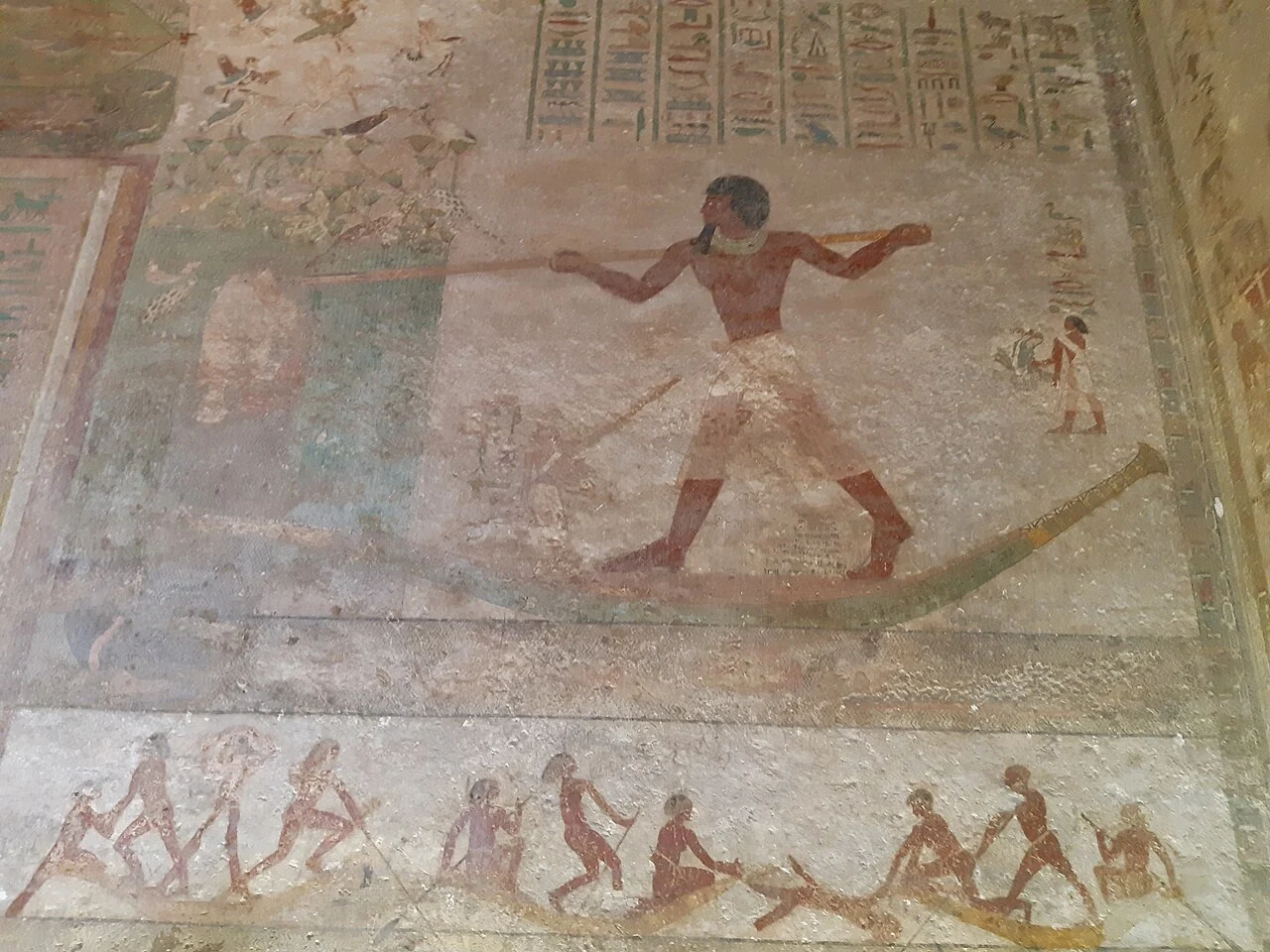
The ministry records 222 columns of text concerning Khnumhotep’s life. Such inscriptions do not offer a modern autobiography in the ordinary sense. They are carefully selected statements of status, ancestry and achievement, combined with visual programmes that situate the deceased in a world of ritual and prosperity. Fishing and fowling scenes near the statue shrine connect the elite owner with the productive environment of the Nile.
It is particularly important not to confuse Khnumhotep II at Beni Hasan with every other ancient Egyptian official carrying the name Khnumhotep. Egyptian names recur, and historical attribution depends on titles, family relationships and the original inscription. A caption that omits the number or site can unintentionally merge separate people and monuments.
The Aamu delegation and the limits of ethnic identification
A celebrated painting in Khnumhotep II’s tomb shows a group of people identified as Aamu arriving from regions to Egypt’s east or north-east. The Egyptian ministry describes a delegation of 37 men, women and children bringing eye-paint, led by a figure named Abisha(i). The leader is described with the phrase heqa khaset, often translated as ruler of a foreign land. The scene records how foreign visitors were represented in an Egyptian provincial tomb.
This painting is often cited in debates about trade, mobility and Egyptian contact with neighbouring communities. The clothing, objects, captions and arrangement of figures deserve close attention. Nevertheless, it is not a census of every people living in the Levant, nor does it prove an entire migration narrative by itself. Some popular interpretations equate the delegation directly with the later Hyksos rulers. That goes beyond what one painted scene can establish across different historical periods.
The word heqa khaset later contributes to the term known in Greek as Hyksos. A linguistic relationship is not the same thing as identifying these specific visitors as a later dynasty. In an evidence-led treatment, the inscription, the people in the painting and the broader chronology remain carefully separated.
Khety’s tomb and the extraordinary wrestling scenes
The tomb of Khety is another major source for life and representation in the Oryx nome. The ministry places Khety within the early Middle Kingdom and describes an entrance forecourt with a chamber originally furnished with rows of lotus-capital columns. Only some of those supports survive intact. This combination of architecture and art reminds us that tomb paintings were designed for specific rooms, not produced as free-standing illustrated books.
The east wall contains memorable wrestling scenes. According to the ministry, 122 pairs of wrestlers appear in five registers facing the entrance, each pair shown in a different position. Other scenes depict military training and a fortress under attack. The specificity of these images supports questions about techniques, bodily movement and the visual grammar of conflict, but it does not give us a complete ancient rulebook for competitive sport.
Elsewhere, Khety’s chapel shows hunting, handicrafts, musicians, boat-related work, games and funerary rituals. These scenes form an idealized, ordered world under the gaze of the tomb owner. They provide invaluable evidence for the types of work and recreation Egyptian artists considered worth portraying while still requiring interpretation as elite funerary art.
Baqet III: crafts, taxes and 220 pairs of wrestlers
Baqet III’s tomb provides a useful comparison with Khety’s. The official site describes a decorated chamber with a false door, offering platform and a range of painted activities. Crafts represented include sandal making, spinning, weaving and goldsmith work. A tax-collection scene depicts defaulters brought before a scribe by force. It would be a mistake to present this as the direct transcript of one identifiable tax dispute, but the composition reflects the state’s coercive potential as elite artists understood it.
The east wall includes a besieged fortress and 220 pairs of wrestlers, a count that belongs to Baqet’s monument rather than Khety’s. Confusing the two totals is surprisingly easy in popular accounts. The ministry notes contrasting colours used to help viewers distinguish the bodies of the two participants in the athletic scenes. That detail is evidence of deliberate visual explanation, not merely decoration.
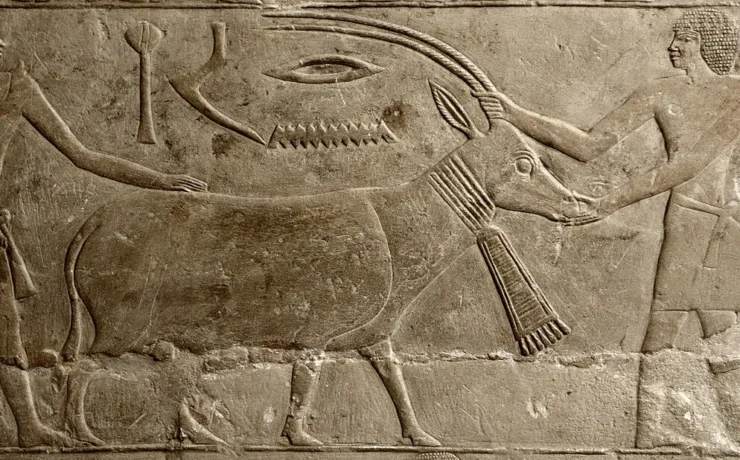
Birds, fish, cats and monkeys also appear within the programme. Such imagery invites research into Egyptian knowledge of animals and the symbolic value of ordered nature. Because the scenes are stylized and sometimes humorous, each should be interpreted within its artistic context rather than treated as an exact list of species living at the tomb owner’s residence.
Amenemhat’s painted ceiling and patterned space
Another prominent official at Beni Hasan was Amenemhat, associated by the ministry with the reign of Senusret I. His tomb includes a portico, forecourt, a statue shrine and an elaborate painted ceiling. The decoration imitates beams, woven matting and repeated geometric motifs. Looking upward in a chamber of this kind reveals something a photograph of wall scenes alone may miss: the painted environment was organized as an integrated architectural experience.
The ministry describes agriculture, fishing, fowling, carpentry, pottery and the manufacture of equipment among the scenes in Amenemhat’s tomb. These activities speak to a broad ideal of a prosperous estate and a well-ordered community. Yet a funerary composition is selective. Scenes can combine observation, established motifs and symbolic aspirations, sometimes preserving forms more consistently than individual events.
The painted ceiling also makes preservation a central question. Surface pigments can deteriorate under fluctuating moisture, light and visitor contact. Photographs provide a valuable dated record, but they should be accompanied by clear provenance and never artificially recoloured in a way that disguises the current state of the material.
Architecture carved with ordinary tools
The upper tombs were cut directly into the limestone face. The Ministry of Tourism and Antiquities describes workers using bronze-bladed chisels struck with wooden mallets. The form of the chambers reflects planning, measuring and repeated labour, rather than unexplained technologies. Facades, doorways, columns and internal shrines were carved from a geological setting that shaped what could be built.
The column forms of Khnumhotep II’s chapel are often called proto-Doric because they resemble later Greek architectural shapes. This is a descriptive comparison of appearance, not proof that a specific Greek architect designed the Middle Kingdom tomb. Chronology alone makes that interpretation untenable. The Egyptian monument predates the classical Greek orders by many centuries.
A good archaeological photograph allows the reader to distinguish original stone, damaged surfaces and modern treatment. Both photographs included with this article show actual Beni Hasan tomb remains, sourced from distinct high-resolution 2021 images with documented authorship and Creative Commons terms. Neither is presented as an ancient painting recreated by artificial intelligence.
What the painted scenes reveal about agriculture and work
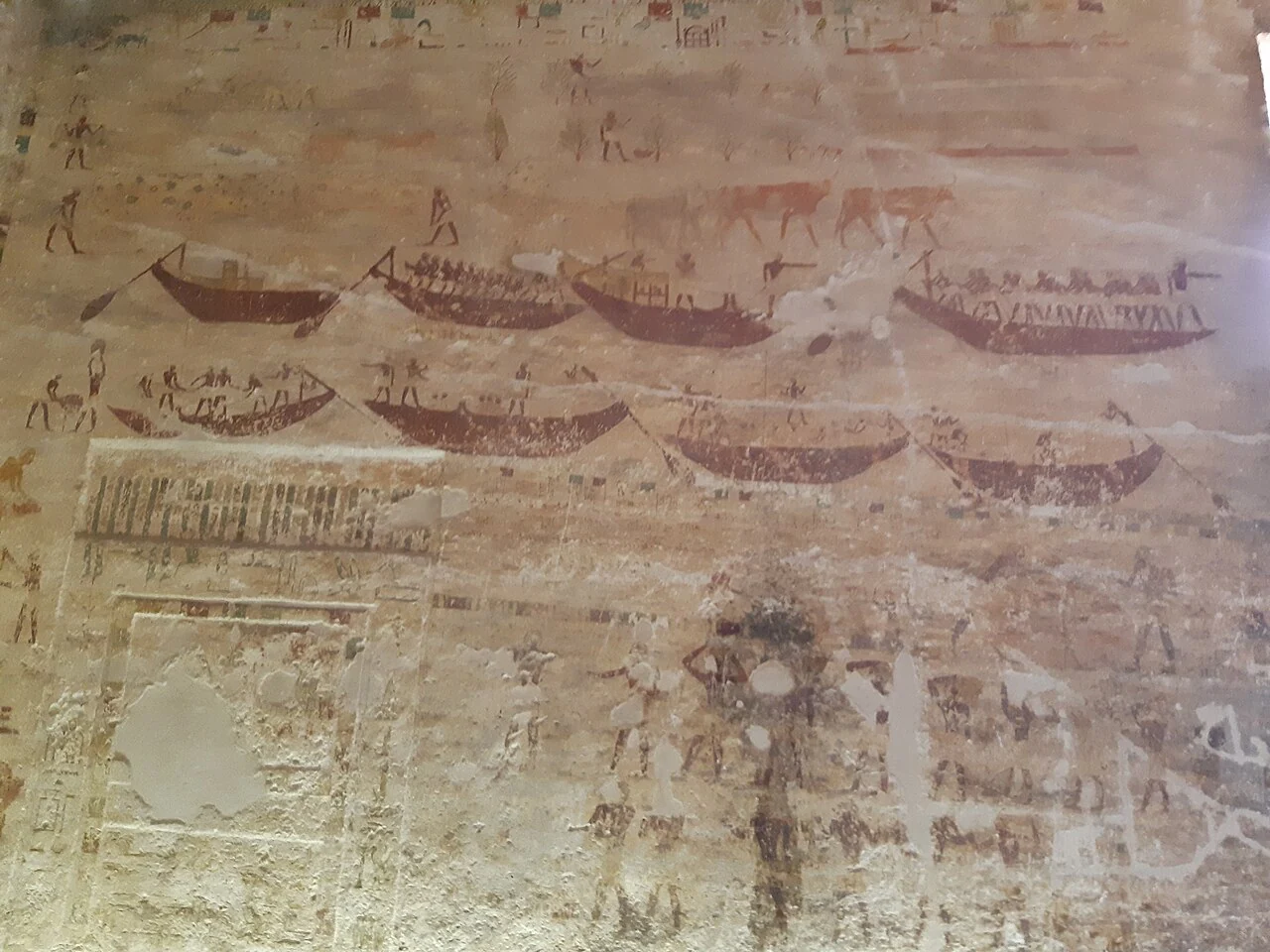
Farmers, herders, craftspeople and officials recur across the painted tombs because the owners wished to be associated with a productive and ordered society. Scenes of grain, textile preparation, animal handling and everyday technologies give researchers clues about tools, body positions and work sequences. But the composition also reflects status: those who commissioned the tombs chose which activities to emphasize and where to place themselves in relation to workers.
A literal reading would overstate the evidence. A harvest scene is not a calendar that identifies the agricultural output of a precise estate in a documented year. A picture of a smith or potter does not reveal the wages of all skilled workers. Archaeologists strengthen interpretations by comparing tomb paintings with tools, settlement remains, excavated objects and written documents from related periods.
This approach makes the decoration more interesting, not less. The difference between material evidence and artistic selection becomes a research question: which activities were common enough to be recognizable, which were ceremonial ideals, and why did a provincial official want them represented in a permanent memorial?
Hunting, animals and the imagined desert
Several Beni Hasan tombs depict hunting in desert landscapes and in riverine environments. Birds, fish and wild animals occur alongside scenes of elite leisure and organised labour. Their careful representation allows discussion of ancient environmental knowledge, yet the images are highly structured compositions with an intended ritual effect. They were not made by a camera recording an ordinary day.
The presence of an animal in a scene does not necessarily establish its abundance at Minya in the exact decade when the tomb was carved. Artists may have reused recognizable forms and themes. Species identification itself can be uncertain where pigment has disappeared or bodies are stylised. Text, image and environmental evidence should be compared before firm conclusions are drawn about historic biodiversity.
An animal can also be a symbol in a funerary setting. The successful capture of wild creatures evokes the control of disorder, while fishing and fowling may signal abundance and renewal. These meanings can coexist with practical knowledge of working in the Nile environment. Readers benefit when neither dimension is reduced to a single explanation.
Photographs and the problem of historical reconstruction
The two documentary images in this article identify real tomb architecture at Beni Hasan and retain full attribution to their photographer. Their high original resolution helps viewers distinguish limestone surfaces and the arrangement of entrances. They do not, by themselves, show every painted programme described in the text. Where an individual scene is discussed, the ministry’s named tomb description is the source for its exact subject and count.
This limitation is useful. A general exterior image cannot verify the exact number of wrestlers in an interior painting; similarly, a drawing of a painted scene should not be captioned as an unaltered photograph. Museum archives, nineteenth-century copies and recent conservation images each provide different evidence. They should be labeled according to what they really are.
Claims about modern restoration, opening hours or whether photography is permitted need a date and official confirmation. Conservation rules can change, especially in painted rock-cut interiors. This article deliberately avoids promising access to every chamber or publishing unverified ticket prices as permanent visitor facts.
How Beni Hasan fits into the Middle Kingdom
Beni Hasan supplies a provincial perspective on the Middle Kingdom that complements royal pyramids and central-state documents. The Hawara Pyramid of Amenemhat III represents royal building and Fayum investment; the Beni Hasan tombs represent elite local commemoration and the presentation of work. Neither source type can substitute for the other. Together they illuminate different institutions.
The Meketre tomb models show a different method of depicting productive activity in miniature form, while the Tale of Sinuhe offers literary perspectives on identity, travel and return. Reading these sources alongside Beni Hasan makes the historical period richer than a sequence of royal accession dates.
The paintings also remind us that identities in ancient Egypt were complex. Inscribed foreign visitors, provincial governors, labourers and ritual figures share the walls of a small number of tomb chapels. It is the precise context of each scene, and not a generic claim about what all Egyptians thought, that makes the site worthy of sustained study.
Verified sources and primary site records
The monument descriptions and quantitative details above were checked against the following distinct original records from Egypt’s Ministry of Tourism and Antiquities: Beni Hasan site overview; Khnumhotep II’s tomb; Khety’s tomb; Baqet III’s tomb; Amenemhat’s tomb. Individual tomb descriptions matter because the best-known wrestling totals, foreign delegation and architectural features belong to different monuments.
This article uses original high-resolution, openly licensed photographs from Beni Hasan, with file-page authorship and licence attribution in each caption. The site photographs establish real stone architecture and geographical context; official descriptions provide the specific evidence for painted scenes not visible in those two images.