The Tale of Sinuhe is one of ancient Egypt’s most accomplished literary works, preserved in real Middle Kingdom papyri and in later scribal copies. Its narrator flees after the death of a king, builds a prosperous life among Levantine hosts, and eventually returns to Egypt. The text offers something more interesting than an adventure plot: a meditation on kingship, loyalty, exile, identity and burial, composed in the voice of a court official.
Rather than treating Sinuhe as a verified historical traveler, this guide follows the physical evidence. It compares the Berlin papyri, New Kingdom ostraca and published manuscript research; explains where summaries simplify the Egyptian text; and shows what the story can and cannot tell us about the Middle Kingdom. All three documentary illustrations are images of genuine ancient objects or historical records of them, not AI reconstructions.
What is the Tale of Sinuhe, and why does it matter?
The Tale of Sinuhe is a Middle Kingdom Egyptian literary composition told in the voice of a royal courtier who unexpectedly leaves Egypt, becomes successful abroad, and eventually returns to receive an Egyptian burial. Its first-person form resembles the autobiographical inscriptions that officials placed in tombs, yet the work is a crafted narrative rather than a securely identified personal memoir. That difference is essential. It permits the story to explore political anxiety, loyalty, hospitality, foreign landscapes, aging, and the security of burial without requiring every narrated event to be treated as a historical report. The text has survived because Egyptians copied and studied it for many generations, not because a tomb of the protagonist has been found. It is one of the rare ancient stories for which scholars can compare multiple manuscripts from significantly different eras, studying both a celebrated narrative and the scribal practices that preserved it. At its heart lies a question that remains understandable without romanticizing ancient history: can a person who has prospered elsewhere still belong to the country and institutions that first defined his identity?
When was the tale composed? The Twelfth Dynasty setting
The action is set after the death of Amenemhat I, the founder of Egypt’s Twelfth Dynasty, and during the accession of his son Senusret I. Modern reconstructions usually place the literary composition within the Middle Kingdom, but the date of the events described, the likely period of composition, and the ages of the surviving copies must be kept separate. A papyrus copied around 1800 BCE does not automatically mean its author wrote the work in that particular year. Sinuhe’s voice is placed close to the court and its networks of service, an environment in which the death of a king could be politically dangerous. The Egyptian narrative gives special attention to the accession of Senusret and the restoration of political order. Yet it does not provide an independent contemporary court record explaining all circumstances of Amenemhat’s death. The famous assassination theme is also found in other Egyptian literary compositions, especially the Instruction of Amenemhat. Using such texts together can clarify a contemporary atmosphere of dynastic legitimacy, but treating their dramatic dialogue as a verbatim transcript of a royal murder would confuse literary evidence with administrative documentation.
The surviving originals: Berlin P. 3022 and P. 10499
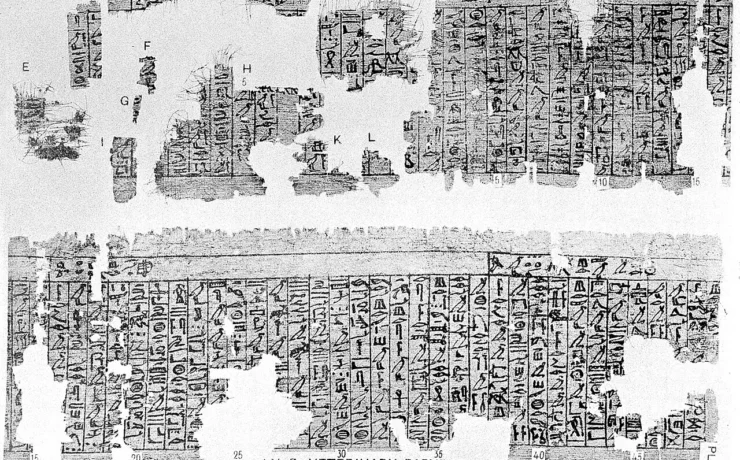
Two Berlin papyri provide the foundation for the modern reconstruction. Berlin P. 3022, often called manuscript B, preserves a long account but lacks its original opening; Berlin P. 10499, associated with the Ramesseum group, supplies material important for the beginning. University College London’s Digital Egypt project distinguishes these manuscripts and lists additional fragments from Egyptian and international collections. The Berlin Papyrus Collection confirms that the institution preserves two exemplary Sinuhe manuscripts. They are not interchangeable photographs of a single complete scroll. Their hands, physical histories, damage patterns, and textual readings differ, which is precisely why scholars compare them. Cambridge Egyptologist James P. Allen notes that manuscript B can be the best preserved witness without being uniformly the most dependable reading. When editors print a continuous English tale, they sometimes combine passages reconstructed from witnesses with different dates and gaps. A responsible encyclopedia should therefore explain what the papyrus actually preserves before presenting a smooth retelling. Museum inventory identifiers make this comparison independently checkable, rather than relying on generic photographs labelled simply ‘ancient Egyptian writing’.

A papyrus is an artifact, not an abstract book
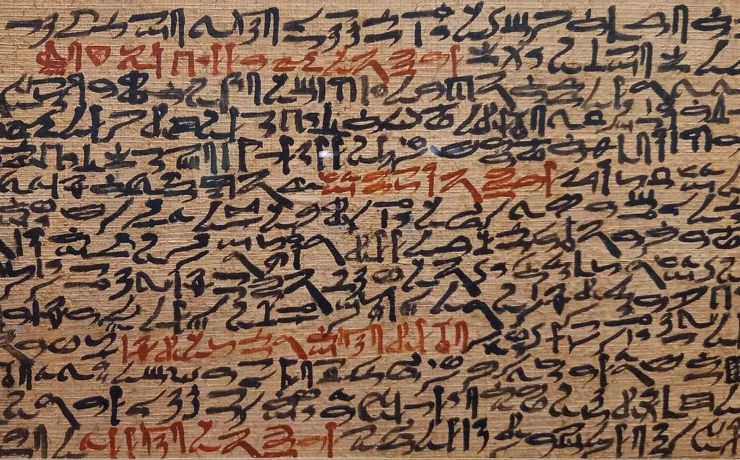
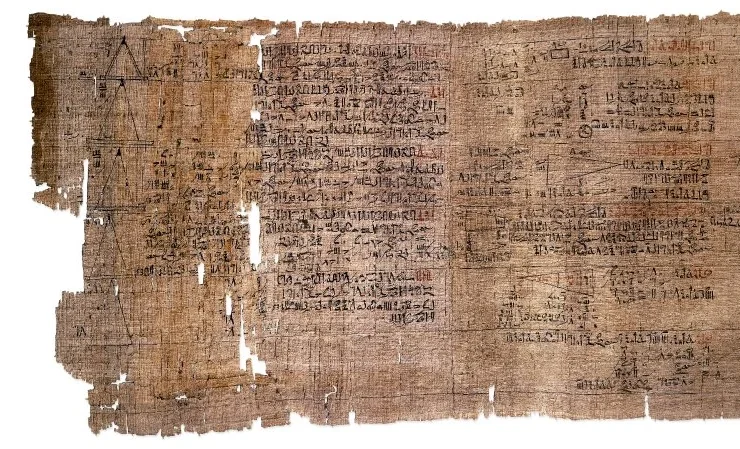
A photograph of a Sinuhe manuscript shows a physical object: sheets made from papyrus plant material, dark ink, signs written by a trained hand, and irregular edges shaped by survival and conservation. The ancient work circulated in hieratic, a cursive Egyptian writing tradition that looks very different from monumental hieroglyphs cut in stone. Lines, columns, corrections, and red marks can be evidence for how a text was prepared and read. A museum reproduction may enlarge a tiny section, straighten the scroll digitally, or represent only one side; such presentation choices should not be mistaken for the original format. P. 3022 was copied centuries before many surviving school ostraca, so differences between them are useful historical clues, not mistakes that must be hidden. The physical text also reminds us that access to literature depended on specialist training, supplies, and places where papyrus could be made, stored, and recopied. The manuscripts’ survival is selective. What remains in a dry archaeological context does not reveal how many performances, recitations, or now-lost copies were once known across Egypt.
The royal death and a frightened official
Sinuhe begins in the orbit of a court crisis. The prince Senusret is returning from an expedition when news arrives of the death of Amenemhat I. Sinuhe overhears a communication associated with the royal family and suddenly flees. The story deliberately keeps his reasons complicated: he is frightened and later has difficulty explaining why he left at all. A modern summary that confidently says he was a convicted conspirator goes beyond the evidence. The reader never receives an Egyptian legal dossier charging Sinuhe with a crime. Indeed, his later restoration depends on the king’s willingness to regard the departure as a bewildering act rather than permanent treason. That dramatic uncertainty makes the narrative distinctive. Instead of treating exile as a neat military adventure, the writer gives political panic an inward dimension. The flight changes not merely Sinuhe’s address but his relationship with authority, speech, and memory. The society imagined in the poem values kingship as a framework that makes personal status intelligible, so an official displaced from court must rebuild both practical security and a story about who he has become.
Across the frontier: how to read the journey
The narrative sends Sinuhe across Egypt’s northeastern frontier toward the Levant, a region represented through place names, peoples, and frontier experiences familiar to Egyptian literary geography. Such names are valuable cultural evidence, but every stopping place cannot be plotted with the certainty of a modern GPS track. Translations of regional designations such as Retjenu can differ in geographical scope, while the literary sequence organizes emotion as much as distance. Accounts of thirst, night travel, and unexpected assistance present the boundary as a place where royal protection gives way to uncertainty. The courtier’s successful crossing illustrates how the narrator moves from an ordered Egyptian world into a setting where identity must be negotiated with new hosts. A reader should not conclude from a plausible route that archaeologists have recovered the campsite, well, or exact path of this fictional traveler. Equally, it would be wrong to dismiss the description as useless: Egyptian contact with Levantine communities, movements of people, and trade networks belong to a documented historical setting. Literature and archaeology answer related, but different, questions.
Amunenshi and the politics of hospitality
Once abroad, Sinuhe is welcomed by Amunenshi, a leader associated with the region of Retjenu. The host recognizes his Egyptian reputation and becomes a crucial patron. He gives the traveler a position of honor, arranges his marriage, and connects him to land, family, and authority. Hospitality here is not simply a pleasant interlude; it has political meaning. A ruler demonstrates power by protecting and advancing a distinguished stranger, while Sinuhe proves useful through leadership and loyalty in a new community. The episode counters the assumption that the poem depicts all foreigners as uncivilized or hostile. Its foreign ruler can be generous, resourceful, and socially sophisticated, even while the narrative remains shaped by an Egyptian elite perspective. The alliance also changes the stakes of Sinuhe’s eventual decision. He is not forced home by destitution. He has responsibilities, wealth, and children abroad. Therefore his return must be explained by values stronger than immediate personal comfort. The tension between gratitude to his foreign household and attachment to Egyptian burial traditions is one of the story’s finest literary achievements.
The rich land of Retjenu: food, status and ideal abundance
Sinuhe describes a prosperous territory with fields, animals, fruit, and agricultural resources. These passages are often quoted as if they were a straightforward economic survey of ancient Syria or Palestine. Their real value is more subtle. Descriptions of abundance establish the success of Sinuhe’s new life and demonstrate how a good patron can create material security. At the same time, a cultivated landscape of grain, vines, herds, and carefully distributed land resembles the language of wealth and good administration familiar from Egyptian elite writing. The text offers insight into how Egyptian audiences imagined a flourishing foreign estate, but it does not allow researchers to calculate harvest yields or household income. The emphasis on plenty also helps structure the narrative’s paradox: Sinuhe enjoys the things an elite official could desire, and yet something central remains missing. The poet is interested in the difference between a life that has become materially successful and a death that can be socially and ritually secure. That difference becomes the motor of the closing movement, when prestige abroad no longer removes his longing for an Egyptian tomb.
A single combat and the creation of a hero
The encounter with a powerful challenger is perhaps the most dramatic event in the narrative. A fighter seeks to defeat Sinuhe, the established outsider who has achieved influence within the host community. The story carefully positions the conflict as a test of courage, reputation, and personal legitimacy. Its excitement comes from the risk that one confrontation could undo years of accumulated status. Sinuhe’s victory transforms military skill into public recognition, demonstrating that he can master the expectations of the community that accepted him. Yet the episode should not be treated as independent evidence of a recorded duel between two historically verified people. We possess the narrative, not a battlefield inscription naming the combatants. Literary comparison may illuminate the conventions through which Egyptians represented physical skill and rightful success, but similarity to another tale is not proof of borrowing. More important is what the poet does after the triumph. Victory does not solve Sinuhe’s growing concern about the end of life. The movement from spectacular combat to vulnerable old age is central to the work’s moral and emotional design.
Homesickness is not the same as failure abroad
Many familiar adventure stories send a displaced hero home when his foreign experiment collapses. Sinuhe does almost the opposite. His household, reputation, and resources appear secure when he begins to think more intensely about Egypt. The poem therefore asks its audience to consider belonging as something that cannot be reduced to a better standard of living. Memories of childhood, obligations to the king, and anxieties about the treatment of the dead become increasingly important. Egyptian burial ideals made a tomb, proper ritual, and durable remembrance powerful markers of a completed life. Sinuhe’s longing for such treatment should be read as an ancient social and religious expectation, not a scientific claim that one burial location produced a measurable afterlife. Nor should the exile’s desire be generalized to every Egyptian abroad in every period. This is the perspective of a carefully imagined member of the courtly elite. The narrator’s emotion is persuasive precisely because the external conditions are favorable. He can admire his hosts while still yearning for recognition within the institutions from which he fled.
The king’s message: mercy and political restoration
Senusret’s invitation turns the story toward reconciliation. Instead of simply ordering the return of an offender, royal speech allows Sinuhe to approach the court again under the protection of legitimate authority. The sequence gives particular weight to language: messages are sent, responses formulated, and obligations expressed through carefully staged declarations. Royal clemency becomes a sign of a ruler who can restore order without reducing every problem to punishment. A literary text may idealize kingship, and that is part of what historians can learn from it. The court scene indicates how an Egyptian writer believed a good sovereign should behave toward a frightened but useful official, not how every Twelfth Dynasty ruler actually treated every exile. By accepting the invitation, Sinuhe must leave behind the life he built among his hosts. He also has to negotiate his own dignity, since his departure cannot erase his foreign family and achievements. The resolution depends on acts of recognition from both sides rather than a simplistic contrast between a wholly virtuous Egypt and a wholly threatening outside world.
Returning to Egypt: identity, aging and recognition
When Sinuhe returns, the narrative again concentrates on bodily and social transformation. Time abroad has changed him, and he must be seen, recognized, and reintegrated. The palace setting permits a series of reactions that underscore the contrast between the young official who fled and the older person now standing before the court. Restoration is not achieved merely by crossing the frontier. It involves language, clothing, public status, and renewed proximity to the king. The story’s staged recognition resembles scenes in which someone apparently lost is restored to the community, but it remains grounded in a specifically Egyptian worldview about offices, rank, and funerary preparation. A modern reader can appreciate its emotional complexity without asserting a literal eyewitness chronology. The narrative invites a delicate question: is Sinuhe returning as the same man or as someone redefined by exile? His past successes are real within the world of the story, yet courtly recognition reshapes their meaning. He is no longer only the favored outsider; he is once again a subject who can be provided for within an Egyptian institution.
An Egyptian tomb and the meaning of a good ending
The close of the tale devotes remarkable attention to the prospect of a proper burial. This is not an incidental reward added after the exciting episodes; it reveals what the narrative has been building toward. Sinuhe receives the promise of the social and ritual provisions associated with an elite Egyptian funeral. The concern is less about recovering a lost bag of wealth than about completing the arc of a person whose name, identity, and place in a community had become unstable. Egyptian funerary beliefs varied across periods and contexts, but tomb provision, offerings, and remembrance could carry enormous symbolic weight. The story is not the same as a Book of the Dead manuscript. One is an adventurous literary biography written in a courtly voice; the other represents changing collections of religious compositions for the deceased. Readers interested in the latter can consult our evidence-led introduction to the Book of the Dead and the original Papyrus of Ani. Keeping the genres separate makes both more informative.
How much of the story is historical fact?
The setting contains recognizable Twelfth Dynasty royal names and plausible patterns of Egyptian contact with northeastern neighbors. This historical framework does not establish Sinuhe as an archaeologically verified individual. The Bibliotheca Alexandrina’s inscriptions library explicitly notes the absence of an identified tomb, statue, stela, or comparable contemporary monument that securely confirms this character as a real official. That is not evidence that no such person could ever have existed; it is a limit on current historical claims. We must also resist presenting the Egyptian account of a court crisis as an independently dated police report. Literary authors routinely use convincing political and geographical details to develop fictional figures. Conversely, calling the poem literature does not make it irrelevant to history. It is excellent evidence for what some literate Egyptian audiences found persuasive, admirable, dangerous, or emotionally meaningful. Proper analysis distinguishes the history represented within the text, the history of the papyrus copies, and the later history of their modern collection and interpretation. These are three connected but separate subjects.
Why students copied Sinuhe on ostraca
New Kingdom school and scribal contexts preserved passages of the text long after the Middle Kingdom setting in which it had been created. The British Museum’s limestone ostracon EA 5629 contains the concluding part of the tale, written in hieratic with red verse marks, and is assigned to the Nineteenth Dynasty. The Ashmolean Museum identifies its large Sinuhe ostracon as AN1945.40, a similarly important witness from the New Kingdom. Such finds show that Egyptian scribes did not discard older compositions as soon as their royal context had passed. The act of copying could help students develop handwriting, familiarity with admired phrases, and command of literary language. But a single school exercise is not proof that all children attended a national education system or that the tale served as the same compulsory schoolbook throughout Egypt. Its transmission is best understood through the physical evidence: dated fragments, scribal signs, marks in ink, and the locations where examples were found or collected. Ostraca may be cheap writing surfaces, but for modern scholarship they are invaluable witnesses to a long-lived literary culture.
The Cairo ostracon and other manuscript witnesses
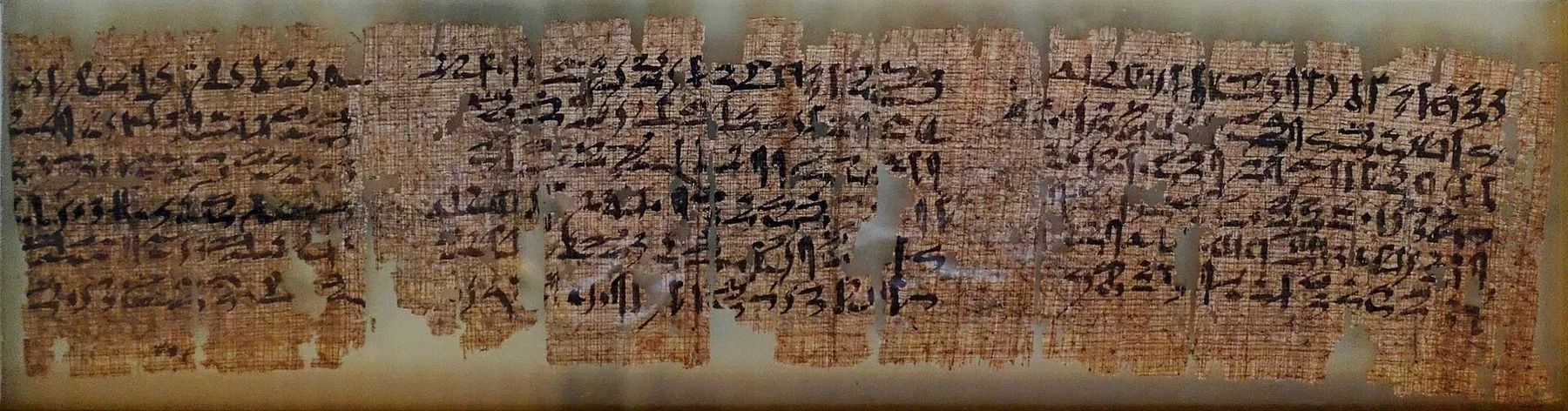
One striking witness is ostracon Cairo CG 25216, recorded as a large inscription associated with the Sinuhe tradition. Its old documentary photograph is useful precisely because it shows a text occupying a physical surface rather than a modern reconstruction of a portable papyrus book. The object and its early photographic record should not be conflated with the Berlin manuscripts: the pottery or limestone surface, later date, and scribal context differ from those of a Middle Kingdom roll. University College London’s manuscript inventory also identifies the Petrie Museum fragment UC 32773 from Harageh and several other ostraca and papyri. A critical edition compares such witnesses to detect copying habits, omissions, corrections, and passages lost from better known exemplars. A modern continuous translation conceals much of this work. Words restored by an editor may be supported by another manuscript even if they are unreadable on the particular papyrus reproduced in an illustration. Readers should ask which physical witness underlies an interpretation before citing a sentence as though it came from a single completely intact ancient volume.

Sinuhe and the problem of translation
The Egyptian text does not arrive in modern English without interpretation. Translators must decide how to reproduce titles, honorific language, compressed imagery, contested words, and shifts between narrative speech and formal praise. Names also vary: Sinuhe and Sanehat are both common modern renderings, while Senusret can appear as Sesostris in older English scholarship. Differences in spelling are not necessarily competing historical identities. Modern editions may silently fill lacunae from a different manuscript or choose a smoother phrase where hieratic signs allow more than one reading. Comparing scholarly translations can therefore be illuminating, especially where a passage seems psychologically strange or unusually modern. The University of Cambridge edition by James P. Allen is valuable precisely because it treats the tale as a textual tradition rather than a perfectly preserved modern novel. A careful article need not reproduce long copyrighted translations to be useful: it can summarize the narrative in original language, link to museum manuscripts and academic publications, and explain why textual uncertainty exists. That method respects both ancient evidence and the modern work of editors.
What this story reveals about Egyptian ideas of home
Sinuhe connects several ideas that are often treated separately in popular histories of Egypt. Political legitimacy appears in the transition between kings. Mobility appears in travel beyond the northeastern frontier. Social order appears in the patronage of a foreign leader and an Egyptian sovereign. Burial appears as a future-facing concern that changes the meaning of accumulated wealth. A reader who approaches the story only as an action adventure will miss the carefully constructed relationship between these themes. Yet interpreting home as a simple modern nationality is also misleading. Egypt in the Twelfth Dynasty was not a modern nation-state, and belonging was mediated by kingship, locality, family, language, ritual, and rank. The tale gives us a particular elite viewpoint, not a poll of ordinary Egyptians. It also acknowledges that a foreign place can offer genuine prosperity and human ties. That tension is why the ending remains powerful: the hero’s relationship with Egypt is restored without pretending his years abroad did not matter. Literature can preserve such complexities in ways that royal victory inscriptions rarely do.
Evidence map: objects, dates and historical limits
The surviving witnesses should be treated as a network rather than a single definitive manuscript. Berlin P. 3022 is a major Middle Kingdom text but has an incomplete opening; Berlin P. 10499 supplies an important parallel witness from the same broad era. The Ashmolean ostracon AN1945.40 and British Museum EA 5629 belong to a later scribal world, illustrating continued copying in the New Kingdom. The Petrie Museum Harageh papyrus fragment UC 32773 adds another important piece to the textual record. Dates attached to objects are generally periods assigned by material, handwriting, context, and scholarly study, and should not be confused with a claim about the first date the tale was ever performed. This article’s image selection likewise distinguishes an original papyrus photograph, a separate original witness, and an archival photograph of a later ostracon. None is a cinematic reconstruction or a portrait of a demonstrably historical Sinuhe. The table below gives each principal item its own cataloguing identity so that students can start with the objects rather than with the mythology of a ‘lost true diary’.
| Witness | Period | Why it matters |
|---|---|---|
| Berlin P. 3022 | Middle Kingdom | Major surviving narrative copy; beginning incomplete |
| Berlin P. 10499 | Late Middle Kingdom | Independent reading for earlier portions |
| Ashmolean AN1945.40 | New Kingdom | Substantial ostracon demonstrating later transmission |
| British Museum EA 5629 | Nineteenth Dynasty | Final stanzas and scribal verse marks |
| UCL UC 32773 | Late Middle Kingdom | Fragment from Harageh; independent archaeological witness |
References, source criticism and further reading
The principal institutional starting points are the Egypt Exploration Society’s 2026 guide, UCL Digital Egypt’s manuscript census, the Berlin Papyrus Collection, and the Ashmolean Museum’s explanation of its Sinuhe ostracon. For close reading and text criticism, consult James P. Allen, Middle Egyptian Literature (Cambridge University Press, 2015), and the manuscript documentation discussed in R. B. Parkinson and Lisa Baylis, Four 12th Dynasty Literary Papyri (2012). Older publications by Alan Gardiner and translations by Miriam Lichtheim remain historically important but must be read in light of subsequent scholarship. Each record answers a different question: collections document objects, academic editions analyze readings, and historical interpretation evaluates the meaning of the story. The present treatment avoids reproducing lengthy translated passages and flags uncertainty where the surviving evidence does not justify certainty.
Frequently asked questions about the Tale of Sinuhe
Was Sinuhe a real person? No securely identified archaeological evidence currently establishes that the literary narrator existed as a particular historical courtier. The named kings and setting are historical, but the protagonist is a literary figure in the surviving evidence.
What was the original language? The tale was composed in ancient Egyptian and survives principally in hieratic manuscripts. Hieratic is a writing style used for Egyptian, not a separate spoken language.
Where is the main papyrus? Important original witnesses include Berlin P. 3022 and P. 10499. Later textual copies survive on ostraca in other museum collections.
Is Sinuhe connected with the 1954 film? The twentieth-century novel and film are later adaptations using a related name, not literal translations of the Middle Kingdom story.