Is Amr ibn al-As Mosque the oldest mosque in Egypt? The mosque of Amr ibn al-As was established in Fustat in 21 AH/641 CE and is traditionally identified as Egypt’s first mosque. The Egyptian monuments authority stresses that the visible structure has undergone extensive rebuilding, mainly associated with the twentieth century, so it is not an untouched seventh-century building.
Visitors to Old Cairo often see a broad courtyard surrounded by columned prayer halls and naturally assume that the stones have stood unchanged since the Arab conquest. The history of Amr ibn al-As Mosque is more complicated and more revealing. The original building was founded soon after Fustat became the first Islamic capital of Egypt, but over centuries the mosque was enlarged, damaged, repaired and reconstructed. Its location and religious continuity are much older than much of the masonry visitors photograph today. This study follows the Egyptian Ministry of Tourism and Antiquities’ official chronology, then connects the building with the archaeology of Fustat and the later foundations of Abbasid, Tulunid and Fatimid urban Cairo.
For different documentary perspectives, read the Cairo Geniza documents and medieval Fustat society and compare the later Tulunid mosque of Ahmad ibn Tulun. Their different periods are essential to the history.
Why Fustat came before the later city of Cairo
Following the Arab conquest of Egypt in 640–641 CE, the administration needed a capital connected with its military and fiscal organization. Egypt’s Ministry of Tourism and Antiquities describes Fustat, founded under the general Amr ibn al-As, as the first Islamic capital of Egypt. It occupied an area now included within Old Cairo, south of the later medieval and modern city center. The name and location give an important geographical context to the mosque: it served a newly formed government settlement before the foundation of Fatimid al-Qahira.
Fustat did not exist in a vacuum. Earlier Egyptian, Roman and Byzantine settlements formed parts of the Nile Valley’s urban landscape. The new political capital emerged alongside existing populations and institutions, and its history should not be presented as the birth of all urban life in Egypt. Recognizing the differences among Roman Babylon, Fustat, al-Qata’i and later Cairo makes the architectural history of the region far easier to follow.
Amr ibn al-As and the foundation of 641
The ministry dates the founding of the mosque to 21 AH/641 CE, one year after the conquest of Egypt. It identifies Amr ibn al-As as the general responsible for establishing the new capital and the first mosque. Early accounts associate its creation with the instructions of Caliph Umar ibn al-Khattab and mention other early Muslim figures who participated in its founding. The date anchors the institution to the first generation of Islamic government in Egypt.
The foundation of a mosque does not mean that every room or stone surviving today belongs to that first ceremony. A sacred site can remain continuously meaningful even when structures are enlarged or rebuilt. Egyptian authorities explicitly describe successive changes in the mosque’s history. Readers should therefore separate the first foundation, later religious life and today’s architectural appearance rather than treating them as one unchanged event.
What the earliest prayer building looked like
The Ministry of Tourism and Antiquities describes the first mosque as modest: palm trunks served as structural supports, and palm fronds provided covering. That form suited the immediate needs of a small new community and an early capital under construction. It differed markedly from the expansive stone arcades familiar in later Cairo photographs. The original building’s simplicity is a historically important part of its story, not an embarrassment to conceal behind decorative modern images.
Because the early materials were perishable and the site was heavily rebuilt, the first layout cannot be reconstructed by simply counting the present columns. Some historical accounts suggest an initial rectangular prayer space, but exact dimensions in older sources should be treated with care and attached to their individual evidence. A modern diagram must be labeled a reconstruction. The present building is a place to remember the founding, not a preserved full-scale model of its first year.
A mosque for a small early community
The ministry notes that Muslims and Amr’s troops were a minority within Egypt at the time of the foundation. The mosque offered a place for communal prayer and gathering in the new administrative center. It occupied a distinctive role in the political and religious organization of Fustat, a city where many residents continued to practice other religions and use different languages.
That early setting should not be simplified into a claim that everyone in Egypt immediately attended the mosque after the conquest. Cultural and religious change unfolded over centuries. Administrative, fiscal and social conditions varied, and the growth of Islamic institutions was gradual. The history of the mosque becomes clearer when its original congregation is understood within a broader, diverse urban environment rather than portrayed as a complete picture of all Egyptian society.
The long sequence of enlargements and rebuilding
As Fustat developed, the mosque’s significance and physical needs changed. Egyptian heritage authorities emphasize that the building underwent numerous alterations throughout its history, expanding well beyond the small first prayer shelter. Different rulers and communities invested in its repair and reconstruction. A standing religious institution can preserve a name and location while almost all its present structural fabric belongs to later phases.
This process also makes simple stylistic dating hazardous. A column may be old but reused, a courtyard may be reshaped, and a decorative element may reflect a modern restoration. Without a dated building record, a present photograph cannot prove which century produced every feature. The most responsible historical description begins with the well-supported foundation date and then identifies later phases separately.
Why the present mosque is not seventh-century masonry
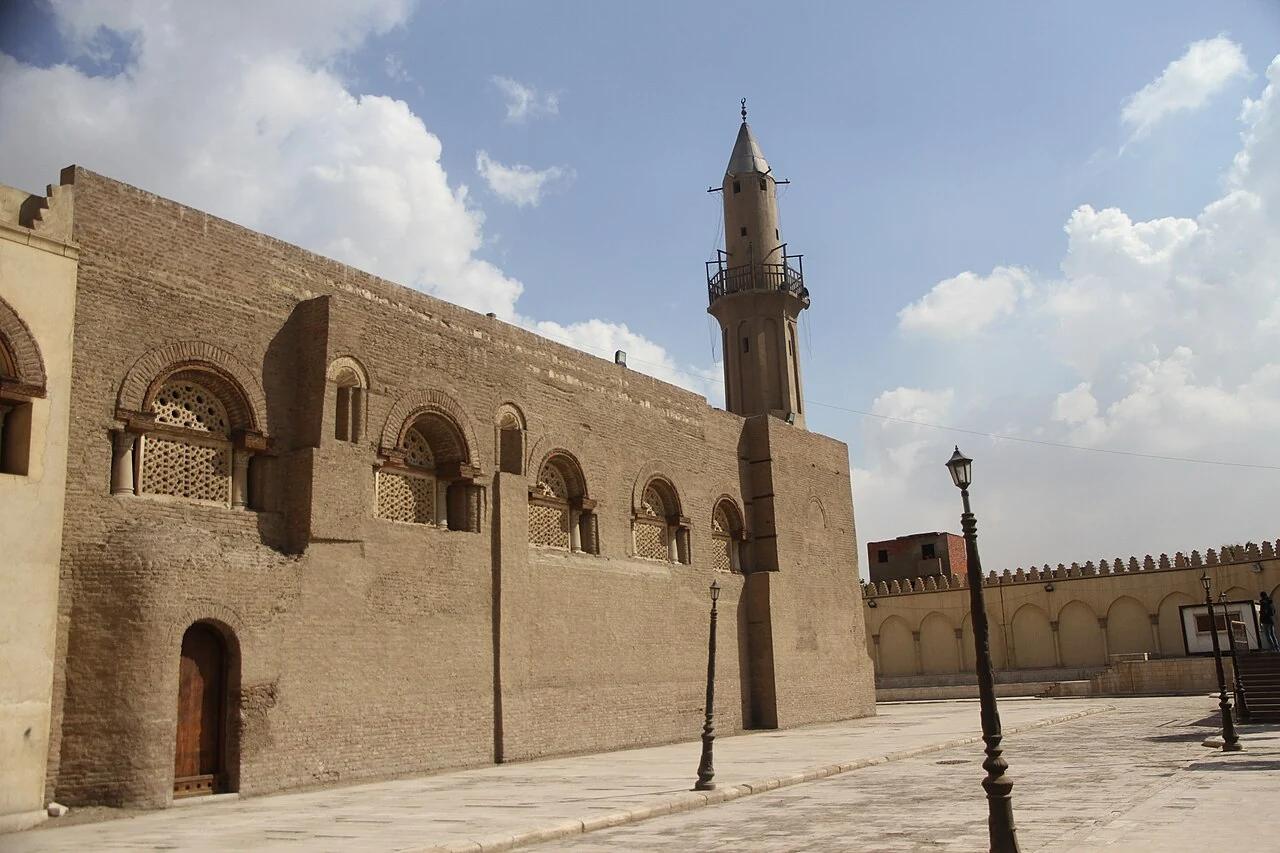
The official monument description makes an unusually clear point: much of the building visible today belongs to twentieth-century reconstruction. This does not diminish the mosque’s antiquity as an institution or the importance of the site. It distinguishes archaeological age from the age of the current architectural fabric. Tourists often assume the phrase ‘oldest mosque’ means every arch, roof and stone is the oldest surviving example, which the ministry does not claim.
This issue is a useful lesson in historic architecture. Buildings can be rebuilt after destruction or deterioration while preserving a sacred or public role. The difference between a foundation and its surviving masonry is not specific to Egyptian Islamic monuments; it matters across ancient temples and modern heritage sites. Accurate captions should explain that the photos document the present building rather than use them to claim visual certainty about 641.
Courtyard, arcades and current spatial experience
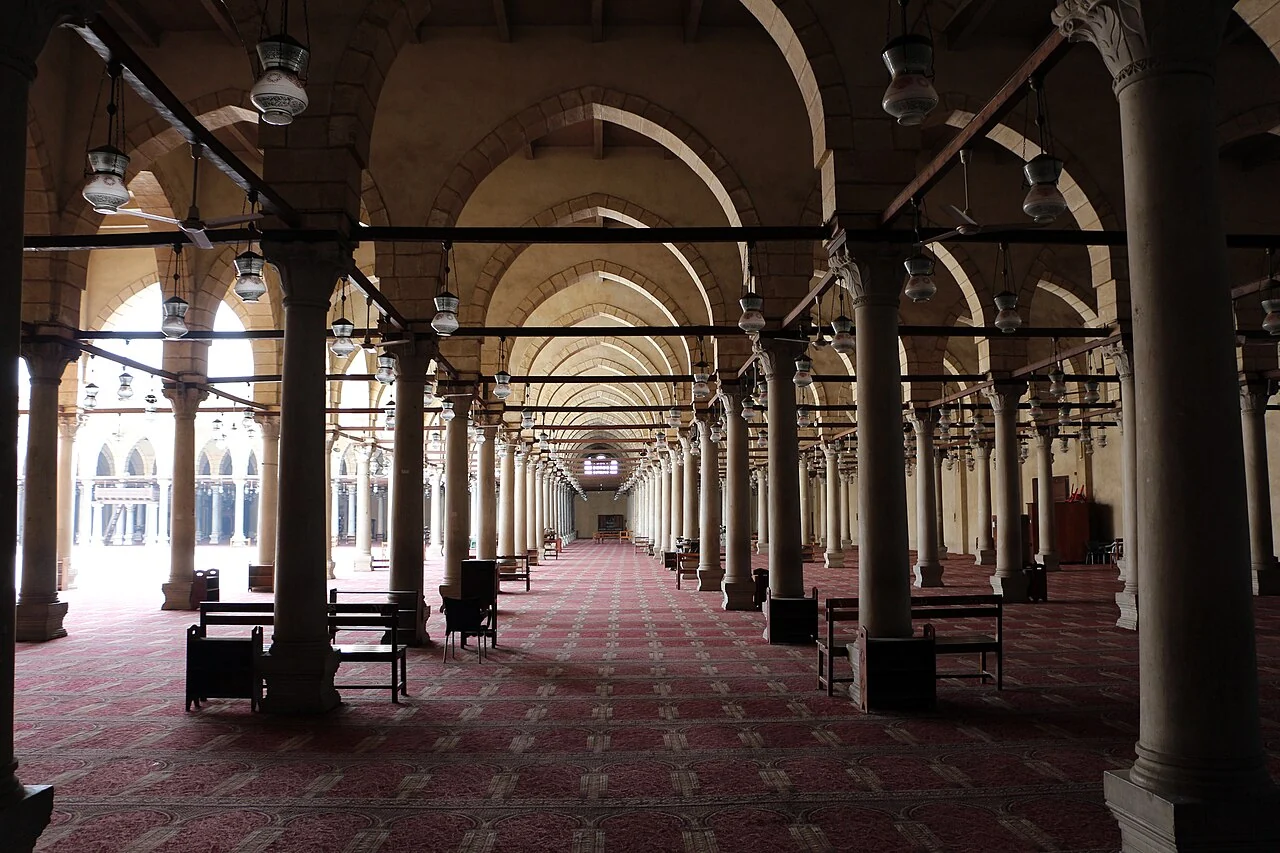
The current mosque has a large courtyard surrounded by arcaded prayer halls. The formal rhythm of columns and arches makes it recognizable to visitors, and the open central space establishes a transition between sheltered and open areas. Those features create a coherent modern religious setting, but the present proportions and materials are the product of the long rebuilding history.
Photography can effectively document the courtyard and its spatial organization, especially when the photographer and date are known. It cannot independently tell us how many worshippers used the first structure, what early materials were arranged where, or how the building looked in a particular medieval century. Historical questions about those phases require textual accounts, architectural surveys and archaeology.
Fustat’s urban archaeology beyond the mosque walls
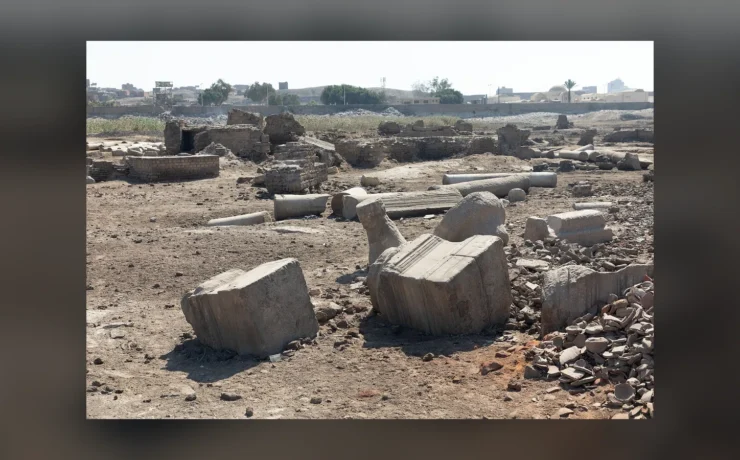
Egypt’s monuments portal describes Fustat as a deep historical landscape including remains of the old capital, places of worship, the Rawda Nilometer and other monuments. The urban area expanded and changed under successive administrations, leaving layers of domestic, commercial and religious evidence. The mosque is therefore one important part of a much larger archaeological story.
A visitor who only sees the mosque’s restored appearance might miss how nearby excavations contribute to the study of Fustat’s streets, households and economic life. Likewise, a famous manuscript associated with the medieval city need not have been written in the mosque itself. Connecting different sources through precise places and periods avoids the misleading idea that a single building can stand for the entire history of Old Cairo.
Fustat in documents: trade, communities and the Geniza
The Cairo Geniza preserves a remarkable range of medieval documents, many linked to Jewish communities and the wider urban economy around Fustat. Letters, contracts and everyday records provide a different kind of history from mosque architecture. They illuminate patterns of commerce, language and personal affairs that religious buildings alone cannot reveal. The site’s separate Geniza study explores that textual evidence in detail.
The comparison should not lead to an assumption that the Geniza documents were produced by the founding community of Amr’s mosque in 641. They belong mainly to much later periods and to distinct documentary contexts. That chronological difference is exactly why they are valuable companions rather than replacements. Together, architecture and texts can outline a changing city while keeping each source’s provenance clear.
Later capitals: al-Askar, al-Qata’i and al-Qahira
After Fustat, Egypt’s governmental geography changed with new administrative centers and urban extensions. Abbasid al-Askar, Tulunid al-Qata’i and Fatimid al-Qahira emerged in different political settings. The Mosque of Ahmad ibn Tulun belongs to the ninth century, while Al-Azhar was founded in the tenth-century Fatimid capital. Those dates make it impossible to label every prominent Cairo mosque as belonging to the same dynasty.
Comparing the buildings is instructive: Amr’s mosque is the foundation of the earliest Islamic capital, Ibn Tulun reflects the ambitions of a more autonomous provincial ruler, and Al-Azhar marks the foundation of a new Fatimid city. Each served a changing urban population. Their relationships explain the development of Cairo far more accurately than a list of famous mosques with no chronology.
Worship, education and civic life
Over many centuries, a major mosque could function as more than a site of Friday prayer. Teaching, discussion and public gatherings might take place within or around religious buildings, though their exact forms changed. The historical roles of Amr’s mosque must be studied in their individual periods rather than equated automatically with a modern university or an early democratic assembly.
The importance of a congregational mosque lies partly in its capacity to connect community practice with public authority. That relationship was especially visible at the foundation of a new capital. Yet the experiences of women, families, merchants and minority communities cannot all be read from its surviving building. A wider history of the city is needed to tell those stories with their own sources.
How to interpret architectural photographs correctly
The two accompanying photographs show the actual Amr ibn al-As Mosque in Old Cairo. Their Commons file records identify distinct photographers, and the publication retains each Creative Commons attribution. They are original documentary photographs, not illustrations generated to imitate seventh-century architecture. Their purpose is to identify the standing monument and illustrate what visitors currently see.
Images of the building cannot confirm the material of the first roof or columns. Those details belong to the Ministry’s historical account. A good caption marks that difference, and a good comparison with other mosques avoids interchanging pictures of Amr’s courtyard with those of Ibn Tulun or Al-Azhar. Source identity is part of historical accuracy, not merely a licensing formality.
A heritage site that remains a place of worship
Amr ibn al-As Mosque is not a deserted excavation site. It is a functioning religious space in Old Cairo, and modern visitors should be respectful of prayer, access arrangements and current restrictions. The official monuments portal provides visitor information, but a research article cannot guarantee hours, prices or access to all areas on a date in the future.
Those considering a visit should distinguish the mosque from the surrounding archaeological remains of Fustat. The nearby area contains monuments of different traditions and periods, requiring separate descriptions. Historical understanding is improved by looking at the mosque’s location and current architecture while remembering the extensive rebuilding that has occurred since the early medieval foundation.
Why the first Egyptian mosque matters even after reconstruction
The mosque’s enduring significance lies in its foundation in 641 and its relationship with Fustat, the earliest Islamic capital in Egypt. That history connects conquest, settlement, religious practice and the changing urban environment. The survival of the site as a prominent mosque is important even though the material fabric was repeatedly altered and reconstructed.
An evidence-based article should end by preserving this distinction rather than treating it as a flaw. The institution is old, but the present stone and architecture are not entirely seventh century. Reading the Egyptian Ministry’s source record alongside the archaeology of Fustat and the histories of later Cairo mosques offers a stronger understanding than attractive but historically false claims that the visible building is an untouched original.
Evidence table: what was built when?
| Evidence | Documented meaning | Important limit |
|---|---|---|
| Foundation 21 AH/641 CE | Egypt’s first mosque established in early Fustat | Not the date of every surviving stone |
| Palm-trunk early construction | Official account of simple original shelter | Cannot be inferred from today’s masonry |
| Fustat capital | First Islamic administrative capital in Egypt | Not identical to later Fatimid Cairo |
| Twentieth-century reconstruction | Substantial present building work is modern | Does not cancel the site’s historical continuity |
| Current mosque photographs | Real modern architecture in its actual location | Not eyewitness images of the seventh century |
| Geniza documentary comparison | Evidence for later medieval urban society | Not an archive from the mosque’s foundation year |
Primary heritage records and photo sources
The Ministry’s history is the primary institutional source for foundation, reconstruction and historical access. The UNESCO listing identifies the wider urban context. Evidence reviewed 4 November 2026.