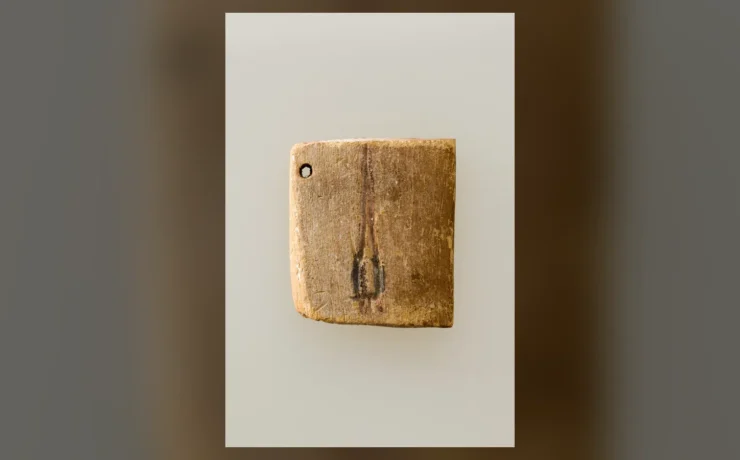
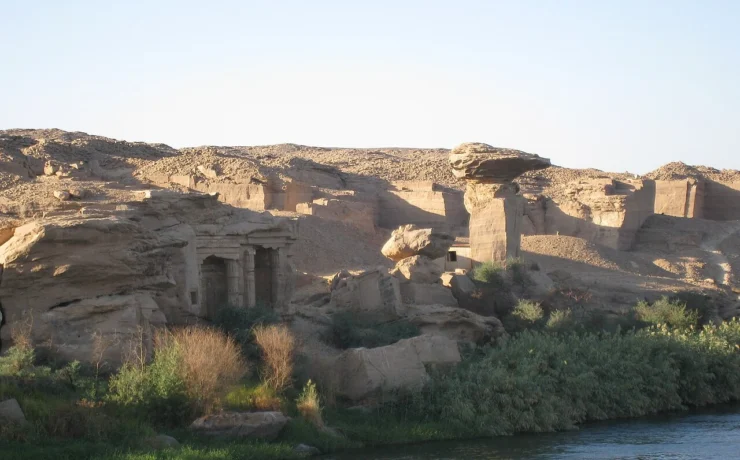
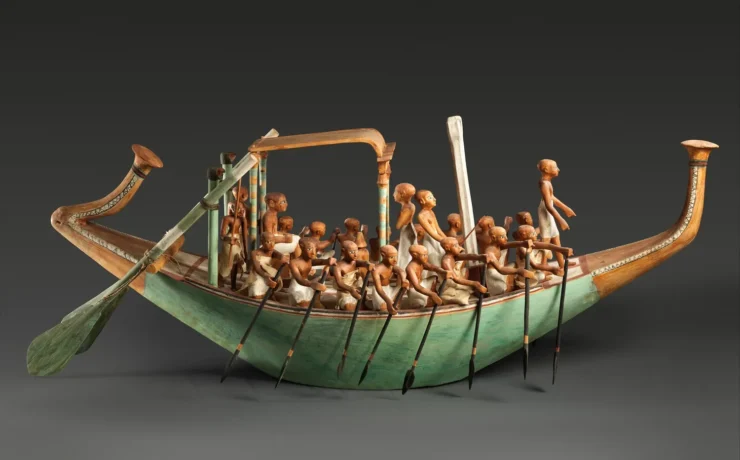
In the middle of the Eighteenth Dynasty, Hatshepsut’s government organised a celebrated expedition to a region Egyptian texts called Punt. The most remarkable account survives not as a ship’s log but as monumental reliefs in her mortuary temple at Deir el-Bahri. Carved boats, trees, people and prized products turn a state-sponsored voyage into a scene of prosperity and royal legitimacy. It is one of the most vivid Egyptian portrayals of contact with another land, yet it must be read with the same caution applied to any monument commissioned by a ruler.
The expedition is usually assigned to the ninth regnal year of Hatshepsut. The scenes represent exchange, transport and presentation of goods, not a neutral documentary film. Modern scholarship and the Egyptian Museum in Cairo help explain the people and products visible in surviving fragments. This article follows the evidence from ships to living incense trees, and from commercial exchange to the political message behind the images.
Hatshepsut and the royal setting of the expedition
Hatshepsut ruled during the Eighteenth Dynasty, initially within a royal system that also included Thutmose III. The political history of her reign cannot be reduced to an exceptional woman wearing a crown; her government worked through existing institutions, temples, estates and official networks. Deir el-Bahri was a place where those institutions could represent the ruler as favoured by Amun and capable of sustaining the cosmic and political order. The expedition to Punt appears among narratives of divine approval and monumental accomplishment. Its placement within the temple is therefore part of the historical evidence, not merely an attractive background.
The Egyptian Ministry of Tourism and Antiquities explains that the temple’s Middle Platform includes the Punt portico, while another section presents Hatshepsut’s claims about her legitimate accession. This proximity helps readers understand why an international voyage could support a royal self-portrait. Foreign goods, incense and exotic plants were valuable not just as possessions but as offerings used within religious practice. A prosperous exchange could demonstrate connections between king, god and world. None of this means the event was fictional; it means that the surviving account selects and arranges reality for a political and ritual audience.
Where was Punt, and how certain can we be?
Egyptian texts associated Punt with valuable aromatic products and a landscape on or accessible from the Red Sea network. Modern discussions often place it somewhere around the African side of the southern Red Sea, with areas of present-day Eritrea, Ethiopia, Djibouti or Somalia suggested in different reconstructions. The Egyptian Museum in Cairo describes a likely position south of Egypt along the Red Sea coast. However, identifying an exact modern border is not justified by the temple images alone. Punt was an Egyptian geographical concept used across periods; routes and political relationships could change over the centuries.
The reliefs offer ecological and social clues: houses raised on supports, trees, animals and the goods that visitors exchanged or acquired. They do not include a modern scale map or longitude. Some popular accounts claim that one plant species or the appearance of a shoreline proves a unique location, while other discussions treat Punt as identical to a single country today. These shortcuts ignore environmental change, networks extending inland and the nature of ancient artistic representation. A sound account presents the possibilities and describes which evidence supports them, rather than selling a dramatic solution to a location that scholars continue to investigate.
Ships and the voyage from Egypt toward the Red Sea
The Punt expedition depended on organised maritime transport. Temple scenes show vessels, personnel and the dramatic arrival and departure of loaded boats. Such imagery establishes that the Egyptians wanted viewers to understand the journey as a major achievement of state coordination. Wooden ships needed crews, supplies and navigational experience; cargo had to be loaded and protected. Even so, a carved boat is not an engineering blueprint. Artists may simplify proportions or repeat forms to make a composition legible. Maritime reconstructions must combine these images with independent archaeological evidence.
Connecting the Nile Valley with Red Sea ports also required movement across desert corridors or other inland routes. Those journeys likely called for provisions, supervision and labour beyond the crews shown on the temple walls. The exact path taken by this ninth-year expedition cannot be traced mile by mile from the surviving narrative. Stories about secret canals or precisely numbered caravans require sources stronger than speculative modern maps. What the images safely demonstrate is a logistical project imagined at royal scale, with vessels and goods central to the presentation. What they do not provide is a complete itinerary for modern tourists to retrace.
Reading the reliefs as a primary historical source
The Punt portico is valuable because it preserves identifiable episodes. Egyptian men and foreign inhabitants appear in scenes of greeting, carrying and transporting goods. Architectural and ecological details suggest what the artists considered visually distinctive about the destination. Some features may reflect observations supplied by travellers or officials, while other choices follow Egyptian artistic conventions. A relief’s exact position, surviving colour, inscription and relationship to neighbouring scenes matter. A close-up photograph cannot replace a study of the entire wall programme.
The Egyptian Museum in Cairo holds painted limestone fragments associated with the same narrative, including the well-known figures of the Punt ruler Parehu and his wife Ati. Their representation should not be treated as a medical diagnosis or a reliable ethnographic portrait of a whole people. Royal art can exaggerate contrasts and select unusual features as signs of foreignness. The museum identifies goods such as incense, myrrh, gold and ivory, but the list on a monument may express desirable abundance as much as an accountant’s measured shipment. Captions should explain what survives and acknowledge when individual details depend on reconstruction.
The people of Punt: Parehu, Ati and representation
The named figures Parehu and Ati are important precisely because foreign individuals rarely emerge with this visibility in popular Egyptian histories. Yet their names and poses reach us through a royal Egyptian visual language. The artists chose how to represent bodies, clothing, attendants, dwellings and gestures. The scenes can tell us about Egyptian ways of displaying diplomacy and exchange, but they cannot by themselves disclose the personal thoughts of those depicted. Treating Ati as an object of ridicule, as some older popular retellings have done, is both unnecessary and historically misleading.
A measured interpretation separates the visible person from an explanation imposed later. Clothing or adornment can offer clues about visual conventions; physical appearance cannot establish a specific modern illness without reliable biological evidence. Terms such as king of Punt are translations of an Egyptian account, not proof that the entire region followed the same kind of centralised monarchy as Egypt. Even the apparent sequence of greeting and gifts might have served an ideal narrative. The people of Punt deserve recognition as participants in a historical encounter rather than decorative figures in a story exclusively about Hatshepsut’s power.
Myrrh, incense trees, ebony and royal demand

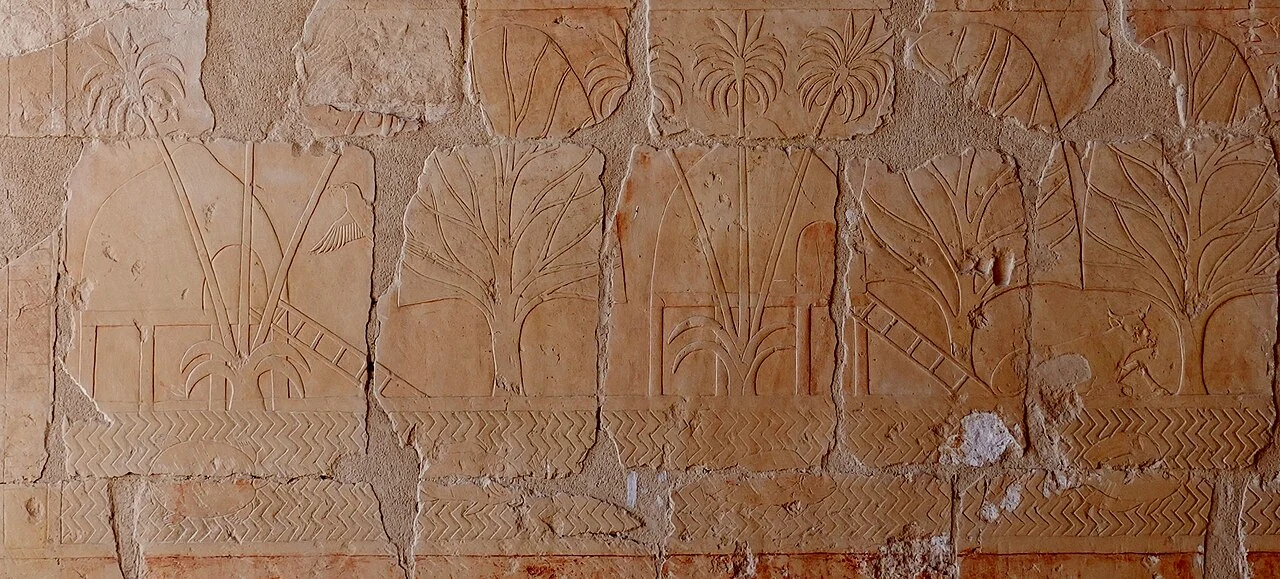
Aromatic resins were significant in Egyptian ritual, while other luxury products could support elite consumption and royal display. The Deir el-Bahri reliefs famously depict the transport of living incense-bearing trees, a detail made especially compelling by images of their roots or baskets. Carrying a tree and successfully cultivating it are not the same event. The scenes show the aspiration and claimed achievement of bringing plants home, but botanical identification and long-term survival must be evaluated cautiously. The Egyptian Museum describes incense materials, gold, ivory, ebony and other desirable items associated with the expedition.
The emphasis on aromatic plants points toward the close relationship between trade and temple ceremony. Myrrh and incense were not merely fashionable fragrances. Their use in offerings could symbolically connect distant landscapes with the divine order maintained through Egyptian cults. That religious meaning explains why an expedition could deserve permanent place in a mortuary temple. Still, we should not transform an image of bark or branches into a complete ancient inventory of species or botanical cultivation methods. The evidence supports the movement of valuable aromatic materials and a royal claim about transplanted trees, but uncertainty remains over details.
Trade, tribute or diplomacy?
Modern writing sometimes calls the voyage trade, sometimes tribute and sometimes conquest. These words are not interchangeable. Temple images might show offerings exchanged between parties, gifts presented to an Egyptian monarch or products represented as tribute. The narrative deliberately elevates Hatshepsut and the gods, so it cannot be assumed to describe a contract negotiated between economic equals. On the other hand, a royal claim to receiving foreign treasures does not prove that an Egyptian army captured Punt. The visual emphasis is on access, prestige and the movement of desirable commodities.
An expedition of this scale required resources in Egypt as well: food, manufactured exchange goods, labour and transport. These are often absent from modern accounts that focus only on gold arriving back at the royal court. Much of what we would need to calculate actual profits has not survived. There are no complete purchase ledgers that could turn the programme into a modern cost-benefit analysis. A historically responsible description therefore discusses state-led exchange and diplomatic performance, while declining to provide unsupported quantities, prices or claims that one expedition suddenly transformed the entire Egyptian economy.
What the temple’s message says about legitimacy
Deir el-Bahri makes the voyage part of a larger claim that Hatshepsut was a successful, divinely favoured sovereign. Royal ideology did not necessarily demand inventing every event. It often involved choosing meaningful achievements and giving them lasting form in stone. The expedition fitted this strategy because it linked the king with distant lands, wealthy temples, successful administration and Amun’s sacred realm. The pictures would have been encountered by people participating in the temple’s religious and ceremonial life, not by a mass audience consuming a modern newspaper.
The ruler’s position also shaped the way later historians interpreted the event. Some accounts once portrayed Hatshepsut’s reign as mainly unusual because of her gender and treated the voyage as a substitute for supposedly masculine warfare. This framing is too crude. Monument building, expeditionary activity, religious endowment and foreign relations were normal resources of kingship, regardless of the ruler’s sex. The Punt reliefs are a case study in how an Egyptian monarch used the visual arts to present authority. Readers should compare the travel imagery with the temple’s separate succession narrative rather than treating it in isolation.
What survives, what was restored and what remains unknown
The scenes have been damaged, documented and restored over time; some fragments entered museum collections. A modern photograph may show a beautifully unified wall while masking breaks, reassembly or missing portions. The Egyptian Museum’s catalogued blocks can sometimes reveal specific surviving details more clearly than a sweeping travel photograph. Site plans, conservation accounts and photographs taken at different dates allow researchers to distinguish what is ancient from what is editorially reconstructed. Inscriptions are often necessary to identify subjects that otherwise appear ambiguous.
There is no surviving visitor diary giving every exchange at Punt, no exact modern coordinate confirmed by the reliefs and no guarantee that each species can be named from a carved plant alone. Equally, the scenes should not be dismissed as mere fantasy. They preserve important evidence for maritime ambition and for the court’s cultural geography. The best reading holds those truths together: the expedition is historically meaningful, and the record we possess was created in the service of a ruler who wanted to be remembered in a particular way.
Study the objects, then follow the connected history
Visitors at Deir el-Bahri can look for the portico scenes of boats, people, houses and trees, while respecting current conservation barriers. Museum records help interpret the detached fragments. Rather than rushing to a single mysterious location on a map, study how movement, gift exchange and divine ideology are presented in the decorative programme. Distinguish Egyptian conventions of depicting outsiders from evidence about the people themselves. Notice how botanical imagery and logistics appear together in the visual story of royal success.
For a wider foundation, read Kemet Vault’s Hatshepsut kingship study and the Thutmose III Megiddo campaign. The former covers the sovereign’s broader monuments and political position; the latter illustrates a different form of royal narrative about foreign action. Linking these studies lets readers compare evidence across an era without duplicating general biographies. A research question that remains worth asking is not merely where Punt stood, but why this particular journey was monumentalised so vividly.
Sources and photographic provenance
The Egyptian Ministry’s official Hatshepsut temple description explains the portico’s role and its relation to royal legitimacy. The Egyptian Museum Cairo’s Punt fragments catalogue identifies surviving painted limestone and associated figures. Its New Kingdom artefact collection provides further museum context. The documentary photographs reproduce the reliefs themselves, not AI-generated versions of a vanished port or people. Interpretations of geography and diplomatic power are marked as reasoned possibilities, not direct eyewitness facts.