In Tutankhamun’s burial chamber, a stone sarcophagus did not stand alone under the painted walls. It was enclosed within four enormous gilded wooden shrines, one inside another. Inside the sarcophagus lay three human-shaped coffins, and inside the last coffin was the wrapped body of the young king. The gold mask, now the tomb’s best-known object, formed only the innermost visible part of this arrangement.
That sequence is much easier to understand when the objects are treated as a system rather than a pile of treasures. The shrines defined sacred space; the stone and wooden containers surrounded the body; inscriptions, protective figures and seals gave the burial ritual meaning. Howard Carter’s excavation papers allow us to follow how the layers were uncovered instead of imagining the entire chamber exposed in one afternoon.
Four shrines occupied almost the entire burial chamber
The Metropolitan Museum’s account of the discovery notes that the largest of the four gilded wooden shrines nearly filled the small burial chamber. They were constructed as nested enclosures, with doors that had to be opened before the stone sarcophagus inside could be reached. Their scale matters: the chamber was not a spacious gallery that happened to contain an impressive box.
The shrines were covered with sacred imagery and texts. Their surfaces were part of a religious environment, not simply expensive packaging. The barriers also have a history as archaeological objects. Carter’s team recorded their position and fittings as they dismantled them. A photograph of a reconstructed shrine in a museum therefore answers a different question from a photograph of its discovery inside KV62.
The Met reports that clay seals on the doors of the second and third shrines were still intact when Carter examined the chamber. That detail helped suggest that the central burial had not been completely disturbed even though the tomb showed signs of ancient entry. It would be wrong to call every corner of KV62 untouched, but equally wrong to assume the intact inner barriers were modern additions.
Inside the shrines was a quartzite sarcophagus
At the center stood a red quartzite sarcophagus. The Griffith Institute’s spatial archive identifies the burial chamber as the setting of the nested shrines, sarcophagus and successive coffins. The Met describes four protective winged goddesses associated with the sarcophagus.
In ordinary language, a sarcophagus is a stone coffin or container. In this case it is useful to keep the stone sarcophagus separate from the three anthropoid coffins it held. They are not four interchangeable “gold coffins.” Different materials and shapes did different work in the physical and symbolic burial.
The sarcophagus helped define a durable boundary around the human-shaped coffins. The goddesses and inscriptions gave that boundary another meaning: protection of the deceased as he passed toward a desired afterlife. Ancient funerary objects were made to be seen by gods and ritual participants as well as, eventually, by excavators. A modern photograph reveals the surviving material without recreating the ritual itself.

Three coffins, but only the innermost was solid gold
The gold mask is so famous that it often eclipses the coffins around it. The Egyptian Ministry of Tourism and Antiquities describes three anthropoid coffins. The two larger examples were made of gilded wood with decorative inlays; the innermost was made of solid gold. The ministry lists the weight of the gold inner coffin as 110.4 kilograms and describes how the coffins fitted one inside another.
These coffins shared the king’s human form and elements of royal and Osirian symbolism, but they were not identical copies. The outer gilded coffin was larger and carried the familiar crossed arms and insignia. The central coffin had its own construction and decorative scheme. The innermost gold example provided the immediate container for the king’s mummy.
A caption should never describe the mask as if it were part of the coffin lid. It was a separate object positioned across the wrapped head and shoulders of the deceased. Readers who want its inlaid materials, museum number and protective inscription can consult Kemet Vault’s dedicated study of the gold mask and spell 151. The subject of this article is the burial’s nested arrangement, not a second explanation of the mask.
How Carter recorded the layers
The four shrines, the sarcophagus and the coffins were found in place, but recording and dismantling them took years. The Griffith Institute’s fourth-season journal shows how the work continued into October 1925, long after the tomb entrance was first discovered in November 1922.
The sequence is revealing. The coffins could not simply be lifted out like items from a display shelf. Heavy lids, fragile surfaces, resins, sealed doors and limited working space required documentation and physical intervention. Carter’s plan of the burial chamber, archived as MSS i.G.31, maps where burial objects lay and identifies their excavation numbers.
That plan can tell us how things were positioned before their removal. It cannot recover every action performed in the eighteenth dynasty, and Carter’s published narrative is itself a historical source with limitations. Still, the combination of plan, object cards, photographs and dated journal entries is far stronger than an unsourced animation showing a neat sequence of boxes opening.
On 28 October 1925, Carter’s team lifted the lid of the innermost gold coffin and encountered the masked mummy. That date must be kept separate from the opening of the tomb’s entrance in 1922 or the first view into the burial chamber in February 1923. Ancient burial and modern excavation are distinct events separated by millennia.
Protection worked through both barriers and images
The first function of the nesting was physical. Wood, stone and metal formed successive containers around the body. But the arrangement also embodied the king’s transformation after death. The human forms on the coffins, the winged goddesses and the inscriptions connect the burial to Egyptian ideas of renewal and divine protection.
It is tempting to explain every layer as an attempt to defeat tomb robbers. Safeguarding the burial was important, but this does not exhaust the meaning of decorated shrines or inscribed coffins. The text and imagery were made for a funerary world in which divine powers surrounded and sustained the deceased. Expensive craftsmanship and spiritual function were closely linked rather than competing explanations.
The order of objects is therefore worth remembering: four gilded wooden shrines, a red quartzite sarcophagus, three anthropoid coffins and the mummy with a separate gold mask. That is a physical sequence supported by the excavation record. Details about the thoughts of individual priests, carpenters or mourners remain outside what the surviving objects can demonstrate.
What the surviving photographs actually show
There are two original photographs in this article. The first shows the genuine gold mask in a modern museum setting. The second shows the surviving burial chamber and sarcophagus at KV62 as photographed in 2020. Neither image captures the four intact shrines as Carter first found them. For that, readers need the Griffith Institute’s original excavation documentation and surviving historic photographs.
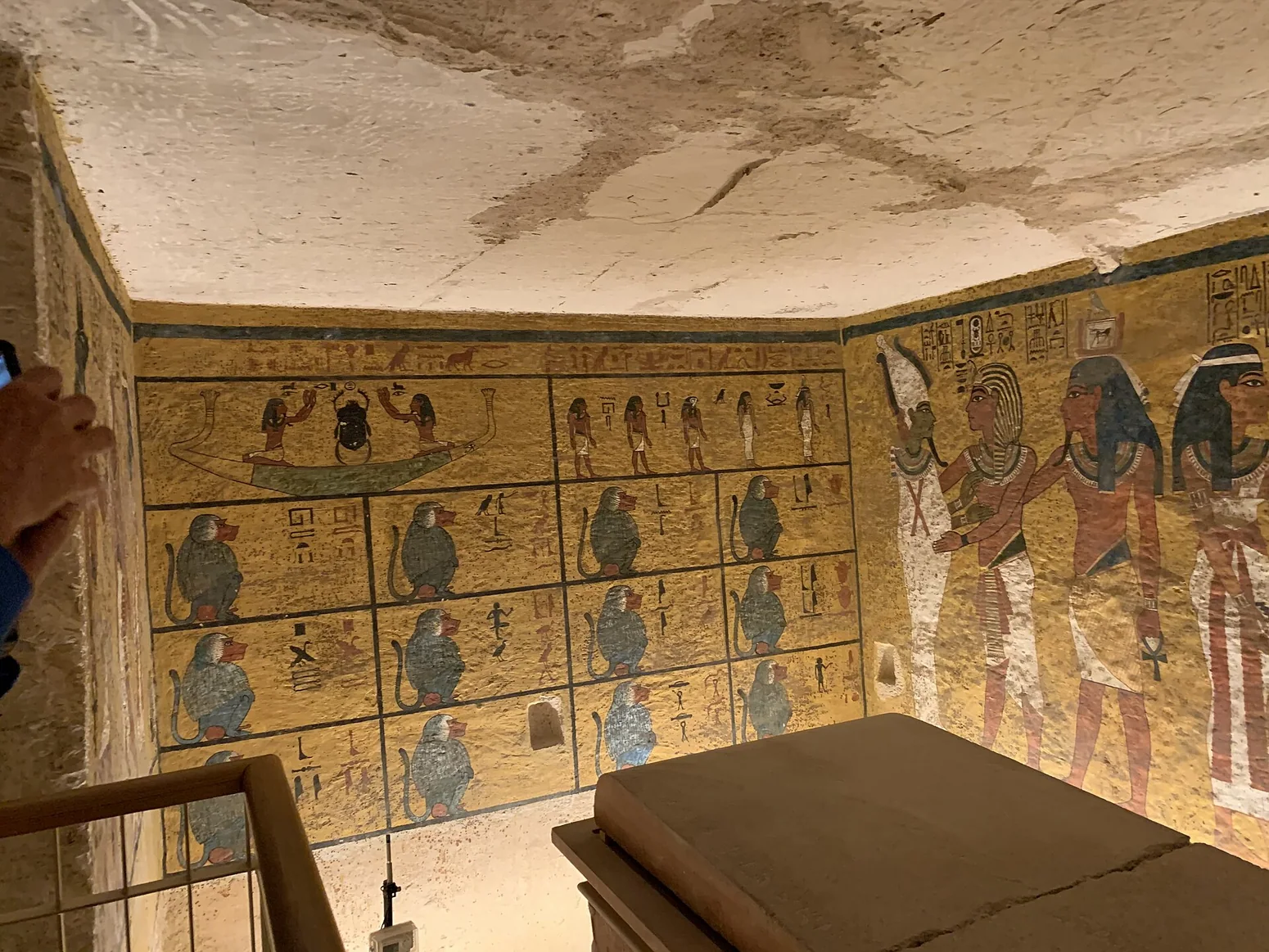
That difference is not a minor disclaimer. A modern visitor sees the tomb after more than a century of excavation, conservation and display decisions. The original arrangement must be studied from records of the objects’ positions, not invented by placing museum photographs over one another.
Why the burial sequence still matters
Tutankhamun’s burial tells a story that a single gold object cannot. Its nested architecture lets us examine the relationship between material craftsmanship and religious protection in a royal tomb of the late Eighteenth Dynasty. The four shrines created a small sanctuary around the sarcophagus; the coffins brought that protection progressively closer to the deceased.
The evidence can be checked: the Met explains the four shrines and intact inner seals; Egypt’s antiquities authority describes the three coffins and their materials; the Griffith Institute preserves Carter’s plans and journals. The combination makes a richer and more verifiable account than a list of treasure values or a claim that the mask alone protected the king.
To understand the architecture of all four rooms rather than the burial equipment, read Kemet Vault’s KV62 room-by-room guide. The two articles address related but distinct questions: what surrounded the king in his burial chamber, and how that chamber fitted into the whole tomb.