What is Egypt’s White Desert National Park? The White Desert is a protected geological landscape near Farafra Oasis in Egypt’s Western Desert, designated in 2002. Its extraordinary white chalk outcrops, wind-carved columns, fossils and desert habitats reflect natural processes over geological time. Visitors should check access rules, vehicle routes and camping permits through authorized local operators.
This research-led guide explains the real geology and responsible ways to experience the formations without repeating invented tour fees or claims about imaginary ancient builders.
Egypt’s White Desert is a protected landscape, not just a photo spot
The White Desert near Farafra is a remarkable landscape of pale chalk, eroded rock columns, open desert and traces of much older geological environments. It is a designated Egyptian protected area rather than an unrestricted sculpture garden. Egypt’s State Information Service identifies Prime Ministerial Decree No. 1220 of 2002 as a basis for its declaration, and the Environmental Affairs Agency publishes park-management and permit information. The exact protected-area boundary and size figures vary across official documents and management editions, so a responsible guide should not invent a single unqualified square-kilometer number. The travel experience begins with appreciating that the rocks are geological heritage, while the terrain also supports plants, wildlife and human activity around the oases. A tourist may focus on the unusual shapes, but an excellent visit also respects fragile surfaces and designated routes. This article combines natural-history research with practical planning, without implying that a tour vehicle can go anywhere or that camping is automatically allowed at every formation.
Farafra Oasis and the Western Desert setting
Farafra lies within Egypt’s Western Desert and is widely used as a gateway to the White Desert. The Ministry’s Experience Egypt platform describes the oasis as a starting point for desert excursions and notes the nearby Black Desert, Crystal Mountain and sand-dune landscapes. These are distinct environments, not interchangeable names for the same white-chalk area. Routes can connect several of them, but the operator should specify which protected areas and stops are included. Distance and driving time depend on the actual starting settlement, permitted roads, route condition and travel plan. A map of the Western Desert helps orient travelers to the oases, but it does not replace local navigation or required permits. The area is not an ordinary city excursion with dense public transport and services at every turn. Dependable local arrangements matter because the landscape is remote, the climate can be severe and routes may change. Farafra’s presence as a living oasis community should not disappear behind photographs of uninhabited rock pillars.
Why the White Desert was protected in 2002
The governmental designation of the White Desert as a reserve in 2002 reflects its natural and geological importance. Egypt’s Environmental Affairs Agency treats the area within the wider national network of protected places and provides separate documentation for visitor activities. Protecting a place does not mean every feature is immune to damage: off-road driving, litter, destructive collecting and uncontrolled camping may affect fragile environments. The State Information Service describes the pale landscape, unusual formations and associated wildlife as reasons for conservation. A scientific paper on the White Desert’s karst heritage explains that its value extends to geological education and research as well as tourism. A protection date establishes when a modern legal arrangement was created, not when the geology began forming. The rocks are the result of natural processes over geological time. Readers should resist the temptation to describe a government decree as if it had ‘created’ the desert or to claim every displayed formation has an official individual monument status.
What the white rocks are made of
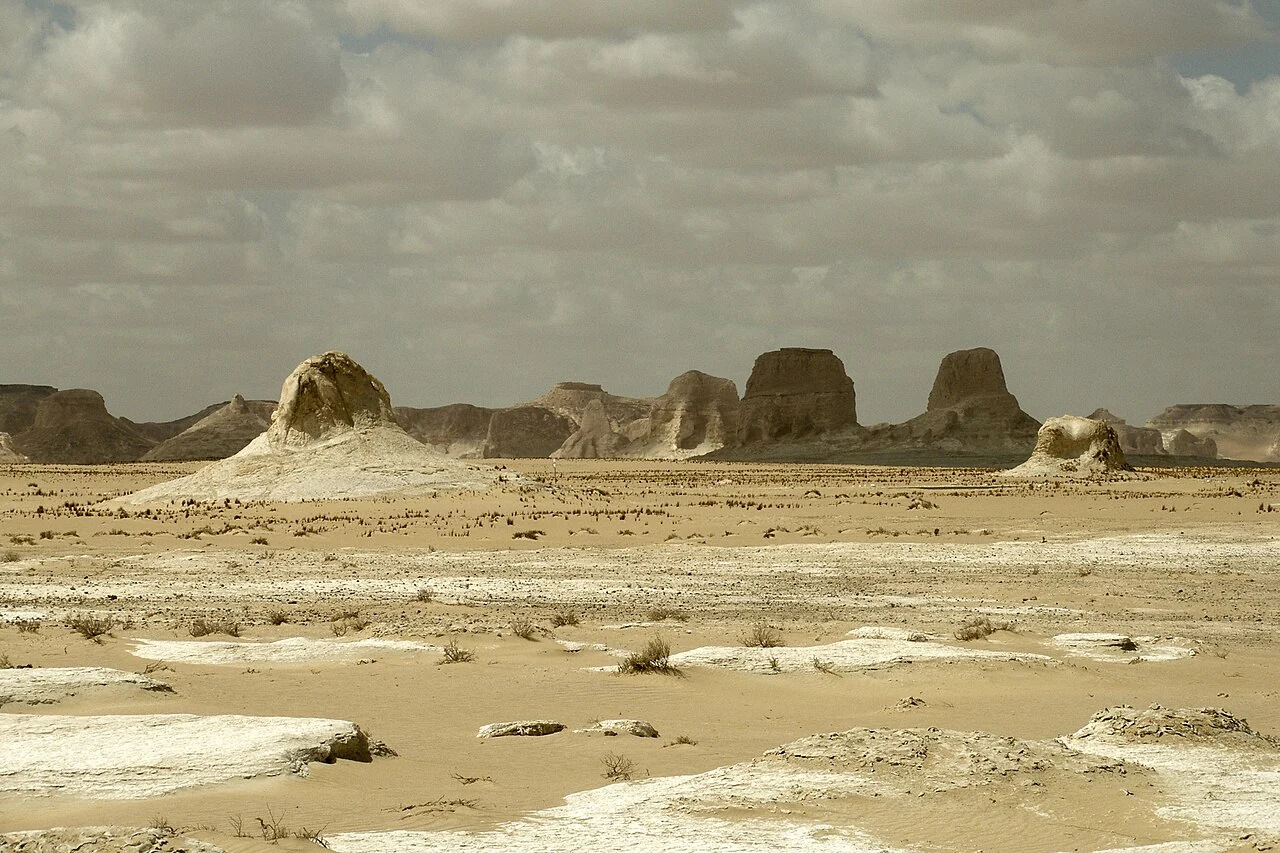
The White Desert’s famous pale outcrops are largely chalk, a soft carbonate rock. Scientific research describes the region’s Khoman Formation as an Upper Cretaceous marine chalk unit, evidence of environments very different from today’s hyper-arid landscape. Chalk derives from long-term accumulation and transformation of carbonate-rich material, including microscopic marine remains. Its light color and physical properties help explain why the outcrops look so different from nearby dark hills and sand. A visitor does not need to be a geologist to appreciate that these forms were not carved by a prehistoric architect or deposited as fresh snow. The State Information Service also identifies chalk as the origin of the area’s striking color. Scientific terms such as Cretaceous and marine sediment are interpretations supported by geological surveys and stratigraphy, not inventions based on shape alone. The rocks record deep-time environmental change within the wider Western Desert.
How mushroom rocks form: erosion instead of hidden technology
Mushroom-shaped chalk columns are among the White Desert’s best-known features. Their unusual silhouettes result from natural weathering and erosion acting on rocks with differing resistance, fractures and exposures. The Environmental Affairs Agency’s management document discusses wind-sculpted chalk stacks, while specialist research examines how wind-blown sand, salts and temperature differences affect the limestone. A narrow pedestal and wider top can develop through these interacting processes, rather than through deliberate carving by an unknown civilization. The exact history of one individual stack may be complex, and the same visible shape can emerge by different combinations of weathering. It is therefore better to explain geological mechanisms than to assign an invented age to every mushroom rock. These formations are fragile. Climbing a pedestal, balancing objects on it or chipping material to take home can cause damage that is difficult or impossible to reverse. Admiring the forms from permitted ground preserves their significance for future visitors.
The scientific importance of ancient marine sediments
Fossils within the Western Desert’s marine sedimentary units tell a story of ancient environments in which organisms lived long before modern oases existed. Official Egyptian descriptions mention fossils and the broader geological value of the park, while geoscientific work dates the chalk and associated formations using stratigraphy and other methods. A fossil encountered in the landscape should not automatically be classified from a tourist photograph. Correct identification can require details of its preservation, rock context and comparisons with documented specimens. Travelers should not remove fossils or break open outcrops, especially inside a protected area. Geological samples belong to scientific records that depend on knowing where they came from. A dramatic claim that the entire desert was once a single ancient city is not supported by marine sediment evidence. The real history is more compelling: rock formed under environmental conditions that no longer exist here and was subsequently exposed and reshaped over immense periods.
Chalk towers, caves and the diversity of desert forms
The White Desert is not composed exclusively of one famous rock known as the chicken and mushroom. The protected landscape includes numerous chalk towers, eroded escarpments, depressions and contrasting sedimentary features. Egypt’s official tourism information mentions caves and nearby rocky landscapes, while geological research describes karst depressions and related structures in the Bahariya–Farafra region. Karst involves rock features shaped in part by dissolution, although wind and other weathering processes are also important in today’s exposed terrain. Each setting has its own access questions. A cave shown in a tour brochure may not lie on the ordinary route or be suitable for unescorted entry. A science-based guide keeps named features connected to their actual geological context rather than treating every rock as evidence of the same mechanism. The strongest experience is to see several landforms and compare them without touching or altering surfaces. A guided explanation can bring apparently abstract processes into focus.
The chicken-and-mushroom formation and tourist photography
A particularly recognizable group of White Desert rocks is popularly described as the chicken and mushroom. The forms offer an example of how people interpret natural shapes through familiar objects. A rock resembles a bird from one angle and something quite different from another. Such nicknames are useful for orientation but do not constitute formal scientific classifications. Our second authentic photograph documents this real site, photographed by AmiraAdel93 and released under a separately identified Commons licence. The image does not promise that a visitor can park next to the rocks or climb them for a selfie. The formation’s delicacy is part of its appeal, and physical contact can degrade the underlying chalk. Photographers can work with light, perspective and foreground instead of stepping onto restricted surfaces. Small visual differences between photographs are expected because of weather, angle, camera equipment and natural changes. A responsible article distinguishes a popular rock nickname from an archaeological discovery or geological age estimate.

Wildlife and vegetation in an apparently barren area
The government’s description of the White Desert includes desert plants and wildlife, some of which are considered rare or threatened. This is a useful corrective to the claim that the desert is biologically empty simply because there are long stretches without obvious vegetation. Species distribution changes with habitat, water availability and human pressure. Wildlife should never be treated as a guaranteed part of a short tourist excursion; many animals are nocturnal, elusive or sensitive to disturbance. Travelers should not feed foxes or other animals, leave food waste near camps or pursue a species to obtain a photograph. Desert vegetation can be slow to recover when damaged by wheels or repeated foot traffic. A careful ecological visit recognizes that living systems can be present even when they do not create the green appearance of a national park elsewhere. Visitors who value conservation should ask their operator about waste management, legal routes and how the trip avoids harming habitats.
White Desert versus Black Desert and Crystal Mountain
A day or overnight itinerary from Farafra may combine more than one landscape. The official Experience Egypt destination description distinguishes the pale White Desert, dark-stone Black Desert and Crystal Mountain. These names refer to different visual and geological settings, not three commercial zones within one theme park. A provider who advertises all three should specify distances, access arrangements and the proportion of time spent at each. Crystal-bearing geological material is not a souvenir for unrestricted extraction. The Black Desert’s darker surface is not evidence that the White Desert rocks were recently painted or artificially whitened. Comparing the stops can reveal how rock composition, weathering and topography influence what visitors see. Some tour routes also pass through Bahariya Oasis, but the actual starting point and road permissions must be confirmed. Good trip design avoids cramming too many remote sights into a single day if it leaves no time to understand any of them.
Is overnight camping possible?
Camping is part of the White Desert’s popular travel image, but whether and where it is allowed depends on protected-area rules, permits and operational conditions. Egypt’s Environmental Affairs Agency explicitly publishes requirements for activities and camping inside protected areas. The Ministry’s Experience Egypt site advises visitors to consult their travel company or authorized guide about permits and regulations before heading into the desert. A social-media photograph of tents under chalk towers does not establish that camping at that exact location is currently legal. Ask an operator to identify the approved campsite, sanitation arrangements, waste removal, drinking water and emergency contact. Conditions can be cold after sunset even when daytime sun feels warm, and an overnight trip should include adequate clothing and suitable sleeping equipment. Responsible camping means leaving no food scraps, plastics, firescarred rock or discarded batteries. The desired photograph of a star-filled sky should never outrank the safety or conservation obligations of the trip.
Four-wheel-drive transport and guide decisions
The remote terrain and protected status make knowledgeable local arrangements especially important. An appropriate vehicle and experienced driver can help keep guests on permitted routes while responding to weather or mechanical problems. Four-wheel drive does not justify unlimited off-road exploration. Ask whether the driver and operator have the relevant permissions for the route, and clarify the plan if a track is temporarily closed. A suitable trip should identify the number of passengers, the vehicle type, expected meal arrangements and where guests can obtain drinking water. The absence of mobile reception in some remote places makes it important to know the operator’s communication and emergency procedures. Visitors should not follow a route drawn from a generic travel blog without local verification. The itinerary is safer and more environmentally responsible when a qualified person understands both the landscape and current restrictions. Budget sufficient time for any road transfer rather than trusting a universal driving estimate.
When to travel and what weather can change
The Western Desert’s dry conditions can produce strong contrasts between daytime and nighttime temperatures. The best time for a particular traveler depends on tolerance for heat, planned camping, walking and the operator’s recommended conditions. Wind can affect visibility and create blowing sand; a clear weather forecast for Cairo does not establish the same conditions around Farafra. Travelers should check local weather and official advice close to departure. Extra sun protection, water and layers for evening temperatures are sensible considerations, while the precise equipment depends on the activity and duration. Some visitors prioritize morning photography, others the different color of chalk at sunset. Neither lighting preference justifies departing from an approved route or remaining in a restricted zone. The article avoids a fabricated calendar of universally perfect dates. Weather, regulations and route access all influence the real experience, and a responsible operator should be willing to adjust plans when conditions make an activity unsafe.
Pricing and permissions: what should appear in a real quote
A reliable desert tour proposal should state the departure location, duration, passenger count, vehicle arrangements, included meals and overnight facilities if relevant. It should also clarify whether protected-area entry fees and legal permits are included, and which parts of the journey are optional. The current cost can change, so an old online tariff should not be passed off as a verified November 2026 fact. Comparing two offers requires checking whether they cover the same protected area, length of stay and services. A cheaper quote may exclude permits or camp equipment, while an expensive one may include arrangements a guest does not need. Travelers should ask for a formal confirmation that identifies the responsible operator and emergency plan. The official EEAA guidance provides the correct category of authority for protected-area activities. Booking is not the same as permission to enter every site. An operator’s commercial offer remains subject to actual environmental regulation and the day’s conditions.
Photographs, fragile landforms and a responsible Discover image
The two images accompanying this guide are original documentary photographs rather than AI simulations of an impossible desert landscape. The first, by Vyacheslav Argenberg, shows actual eroded white rock formations; the second, by AmiraAdel93, captures the recognizable chicken-and-mushroom group. Their files have separately verified Creative Commons licences and actual author records. This matters because heavily composited travel images sometimes make white chalk look like an artificial ice palace. Genuine photographic evidence gives readers a more trustworthy sense of the place. The photographs were taken under conditions specific to their dates; lighting and access may differ during a future trip. Kemet Vault’s captions identify what is depicted without claiming the images show a current live view or an authorized commercial route. Visitors making their own pictures should avoid touching formations, collecting samples or entering closed areas in search of a more dramatic frame. The rocks’ natural appearance is already distinctive enough.
How the White Desert differs from other Egyptian protected and oasis destinations
Egypt contains protected places with very different environmental purposes. The Ras Mohammed National Park guide concerns living marine reefs and coastal habitats around Sinai, whereas Farafra’s White Desert is best known for chalk geology, fossil evidence and fragile landforms. Conservation rules in one park should not automatically be copied into the other. Oasis travel has separate cultural dimensions too: our Siwa Shali fortress cultural guide focuses on a historic inhabited oasis setting, not a substitute route through the White Desert. The comparison helps travelers choose an interest honestly. A geology-first excursion is different from a reef-snorkeling trip or an architectural heritage visit. Across all three, genuine experiences depend on local communities, responsible guides and verified access rather than on a generic promise of untouched nature.
Official and scientific sources
The protected-area designation and natural features are grounded in the Egyptian State Information Service’s White Desert record and the Environmental Affairs Agency’s reserve directory. Its activity and camping permit information identifies operational matters that visitors should check with their operator. The official Experience Egypt excursion description addresses Farafra access. The geology is checked against a peer-reviewed karst heritage study and a scientific paper on Farafra sedimentary history. These sources agree that the pale chalk and erosion are natural geological features, although older and newer documents report different protected-area sizes. The two distinct documentary photographs are attributed in their own captions. Neither exact 2026 permit prices nor specific active camp permissions are invented.