Why is Wadi Al-Hitan a UNESCO World Heritage Site? Wadi Al-Hitan, also called Whale Valley, was inscribed in 2005 because its exceptionally abundant, well-preserved Eocene whale fossils document the evolutionary transition toward fully marine life. It is a protected fossil landscape, not a theme park or a site where visitors may collect specimens.
Egypt’s Western Desert once contained marine environments whose life left extraordinary fossil evidence. At Wadi Al-Hitan in Fayum, skeletons of extinct whales are preserved within the landscape in which they were buried. This makes the destination both a major scientific site and a carefully managed visitor area. The guide follows UNESCO’s World Heritage description and sustainable-tourism recommendations, distinguishing the protected fossil trails from nearby attractions whose access requirements and travel times are separate.
Further relevant reading includes how scientists reconstruct ancient Egyptian landscapes and a separate wider Egypt trip planning guide. These subjects offer background context without duplicating this article’s evidence.
A fossil marine landscape in the Western Desert
Wadi Al-Hitan is a protected area in the Fayum region of Egypt’s Western Desert. Its name means Whale Valley, referring to the ancient whale skeletons exposed in the desert strata. The setting may surprise visitors who expect an ocean coastline rather than sand and rock. Geological history explains that contrast: the area preserves deposits from a time when marine environments extended over what is now dry land. The fossil record is therefore evidence about ancient ecosystems as well as whale evolution.
UNESCO’s World Heritage description emphasizes the unusual combination of fossil abundance, preservation quality and landscape setting. The fossils were embedded in sediments of their ancient environment, allowing researchers to investigate relationships among animals, rock layers and ecological conditions. Wadi Al-Hitan is not an archaeological city built by humans. Its core scientific subject is the deep-time natural history of vertebrates in the Eocene, long before pharaonic Egyptian culture existed.
Why UNESCO inscribed it in 2005
UNESCO added Wadi Al-Hitan to the World Heritage List in 2005 under natural criterion viii, recognizing its exceptional value for the history of life on Earth. The site preserves evidence of a remarkable evolutionary transition: early whales adapted from ancestors that lived on land toward a fully aquatic existence. Fossils of archaeocetes provide a combination of anatomical features that make that transition visible rather than merely hypothetical.
Inscription does not mean that every fossil was discovered in 2005 or that scientists finished studying the area that year. A World Heritage decision recognizes existing scientific significance and places emphasis on protection and long-term management. It also means that visitors share a responsibility to treat the landscape as a fragile research archive. The value is not just in an impressive bone photograph but in the preserved relationships among skeletons, sediment and surrounding fossil species.
What the ancient whales reveal about evolution
Some whales at Wadi Al-Hitan had bodies adapted to swimming in water while retaining traces of hind limbs. UNESCO identifies the fossil assemblage as especially important for demonstrating the late stages of the change from land-dwelling ancestors to ocean-going mammals. The skeletons provide anatomical evidence, including features of the skull, teeth and limb structures. Researchers can compare these features with those of earlier fossil mammals and modern cetaceans to reconstruct evolutionary relationships.
It is incorrect to describe an exposed fossil as a modern whale that simply wandered into the desert or as an intermediate individual that suddenly became a whale during its own lifetime. Evolution occurs through changing populations over many generations. The site’s significance lies in the evolutionary history preserved across the fossil record, not in one skeleton transforming in place. Responsible interpretation presents fossil anatomy and scientific context without replacing them with a literal science-fiction story.
Archaeocetes, Dorudon and Basilosaurus
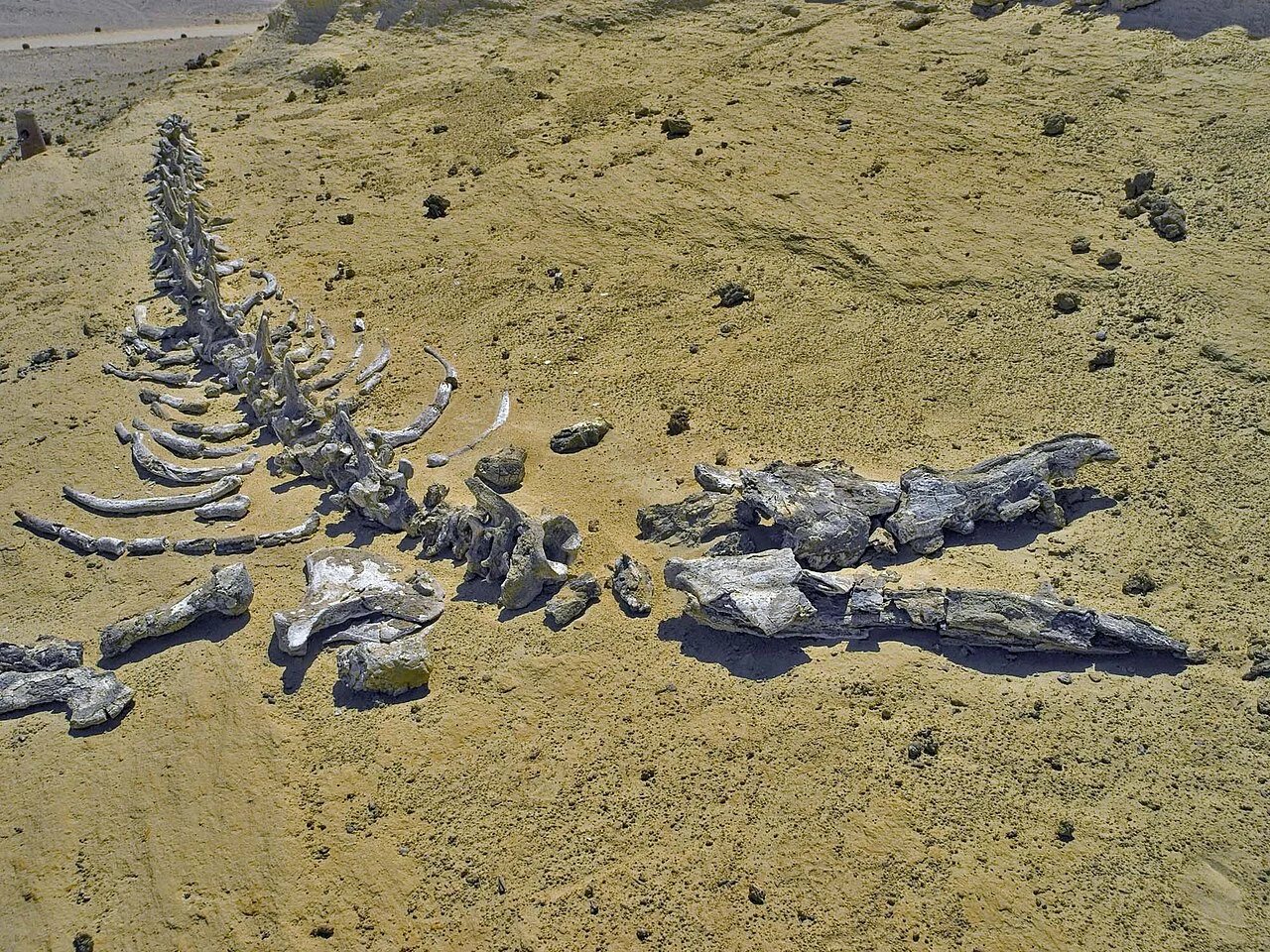
Many published discussions of Wadi Al-Hitan focus on archaic whales grouped among archaeocetes. Dorudon and Basilosaurus are well-known Eocene whale genera represented in Egypt’s broader fossil record. Species, specimen identity and exact stratigraphic positions matter to specialists, however. One image labeled ‘Dorudon fossil’ should not be used as a portrait of every whale in the protected valley. The fossil in the first photograph has its own source description and photographed date.
The distinction between a genus, a species and an individual preserved skeleton is essential. Museum exhibits can bring fossils together from different locations and dates for teaching purposes. An on-site fossil visible in original sediment tells a different kind of story. Researchers use both, but they record provenance when comparing them. Wadi Al-Hitan’s unusual access to real fossil-bearing strata helps visitors see the environment in which these animals died and were buried.
The last stages of losing hind limbs
UNESCO highlights the fossils’ retention of reduced hind limbs as a particularly evocative feature. Modern whales have streamlined bodies adapted to life in water, but their evolutionary ancestors possessed structures associated with life on land. The comparison between fossil and living anatomy provides a concrete way to study changes in body plan. It also illustrates why an apparently small bone can be scientifically significant when its position and relationships are securely established.
An image of a vertebral column or skull may not show the hind limbs at all, so a caption must not claim they are visible without supporting identification. Scientists work from many bones and specimens rather than a single tourist photo. The broader evidence includes sedimentary history, skull and tooth features, and comparisons to other sites. Keeping this distinction prevents popular guides from exaggerating what one skeleton in the sand demonstrates.
Sediments, shells and other signs of an ancient sea
The fossil whales are part of a wider marine assemblage. UNESCO notes that other fossils and geological evidence help reconstruct ancient environmental conditions and life around the whales. Sedimentary layers can preserve information about water movement, deposition and changing habitats. Shells, fish and other organisms add context for what kind of ecological system existed. This combination matters because it connects evolutionary anatomy with a real paleoenvironmnet rather than presenting bones as isolated curiosities.
The desert scenery today is a product of much later environmental history. Wind erosion and weathering may expose fossils, but the visible surface need not equal the seafloor at one instant. Layers were deposited at different times, then altered and exposed. A responsible visitor should not collect shells or fragments, even if an object looks small or common, because removing it can destroy information about location and geological association.
How researchers read skeletons in their original setting
An original fossil site’s value comes from context. Researchers document the location of bones, their orientation, rock layer, degree of articulation and association with other material. These observations may reveal aspects of burial and preservation, although individual claims about cause of death usually require specialized evidence. A skeleton laid out in a museum for visitors is a carefully presented object, while an original fossil embedded in rock may preserve a less intuitive but more informative archaeological-style context.
On a managed trail, interpretive panels can explain why a particular fossil is protected and what scientists have learned. But plaques and popular labels need to be connected to research if one wants detailed anatomy or species attribution. The valley remains a research landscape, so scientific conclusions can be revised as additional specimens and analytical methods become available. That continuing inquiry is one reason the site should be respected as more than an unusual photography stop.
The World Heritage zone and why access is controlled
Wadi Al-Hitan lies within the Wadi El-Rayan Protected Area and operates under Egyptian nature-protection laws. UNESCO describes controlled visitor access as an important part of maintaining the site’s scientific integrity. Fossils can be damaged by vehicles, trampling, careless collection and erosion amplified by human activity. Protection therefore includes defined routes, visitor infrastructure and keeping cars away from fragile fossil zones. The geological archive cannot be repaired after a specimen has been broken or removed.
UNESCO’s sustainable-tourism case study describes guided and prearranged access along controlled trails. That is evidence for the management approach reported in the study, not a guarantee that the same booking procedure and frequency apply today. Travelers should contact the protected-area administration or an authorized local provider for current arrangements. The core rule remains simple: follow designated paths and current site instructions, and never drive across fossil-bearing ground.

Planning a visit from the Fayum region
Whale Valley is remote compared with city monuments such as museums in Cairo. A realistic trip must account for desert-road conditions, suitable transport, official entrance restrictions, access arrangements, sun exposure and the time needed to examine fossil displays without rushing. Distances and drive times depend on the chosen route and the conditions on the day, so a responsible guide avoids inventing a guaranteed short transfer. Proper planning matters more than an optimistic itinerary headline.
UNESCO highlights the role of defined footpaths and visitor services within the protected landscape. Travelers should ask in advance about the current access point, guide arrangements, transport suitability, water and bathroom facilities, and whether the conditions allow a visit in the desired season. Bringing sun protection and adequate drinking water is sensible for an outdoor desert setting, but the most important requirement is following the rules set by the site manager.
Fossil trails versus museum presentations
Some visitors encounter ancient whale skeletons as museum specimens before seeing fossils in the desert. Both experiences have value, but they serve different functions. A museum may present bones in a layout chosen for education, together with diagrams or explanations, while the original Wadi Al-Hitan trails protect fossils in relation to the strata from which they emerge. A picture of a gallery skeleton is therefore not interchangeable with an on-site fossil photograph.
The images included in this article show real outdoor fossils photographed at Wadi Al-Hitan. They are not studio renders or photographs of unrelated museum specimens. Their captions preserve photographer identity and documented licensing. A different educational page may use a museum image, but should say so explicitly. Readers seeking the actual protected landscape deserve photographs and explanations that correspond to their destination rather than generic pictures of prehistoric mammals.
Respectful photography and fossil conservation
Visitors may photograph approved viewpoints without touching, rearranging or collecting remains. Some bones look like loose stones until the fossil context is understood, which makes restraint especially important. Walking off a marked path can damage fragile exposures or undermine conservation work. Responsible visitor behavior supports the site’s continued scientific value and helps ensure that future researchers can examine relationships among remains.
Drones, tripods, commercial filming and access to restricted areas may require separate permission depending on current protected-area rules. A web guide should never promise blanket permission to enter all zones or take specimens. If a photograph depicts an exposed skeleton from 2008, it documents that surface at that date; changes from later conservation or erosion should not be ignored. The strongest travel imagery respects historical and scientific attribution at the same time.
Tourism and local communities
UNESCO’s sustainable-tourism case study emphasizes the need to protect the fossils while offering a carefully controlled opportunity for visitors and local communities. It describes limits on vehicles and visitors, guide systems and tourism services designed to reduce intrusion. The goal is not maximum footfall at any cost. A fossil site can suffer permanent loss when the pursuit of more photographs overrides the need to maintain fragile original material.
Local guides and services have an important part in turning scientific importance into educational visits, but their role should be represented with care. Availability, rules and prices can change, and the article does not endorse an unverified operator. Visitors should prioritize authorized arrangements and safe environmental practices. Responsible tourism here is directly connected with conservation: the destination remains attractive because its original fossils and desert context are protected.
Wadi Al-Hitan is not an ancient Egyptian temple
Whale Valley belongs to Egypt’s natural heritage rather than the archaeology of the pharaonic kingdoms. Its fossils are millions of years older than the written history of Ancient Egypt. This makes it a useful addition to a cultural destination site precisely because it expands the visitor’s understanding of the land across different timescales. The site’s name and location place it in Egypt, but the scientific evidence does not document ancient royal ceremonies or the beliefs of later desert travelers.
A well-organized cultural website can connect Whale Valley to broader studies of Egyptian environmental change and geographical history without presenting the two topics as one. Ancient channels of the Nile Delta are much younger landscape questions than the Eocene marine beds of the Western Desert. Distinguishing geological epochs from archaeological periods keeps the educational value high and reduces the risk of repeating generic ‘Egyptian secrets’ stories.
Why the fossils deserve a place in a cultural itinerary
Wadi Al-Hitan offers a rare way to see deep-time evidence in an original landscape. The quality of its fossils and their scientific context underlie UNESCO World Heritage status, while carefully managed trails can make that evidence accessible to visitors. It is a meaningful destination for people interested in geology, evolution, conservation and the diversity of Egypt beyond monuments. No invented price, driving duration or guaranteed opening period is needed to explain that appeal.
The strongest preparation is to read UNESCO’s property statement, confirm current protected-area access, then visit responsibly with appropriate arrangements. Once there, observe the fossils as components of a geological record rather than objects to handle. Comparing the original-site photographs with authoritative interpretive material helps communicate an extraordinary evolutionary story without sacrificing the scientific and environmental responsibilities that make the visit possible.
Evidence table: distinguishing historical fact from interpretation
| Source or issue | Documented conclusion | Limit |
|---|---|---|
| UNESCO inscription, 2005 | Outstanding fossil evidence under natural criterion viii | Inscription date is not a fossil discovery date |
| Extinct archaeocete skeletons | Anatomical evidence of transition to marine life | A single image cannot prove all anatomical relationships |
| Fossils in original sediment | Landscape and paleoenvironmnet can be studied together | The modern desert surface is not one instant of ancient seafloor |
| Managed fossil trails | Protection and controlled educational access | Current guide and entry arrangements need verification |
| Original on-site photographs | Actual Wadi Al-Hitan fossils | No collecting or moving remains |
Institutional sources and original image credits
The links below identify dated primary institutions or specialist scholarship. Photographs are licensed documentary originals and are not represented as maps or records of events they did not photograph.
- UNESCO World Heritage Centre: Wadi Al-Hitan outstanding universal value
- UNESCO Sustainable Tourism Toolkit: Wadi Al-Hitan visitor management case study
- UNEP-WCMC World Heritage Datasheet: Wadi Al-Hitan
See how scientists reconstruct ancient Egyptian landscapes and a separate wider Egypt trip planning guide for the wider period. Evidence reviewed: 3 November 2026.