Why would a powerful Mediterranean navy depend on workshops beside the Nile? In Fatimid Egypt, arsenals around Fustat, Rawda Island and al-Maqs connected state building offices with river transport and overseas military ambitions. This original study starts with the shipbuilding and Diwan al-Ama'ir chapter of al-Sayyid Abd al-Aziz Salim's 1997 book, then compares it with modern scholarship on the Fatimid navy, finance and the Nile. Its two photographs document real Cairo heritage landscapes but are explicitly not presented as excavated medieval shipyards.
Editorial standard: This original source-critical study is developed from al-Sayyid Abd al-Aziz Salim’s Studies in the History of Islamic Egypt through the Fatimid Era (Alexandria, 1997), then independently checked against Egyptian monument records, university scholarship and real historical objects. Ancient testimony, the author’s interpretations and modern historical judgment are identified separately. Documentary photographs are of real objects, never reconstructed as photographs of lost events.
The shipyard was inland for a reason
A great naval fleet sounds like something that should begin beside the Mediterranean. In Fatimid Egypt, however, some of the most important places where ships were built and maintained were on the Nile, close to Fustat and the new city of Cairo. This creates a wonderfully practical question: how could a court based inland organize ships for campaigns at sea? The answer starts with Egypt's waterways, administrative offices, urban workforces and access to wood rather than with a painting of a heroic naval battle.
The starting point is the 1997 Egyptian historian al-Sayyid Abd al-Aziz Salim, whose section on "maritime organization under the Fatimids" appears on printed pages 299–307 of the supplied book, corresponding to PDF leaves 301–309. He locates shipbuilding responsibilities inside the Diwan al-Ama'ir, the office overseeing royal works, and describes arsenals around Fustat and Cairo. The specific office names and numerical claims are his historical synthesis of medieval texts, not a surviving excavation inventory. Modern work by Yaacov Lev, David Bramoullé and Delia Cortese lets us test how these arrangements connected military finance, river travel and Mediterranean politics.
Fustat was a port city without looking like a seaport
Fustat grew beside the Nile in an area already significant for the movement of goods, crops and people. Its situation allowed vessels to assemble near the inland capital before reaching the Delta's channels and maritime outlets. A shore serving as anchorage is not the same thing as a modern concrete harbor with fixed cranes and container terminals. Medieval boats might be moored or serviced along suitable banks and the river's usable margins, while conditions changed with water levels and sediment.
Salim describes a shipmaking area near Fustat and the older industrial riverfront. This does not entitle a modern historian to identify any exposed mudbrick wall in today's Old Cairo as a Fatimid shipyard. The original structures have been altered or lost, and exact urban topography needs dedicated archaeological studies. What survives is a documented relationship between government, craftsmen and access to water. The separate history of Fustat's traveler markets explains how people used the older town for commerce, while the present investigation follows one especially specialized type of work: building vessels that the court might need for war, ceremony or transport.
Rawda Island was more than a picturesque Nile view
A series of medieval traditions locates part of Egypt's naval manufacturing around Jazirat al-Rawda, the island between Fustat and Giza. The island offered a strategic connection to the river channel, close enough to government centers to coordinate work but positioned in the waters on which vessels would move. Salim discusses the "island shipyard" alongside other Fatimid production locations; a later survey of naval establishments likewise places one principal arsenal in this Nile setting.
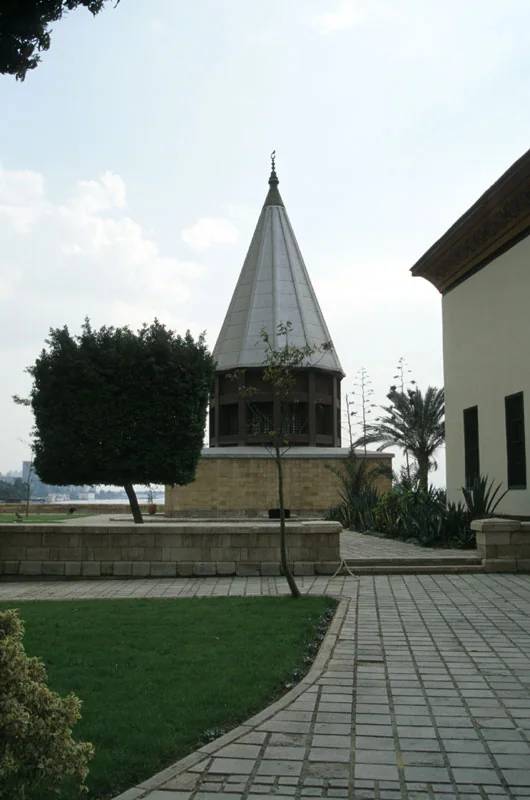
The first photograph here shows the real Nilometer on Rawda Island in a picture taken by Roland Unger in February 2000. The Nilometer itself is an Abbasid-period monument, constructed in 861, not a preserved Fatimid naval workshop. Its relevance is topographical. It confirms the enduring importance of this very island in the management and understanding of the Nile. The photograph cannot restore vanished docks or reveal where a medieval timber yard began and ended. That explicit limitation is useful: river geography and archaeological building identity must not be mixed simply because they appear in one frame.
The Diwan al-Ama'ir was not only a building department
The most revealing passage in Salim's chapter concerns the administrative responsibility of the Diwan al-Ama'ir, an office of official construction and works. He states that its sphere included construction of ships used by the fleet and royal vessels for caliphal processions and travel. That is a stronger institutional claim than saying merely that Fatimid rulers enjoyed sailing. The court had to coordinate labor and materials across uses that could be military, ceremonial and practical.
The title itself should not be translated mechanically as a modern Ministry of Infrastructure. Its obligations could differ by reign, and several layers of official reporting may separate a ruler's decision from the craftsmen at work. Salim also mentions the expense of maintaining royal barges and the draw on public resources, but a claim about spending needs more evidence before we convert it into a precise annual budget. The value of the account is its identification of ships as a government project that required continuing organization. A vessel could be built for prestige while employing the techniques, tools and workers needed elsewhere in a working fleet.
Al-Maqs: an arsenal near a new capital
When the Fatimids founded Cairo as a separate court city after 969, the balance between the older commercial town and the ruling precinct altered. Naval production did not simply relocate all at once. Salim records an arsenal at al-Maqs associated with the Fatimid era, and accounts of the navy connect this location with the need to supply and maintain court vessels. Historians frequently distinguish this northern riverside establishment from older facilities linked with Fustat or Rawda.
The names of medieval shore districts need caution because the Nile's channels and the developed city changed through time. The modern street map cannot be used to pin a tenth-century slipway to the present-day edge of one building. The significance of al-Maqs lies instead in the administrative geography. A royal city had a nearby maritime workshop while older shipmaking traditions could remain active. This is a good example of cumulative urban development: institutions may be duplicated, specialized or shifted without one foundation erasing the city and infrastructure that preceded it.
A naval base can have more than one geography
Fatimid naval activity required links among inland construction, coastal ports and the Mediterranean. A ship commissioned in a river workshop could be intended for a different operating theater. Alexandria and Damietta were prominent maritime centers, while the Nile Delta was neither a single straight canal nor a permanently stable network. Passages changed according to water and sediment, and not every vessel would have been equally suitable for both shallow channels and open water.
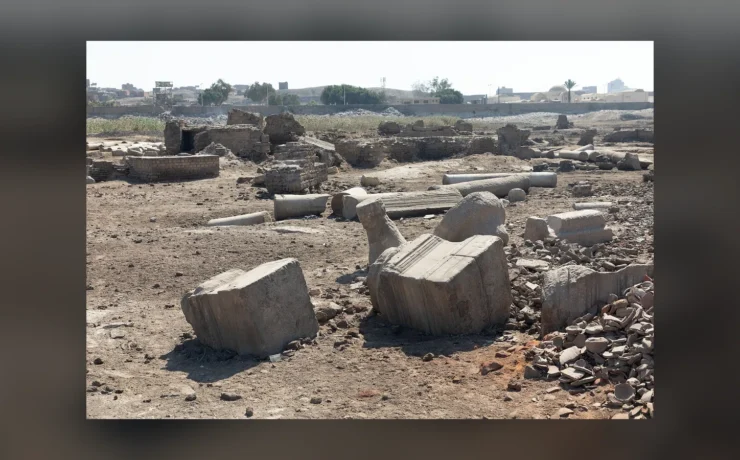
Salim names Alexandria and Damietta among locations associated with naval production or operations. The second real image in this essay records the present-day ruined urban site at Fustat, photographed by Roland Unger in 2017. It shows the older town from which part of this system was managed; it does not show the sixteenth-century—or any other—remains of a dockyard. We use photographs of places only for what they document. For the medieval distribution of bases, written testimony and research on the Fatimid state are the main evidence. A full map of docks would require archaeological confirmation beyond these two illustrative pictures.
Wood did not grow wherever a warship was ordered
A fleet can be decreed, but its hulls still need timber. Egyptian workshops often had to confront the shortage of suitable large shipbuilding trees, despite Egypt's long traditions of carpentry and Nile transport. Procuring wood could tie the navy to imported resources and to political conditions outside Egypt. Historians of the Crusades and Fatimid warfare note the significance of eastern Mediterranean supplies, while river access and local workshops helped turn those supplies into useful vessels.
It would be misleading to assert that every plank in every Fatimid ship came from Lebanon or that an order from one port always met its quota. The sources support an economic vulnerability and a history of maritime procurement, not a complete wood ledger for all dynastic reigns. Skilled builders also required cordage, fastenings, waterproofing materials, replacement parts and trained labor. None of those necessities should be mistaken for an excavated list from Rawda unless a particular document is identified. This distinction reveals a larger argument: naval power depended on supply networks extending well beyond the place where a finished boat entered the river.
Warships and procession boats shared an institutional world
One of the best details in Salim's pages is the distinction between vessels intended for naval combat and barges reserved for royal ceremonial journeys. The government financed both, but their functions were not interchangeable. A boat designed to carry dignitaries, flags and courtly furnishings does not become evidence for a warship's crew or armament merely because the same administration paid for both. Public display and combat readiness required different outfitting, personnel and operating conditions.
A Nile procession might demonstrate sovereign power through a controlled landscape where crowds could witness it. A Mediterranean expedition could encounter opposing fleets, storms and the need for provisions. Some materials and shipwright skills could serve both contexts, but our evidence does not prove every worker moved freely between every category. Paule Sanders has studied Fatimid processional writing, while Salim records the institutional allocation of vessels. Reading them together allows a better question: what did a dynastic state need ships to do, beyond merely move people on water? This is why the title shipyard is at once an economic, military and ceremonial subject.
The Nile was a route and a hazard
Delia Cortese argues that the Fatimid state's success depended in part on using the Nile as a corridor connecting African and Indian Ocean commerce, Upper Egypt, Cairo and Alexandria. The same river brought conditions that rulers could not simply command. Its annual flood and variable channels affected transport, agriculture, provisioning and court celebrations. Boats moved through a changing physical system rather than a permanent waterway mapped like a modern highway.
This environmental context matters to naval production. Where a boat could be launched, repaired or supplied depended on the relationship between riverbanks and usable water. The case is not proof of one uniform annual shipbuilding season; documentary dates and local conditions would be needed for that. Salim describes government shipyards as places, while Cortese supplies a larger explanation of why their Nile location made both economic and political sense. A royal arsenal standing within an important river network could be protected from direct maritime attack yet remain connected to the coast. That advantage had limits: inland location could not eliminate weather, supply failures or changing water levels.

What the claim of hundreds of ships cannot tell us
Medieval and modern narratives sometimes report very large numbers of vessels associated with early Fatimid rulers. Salim draws on older chronicles and speaks of numerous ships in the court's service, while other later writing repeats figures such as six hundred. Such statements should not be converted automatically into six hundred fully crewed war galleys operating together at the same moment. The same count may group river craft, ceremonial vessels, transports and combat ships, or reflect an author's rhetorical sense of power.
A reliable fleet census would require dated categories, a method of counting and a statement of which vessels were functional. We do not have that comprehensive record for every period of Fatimid rule. The more important finding is structural: shipmaking was sustained across several workshops under government supervision, and rulers invested in both the Mediterranean fleet and Nile ceremonial craft. Scholarly studies of the navy and state finance can examine capacity without taking every chronicle total literally. Keeping the uncertainty visible is essential to a site whose readers expect research rather than grand numbers recycled between blogs.
An arsenal was a workplace, not just a dock
Woodworkers, shipwrights, rope handlers, officials, sailors and other specialists had to cooperate if a fleet was to be created and kept active. Salim's description of a works department makes this labor visible indirectly through administration. Yet the book does not give us a preserved timesheet naming every worker at the Rawda arsenal, and it would be dishonest to supply invented ordinary biographies to make the scene feel cinematic.
A shipyard also contains temporal layers of work: preparation of material, shaping pieces, fitting structures, launching vessels, repairs and eventual replacement. The precise sequence depends on ship type and construction practice, which a medieval text might describe only in fragments. When a modern article shows a photograph of a Nile structure, readers should know whether it is a documented shipyard remnant or merely part of the landscape where workshops once operated. The latter is all that our two site photographs can honestly claim. The interpretation itself rests on the named chronicles through Salim and the more recent research by Lev, Bramoullé and Cortese.
What a specialist source adds to a dramatic story
David Bramoullé's research into the khums and matjar services raises the question of how Fatimid authorities financed maritime enterprise and monitored commercial flows. These services cannot be reduced to one generic 'navy tax' without studying their specific dates and operations. They reveal, however, the value of moving beyond descriptions of strong ships to the institutions that made naval capacity possible. Military fleets required resources gathered, allocated and accounted for over time.
Yaacov Lev has likewise examined the Fatimid army and navy in connection with their conflicts and changing political power. Where a chronicler describes the launch of an impressive vessel, the institutional historian asks who paid for it, where its wood came from and which agency maintained the crew. The two kinds of writing should be read together, not collapsed into one set of invented facts. Salim's contribution is an accessible overview of the Arabic historical evidence, and the modern studies help situate it within naval finance, strategy and the long-term life of the Fatimid state. That combination creates a more useful account than a list of rulers building ever larger fleets.
Two authentic places, one reconstructed institution
The great irony of medieval Egyptian shipyards is that we can often describe their administrative functions more confidently than we can photograph surviving dockyard structures. Rawda is real, Fustat's ruins are real, but neither of the paired photographs on this page shows a certified Fatimid boatbuilding hall. The Nile view connects the geography, while the excavated town image reminds us that the ordinary working environment has been transformed over centuries.
The institutional story is recoverable because authors preserved names, offices and distinctions between ship types. Its limits are recoverable too: chronicle totals are uncertain, shorelines moved and not every workshop has left identified archaeological fabric. A history website earns trust by making that gap explicit. The result is a different vision of Fatimid naval power. A ship was not simply a ruler's will turned into timber. It was the product of an urban and riverine network, linking craftspeople, offices, materials and the changing landscape of the Nile to political goals in the Mediterranean.
Evidence at a glance
| Evidence | What can be concluded |
|---|---|
| Salim 1997, pp. 299–303 | Historiographical account of the Diwan al-Ama'ir, Nile shipbuilding centers and royal and military vessels. |
| Rawda photograph, 2000 | Actual island setting and 861 Nilometer; does not itself preserve a Fatimid dock. |
| Fustat archaeology, 2017 | Genuine excavation location; shipyard identification comes from written history rather than this photo. |
| Lev and Bramoullé | Modern studies of the navy's military organization and its financing mechanisms. |
| Cortese 2015 | Specific argument about political and commercial dependence on Nile transport. |
| Reported huge fleet totals | Medieval numerical claims that should not be presented as audited concurrent warship census. |
Frequently asked questions
Where were Fatimid ships built in Egypt?
Historical texts describe facilities around Fustat, Rawda Island and al-Maqs, with important Mediterranean ports including Alexandria and Damietta.
What was the Diwan al-Ama'ir?
In Salim's survey it was an administration for state works that also oversaw construction of naval and royal vessels; the modern term 'construction ministry' is only an analogy.
Are the photographs actual Fatimid shipyards?
No. They are real photographs of Rawda's Nilometer and Fustat archaeology, carefully labeled as geographic contexts rather than certified arsenal remains.
Did the navy always have 600 warships?
Some sources offer very large figures, but differing vessel types and uncertainties make it unsound to treat these as a verified simultaneous fighting force.
Sources and image provenance
This article uses the historical source listed in the bibliography as a research starting point, specifically PDF pages al-Sayyid Abd al-Aziz Salim, Dirasat fi Tarikh Misr al-Islamiyya Hatta Nihayat al-Asr al-Fatimi, 1997; original book printed pages 299–307, supplied scanned PDF pages 301–309, especially printed 299 (Diwan al-Ama'ir) and 303 (shipbuilding places). Claims in the modern scholarly sources are not attributed to this 1997 volume.. Its historical rhetoric and older interpretations are not treated as conclusive archaeological evidence. The external museum and research records below are linked for independent checking.
- Al-Sayyid Abd al-Aziz Salim, uploaded 1997 book, section 'al-tanzimat al-bahriyya fi al-asr al-Fatimi', printed 299–307
- Yaacov Lev, The Fatimid Army and Navy and the Crusades, State and Society in Fatimid Egypt (1991)
- David Bramoullé, Khums and Matjar and Fatimid maritime services, Oxford (2025)
- Delia Cortese, The Nile and the fortunes of the Fatimid Dynasty, History Compass (2015)
- Egyptian Ministry of Religious Endowments, historical institutional summary of naval bases and fleet
- Egyptian historical article, Fatimid naval activities, University of Mosul (2007)
- Original licensed archaeology photo, Nilometer Rawda Island, Roland Unger, 2000
- Original licensed Fustat excavation photo and photo history
- Paule Sanders, A New Source for the History of Fatimid Ceremonial, Annales islamologiques 25 (1991)
- Photograph: Real photo of the Nilometer building on Rawda Island, photographed 25 February 2000 by Roland Unger, CC BY-SA 3.0. The 861 structure is NOT a surviving Fatimid shipyard., Roland Unger, genuine photograph of the historical Rawda Island Nilometer taken 25 February 2000, CC BY-SA 3.0
- Photograph: Actual 2017 photograph of the Fustat archaeological site by Roland Unger, CC BY-SA 4.0. The photographed remains are not identified as the Fatimid arsenal., Roland Unger, March 5 2017 real archaeological photograph of Fustat excavated ruins, CC BY-SA 4.0