Who was Mereruka, and why is his tomb important? Mereruka was a powerful Sixth Dynasty Egyptian vizier under King Teti. His large mastaba at Saqqara has thirty rooms, including spaces associated with his wife and son, and unusually detailed reliefs of work, animals and ritual. It is evidence for elite commemoration, not a literal photographic record of daily life.
The tomb of Mereruka stands within the great funerary landscape of Saqqara, where royal pyramids and elite mastabas reveal very different levels of power and commemoration. The official Egyptian monument record identifies Mereruka as a high-ranking official connected with King Teti and describes his multiroom tomb, carved scenes and false door. These details offer a valuable way to study labor and animals in Old Kingdom imagery, while also raising questions: which activities did the tomb owner actually perform, what did artists idealize, and why were such scenes placed in a funerary chapel? This study focuses on the specific monument rather than repeating a generic guide to pyramids or mummification.
For broader context, compare the wider archaeology of Old Kingdom monumental building with a separate overview of food, families and work in Egyptian history. This page studies one named mastaba, not a generic pyramid or daily-life guide.
Saqqara and the elite cemetery around Teti’s pyramid
Saqqara was a major necropolis within the ancient Memphite landscape, used across many periods of Egyptian history. Royal pyramids, elite tombs, sacred animal burials and later monuments occupy different parts of the site. Mereruka’s mastaba lies in the cemetery associated with the pyramid complex of King Teti, placing his memorial in a privileged relationship with royal burial architecture. That position is archaeological evidence of status, not proof that every person depicted in the tomb lived in the same household.
The Ministry of Tourism and Antiquities describes the mastaba as among the largest and most elaborately decorated tombs in Teti’s cemetery. Its size should be considered alongside the political role of the owner and the resources required for construction and relief carving. A wealthy official’s tomb can illuminate elite ideas of the ideal life, but not all Egyptians could commission comparable rooms, imagery or ritual arrangements. The distinction between royal, elite and ordinary burial evidence remains essential.
Who was Mereruka, and what did a vizier do?
Mereruka is identified in Egypt’s official monument account as a vizier serving during the reign of King Teti in the Sixth Dynasty, in the Old Kingdom. The vizier was a very senior administrative figure whose responsibilities could involve coordinating the central government and acting as a powerful royal official. Mereruka’s marriage into the royal family is also part of his documented status, placing his tomb and titles within a network of high political authority.
A modern summary can make the office sound like a single contemporary job, but ancient administrations did not operate by exactly the same rules as modern ministries. Mereruka’s titles, the monumental scale of his tomb and its relationship to Teti’s cemetery are specific evidence for elite power. They cannot demonstrate how every village tax was assessed or prove the daily conversations of a named ruler. The correct starting point is the identity recorded by the monument’s inscriptions and Egyptian institutional catalogues.
A Sixth Dynasty monument and its approximate dates
The Sixth Dynasty falls in the later Old Kingdom, after the age associated with the great Fourth Dynasty pyramids at Giza. Teti’s reign is commonly placed in the twenty-fourth century BCE, though ancient chronologies are expressed in modern studies with varying degrees of precision. Mereruka’s tomb belongs to that broad historical setting, and its architectural and epigraphic record gives context for the career and commemoration of the owner.
Dates in ancient history often depend on king lists, reign lengths, inscriptions and archaeological sequences. For a mastaba, the association with a known ruler can be stronger than assigning a precise calendar day to the construction of each chamber. A responsible guide therefore names Teti and the Sixth Dynasty without inventing a modern exact completion date for the tomb. Later conservation and modern photography form additional chronological layers that must not be mistaken for original events.
What makes a mastaba different from a pyramid?
A mastaba is a tomb superstructure commonly characterized by a rectangular mass with sloping sides, covering or associated with a burial arrangement below. Elite mastabas could include decorated chapels in which offerings and remembrance took place. Mereruka’s monument belongs to this elite tomb tradition, not to the category of royal pyramid monuments. Its architectural importance lies in the relationship among burial, chapel and commemorative scenes.
The external shape alone is not enough to explain how people used the building. Burial areas could be separated from spaces accessible for ritual, and decorative programs were planned around particular social and religious ideas. At Saqqara, the presence of both royal pyramids and powerful officials’ mastabas shows the hierarchy of monumental commemoration. A tourist map might group them all under the broad heading ‘tombs’, but historical interpretation benefits from distinguishing their patrons and physical purposes.
Thirty rooms: the organization of an extraordinary tomb
Egypt’s monument authority describes Mereruka’s mastaba as having thirty rooms, including six associated with his wife and five with his son. The total emphasizes the scale of the family memorial. It is an unusually complex arrangement by the standards of many other surviving elite tombs, and it provides evidence for how high-status relationships could be expressed spatially within funerary architecture.
These room counts come from a documented plan, not from an inferred number of servants or a modern tour itinerary. A chamber connected with a family member should not automatically be called that person’s original bedroom, because the monument was built for funerary purposes rather than as a normal domestic residence. Modern conditions may limit which rooms visitors see, and a count on a website is no guarantee of access to all of them. The layout is foremost archaeological evidence for commemorative organization.
Family and prestige carved into stone
Mereruka’s association with royal authority and his family’s memorial spaces show how status and kinship were important themes in elite tomb decoration. Scenes of family members and the tomb owner can communicate continuity, legitimate rank and the hope of continued provisions after death. Their placement in the chapel belongs to the visual language of commemoration, rather than simply documenting a family portrait session in a particular year.
An elite tomb also tells only part of a family’s experience. Inscriptions may preserve titles and relationships while leaving ordinary household concerns unrecorded. The apparent calm and order of ceremonial scenes can reflect artistic conventions and patronal choices. It would therefore be misleading to infer that all marriages or parent-child relationships in Old Kingdom Egypt operated exactly like Mereruka’s represented household. The monument offers a highly valuable, but socially selective, view.
Farm labor, herding and animals on the walls
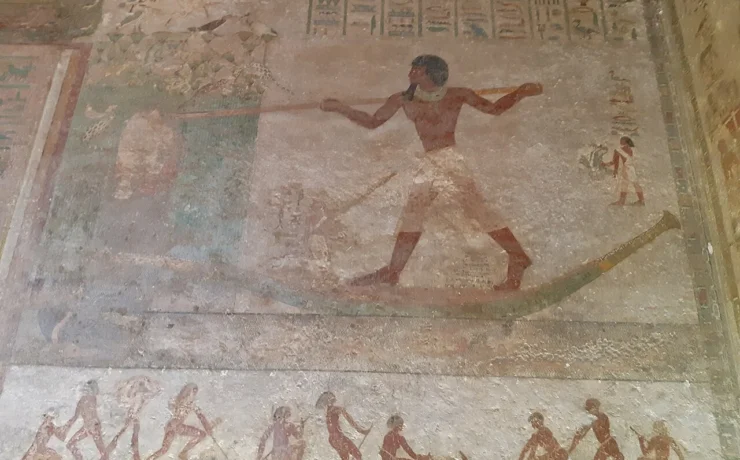
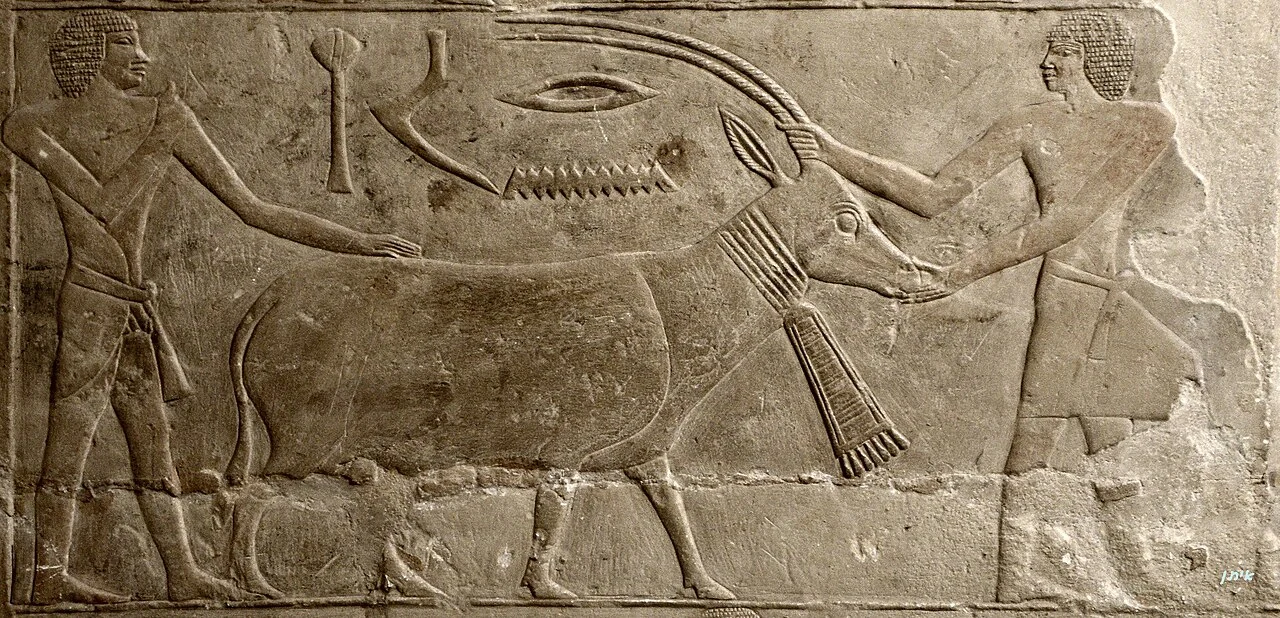
The official Egyptian monument description points to reliefs of herding cattle, hunting and the practical activities that helped support an elite estate. In such pictures, workers appear carrying out tasks involving animals, food and production. The scenes are historically useful because they preserve information about tools, gestures, clothing and the visual language of labor that written administrative records may not describe in the same way.
Yet a tomb relief is not a census or an objective live report. Artists arranged figures to support a funerary program, and the tomb owner could be shown as the beneficiary or supervisor of ideal abundance. The scale of the figures, sequence of activities and symbolic choices may matter more than a literal count of livestock. Students can use the images to ask which practices are recognizable and which details were standardized or idealized for ritual reasons.
Fishing, fowling and marsh landscapes
Fishing and fowling scenes are well established in Egyptian tomb art, and the Ministry includes such imagery among Mereruka’s notable reliefs. Marshes, boats, fish and birds create a picture of productive environments linked to the Nile’s ecology. These representations reveal that artists could observe natural forms closely while arranging them into carefully planned compositions within a funerary setting.
The presence of a fish species or a recognizable bird in a relief can contribute to historical ecology, but it should not be treated as proof that the particular creature was captured by Mereruka himself on a documented date. Tomb scenes often express abundance and the capacity to provide for the deceased. The correct interpretation combines natural observation, artisan skill and religious purpose. A detailed photograph of a carving gives direct visual evidence, whereas interpreting the scene requires broader scholarship.
The remarkable hippopotamus images
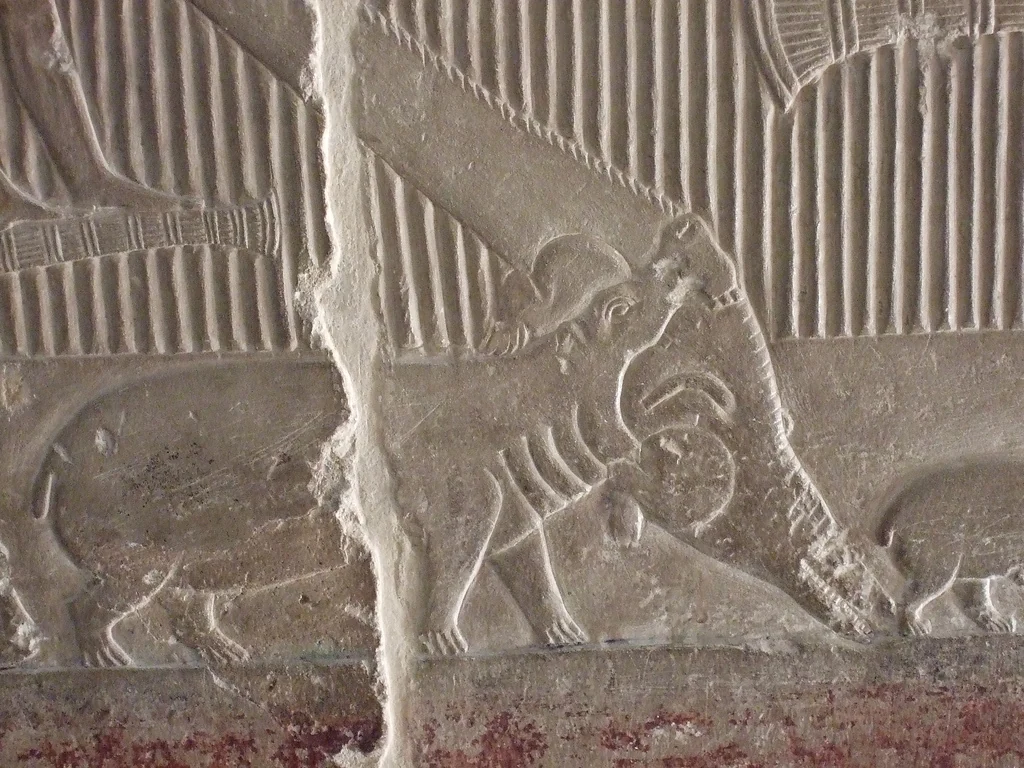
Hippopotamuses feature in some Old Kingdom tomb scenes as part of Nile and marsh imagery. A genuine photograph of a hippo relief from Mereruka’s tomb appears in this article. The carved animal can be studied as a documented example of ancient artistic representation, including how the sculptor selected its form and placed it among other motifs.
The image should not be presented as a zoological field photograph or as evidence that Mereruka personally encountered that exact animal. Ancient Egyptian art uses animals in contexts that can combine daily experience, danger and religious symbolism. Without examining the surrounding registers and text, assigning a single fixed meaning to every hippopotamus is risky. The provenance of the actual relief is what makes this photo valuable: it comes from the named tomb, not from an unrelated museum object.
Hyenas and what unusual animal scenes tell us
The ministry notes an especially unusual aspect of the mastaba’s decoration: depictions of force-feeding animals, including hyenas. Such details have attracted attention because they complicate expectations about which animals could appear in scenes of elite provision. The imagery is evidence that artists represented a striking activity. It does not, by itself, demonstrate that this was a widespread everyday practice across Egypt or identify an established modern equivalent.
Interpreting the scene requires caution. A carving can contain stylization, a symbolic program or a selection of practices intended to evoke abundance. Textual evidence and comparison with other tombs may clarify whether an image shows an ordinary task, an exceptional performance or a convention. The strongest research question is not simply ‘did ancient Egyptians keep hyenas as pets?’ but why this rare depiction was placed on the wall of a vizier’s funerary monument.
The three seasons and a calendar turned into art
Another notable feature in the Ministry’s account is a representation personifying the three seasons of the ancient Egyptian calendar. These were connected with inundation, emergence and harvest or low water. Their depiction in tomb art links the rhythms of agricultural production to the wider order of life and renewal, offering evidence for concepts that are more abstract than a scene of workers carrying grain.
The personifications should not be mistaken for a mechanical device predicting a particular harvest. Ancient Egyptian time reckoning, religious imagery and agricultural experience were linked through culturally meaningful forms. Studying the surrounding inscription, if available, is important before translating a season name or identifying every figure. The image shows how ideas about cyclical time could enter elite funerary art, not an exhaustive scientific manual about the Nile.
The false door and statue of Mereruka
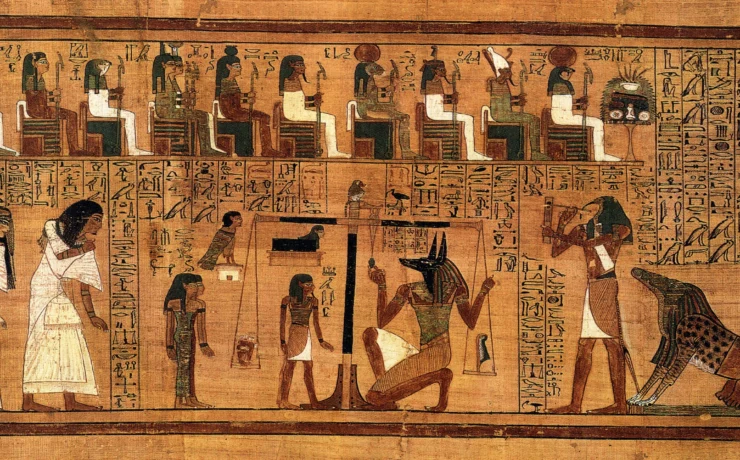
Like many Egyptian elite tombs, Mereruka’s mastaba included a false door associated with the offering cult. In its particularly remarkable example, the Ministry describes a life-size statue of the owner appearing at the false-door setting, facing the place where offerings were given. This arrangement shows how sculpture, architecture and ritual provision worked together in a commemorative space.
The door was not a hidden corridor designed for modern visitors to discover. In Egyptian funerary practice, such features had symbolic and ritual significance. A carved opening could focus the relationship between the deceased and the living participants who brought or invoked offerings. Its function should be understood in that tradition rather than read as proof of a secret chamber or a lost mechanical system. The sculpted figure presents a desired enduring presence, not a literal preserved body.
How the tomb was recorded and interpreted in modern times
Modern scholars and Egyptian heritage authorities have documented the mastaba because its scale and decorative preservation make it an important Old Kingdom source. The Ministry offers a site record and a virtual-tour introduction, allowing interested readers to connect a historical description with the actual rooms and reliefs. Those institutional materials matter particularly where internet photographs are incorrectly captioned as coming from a different Saqqara tomb.
Images and plans must be attached to a named object and its known location. A tomb at Saqqara is not automatically Mereruka’s, and even a recognizable fishing scene may belong to another official’s chapel. The two photographs selected here have file-level records identifying Mereruka’s monument. Their modern date and copyright information are preserved; neither claims to be an original ancient painting in its pristine colors.
What the elite scenes cannot tell us about everyone else
Mereruka’s tomb is one of the strongest visual sources for elite ideals of productive life in the Old Kingdom. It can help historians study how agriculture, fishing, animal management and hierarchy were represented. Its detailed scenes are especially informative when compared with archaeological settlement remains and written records from other contexts.
But the tomb does not permit an easy leap from one vizier’s memorial to the lives of every Egyptian. The people who carved its reliefs had artistic conventions and patrons, and the spaces were built for ritual remembrance. The safest approach is to ask what the monument positively documents and where interpretation begins. That distinction makes Mereruka a valuable companion to broader articles on Egyptian families and labor, rather than a replacement for those different historical questions.
Evidence table: the monument and its limits
| Evidence | What survives | What requires caution |
|---|---|---|
| Mereruka and King Teti | A high-status Sixth Dynasty vizier tied to Teti’s cemetery | Not an ordinary village household |
| Thirty chambers | Large multiroom funerary monument with family spaces | Not thirty living rooms of a house |
| Cattle and fishing scenes | Visible Old Kingdom representations of production | Not a statistical census of labor |
| Hippopotamus relief | Real animal carving photographed in the named tomb | Not a photograph of a living animal |
| False door and statue | Ritual relationship between offering place and tomb owner | Not a secret passage |
| Hyena and season images | Unusual themes recorded by heritage authorities | Single scenes require careful interpretation |
Official archaeological records and original photo credits
Evidence and copyright status checked on 4 November 2026. The two documentary photographs refer to the specific Mereruka monument; neither is a photograph of a lost funeral or a digitally created reconstruction.