In December 1912, an excavation at Amarna brought a painted face into the daylight. The German archaeologist Ludwig Borchardt was so struck by the sculpture that his diary reduced the task of describing it to a famous admission: “Description is useless, must be seen.” More than a century later, the bust of Nefertiti is still one of the most recognizable images of ancient Egypt.
But the face we know so well has a history that isn’t usually visible in its photographs. There is the ancient workshop where it was made, the unusual construction of its eyes, the Egyptian workers who helped uncover it, and the complicated journey that brought it to Berlin. Those details tell us more than another claim that Nefertiti was the world’s most beautiful queen.
A queen’s face from an artist’s workshop
The sculpture dates to the reign of Akhenaten in the late Eighteenth Dynasty, around 1340 BCE. The court lived at Akhetaten, the city now called Amarna, during an extraordinary period of religious and artistic change. Nefertiti, Akhenaten’s queen, appears in the imagery of this royal household. Her towering blue crown makes the famous bust recognizable even before a viewer sees the features of her face.
The bust was found in a workshop complex traditionally associated with the sculptor Thutmose. Other heads and models were recovered there too. That setting has encouraged the interpretation that the bust served as a workshop model, something artists could refer to when producing representations of the queen. It’s a plausible reading of the evidence, though scholars still debate the precise use of the various pieces found in those rooms.
What the bust cannot give us is Nefertiti’s private biography. It does not tell us whether she liked the finished work, personally sat for its maker, or what happened during the uncertain final years of her life. For the political world around her, the surviving Amarna letters offer a different kind of evidence: diplomatic correspondence written for purposes far removed from royal portraiture.
Look at the eyes, then look at the stone
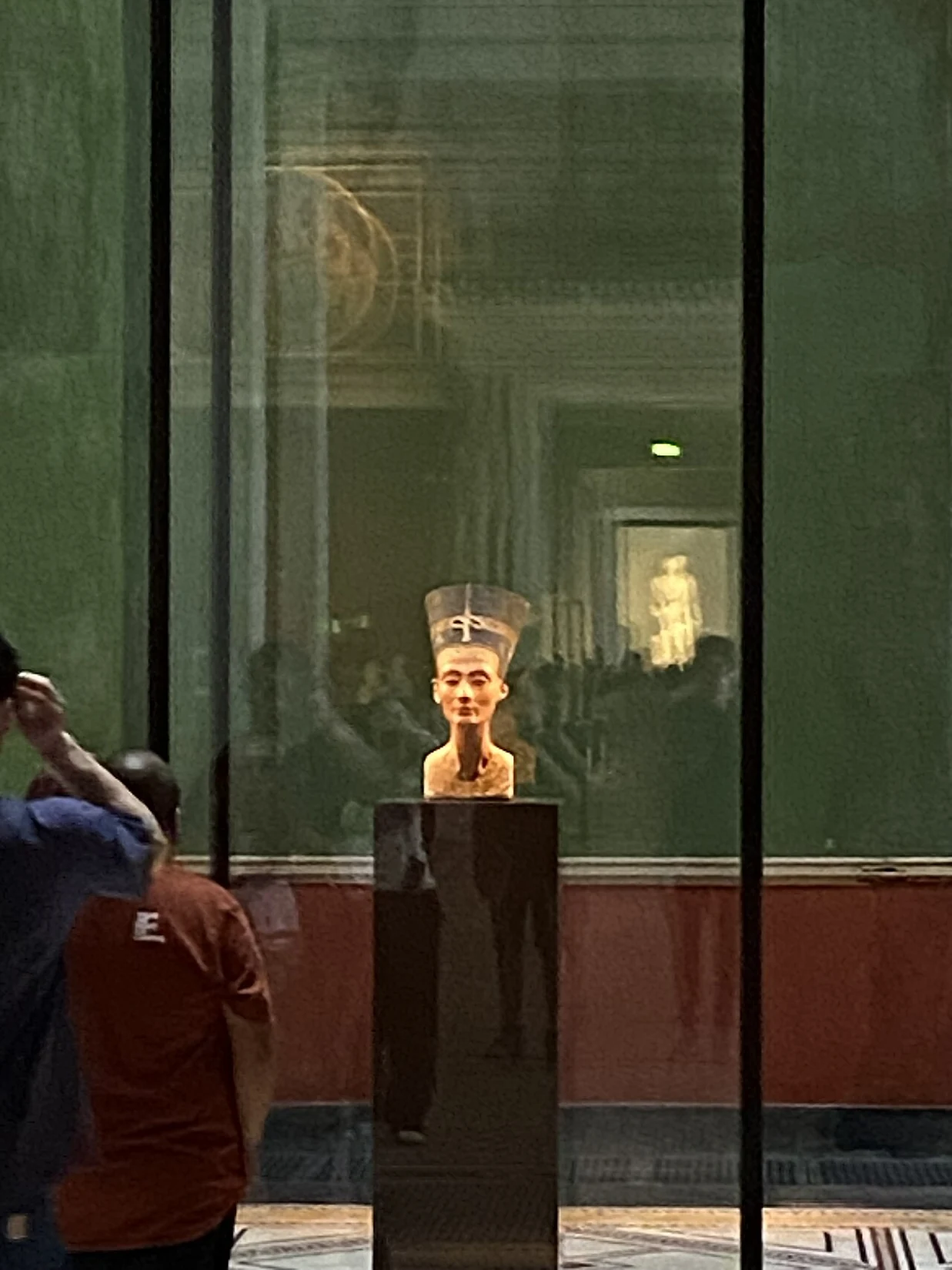
The right eye catches the light through a polished rock-crystal inlay, with dark wax used for its pupil and iris. The left eye has no equivalent insert. That asymmetry is one of the first details viewers notice once they get past the overall beauty of the object.
The missing eye has generated remarkably confident stories. Some suggest that the queen was blind; others assume a piece simply fell out. Neither explanation follows automatically from the sculpture. Borchardt searched the debris for an inlay after the discovery. He later concluded that it had never been installed. Berlin’s museum researchers note the physical evidence for an unfinished socket while treating the broader conclusion with appropriate caution.
There’s more going on below the paint. The core is limestone, with layers of modeled stucco used to refine the contours. Modern CT scans revealed variations in the stucco and features concealed beneath the surface. The slight imperfections and delicate repairs are part of the artifact’s history, not flaws that need to be edited away for a perfect promotional photograph.
Even the bust’s dimensions help bring it back to a human scale: it stands about 49 centimeters high. It’s tempting to imagine a full statue behind every surviving head, but this object was made as a bust, and its exact role within the workshop remains a subject of study.
6 December 1912: the people at the excavation
The recorded discovery date is 6 December 1912. Borchardt directed the German expedition, but an excavation is never the work of a single famous archaeologist. The Berlin museum’s historical research identifies Mohammed es-Senussi among the Egyptian personnel involved in the find and notes his presence in early photographs of the sculpture at Amarna. Prince Johann Georg of Saxony took photographs at the excavation, while Paul Hollander photographed the cleaned bust later that month.
Those photographs matter for more than visual curiosity. They preserve people, the find’s immediate setting and a chronology of handling that a modern museum image cannot supply. They also make it harder to tell the simplistic story of one European scholar arriving in an empty desert and ‘discovering’ Egypt’s past alone.
Researchers can follow the excavation diary and images on the Berlin museum’s discovery and division-of-finds page. That account includes the ancient workshop setting and the 1913 division through which the bust was allocated to the German share. Whether that transfer should settle the modern question of where the bust belongs is a separate, still-contested issue.
From Amarna to a room built around her
After the excavation, the bust arrived in Berlin in 1913 as part of the collection of James Simon, who had financed the archaeological work. The Amarna finds attracted attention when presented to the public that year, but the colorful bust itself was not among the objects shown in the initial exhibition. Simon donated the pieces to the museum in 1920. The bust became a prominent public exhibit in 1924.
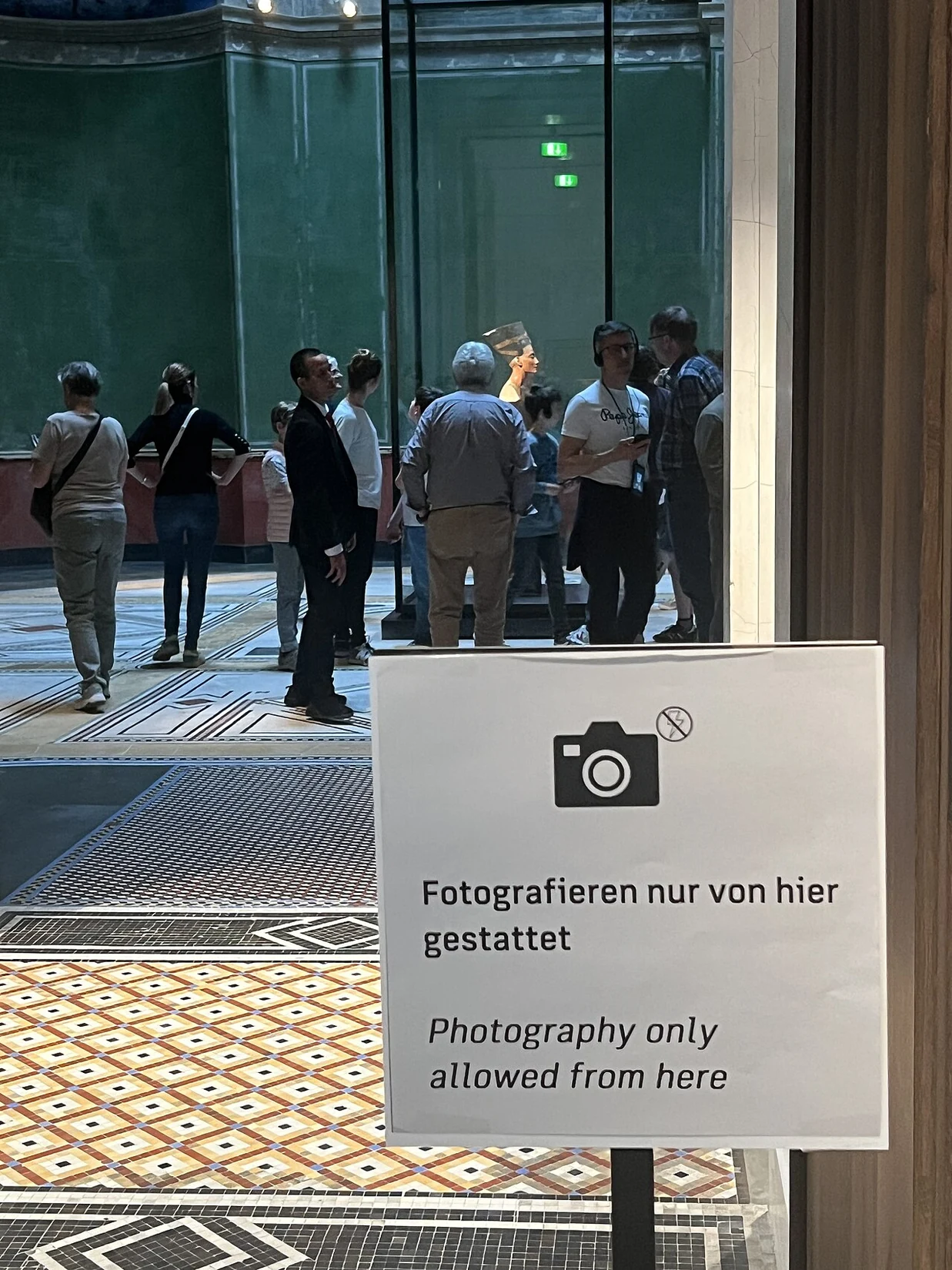
Today it stands in the North Dome Room of the Neues Museum, which reopened in 2009. The lighting, architecture and distance between the object and the visitor all contribute to the experience. What looks so familiar on a phone screen is a relatively small, carefully protected ancient sculpture.
The object is also unusually fragile. Museum research into its layers and paint has led Berlin’s conservators to classify it as unsuitable for transport. That finding matters to discussions about exhibition loans, although conservation assessments alone do not resolve the wider debate about repatriation.
Why the location remains contested
Egyptian requests for the bust’s return and disagreements over the original division of finds belong to the history of the object just as much as its pigments and excavation date do. Berlin’s museum maintains a documented account of the 1913 division and Simon’s donation. Critics question the fairness and circumstances of that transfer in a period when European archaeological missions exercised enormous influence over Egyptian antiquities.
It’s possible to acknowledge both the surviving paperwork and the ethical argument without announcing a legal verdict that the sources do not establish. The bust is an ancient Egyptian cultural object. Its display in Berlin has made it globally familiar, but international fame is not an answer by itself to questions about historical ownership, access or cultural responsibility.
The same distinction applies to modern photographs. The two images reproduced here have reusable photographic licences; that does not mean the photographs decide who owns the ancient sculpture they depict.
What the famous image can, and cannot, tell us
Nefertiti’s bust has become a shorthand for elegance, royal power and ancient Egypt itself. Yet its fame can obscure the actual material evidence. Behind the graceful face are a limestone core, a surface worked in stucco, delicate pigments, an incomplete eye and a workshop whose other finds still help scholars reconstruct Amarna art.
If you want to understand life in the city beyond the royal image, our account of the Amarna workmen’s village follows households and settlement archaeology that rarely appear in the same gallery as a queen. The contrast is useful. One extraordinary sculpture can reveal a great deal about elite art, but never the whole society that produced it.
Records worth opening
For the artifact’s physical make-up and the missing eye, read the Egyptian Museum Berlin’s detailed object study. Its display chronology gives the dates behind the journey to the Neues Museum. The Egyptian Museum’s supporters’ object record identifies the sculpture as ÄM 21300 and summarizes its materials. Museum statements about the transfer are part of the evidence, alongside the continued debate about it. The photographs above are attributed to their independent creators.