What is Nile Air? Nile Air is a private Egyptian airline that began operations in March 2011. The company operates Airbus A320-family aircraft, describes itself as a hybrid carrier and offers scheduled passenger services. Its destination network, baggage conditions and available tickets must be checked for each departure date through its official website.
This independent, research-led profile covers the airline’s dated history, aircraft, booking decisions and passenger questions using verifiable corporate records and original licensed aircraft photographs.
Nile Air at a glance: a private Egyptian airline
Nile Air is an Egyptian privately operated airline that began flying in March 2011. The company describes itself as a hybrid carrier, a term that signals an attempt to combine scheduled network services with some features often associated with full-service airlines. The company is not a brand of EgyptAir, although it has described interline cooperation with Egypt’s national airline in its historical timeline. It is also distinct from Air Cairo and AlMasria Universal Airlines. Nile Air’s public company profile describes a network serving destinations in Egypt and nearby regions, principally through Cairo and Alexandria. This is a profile of the operating airline, not a booking agency or a guarantee that every destination once advertised remains in its timetable. Travelers should check a specific route, flight number and operating date through the airline itself. Aircraft, schedules and commercial arrangements can all change. This article separates the documented history of the company from practical questions a passenger needs answered before purchasing a ticket.
The first flights in March 2011
Nile Air’s own history dates the start of flying to March 2011, when it began with two leased Airbus A320 aircraft. That is a useful fixed milestone, but it should not be confused with the creation of its present route network or with the delivery date of any aircraft visible in a modern photograph. The company subsequently expanded services and changed its fleet composition. Its 2013 milestones include joining the Arab Air Carriers Organization, while a later timeline identifies membership in the African Airlines Association in 2016. An airline’s founding and an individual aircraft’s first registration are different events. A photograph of one airliner in Nile Air livery may have been taken years after services began. Historical airline profiles are therefore better organized around clearly dated events than around a generic claim that all current operations existed from day one. The company’s own historical page is an appropriate starting point; independently verifying its chronology requires dated regulatory or aviation records where available.
How the route network expanded after 2014
The operator’s published company timeline records a first Jeddah flight in 2014, Kuwait service in 2015, Istanbul and domestic Egyptian services in 2016, and later international expansions. It also refers to further connections in Europe and the Gulf. These are dated historical milestones, not a valid list of flights that a passenger can book in November 2026. A destination can appear in an airline’s corporate history even after its seasonal or scheduled operation has changed. Anyone considering a flight from Cairo to a particular city should use a date-specific search on the official booking platform, then verify the departure airport, arrival airport, baggage allowance and actual operating carrier. The difference between a scheduled service, a charter, a connecting arrangement and a codeshare matters. A historical page may mention charter operations that never appeared in the ordinary point-to-point booking engine. Treating all these entries as today’s nonstop routes would mislead readers, especially if they are planning a tight onward connection.
Why Nile Air calls itself a hybrid airline
Nile Air uses the phrase hybrid Egyptian airline in its corporate introduction. The word should not be mistaken for a formal aviation safety classification. It describes the company’s commercial positioning between different passenger service models. A route may be marketed with more than one fare family, baggage provisions or onboard class, while booking conditions still depend on the purchased fare and particular flight. A frequent error in travel blogs is to infer that an airline called hybrid automatically includes a meal, unrestricted changes or free advance seating on every booking. None of those follows from the label alone. Airline economics and customer products change independently of the terminology. Travelers should compare the full displayed price and conditions for their particular flight. This may include checked baggage, cabin baggage, seat selection, change fees and airport of departure. What matters is the fare confirmation rather than a generalized comparison with low-cost or legacy carriers.
Airbus A320 and A321 aircraft in the official fleet
The airline’s public fleet page identifies Airbus A320-200 and A321-200 family aircraft and provides individual examples by registration. Those narrow-body aircraft serve a variety of short- and medium-haul travel markets. One published entry lists aircraft SU-BQK and SU-BQM among its A320 family, and SU-BQN and SU-BQL in the A321 family. An individual registration is a strong way to identify a photograph, but it is not proof that the aircraft is available for a particular upcoming flight. The page also shows different cabin layouts, including single-class and two-class products. For example, its listed A321 examples include a business section, while some A320 entries are described as all-economy. Do not assume a cabin layout solely from aircraft family. A real booking can change aircraft type before departure, and the passenger’s seat assignment may consequently change. Official booking confirmations and airline notifications remain more relevant than an aircraft-identification article.
Two documentary aircraft photographs, not invented liveries
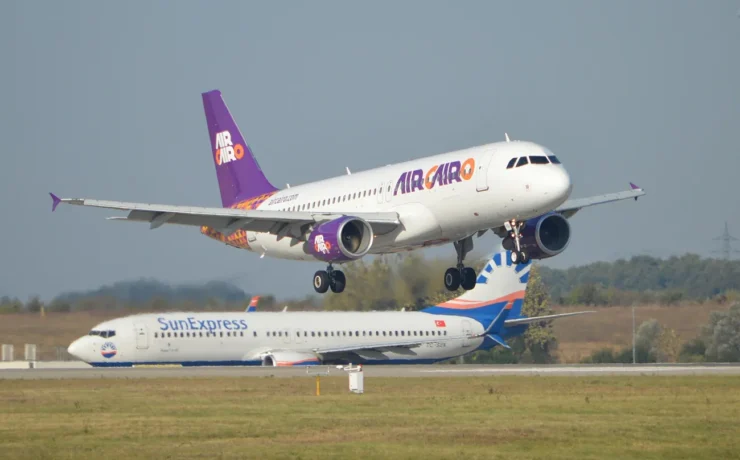
The first photograph in this feature shows an actual Nile Air Airbus A320 photographed at Hamburg Airport by Lars Hentschel. The second image is a real image of the airline’s specially painted SU-BQM A320 credited to Anna Zvereva. Both records have independent author and licence information on Wikimedia Commons. Their purpose is to document real aircraft associated with the carrier, not to predict the equipment or artwork of a flight in 2026. A livery can change; aircraft can be transferred, stored or repainted; registrations and active service histories require date-specific checking. Travel content often illustrates an airline with a generic stock jet carrying a fictional logo, which conveys very little factual value. These source-led photographs instead make clear exactly what was photographed. Captions distinguish the plane from the whole fleet and avoid implying that the photographed airport is a current scheduled destination. The difference is important for a reference site that aims to document actual Egyptian companies.

How to search for a current Nile Air flight
Start at the official Nile Air website and enter your exact origin, destination and travel date. Do not assume a route shown in an old article can be purchased every day. Confirm whether the itinerary is nonstop, which airport terminals are involved, and whether the fare is refundable or changeable. A one-way price displayed in search results can omit extras or change before payment. The payment page and emailed booking confirmation should identify the complete amount and any carrier-imposed restrictions. When the itinerary involves another airline, read the separate carriage and baggage rules rather than assuming all segments share the same policy. Passengers with complex international connections should also consider the time required for immigration and baggage collection. A flight booking article cannot determine visa eligibility: passengers should consult the relevant authorities for their own nationality and itinerary. The critical step is to check the exact live offer rather than trust a historical route map.
Baggage policy: use the actual purchased ticket
Nile Air maintains a public baggage allowance page with country and cabin examples. At the editorial check in November 2026, the page lists common patterns such as a 30 kg economy checked allowance and 40 kg business allowance on various routes, with exceptions including certain Germany–Hurghada services. It explicitly warns that allowances are subject to revision. The table also distinguishes checked baggage from cabin and infant allowances. These values should be used as reference points only, never as a guarantee for a different ticket or commercial fare. The reservation itself governs the traveler. Before buying, check baggage weight and number-of-piece restrictions, prohibited items, and rules for sporting equipment or oversized luggage. A family carrying multiple suitcases should not assume that the phrase ’30 kg’ means unlimited bags of any dimensions. Confirm details with the airline when the ticket conditions are ambiguous.
Extra luggage and the booking-management page
The official Manage Booking interface allows passengers to access an itinerary using the required booking details. Nile Air describes options for reviewing reservations, selecting seats, requesting a business-class upgrade and adding baggage. A separate additional baggage page explains that advance purchase may be cheaper than airport purchase. The exact discount, limits and eligibility should be verified for the specific reservation rather than repeated as a universal offer. An extra bag can be a meaningful share of the travel cost; it is better to calculate the total fare and expected luggage before deciding between competing flights. Do not share reservation numbers or identification details in public messages seeking support. If the site cannot retrieve a booking, use the airline’s official customer service channels rather than disclosing personal data to a social-media account that claims to help. The distinction between airline support and a third-party travel seller is especially important after schedule changes.
Online check-in, seat choices and airport preparation
Nile Air’s management portal describes online check-in and mobile boarding passes, but eligibility can depend on the route, documentation checks and the specific airport. Its public page mentions a window starting 24 hours before departure; that should be checked against the latest instructions shown for the booking. Even with a mobile pass, some international travelers must visit a desk to verify passport or visa documents. A seat-selection screen is not a promise that a particular seat can never change: operational aircraft substitutions and safety requirements can affect allocations. Arrive with a valid itinerary, identification and sufficient time for local security processes. The airline’s website and the operating airport should take precedence over generic travel-site advice about check-in deadlines. Families traveling with infants, passengers requiring assistance and customers carrying unusual equipment should verify arrangements before the departure day. A historical profile of the airline is useful background, but it is not an authority to waive real-world boarding requirements.
What to compare with EgyptAir and Air Cairo
Nile Air is one of several recognizable Egyptian carriers. Our EgyptAir profile concerns the national airline, while the Air Cairo guide covers a separate operator. They have distinct networks, booking systems, commercial arrangements and baggage conditions. A consumer should compare actual flights on the intended date, not declare a permanent winner because one company has a larger historical fleet or a lower promotional fare in an old review. Relevant factors include nonstop availability, airport, total price including baggage, changeability, onward connections and accessible support. The cabin product also matters differently on a short domestic trip and a long international journey. It is particularly important to distinguish the carrier selling a ticket from the airline physically operating the service when an itinerary combines partners. Airline rankings and customer reviews can provide context but should not replace the written carriage contract or current official notices.
The Egypt Tourism special livery and national promotion
Nile Air’s corporate history records a special Egypt Tourism aircraft livery unveiled in 2016 on Airbus A320 registration SU-BQM. This provides a concrete example of how an airline can link aviation branding to the country’s wider tourism sector. The aircraft artwork should not be mistaken for evidence that the airline sponsors a specific monument or operates exclusive tours at the sites depicted. A painted aircraft is a promotional object whose documentation helps date an episode in the company’s history. The second licensed photo in this article shows that type of real decorated aircraft, with its photographer identified. This is more informative than an AI illustration of an invented airline paint scheme. The company’s historical timeline also records its sponsorship relationship with the Egyptian national football team in 2017, another example of corporate identity extending beyond flight transport. Both details are historical company claims and do not establish present sponsorship contracts or future aircraft deployment.

What changes fastest in an airline guide
Flight schedules, fares, route frequencies, baggage policies, aircraft assignments and airport procedures can all change faster than the history of the company. That means a useful encyclopedia entry should make the distinction explicit rather than pretend to be a live booking engine. The historical facts that Nile Air began operations in 2011 and that the company documents its Airbus fleet have different durability from an exact departure hour next Friday. A route introduced in 2024 is part of a dated business history; it may not be served in the same way in November 2026. Even fleet-size figures on a corporate page can lag behind acquisitions or leases. In this guide, official current pages are linked so travelers can verify them without trusting a static repost. An editorial update should prioritize changes affecting real passenger decisions while retaining historical dates only where supported. That is how a useful travel reference avoids becoming a misleading fares directory.
Editorial sources and transparency
The company chronology, hybrid positioning and aircraft family are drawn from Nile Air’s official About Us history and official fleet list. Passenger planning information is grounded in the carrier’s published baggage allowances and Manage Booking instructions, not in a third-party timetable snapshot. The photographs are real separately credited aircraft images distributed on Wikimedia Commons under their documented Creative Commons terms. This November 2026 guide does not claim independently verified on-time performance, safety rankings or today’s seat inventory. Neither the number of departures nor the amount of a specific fare has been invented. Readers should use the official airline when a decision depends on present availability and contract terms.